This comprehensive guide compares Filecoin (FIL) and Bitcoin (BTC) as blockchain investment leaders, analyzing their distinct market positions and value propositions. Bitcoin functions as digital gold with fixed 21-million supply and established institutional adoption, while Filecoin serves decentralized storage infrastructure tied to Web3 ecosystem growth. The article examines historical price performance, supply mechanisms, institutional adoption levels, and technical developments across both networks. Current market data shows BTC at $95,281.5 with $1.38B daily volume versus FIL at $1.572 with $3.57M volume. Through detailed risk assessment covering market, technical, and regulatory factors, plus 2026-2031 price predictions, this guide helps investors determine optimal allocation strategies. Suitable for crypto investors of all experience levels seeking data-driven comparison on Gate.
Introduction: FIL vs BTC Investment Comparison
In the cryptocurrency market, the comparison between FIL vs BTC remains a recurring topic among investors. Both assets demonstrate notable differences in market cap ranking, application scenarios, and price performance, representing distinct positioning within the crypto asset landscape.
Filecoin (FIL): Launched in 2020, it has gained market recognition through its decentralized storage network model, rewarding miners who contribute idle hard disk capacity.
Bitcoin (BTC): Since its inception in 2009, it has been regarded as digital gold and remains among the cryptocurrencies with the highest global trading volume and market capitalization.
This article will provide a comprehensive analysis of the FIL vs BTC investment value comparison, covering historical price trends, supply mechanisms, institutional adoption, technical ecosystems, and future projections, while addressing the question that concerns investors most:
"Which is the better buy right now?"
I. Historical Price Comparison and Market Status
Historical Price Trends of FIL (Coin A) and BTC (Coin B)
-
2021: FIL experienced notable price volatility, with its all-time high recorded at $236.84 on April 1, 2021. The price showed considerable fluctuation during this period as the project gained market attention.
-
2021: BTC reached significant milestones during the same period, with substantial price movements influenced by growing institutional adoption and market expansion. The asset maintained its position as the dominant cryptocurrency throughout the year.
-
Comparative Analysis: During the 2021-2025 market cycle, FIL declined from its peak of $236.84 to a low of $0.848008 (recorded on October 11, 2025), representing a substantial correction. Meanwhile, BTC demonstrated different performance characteristics, reaching its all-time high of $126,080 on October 6, 2025, before experiencing a subsequent pullback.
Current Market Status (2026-01-14)
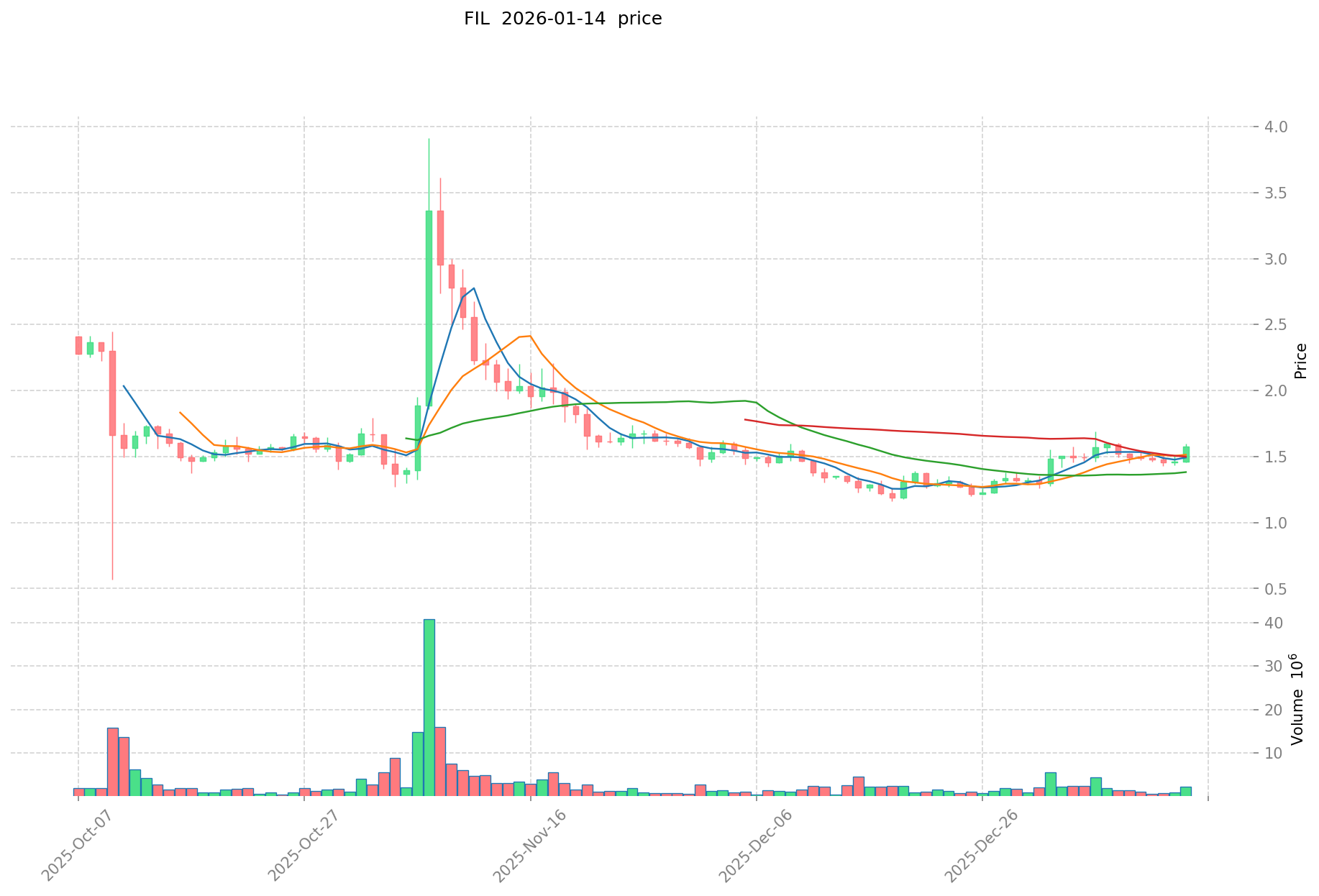
- FIL Current Price: $1.572
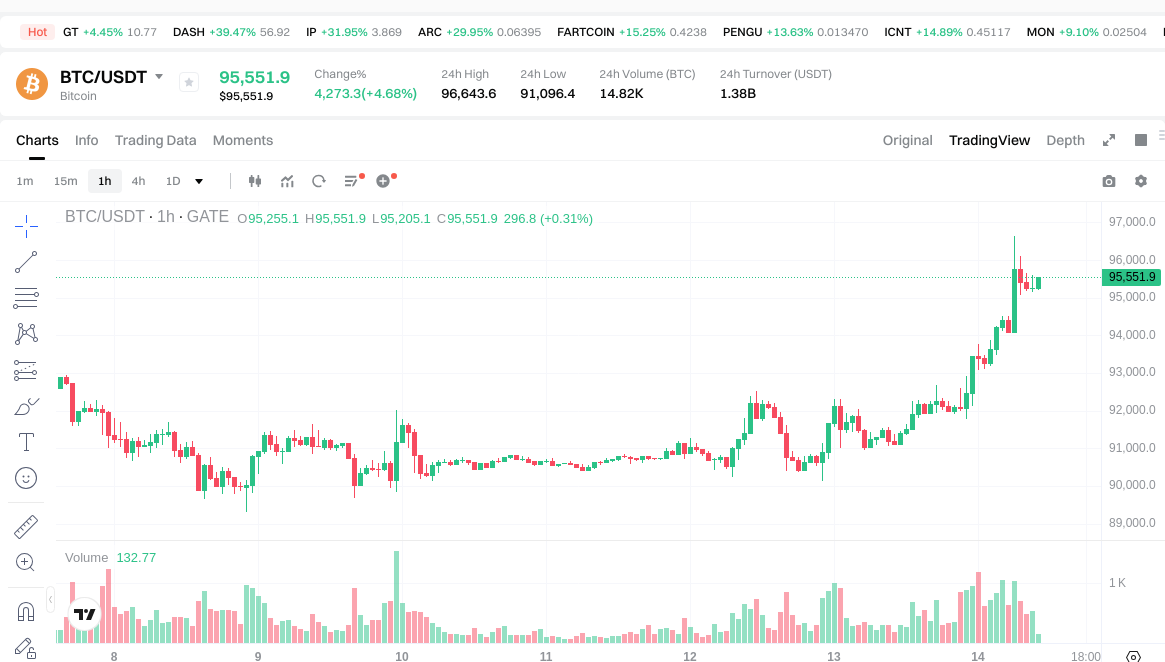
- BTC Current Price: $95,281.5
- 24-Hour Trading Volume: FIL recorded $3,566,835.99 compared to BTC's $1,379,177,805.13
- Market Sentiment Index (Fear & Greed Index): 48 (Neutral)
View real-time prices:
II. Core Factors Influencing FIL vs BTC Investment Value
Supply Mechanism Comparison (Tokenomics)
-
BTC: Fixed supply cap of 21 million coins with a deflationary model. Bitcoin undergoes halving events approximately every four years, reducing block rewards by 50%. This scarcity mechanism has historically driven cyclical price appreciation, with previous halvings in 2012, 2016, and 2020 preceding significant bull markets.
-
FIL: Maximum supply of 2 billion tokens with a scheduled release mechanism. FIL employs storage mining and retrieval mining models, where miners earn rewards by providing storage capacity and data retrieval services. The token release follows a declining curve tied to network storage growth and mining participation.
-
📌 Historical Pattern: Supply mechanisms fundamentally shape price cycles. Bitcoin's quadrennial halving events create supply shocks that have coincided with major upward price movements. Filecoin's emission schedule ties token distribution to actual network utility, creating different demand-supply dynamics compared to Bitcoin's purely time-based release.
Institutional Adoption and Market Application
-
Institutional Holdings: Bitcoin has established itself as the preferred institutional cryptocurrency asset, with major firms including MicroStrategy, Tesla, and various financial institutions adding BTC to their balance sheets. Grayscale Bitcoin Trust and Bitcoin ETFs have facilitated institutional access. Filecoin has seen more limited institutional adoption, though Grayscale Filecoin Trust represents an institutional entry point.
-
Enterprise Adoption: Bitcoin serves primarily as a store of value and medium for cross-border settlements, with growing adoption in international payment systems. Filecoin targets enterprise data storage needs, positioning itself as decentralized infrastructure for Web3 applications. Notable projects like Opera Browser, MetaMask, and Uniswap have integrated with the Filecoin ecosystem, while platforms like OpenSea utilize IPFS for NFT metadata storage.
-
National Policies: Regulatory approaches vary significantly. El Salvador adopted Bitcoin as legal tender in 2021, marking a historic precedent. China banned all cryptocurrency mining and trading activities in 2021, impacting both assets negatively. Other jurisdictions show diverse stances, with some embracing Bitcoin for payment systems while treating storage-focused networks like Filecoin with different regulatory frameworks focused on data infrastructure rather than monetary systems.
Technological Development and Ecosystem Building
-
BTC Technical Upgrades: Bitcoin development focuses on protocol stability and gradual improvements. Recent developments include the Ordinals protocol and Stacks, enabling NFT creation and smart contract functionality on Bitcoin's blockchain. Projects like Yuga Labs have launched NFT collections on Bitcoin, expanding its use cases beyond simple value transfer.
-
FIL Technical Development: Filecoin launched its EVM-compatible Filecoin Virtual Machine (FVM) in January 2023, enabling smart contract functionality. The network continues developing distributed data processing systems and retrieval markets. Technical foundations include unique consensus mechanisms like Proof of Replication (PoRep) and Proof of Spacetime (PoSt), distinguishing it from Bitcoin's Proof of Work model.
-
Ecosystem Comparison: Bitcoin's ecosystem centers on payment systems, store of value applications, and emerging NFT/inscription projects. Filecoin's ecosystem focuses on decentralized storage, supporting over 70 projects including Web3 infrastructure, DeFi protocols requiring data storage, and NFT platforms needing metadata solutions. The two networks serve fundamentally different functional niches within the broader cryptocurrency landscape.
Macroeconomic Factors and Market Cycles
-
Performance in Inflationary Environments: Bitcoin has positioned itself as "digital gold" with potential anti-inflation properties due to its fixed supply. During periods of monetary expansion, some investors view BTC as a hedge against currency devaluation. Filecoin's value proposition relates more to utility demand for decentralized storage rather than monetary hedge characteristics, making its inflation-hedge properties less direct.
-
Macroeconomic Monetary Policy: Interest rate changes and U.S. dollar strength significantly impact cryptocurrency valuations. Rising rates typically strengthen the dollar and reduce appetite for risk assets including cryptocurrencies. Both FIL and BTC have shown sensitivity to Federal Reserve policy shifts, though Bitcoin's larger market capitalization and institutional adoption may provide different volatility profiles compared to Filecoin.
-
Geopolitical Factors: International sanctions, cross-border payment restrictions, and capital controls can drive demand for decentralized payment systems, potentially benefiting Bitcoin. Geopolitical data sovereignty concerns and censorship resistance may support Filecoin's value proposition as a decentralized storage network. Global political instability often correlates with increased interest in cryptocurrency assets as alternative financial infrastructure.
III. 2026-2031 Price Prediction: FIL vs BTC
Short-term Forecast (2026)
- FIL: Conservative $1.29-$1.57 | Optimistic $1.57-$2.24
- BTC: Conservative $56,237-$95,317 | Optimistic $95,317-$131,537
Mid-term Forecast (2028-2029)
- FIL may enter a consolidation phase, with estimated price range of $1.60-$2.79
- BTC may enter an expansion phase, with estimated price range of $89,948-$252,933
- Key drivers: institutional capital inflows, ETF developments, ecosystem growth
Long-term Forecast (2030-2031)
- FIL: Baseline scenario $1.58-$2.51 | Optimistic scenario $2.11-$3.11
- BTC: Baseline scenario $129,269-$307,279 | Optimistic scenario $145,375-$308,922
View detailed price predictions for FIL and BTC
Disclaimer
FIL:
| Year |
Predicted High Price |
Predicted Average Price |
Predicted Low Price |
Price Change |
| 2026 |
2.23508 |
1.574 |
1.29068 |
0 |
| 2027 |
1.999767 |
1.90454 |
1.0665424 |
21 |
| 2028 |
2.03023964 |
1.9521535 |
1.60076587 |
24 |
| 2029 |
2.787675198 |
1.99119657 |
1.2146299077 |
26 |
| 2030 |
2.5089076782 |
2.389435884 |
1.57702768344 |
51 |
| 2031 |
3.110448161997 |
2.4491717811 |
2.106287731746 |
55 |
BTC:
| Year |
Predicted High Price |
Predicted Average Price |
Predicted Low Price |
Price Change |
| 2026 |
131537.322 |
95316.9 |
56236.971 |
0 |
| 2027 |
163335.03984 |
113427.111 |
62384.91105 |
19 |
| 2028 |
203420.1808674 |
138381.07542 |
89947.699023 |
45 |
| 2029 |
252932.929652676 |
170900.6281437 |
88868.326634724 |
79 |
| 2030 |
307279.3294023726 |
211916.778898188 |
129269.23512789468 |
122 |
| 2031 |
308921.684438833557 |
259598.0541502803 |
145374.910324156968 |
172 |
IV. Investment Strategy Comparison: FIL vs BTC
Long-term vs Short-term Investment Strategies
-
FIL: May suit investors interested in decentralized infrastructure development and Web3 ecosystem growth. The asset's utility-driven value proposition ties to adoption of distributed storage solutions and network expansion. Short-term positions may face elevated volatility given the token's performance history, while longer timeframes could allow network effects to materialize.
-
BTC: May appeal to investors seeking exposure to established digital assets with institutional participation. Bitcoin's historical role as a store of value and growing integration into traditional financial systems supports a longer investment horizon. Short-term trading remains subject to macro-driven volatility, while extended holding periods have historically aligned with halving cycles and broader adoption trends.
Risk Management and Asset Allocation
-
Conservative Investors: A potential allocation framework might consider BTC-weighted positioning (e.g., 70-80% BTC, 10-20% FIL, 10% stablecoins) to emphasize established assets while maintaining limited exposure to infrastructure-focused networks. This approach prioritizes capital preservation with measured participation in emerging storage solutions.
-
Aggressive Investors: Higher risk tolerance may support increased FIL allocation (e.g., 40-50% BTC, 30-40% FIL, 10-20% other assets) to capture potential upside from network growth and ecosystem development. This strategy accepts greater volatility in exchange for exposure to early-stage decentralized infrastructure adoption.
-
Hedging Tools: Portfolio risk management may incorporate stablecoin reserves for liquidity and downside protection, options contracts for directional hedging, and cross-asset diversification across multiple cryptocurrency networks to reduce concentration risk.
V. Potential Risk Comparison
Market Risks
-
FIL: The token has demonstrated significant price volatility, with historical declines from peak levels. Market capitalization remains substantially smaller than Bitcoin, potentially resulting in lower liquidity and sharper price movements during market stress. Trading volume differentials indicate reduced market depth compared to major cryptocurrencies.
-
BTC: While Bitcoin maintains dominant market position, it remains subject to macro-driven volatility including monetary policy shifts, regulatory developments, and institutional capital flows. Price corrections have occurred following period of rapid appreciation, and correlation with traditional risk assets may reduce diversification benefits during broader market downturns.
Technical Risks
-
FIL: Network scalability and storage capacity expansion remain ongoing development priorities. The complexity of storage mining operations and proof mechanisms may impact miner participation and network security. Technical execution risks exist around FVM development and smart contract functionality integration.
-
BTC: Mining concentration in specific geographic regions and among major mining pools presents potential centralization concerns. Network throughput limitations and transaction fee volatility during congestion periods remain considerations. Security depends on continued miner participation and hash rate distribution.
Regulatory Risks
- Global regulatory approaches differ significantly between payment-focused cryptocurrencies and infrastructure networks. Bitcoin faces ongoing scrutiny regarding monetary policy implications, taxation frameworks, and securities classification debates. Filecoin may encounter data infrastructure regulations, cross-border data flow restrictions, and evolving frameworks for decentralized storage networks. Jurisdictional variations create uncertainty for both assets, with potential for divergent treatment based on functional categorization.
VI. Conclusion: Which Is the Better Buy?
📌 Investment Value Summary:
-
FIL Characteristics: The network offers exposure to decentralized storage infrastructure development, with technical capabilities including EVM compatibility through FVM. The ecosystem supports Web3 applications, NFT metadata storage, and distributed data solutions. Price performance has shown substantial volatility, with current valuations considerably below historical peaks.
-
BTC Characteristics: Bitcoin maintains market leadership position with established institutional adoption and integration into traditional financial systems. The asset serves as digital store of value with fixed supply mechanics and regular halving events. Historical performance has demonstrated cyclical patterns aligned with supply reduction and broader adoption trends.
✅ Investment Considerations:
-
Newer Investors: May consider beginning with Bitcoin given its established market position, higher liquidity, and extensive available research. Understanding fundamental concepts including supply mechanics, wallet security, and market cycles forms an essential foundation before expanding to specialized networks.
-
Experienced Investors: Could evaluate portfolio allocation across both assets based on individual risk tolerance, investment timeline, and conviction regarding specific use cases. Comparative analysis of technical developments, ecosystem growth metrics, and macro factors may inform position sizing decisions.
-
Institutional Investors: Might assess both assets through frameworks examining liquidity profiles, custody solutions, regulatory clarity, and integration with existing treasury management systems. Bitcoin's mature institutional infrastructure contrasts with Filecoin's emerging positioning in decentralized storage markets.
⚠️ Risk Disclosure: Cryptocurrency markets demonstrate elevated volatility. This content does not constitute investment advice, and individuals should conduct independent research aligned with their financial circumstances and risk capacity.
VII. FAQ
Q1: What is the main difference between FIL and BTC investment purposes?
Bitcoin (BTC) serves primarily as a digital store of value and medium of exchange, often referred to as "digital gold," while Filecoin (FIL) functions as utility-driven infrastructure for decentralized data storage. BTC's value proposition centers on scarcity (21 million supply cap), institutional adoption, and anti-inflation characteristics. FIL's value ties directly to network utility—rewarding miners who provide storage capacity and supporting Web3 applications requiring distributed data solutions. Bitcoin appeals to investors seeking exposure to established digital assets with monetary properties, whereas Filecoin targets those interested in emerging decentralized infrastructure and the growth of distributed storage markets.
Q2: How do the supply mechanisms of FIL and BTC differ, and what impact does this have on price?
BTC implements a fixed supply cap of 21 million coins with quadrennial halving events that reduce block rewards by 50%, creating predictable supply shocks that have historically preceded major bull markets. FIL has a maximum supply of 2 billion tokens released through a declining curve tied to network storage growth and mining participation. Bitcoin's time-based deflationary model creates scarcity regardless of usage, while Filecoin's emission schedule links token distribution to actual network utility and storage capacity provided. These fundamental differences shape price cycles distinctly: BTC follows predictable four-year patterns aligned with halvings, whereas FIL's price dynamics reflect storage demand, miner participation rates, and Web3 ecosystem adoption metrics.
Q3: Which asset shows better institutional adoption: FIL or BTC?
Bitcoin demonstrates significantly stronger institutional adoption. Major corporations including MicroStrategy and Tesla hold BTC on balance sheets, multiple Bitcoin ETFs facilitate institutional access, and Grayscale Bitcoin Trust manages substantial assets. Financial institutions increasingly integrate Bitcoin into treasury management and payment systems. Filecoin has achieved more limited institutional participation, with Grayscale Filecoin Trust representing a primary institutional entry point. However, FIL's institutional narrative focuses on enterprise data storage needs rather than monetary assets, targeting different institutional segments. Bitcoin's 15-year track record, regulatory clarity in major jurisdictions, established custody solutions, and integration into traditional financial infrastructure provide institutional advantages that Filecoin has not yet achieved at comparable scale.
Q4: What are the key technical developments distinguishing FIL from BTC?
Bitcoin development prioritizes protocol stability with gradual enhancements, recently expanding into NFTs through Ordinals and smart contracts via Stacks. BTC's Proof of Work consensus focuses on security and decentralization for monetary applications. Filecoin launched its EVM-compatible Filecoin Virtual Machine (FVM) in January 2023, enabling smart contract functionality on a storage-focused network. FIL employs unique consensus mechanisms—Proof of Replication (PoRep) and Proof of Spacetime (PoSt)—designed specifically for verifiable distributed storage. Bitcoin's ecosystem centers on payment systems and value storage, while Filecoin's ecosystem supports over 70 projects requiring decentralized data infrastructure, including DeFi protocols needing storage and NFT platforms requiring metadata solutions. The technical architectures serve fundamentally different functional purposes within the cryptocurrency landscape.
Q5: How have FIL and BTC performed historically during market cycles?
Bitcoin reached its all-time high of $126,080 on October 6, 2025, demonstrating resilience across multiple market cycles since 2009. FIL peaked at $236.84 on April 1, 2021, shortly after launch, but declined to $0.848008 by October 11, 2025—a substantial correction of over 99% from peak levels. As of January 14, 2026, BTC trades at $95,281.5 (24.4% below peak) while FIL stands at $1.572 (99.3% below peak). Trading volume differentials reflect this disparity: BTC's 24-hour volume of $1.38 billion vastly exceeds FIL's $3.57 million. Bitcoin has demonstrated cyclical appreciation aligned with halving events and institutional adoption waves, while Filecoin has experienced prolonged consolidation following its initial launch surge, indicating different maturity stages and market acceptance levels between the two assets.
Q6: What regulatory risks differentiate FIL from BTC?
Bitcoin faces regulatory scrutiny primarily around monetary policy implications, securities classification debates, taxation frameworks, and its role in payment systems—illustrated by El Salvador's legal tender adoption and China's comprehensive ban. Regulators increasingly treat BTC through monetary and financial system lenses. Filecoin encounters different regulatory considerations focused on data infrastructure, cross-border data flow restrictions, privacy regulations, and frameworks governing decentralized storage networks. FIL may face data sovereignty requirements and content liability questions distinct from payment-focused assets. While both assets face jurisdictional variations and evolving regulatory landscapes, their functional differences (monetary vs. infrastructure) potentially subject them to separate regulatory frameworks, creating divergent compliance requirements and legal uncertainties based on how authorities categorize each network's primary purpose.
Q7: Which investment strategy suits FIL versus BTC?
Bitcoin may align with longer investment horizons given its established position, institutional adoption, and historical four-year halving cycles. Conservative allocation frameworks might emphasize BTC weighting (70-80% BTC, 10-20% FIL) for capital preservation with measured infrastructure exposure. Bitcoin appeals to investors seeking digital store of value exposure and participation in established cryptocurrency markets. Filecoin may suit investors with higher risk tolerance interested in early-stage decentralized infrastructure adoption and Web3 ecosystem growth. Aggressive strategies could increase FIL allocation (30-40% FIL, 40-50% BTC) to capture potential upside from network expansion while accepting elevated volatility. FIL's utility-driven value proposition ties directly to storage demand growth, requiring conviction in distributed data solutions adoption. Both assets warrant independent research aligned with individual financial circumstances, risk capacity, and investment objectives.
Q8: What do price predictions suggest for FIL versus BTC through 2031?
Price predictions indicate divergent trajectories. BTC forecasts show substantial appreciation potential: conservative 2026 range of $56,237-$131,537, expanding to baseline 2030-2031 scenarios of $129,269-$307,279. Optimistic long-term projections reach $308,922 by 2031, representing 224% growth from current levels. FIL predictions suggest more modest movement: conservative 2026 range of $1.29-$2.24, with baseline 2030-2031 scenarios of $1.58-$2.51 and optimistic projections reaching $3.11 by 2031 (98% growth from current levels). These forecasts reflect Bitcoin's established market position and historical appreciation patterns versus Filecoin's need to demonstrate network utility growth and ecosystem adoption. However, cryptocurrency price predictions carry substantial uncertainty given market volatility, technological developments, regulatory changes, and macroeconomic factors affecting both assets.
* The information is not intended to be and does not constitute financial advice or any other recommendation of any sort offered or endorsed by Gate.