This comprehensive analysis compares FIO and ZIL, two leading blockchain infrastructure solutions with distinct positioning. FIO Protocol simplifies blockchain interactions through human-readable wallet addresses and cross-chain metadata solutions since its July 2020 launch, while Zilliqa implements sharding technology for high-throughput scalability since January 2018. The article examines historical price performance, current market status (FIO at $0.010952 vs ZIL at $0.004835), tokenomics, and institutional adoption patterns. Key investment factors include technology development, ecosystem building, and macroeconomic influences on both protocols. The analysis provides price predictions for 2026-2031 periods and tailored investment strategies for conservative, aggressive, and institutional investors. Risk assessments cover market liquidity disparities, technical vulnerabilities, and regulatory considerations, enabling readers to evaluate which protocol aligns with their infrastructure investment thesis and
Introduction: Investment Comparison Between FIO and ZIL
In the cryptocurrency market, the comparison between FIO vs ZIL has been a topic that investors cannot avoid. The two not only show significant differences in market cap ranking, application scenarios, and price performance, but also represent different positioning in the crypto asset landscape.
FIO (FIO): Since its launch in July 2020, it has gained market recognition by positioning itself as a usability protocol designed to simplify blockchain interactions through human-readable wallet addresses and cross-chain metadata solutions.
ZIL (ZIL): Since its inception in January 2018, it has been recognized as a high-throughput public blockchain platform, representing one of the pioneering projects implementing sharding technology to address scalability challenges.
This article will provide a comprehensive analysis of the investment value comparison between FIO vs ZIL, focusing on historical price trends, supply mechanisms, institutional adoption, technological ecosystems, and future forecasts, attempting to answer the question that investors care about most:
"Which is the better buy right now?"
I. Historical Price Comparison and Current Market Status
FIO and ZIL Historical Price Trends
- 2021: FIO reached its all-time high of $0.560433 on April 6, 2021, during a period of broader market enthusiasm for blockchain infrastructure projects.
- 2021: ZIL achieved its historical peak of $0.255376 on May 7, 2021, reflecting increased interest in high-throughput blockchain platforms.
- Comparative Analysis: Throughout the 2021-2026 market cycle, FIO declined from its peak of $0.560433 to a low of $0.00699735 recorded on October 11, 2025, representing a substantial downward movement. In comparison, ZIL experienced a decline from $0.255376 to $0.00239616, reaching its historical low on March 13, 2020.
Current Market Status (January 26, 2026)
- FIO Current Price: $0.010952
- ZIL Current Price: $0.004835
- 24-Hour Trading Volume: FIO recorded $22,578.71 compared to ZIL's $739,897.10
- Market Sentiment Index (Fear & Greed Index): 20 (Extreme Fear)
View real-time prices:
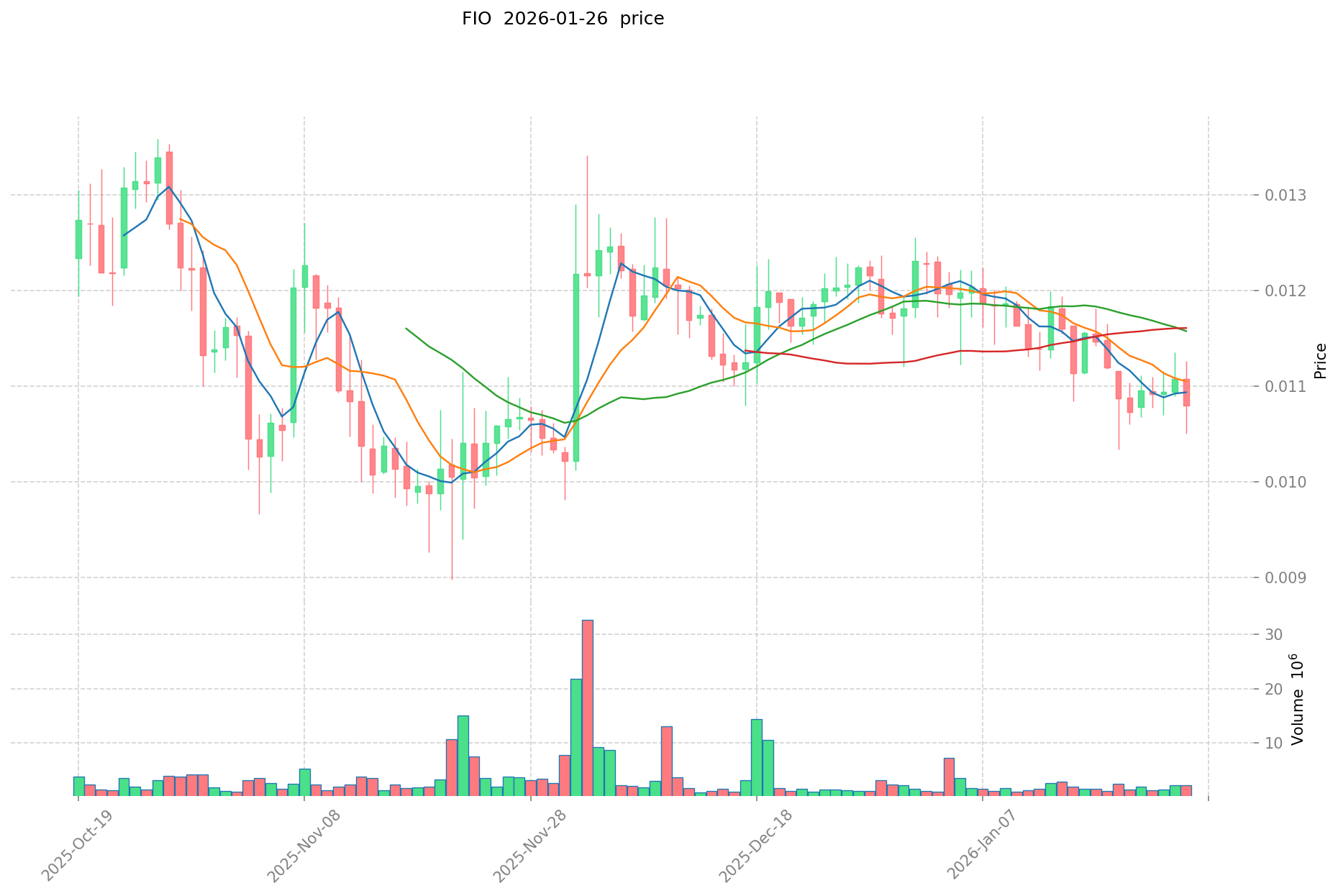
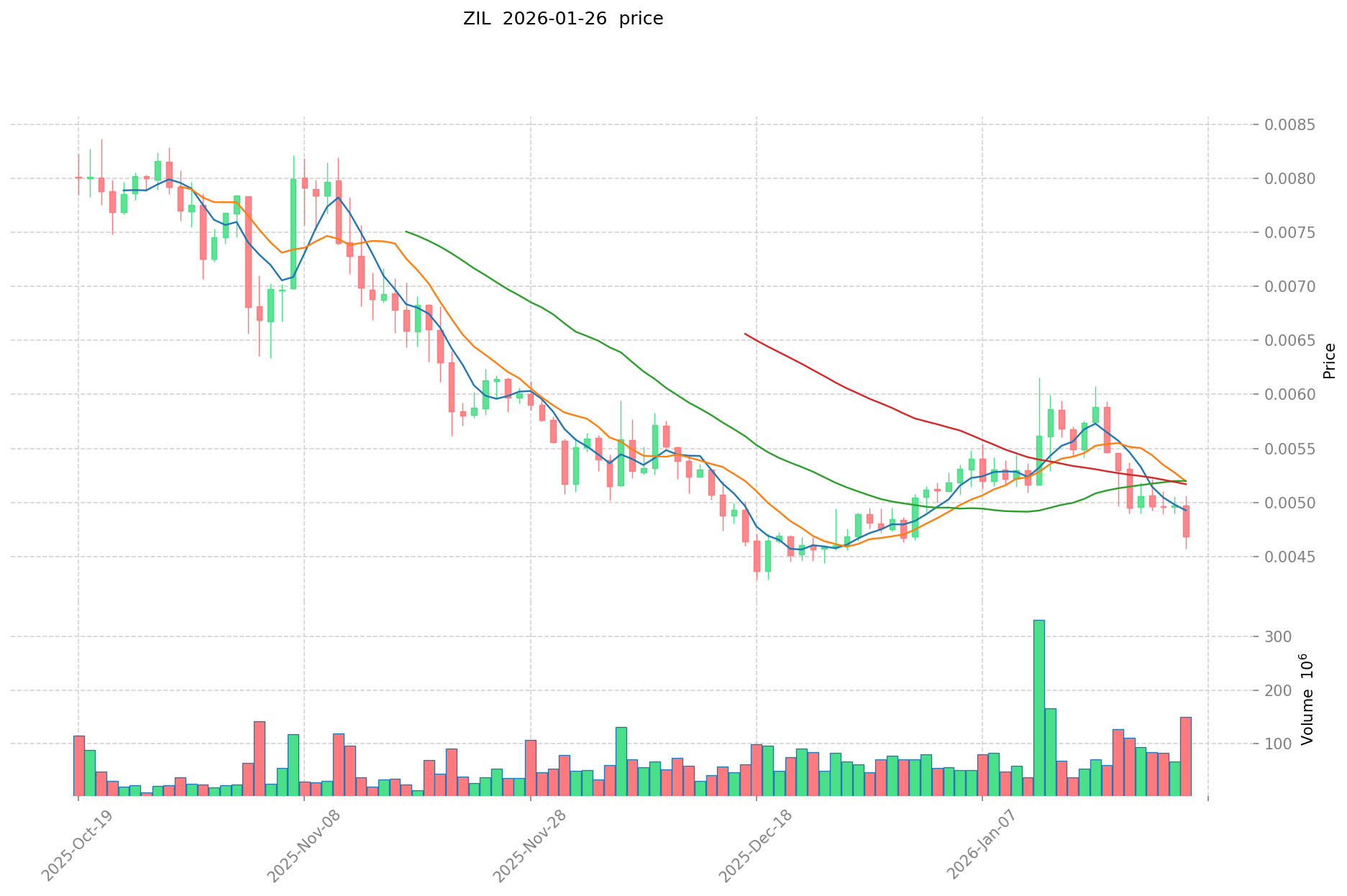
II. Core Factors Influencing FIO vs ZIL Investment Value
Tokenomics Comparison
- FIO Protocol: The supply mechanism and token distribution model remain areas requiring further clarity, as specific details about fixed supply caps or deflationary features were not extensively documented in available materials.
- ZIL: Zilliqa's tokenomics structure includes considerations around network growth and ecosystem expansion, though comprehensive details on halving mechanisms or supply constraints were not prominently featured in the reference sources.
- 📌 Historical Pattern: Supply mechanisms can contribute to price cycle dynamics, though the specific historical correlations for these two assets require project-specific analysis beyond the scope of current materials.
Institutional Adoption and Market Application
- Institutional Holdings: Comparative institutional preference between FIO and ZIL depends on multiple factors including technology maturity, regulatory clarity, and use case validation, areas where detailed institutional holding data was not extensively covered.
- Enterprise Adoption: Both protocols aim to serve different niches within blockchain infrastructure. FIO Protocol focuses on user-friendly addressing and data management, while Zilliqa emphasizes high-throughput blockchain capabilities. Cross-border payment and settlement applications for each require evaluation of their respective technical architectures and partnership developments.
- National Policy: Regulatory attitudes vary significantly across jurisdictions and evolve continuously. Investment value assessment must consider the broader regulatory environment affecting blockchain technologies, including considerations around virtual asset service providers and compliance frameworks.
Technology Development and Ecosystem Building
- FIO Protocol Technology: The protocol's development focuses on improving blockchain usability through human-readable addresses and data management solutions. Ongoing technical improvements and ecosystem partnerships influence long-term value prospects.
- ZIL Technology Development: Zilliqa's approach centers on sharding technology for scalability. The platform's evolution in supporting decentralized applications and its network performance metrics represent key technical considerations.
- Ecosystem Comparison: Both projects participate in broader blockchain ecosystems with varying degrees of DeFi integration, NFT support, payment applications, and smart contract deployment. The maturity and adoption rate of these ecosystem components differ between the two protocols and require ongoing monitoring.
Macroeconomic Environment and Market Cycles
- Performance During Inflation: The inflation-hedging characteristics of specific cryptocurrencies depend on market perception, adoption trajectories, and utility rather than inherent properties. Neither FIO nor ZIL has established a definitive track record as inflation-resistant assets compared to more established cryptocurrencies.
- Macroeconomic Monetary Policy: Interest rate adjustments, dollar index movements, and broader monetary policy shifts affect cryptocurrency markets generally. The specific sensitivity of FIO and ZIL to these macroeconomic factors varies with their market positioning and liquidity profiles.
- Geopolitical Factors: Cross-border transaction demand and international developments can influence blockchain adoption. Both protocols may benefit from increased interest in decentralized infrastructure, though their exposure to geopolitical catalysts differs based on their specific use cases and geographic adoption patterns.
III. 2026-2031 Price Prediction: FIO vs ZIL
Short-term Forecast (2026)
- FIO: Conservative $0.00623 - $0.01093 | Optimistic $0.01093 - $0.01617
- ZIL: Conservative $0.00260 - $0.00481 | Optimistic $0.00481 - $0.00597
Mid-term Forecast (2028-2029)
- FIO may enter a phase of moderate growth, with estimated price range of $0.01132 - $0.02023
- ZIL may enter a phase of gradual expansion, with estimated price range of $0.00570 - $0.00931
- Key drivers: institutional capital inflows, ETF developments, ecosystem expansion
Long-term Forecast (2030-2031)
- FIO: Baseline scenario $0.00994 - $0.02251 | Optimistic scenario $0.02117 - $0.02626
- ZIL: Baseline scenario $0.00444 - $0.01007 | Optimistic scenario $0.00826 - $0.01188
View detailed price predictions for FIO and ZIL
Disclaimer
FIO:
| Year |
Predicted High Price |
Predicted Average Price |
Predicted Low Price |
Price Change |
| 2026 |
0.01617344 |
0.010928 |
0.00622896 |
0 |
| 2027 |
0.0178869504 |
0.01355072 |
0.0077239104 |
23 |
| 2028 |
0.01886260224 |
0.0157188352 |
0.011317561344 |
43 |
| 2029 |
0.0202301409024 |
0.01729071872 |
0.0096828024832 |
57 |
| 2030 |
0.02626460173568 |
0.0187604298112 |
0.009943027799936 |
71 |
| 2031 |
0.025664267981721 |
0.02251251577344 |
0.021161764827033 |
105 |
ZIL:
| Year |
Predicted High Price |
Predicted Average Price |
Predicted Low Price |
Price Change |
| 2026 |
0.00596812 |
0.004813 |
0.00259902 |
0 |
| 2027 |
0.007277256 |
0.00539056 |
0.0046358816 |
11 |
| 2028 |
0.0091841666 |
0.006333908 |
0.0057005172 |
31 |
| 2029 |
0.00931084476 |
0.0077590373 |
0.005819277975 |
60 |
| 2030 |
0.0116075198008 |
0.00853494103 |
0.0044381693356 |
76 |
| 2031 |
0.010876928848632 |
0.0100712304154 |
0.008258408940628 |
108 |
IV. Investment Strategy Comparison: FIO vs ZIL
Long-term vs Short-term Investment Strategies
-
FIO: May suit investors interested in blockchain usability infrastructure projects with focus on user experience improvements and cross-chain interoperability solutions. The protocol's positioning in simplifying blockchain interactions could appeal to those evaluating long-term infrastructure value propositions.
-
ZIL: May suit investors evaluating high-throughput blockchain platforms with emphasis on scalability solutions through sharding technology. The platform's technical approach to addressing network capacity challenges could attract those focused on Layer 1 infrastructure developments.
Risk Management and Asset Allocation
-
Conservative Investors: A potential allocation framework might consider FIO at 30-40% versus ZIL at 60-70% within a diversified crypto portfolio segment, reflecting consideration of liquidity profiles and market positioning.
-
Aggressive Investors: A more growth-oriented allocation might consider FIO at 50-60% versus ZIL at 40-50%, acknowledging higher volatility tolerance and longer investment horizons for infrastructure-focused assets.
-
Hedging Instruments: Diversification approaches may include stablecoin reserves for market downturns, derivatives instruments where available for volatility management, and cross-asset diversification across different blockchain infrastructure categories.
V. Potential Risk Comparison
Market Risks
-
FIO: Trading volume of $22,578.71 on January 26, 2026 reflects limited liquidity conditions, which may contribute to price volatility during periods of market stress. The protocol's market positioning in the usability infrastructure niche presents both differentiation opportunities and adoption uncertainty.
-
ZIL: Trading volume of $739,897.10 indicates relatively higher market activity compared to FIO, though still subject to broader cryptocurrency market dynamics. Competition within the high-throughput blockchain category and evolving scalability solutions across the industry represent ongoing market considerations.
Technical Risks
-
FIO: Protocol adoption depends on successful integration with wallets, exchanges, and blockchain platforms. Technical development progress and ecosystem partnership expansion represent key variables affecting long-term viability.
-
ZIL: Network performance under high transaction loads and the continued effectiveness of sharding implementation require ongoing technical validation. Platform competition from other Layer 1 solutions and evolving scalability approaches across the blockchain industry present technical positioning challenges.
Regulatory Risks
- Both protocols operate within evolving regulatory frameworks affecting blockchain infrastructure projects. FIO's focus on user-facing functionality and ZIL's positioning as a smart contract platform may encounter different regulatory considerations across jurisdictions. Compliance requirements for virtual asset service providers, data management standards, and cross-border transaction regulations represent ongoing areas requiring monitoring for both protocols.
VI. Conclusion: Which Is the Better Buy?
📌 Investment Value Summary
-
FIO Strengths: Differentiated positioning in blockchain usability infrastructure, addressing user experience challenges in cryptocurrency interactions through human-readable addressing solutions. Recovery from historical lows with current price at $0.010952 compared to the low of $0.00699735 recorded in October 2025.
-
ZIL Strengths: Established presence since 2018 in high-throughput blockchain infrastructure, pioneering implementation of sharding technology for scalability. Current price at $0.004835 with relatively higher trading volume indicating sustained market interest.
✅ Investment Recommendations
-
New Investors: Consider starting with smaller position sizes while evaluating both protocols' development progress and ecosystem adoption. Prioritize understanding the fundamental differences between usability-focused infrastructure (FIO) and scalability-focused platforms (ZIL) before allocation decisions.
-
Experienced Investors: May evaluate diversified exposure across both protocols as part of broader blockchain infrastructure allocation, considering their complementary positioning within different infrastructure niches. Regular monitoring of technical developments, partnership announcements, and ecosystem growth metrics recommended.
-
Institutional Investors: Should conduct comprehensive due diligence covering technical architecture, regulatory compliance frameworks, liquidity profiles, and long-term sustainability models for both protocols. Consider correlation analysis with broader crypto market movements and portfolio diversification objectives.
⚠️ Risk Disclosure: The cryptocurrency market exhibits extreme volatility characteristics. This analysis does not constitute investment advice. Price predictions involve substantial uncertainty and should not be relied upon as guarantees of future performance. Investors should conduct independent research and consider their risk tolerance, investment objectives, and financial circumstances before making investment decisions.
VII. FAQ
Q1: What are the main differences between FIO Protocol and Zilliqa (ZIL)?
FIO Protocol focuses on blockchain usability infrastructure, providing human-readable wallet addresses and cross-chain metadata solutions to simplify user interactions, while Zilliqa (ZIL) is a high-throughput public blockchain platform implementing sharding technology to address scalability challenges. FIO launched in July 2020 with a usability-first approach, whereas ZIL has been operational since January 2018 as a Layer 1 smart contract platform. Their core technological focuses are fundamentally different: FIO enhances user experience across existing blockchains, while ZIL aims to provide a scalable infrastructure for decentralized applications through its sharding architecture.
Q2: Which cryptocurrency has better liquidity - FIO or ZIL?
ZIL demonstrates significantly better liquidity compared to FIO. As of January 26, 2026, ZIL recorded a 24-hour trading volume of $739,897.10, substantially higher than FIO's $22,578.71. This approximately 33x difference in trading volume indicates that ZIL offers greater market depth, potentially resulting in tighter spreads, easier entry and exit positions, and reduced slippage during transactions. Lower liquidity in FIO may lead to higher price volatility during market stress periods and could present challenges for larger position sizes or rapid portfolio adjustments.
Q3: What are the price recovery potentials for FIO and ZIL from their historical lows?
Both cryptocurrencies have experienced significant declines from their all-time highs but show different recovery trajectories. FIO peaked at $0.560433 in April 2021 and fell to a low of $0.00699735 in October 2025, currently trading at $0.010952 (representing a 56% recovery from the low but still 98% below its peak). ZIL reached $0.255376 in May 2021 and recorded a historical low of $0.00239616 in March 2020, currently at $0.004835 (approximately 102% above that low but 98% below its peak). The recovery potential depends on multiple factors including ecosystem development, institutional adoption, and broader market conditions, with price predictions for 2031 suggesting FIO could reach $0.02251-$0.02626 and ZIL $0.00826-$0.01188 under optimistic scenarios.
Q4: How should conservative versus aggressive investors approach FIO and ZIL allocation?
Conservative investors might consider a portfolio allocation favoring ZIL at 60-70% versus FIO at 30-40% within their crypto infrastructure segment, reflecting ZIL's higher liquidity, longer operational history, and more established market presence. Aggressive investors with higher risk tolerance and longer investment horizons might allocate 50-60% to FIO versus 40-50% to ZIL, emphasizing FIO's differentiated positioning in usability infrastructure and potential for higher growth if adoption accelerates. Both strategies should maintain stablecoin reserves for market downturns and consider cross-asset diversification across different blockchain infrastructure categories. Position sizing should always align with individual risk tolerance, investment objectives, and overall portfolio composition.
Q5: What are the primary risks investors should consider when comparing FIO and ZIL?
Market risks include FIO's limited liquidity ($22,578.71 daily volume) which may amplify price volatility, and ZIL's competition within the crowded high-throughput blockchain space from emerging Layer 1 and Layer 2 solutions. Technical risks involve FIO's dependency on successful integration with wallets and exchanges for adoption, and ZIL's need to maintain network performance under high transaction loads while competing with evolving scalability solutions. Regulatory risks affect both protocols as blockchain infrastructure projects operating under evolving global frameworks, with FIO's user-facing functionality and ZIL's smart contract platform potentially encountering different compliance requirements across jurisdictions. Both assets also face broad cryptocurrency market correlation risks, particularly during periods of extreme fear (current Fear & Greed Index: 20).
Q6: Which cryptocurrency is better suited for long-term infrastructure investment?
The choice depends on your infrastructure investment thesis: FIO suits investors focused on user experience and blockchain accessibility improvements, believing that simplified interactions represent a critical infrastructure gap requiring specialized solutions. ZIL appeals to those prioritizing scalability infrastructure, evaluating high-throughput platforms as foundational to blockchain adoption at scale. FIO's differentiated positioning in the usability niche offers less direct competition but faces adoption uncertainty, while ZIL's established presence in Layer 1 infrastructure provides operational track record but encounters intense competition from newer platforms. Long-term viability for both depends on continued technical development, ecosystem partnership expansion, and successful navigation of evolving market demands for blockchain infrastructure solutions.
Q7: How do macroeconomic conditions affect FIO and ZIL differently?
Both cryptocurrencies are subject to broader macroeconomic factors including interest rate adjustments, dollar strength, and monetary policy shifts that affect cryptocurrency markets generally. However, their specific sensitivities differ based on market positioning and liquidity profiles. ZIL's higher trading volume and longer market presence may result in greater correlation with mainstream cryptocurrency market movements and macro trends. FIO's lower liquidity could lead to less direct macro correlation but higher susceptibility to sudden market sentiment shifts. Neither has established a definitive track record as inflation-resistant assets compared to more established cryptocurrencies. Geopolitical factors favoring decentralized infrastructure adoption could benefit both, though FIO's focus on cross-chain usability and ZIL's emphasis on high-throughput capabilities may respond differently to specific international developments driving blockchain adoption.
Q8: What timeframe should investors consider when evaluating FIO versus ZIL?
Investment timeframes should align with each protocol's development stage and market positioning. Short-term (2026): Both face challenging conditions in the extreme fear market environment, with conservative price estimates suggesting FIO at $0.00623-$0.01093 and ZIL at $0.00260-$0.00481. Mid-term (2028-2029): Potential institutional capital inflows and ecosystem expansion could drive FIO toward $0.01132-$0.02023 and ZIL toward $0.00570-$0.00931. Long-term (2030-2031): Baseline scenarios suggest FIO reaching $0.00994-$0.02251 and ZIL $0.00444-$0.01007, though these predictions involve substantial uncertainty. FIO may require longer timeframes (3-5 years) for usability infrastructure adoption to validate its value proposition, while ZIL's more established platform might demonstrate results within 2-3 years as scalability demand evolves. Both investments should be considered long-term infrastructure positions rather than short-term trading opportunities given their current liquidity profiles.
* The information is not intended to be and does not constitute financial advice or any other recommendation of any sort offered or endorsed by Gate.