This comprehensive investment analysis compares FLM (Flamingo Finance), a Neo-based DeFi protocol launched in 2020, with RUNE (THORChain), a multi-chain liquidity infrastructure protocol established in 2019. The article examines historical price trends, tokenomics, institutional adoption, and technical ecosystems to help investors evaluate which token offers superior value. As of January 31, 2026, RUNE demonstrates significantly stronger market fundamentals with $316,782.30 daily trading volume compared to FLM's $14,115.30. The detailed analysis includes price performance data, 2026-2031 forecasts, risk comparisons, and tailored allocation strategies for conservative, aggressive, and institutional investors. RUNE appears positioned for broader adoption through its cross-chain liquidity focus, while FLM offers niche opportunities within the Neo ecosystem. The guide addresses critical investment considerations including market volatility, regulatory environments, and strategic allocation frameworks, providing a
Introduction: Investment Comparison Between FLM and RUNE
In the cryptocurrency market, the comparison between FLM vs RUNE has consistently been a topic investors cannot overlook. The two not only exhibit notable differences in market cap ranking, application scenarios, and price performance, but also represent distinct positioning within the crypto asset landscape.
FLM (Flamingo Finance): Launched in 2020, it has gained market recognition through its positioning as a Neo-based interoperability full-stack DeFi protocol.
RUNE (THORChain): Since its introduction in 2019, it has been regarded as a highly optimized multi-chain protocol, standing as one of the cryptocurrencies with substantial trading volume in the decentralized exchange infrastructure space.
This article will comprehensively analyze the investment value comparison between FLM vs RUNE, focusing on historical price trends, supply mechanisms, institutional adoption, technical ecosystems, and future forecasts, attempting to address the question investors care about most:
"Which is the better buy right now?"
I. Historical Price Comparison and Current Market Status
FLM and RUNE Historical Price Trends
- 2020: FLM experienced significant price activity following its launch in September, with initial trading around $0.2814.
- 2021: RUNE reached notable price levels during the broader cryptocurrency market rally in May, reflecting increased interest in cross-chain DeFi protocols.
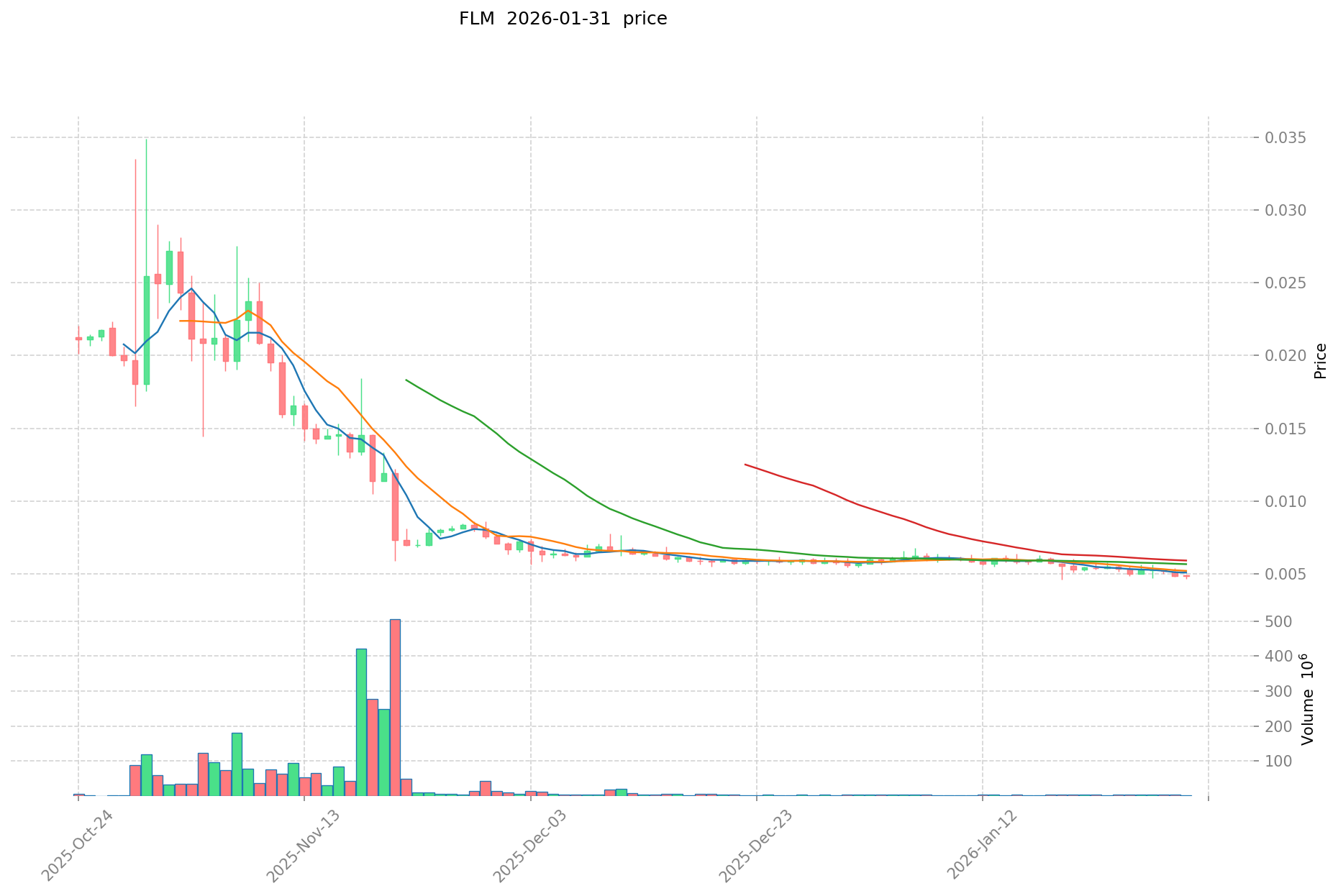
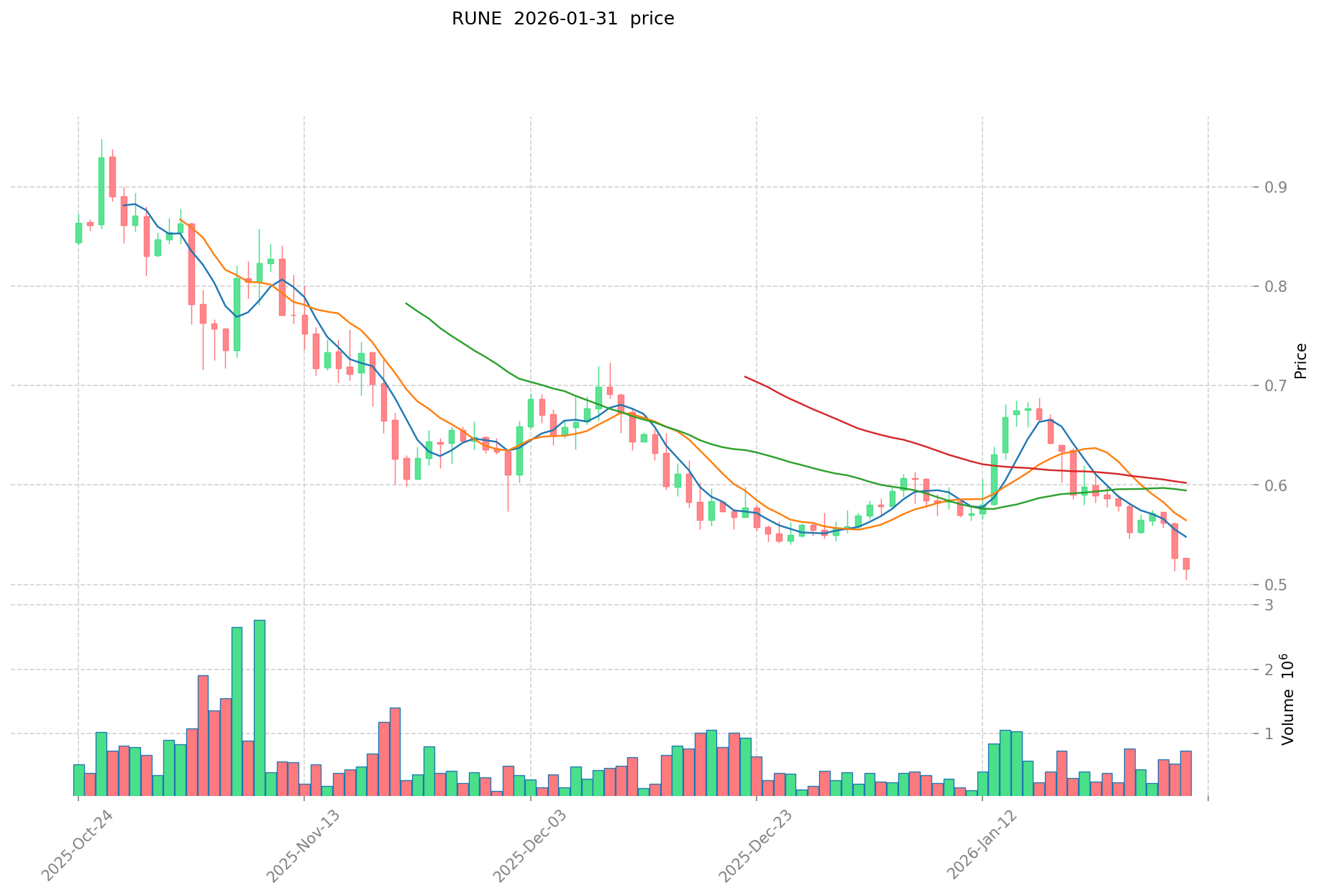
- Comparative Analysis: During the 2021-2026 market cycle, FLM declined from its early trading levels to current ranges near $0.0048, while RUNE experienced significant volatility, moving from higher valuations to approximately $0.5056.
Current Market Status (2026-01-31)
- FLM Current Price: $0.004808
- RUNE Current Price: $0.5056
- 24-Hour Trading Volume: FLM $14,115.30 vs RUNE $316,782.30
- Market Sentiment Index (Fear & Greed Index): 20 (Extreme Fear)
View real-time prices:
- Check FLM current price Market Price
- Check RUNE current price Market Price
II. Core Factors Influencing FLM vs RUNE Investment Value
Tokenomics Comparison
-
FLM: As the native token of Flamingo Finance, FLM operates within the Neo ecosystem. The token serves governance and utility functions within its DeFi protocol, though specific supply mechanisms require verification through official protocol documentation.
-
RUNE: Functions as the settlement and security asset for THORChain's cross-chain liquidity protocol. RUNE utilizes a deterministic pricing model where the token value correlates with the total value locked in liquidity pools, creating an economic relationship between network usage and token demand.
-
📌 Historical Pattern: Supply mechanisms in DeFi tokens tend to influence price cycles through staking incentives, emission schedules, and protocol fee distributions, though individual project trajectories vary significantly based on adoption and network effects.
Institutional Adoption and Market Applications
-
Institutional Holdings: Both projects currently demonstrate limited institutional penetration compared to established crypto assets. Institutional participation in DeFi protocols remains selective, focusing primarily on protocols with substantial liquidity depth and proven security track records.
-
Enterprise Adoption: FLM primarily serves decentralized finance applications within the Neo blockchain ecosystem, while RUNE facilitates cross-chain liquidity provision. Neither has achieved significant enterprise-level adoption in traditional financial settlements or corporate treasury operations as of January 2026.
-
Regulatory Environment: Both assets face evolving regulatory frameworks across jurisdictions. Most countries apply existing securities and commodity regulations to DeFi tokens on a case-by-case basis, with ongoing development in regulatory clarity.
Technical Development and Ecosystem Construction
-
FLM Technical Evolution: Development focuses on enhancing DeFi infrastructure within the Neo ecosystem, including liquidity provision mechanisms and yield optimization strategies.
-
RUNE Technical Progress: Ongoing development centers on expanding cross-chain compatibility, improving liquidity efficiency, and enhancing security measures for cross-chain asset swaps.
-
Ecosystem Comparison: RUNE demonstrates broader cross-chain functionality through THORChain's liquidity network, while FLM concentrates on Neo-native DeFi applications. Both projects maintain active development communities, though ecosystem size and application diversity differ substantially.
Macroeconomic Conditions and Market Cycles
-
Inflation Environment Performance: Neither asset has established a proven track record as an inflation hedge comparable to traditional store-of-value assets. Performance correlates more strongly with broader cryptocurrency market sentiment and DeFi sector dynamics.
-
Monetary Policy Impact: Interest rate adjustments and dollar strength tend to influence risk appetite across cryptocurrency markets, affecting both assets through general market correlation rather than specific mechanisms.
-
Geopolitical Factors: Cross-chain liquidity protocols like THORChain may benefit from increased demand for decentralized asset transfer solutions during periods of capital control concerns, though direct impact remains difficult to quantify.
III. 2026-2031 Price Forecast: FLM vs RUNE
Short-term Forecast (2026)
- FLM: Conservative $0.00332 - $0.00481 | Optimistic $0.00481 - $0.00529
- RUNE: Conservative $0.379 - $0.505 | Optimistic $0.505 - $0.707
Mid-term Forecast (2028-2029)
- FLM may enter a consolidation phase with estimated prices ranging from $0.00491 to $0.00680 across different scenarios
- RUNE may enter an expansion phase with estimated prices ranging from $0.428 to $1.098 across different scenarios
- Key drivers include institutional capital flows, ETF developments, and ecosystem growth
Long-term Forecast (2030-2031)
- FLM: Baseline scenario $0.00477 - $0.00782 | Optimistic scenario $0.00782 - $0.00986
- RUNE: Baseline scenario $1.017 - $1.070 | Optimistic scenario $1.070 - $1.477
View detailed price predictions for FLM and RUNE
Disclaimer
FLM:
| Year |
Predicted High Price |
Predicted Average Price |
Predicted Low Price |
Price Change |
| 2026 |
0.0052888 |
0.004808 |
0.00331752 |
0 |
| 2027 |
0.006663888 |
0.0050484 |
0.004695012 |
5 |
| 2028 |
0.0067345656 |
0.005856144 |
0.00562189824 |
21 |
| 2029 |
0.006798983184 |
0.0062953548 |
0.004910376744 |
30 |
| 2030 |
0.00910056489888 |
0.006547168992 |
0.00366641463552 |
36 |
| 2031 |
0.009858072351254 |
0.00782386694544 |
0.004772558836718 |
62 |
RUNE:
| Year |
Predicted High Price |
Predicted Average Price |
Predicted Low Price |
Price Change |
| 2026 |
0.707 |
0.505 |
0.37875 |
0 |
| 2027 |
0.89688 |
0.606 |
0.47268 |
19 |
| 2028 |
0.7739832 |
0.75144 |
0.4283208 |
48 |
| 2029 |
1.098304704 |
0.7627116 |
0.68644044 |
50 |
| 2030 |
1.2096605976 |
0.930508152 |
0.56760997272 |
84 |
| 2031 |
1.476716437224 |
1.0700843748 |
1.01658015606 |
111 |
IV. Investment Strategy Comparison: FLM vs RUNE
Long-term vs Short-term Investment Strategies
-
FLM: May appeal to investors focused on Neo ecosystem development and DeFi protocol innovation within a specific blockchain environment. The asset's lower price point and ecosystem positioning suggest consideration for those interested in niche DeFi infrastructure plays.
-
RUNE: May appeal to investors seeking exposure to cross-chain liquidity infrastructure and multi-chain DeFi protocols. The broader interoperability focus positions RUNE for consideration by those interested in decentralized exchange infrastructure across multiple blockchain networks.
Risk Management and Asset Allocation
-
Conservative Investors: FLM 20-30% vs RUNE 70-80% allocation within a DeFi-focused portfolio subset, reflecting RUNE's broader ecosystem presence and liquidity depth
-
Aggressive Investors: FLM 40-50% vs RUNE 50-60% allocation for those seeking higher risk-reward profiles within smaller-cap DeFi protocols
-
Hedging Tools: Stablecoin reserves for market volatility management, options strategies where available, and diversification across multiple DeFi protocol tokens to reduce single-project exposure
V. Potential Risk Comparison
Market Risk
-
FLM: Price volatility linked to Neo ecosystem adoption rates and DeFi sector sentiment. Lower trading volumes may result in significant price fluctuations during periods of reduced market liquidity. Market correlation with broader cryptocurrency trends affects short-term price movements.
-
RUNE: Subject to cross-chain liquidity demand fluctuations and competitive pressures from alternative decentralized exchange protocols. Price movements may correlate with overall DeFi sector performance and cross-chain transaction volumes. Market sentiment regarding multi-chain infrastructure influences valuation.
Technical Risk
-
FLM: Protocol scalability within the Neo ecosystem, smart contract security considerations, and dependency on Neo blockchain infrastructure development. Network activity levels and DeFi application adoption on Neo affect protocol utility.
-
RUNE: Cross-chain bridge security vulnerabilities, liquidity pool management complexity, and multi-chain integration challenges. Protocol security considerations related to cross-chain asset transfers and node operator decentralization affect network reliability.
Regulatory Risk
Global regulatory frameworks for DeFi protocols continue evolving across jurisdictions. Cross-chain liquidity protocols face examination regarding compliance with securities regulations, anti-money laundering requirements, and decentralized finance oversight. Both assets operate in an environment where regulatory clarity remains under development, with potential impacts varying by jurisdiction and protocol functionality.
VI. Conclusion: Which Is the Better Buy?
📌 Investment Value Summary:
-
FLM Characteristics: Neo ecosystem integration, DeFi protocol focus within a specific blockchain environment, lower current market valuation with corresponding risk profile
-
RUNE Characteristics: Cross-chain liquidity infrastructure, broader multi-chain positioning, established presence in decentralized exchange ecosystem with greater trading volume
✅ Investment Considerations:
-
Beginning Investors: Consider starting with smaller allocations to understand DeFi protocol dynamics, focusing on assets with greater liquidity depth and established track records. RUNE's broader ecosystem presence may offer more accessible entry points for those new to DeFi protocols.
-
Experienced Investors: May evaluate both assets based on portfolio diversification objectives, risk tolerance, and views on specific blockchain ecosystem development. Consider allocation strategies that balance exposure across different DeFi infrastructure types.
-
Institutional Investors: Require thorough due diligence on protocol security, liquidity depth, regulatory compliance frameworks, and operational risk management. Current institutional adoption levels for both assets remain limited compared to established cryptocurrency assets.
⚠️ Risk Disclaimer: Cryptocurrency markets exhibit extreme volatility. This content does not constitute investment advice, financial guidance, or trading recommendations. Market conditions change rapidly, and past performance does not indicate future results.
VII. FAQ
Q1: What is the main difference between FLM and RUNE in terms of their use cases?
FLM operates as a DeFi protocol within the Neo ecosystem, while RUNE functions as cross-chain liquidity infrastructure across multiple blockchains. FLM focuses on providing decentralized finance services specifically for Neo-based applications, including liquidity provision and yield optimization within that ecosystem. In contrast, RUNE powers THORChain's multi-chain liquidity network, enabling decentralized asset swaps across different blockchain networks without wrapped tokens or centralized bridges. This fundamental distinction means FLM's value proposition depends heavily on Neo ecosystem adoption, whereas RUNE's utility scales with demand for cross-chain liquidity solutions across the broader cryptocurrency landscape.
Q2: Which asset has greater liquidity and trading volume?
RUNE demonstrates significantly greater liquidity with 24-hour trading volume of $316,782.30 compared to FLM's $14,115.30 as of January 31, 2026. This substantial difference in trading volume indicates that RUNE offers better market depth, potentially resulting in lower slippage for larger transactions and more efficient price discovery. Higher liquidity generally reduces execution risk for investors entering or exiting positions, particularly during volatile market conditions. The trading volume disparity reflects RUNE's broader market presence and its role in facilitating cross-chain transactions across multiple blockchain ecosystems, compared to FLM's more concentrated focus within the Neo network.
Q3: What are the key risk factors to consider when investing in these assets?
Both assets face distinct risk profiles requiring careful consideration. FLM's primary risks include dependency on Neo ecosystem development, lower trading liquidity potentially causing price volatility, and limited market adoption outside its native blockchain environment. RUNE faces cross-chain bridge security vulnerabilities, competition from alternative decentralized exchange protocols, and complexity in managing multi-chain liquidity pools. Both assets operate in evolving regulatory environments where DeFi protocols face increasing scrutiny regarding securities regulations and compliance requirements. Market risk remains significant for both, with correlation to broader cryptocurrency sentiment and DeFi sector performance affecting price movements. Investors should assess their risk tolerance and conduct thorough due diligence before allocation decisions.
Q4: How do the long-term price forecasts compare between FLM and RUNE?
Price forecasts through 2031 suggest different growth trajectories for each asset. FLM's optimistic scenario projects prices ranging from $0.00529 in 2026 to $0.00986 by 2031, representing potential percentage gains from current levels but remaining below $0.01. RUNE's forecasts indicate stronger potential appreciation, with optimistic projections reaching $0.707 in 2026 and $1.477 by 2031. These forecasts reflect RUNE's broader ecosystem positioning and established infrastructure role compared to FLM's niche focus. However, all cryptocurrency price predictions carry significant uncertainty, influenced by market cycles, adoption rates, competitive dynamics, and macroeconomic conditions that may differ substantially from forecast assumptions.
Q5: What allocation strategy should different investor types consider?
Investment allocation strategies vary based on risk tolerance and experience levels. Conservative investors might consider a 20-30% FLM and 70-80% RUNE split within a DeFi-focused portfolio subset, reflecting RUNE's greater liquidity and broader ecosystem presence. This approach emphasizes the more established cross-chain protocol while maintaining limited exposure to Neo ecosystem opportunities. Aggressive investors seeking higher risk-reward profiles might adopt a 40-50% FLM and 50-60% RUNE allocation, accepting greater volatility in exchange for potential returns from earlier-stage protocol development. Beginning investors should start with smaller allocations to understand DeFi dynamics, potentially favoring RUNE's greater liquidity depth. All strategies should incorporate proper risk management, including stablecoin reserves and diversification across multiple DeFi protocols to reduce single-project exposure.
Q6: How does the current market sentiment affect these investments?
The current Fear & Greed Index reading of 20 (Extreme Fear) as of January 31, 2026, indicates significant market pessimism that affects both assets. Extreme fear conditions historically present potential accumulation opportunities for long-term investors with conviction in underlying protocols, though they also signal heightened volatility risk and potential for further price declines. During extreme fear periods, lower-liquidity assets like FLM may experience more pronounced price swings compared to higher-volume assets like RUNE. Market sentiment cycles significantly impact DeFi protocol tokens, which tend to correlate strongly with broader cryptocurrency market movements. Investors should consider their investment timeframe and risk tolerance when entering positions during extreme sentiment conditions, recognizing that recovery periods vary and are not guaranteed.
Q7: What institutional adoption factors differentiate these assets?
Both FLM and RUNE currently demonstrate limited institutional adoption compared to established cryptocurrency assets, though they differ in institutional appeal factors. RUNE's cross-chain liquidity infrastructure and higher trading volumes may present relatively more accessible entry points for institutional capital seeking DeFi exposure, as the protocol addresses fundamental blockchain interoperability challenges. FLM's concentration within the Neo ecosystem limits its institutional appeal to entities specifically focused on that blockchain environment. Neither asset has achieved significant enterprise-level adoption in traditional financial operations or corporate treasury applications as of January 2026. Institutional investors require thorough due diligence on protocol security, liquidity depth, regulatory compliance frameworks, and operational risk management—areas where both assets face ongoing development challenges compared to more mature cryptocurrency infrastructure.
Q8: How do technical development roadmaps compare between these projects?
FLM's technical development focuses on enhancing DeFi infrastructure within the Neo ecosystem, including improvements to liquidity provision mechanisms and yield optimization strategies for Neo-based applications. This concentrated approach allows for deep integration with Neo's technical architecture but limits cross-chain functionality. RUNE's development roadmap emphasizes expanding cross-chain compatibility, improving liquidity efficiency across multiple blockchain networks, and strengthening security measures for cross-chain asset transfers. THORChain's ongoing technical evolution addresses broader interoperability challenges affecting the entire cryptocurrency ecosystem. Both projects maintain active development communities, though ecosystem size, developer activity levels, and application diversity differ substantially. Investors evaluating technical risk should monitor development progress, security audit results, and community engagement metrics as indicators of protocol sustainability and growth potential.
* The information is not intended to be and does not constitute financial advice or any other recommendation of any sort offered or endorsed by Gate.