This comprehensive analysis compares FOGO and HBAR across critical investment dimensions. FOGO, a Layer 1 blockchain at $0.04048, emphasizes community-driven innovation within Solana's ecosystem, while HBAR, trading at $0.11727, represents enterprise-grade distributed ledger technology with institutional backing and hashgraph consensus. The article examines historical price trends, tokenomics, technological ecosystems, and market positioning to help investors understand these distinct blockchain projects. Through detailed sections on price predictions, investment strategies, and risk comparisons, this guide provides actionable insights for both conservative and aggressive investors. Real-time data and allocation frameworks enable informed decision-making across different risk profiles and investment horizons on Gate.
Introduction: Investment Comparison Between FOGO and HBAR
In the cryptocurrency market, the comparison between different digital assets remains a central topic for investors. These assets differ significantly in market cap ranking, use cases, and price performance, representing distinct positions within the crypto ecosystem.
FOGO: A next-generation Layer 1 blockchain designed for the ultimate on-chain trading experience. Trading at approximately $0.04048 with a market cap around $146.78 million, FOGO ranks 288th by market capitalization.
HBAR: The native cryptocurrency of Hedera, a public ledger network utilizing hashgraph consensus technology. Trading at approximately $0.11727 with a market cap exceeding $5 billion, HBAR holds the 28th position by market capitalization.
This article examines the investment characteristics of both assets through multiple dimensions including historical price movements, supply mechanisms, technological ecosystems, and market positioning. The analysis aims to provide investors with comprehensive insights for evaluating these two distinct blockchain projects.
"Understanding the fundamental differences between emerging Layer 1 projects and established distributed ledger platforms."
I. Historical Price Comparison and Current Market Status
FOGO and HBAR Historical Price Trends
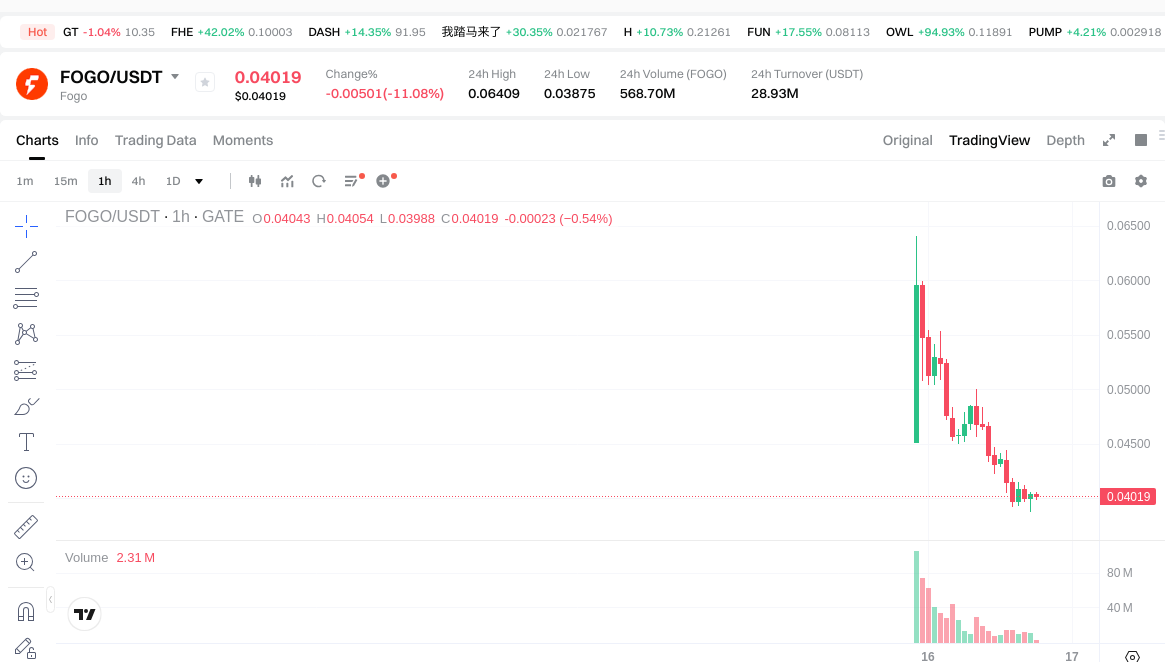
- 2026: FOGO launched on January 14, with the token experiencing significant volatility in its early trading days. The price fluctuated between a 24-hour low of $0.03875 and a high of $0.06409.
- 2021: HBAR reached its all-time high of $0.569229 on September 15, following increased adoption and network development milestones.
- 2020: HBAR recorded its all-time low of $0.00986111 on January 3, during a broader market downturn.
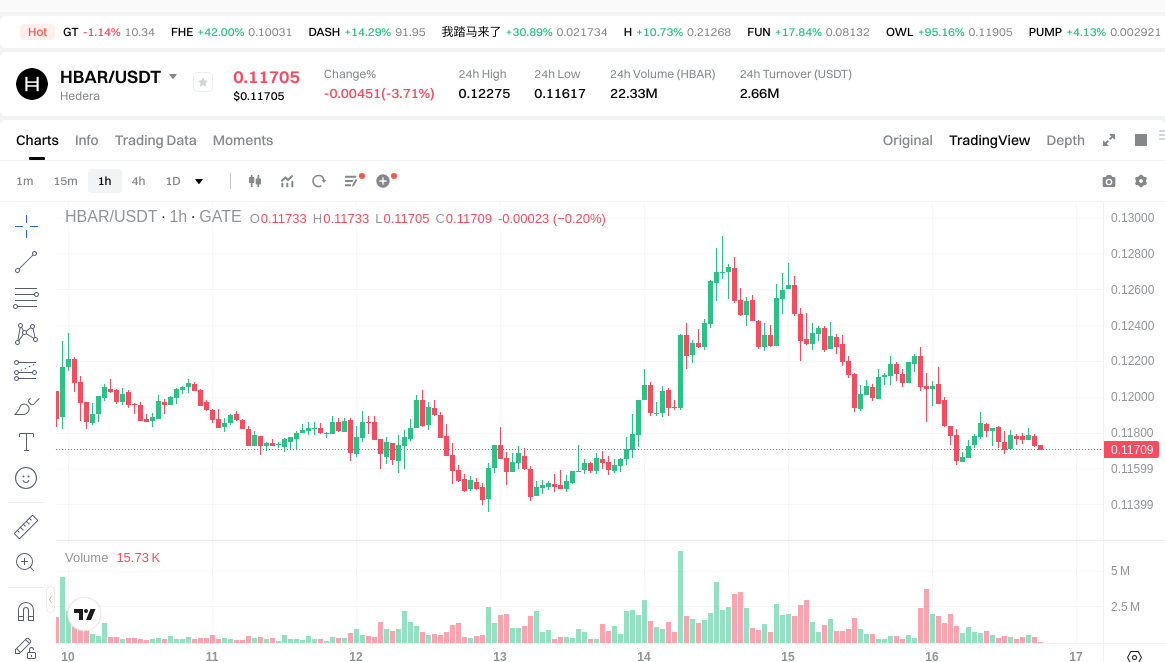
- Comparative Analysis: During recent market cycles, FOGO has experienced a decline of 25.13% over the past 7 days from its recent highs, while HBAR has shown a decline of 1.41% over the same period, demonstrating relatively more stability.
Current Market Status (January 16, 2026)
- FOGO Current Price: $0.04048
- HBAR Current Price: $0.11727
- 24-Hour Trading Volume: FOGO $28,847,891.05 vs HBAR $2,670,013.17
- Market Sentiment Index (Fear & Greed Index): 49 (Neutral)
View Real-Time Prices:
- Check FOGO Current Price Market Price
- Check HBAR Current Price Market Price
II. Core Factors Influencing FOGO vs HBAR Investment Value
Supply Mechanism Comparison (Tokenomics)
-
FOGO: According to available information, FOGO transitioned from a $20 million presale strategy to a community-focused airdrop model, promoting mainnet launch and token ownership innovation. The distribution mechanism is based on user activity, which may reshape cryptocurrency ecosystem participation patterns.
-
HBAR: HBAR operates within the Hedera network with a capped total supply. The token serves multiple functions including network fees, staking, and governance. The supply distribution is managed through a controlled release mechanism designed to support long-term ecosystem development.
-
📌 Historical Pattern: Supply mechanisms with controlled release schedules and utility-driven demand have historically demonstrated correlation with sustained price support during market cycles, though volatility remains inherent to crypto assets.
Institutional Adoption and Market Application
-
Institutional Holdings: HBAR has demonstrated notable enterprise adoption, with Hedera's governance council including major global corporations. This institutional backing may provide enhanced credibility and stability factors for long-term holders.
-
Enterprise Adoption: HBAR's hashgraph consensus technology enables high throughput (over 10,000 transactions per second) and energy efficiency, making it suitable for large-scale applications including tokenized settlement systems and supply chain management. FOGO's focus appears centered on community-driven models within the Solana Layer 1 ecosystem.
-
National Policies: Regulatory frameworks vary significantly across jurisdictions. HBAR's enterprise-focused approach may benefit from clearer compliance pathways in certain markets, while community-driven projects like FOGO face evolving regulatory considerations.
Technology Development and Ecosystem Building
-
FOGO Technology Development: The project emphasizes community-centric distribution mechanisms and mainnet launch initiatives. The activity-based distribution model represents an innovative approach to token ownership within the Solana ecosystem.
-
HBAR Technology Evolution: On January 13, Hedera upgraded its mainnet to v0.68, continuing its technical advancement roadmap. The hashgraph consensus mechanism differentiates HBAR from traditional blockchain architectures, offering unique technical advantages in transaction finality and energy consumption.
-
Ecosystem Comparison: HBAR maintains a market capitalization of approximately $5.81 billion, ranking as a major cryptocurrency. Its ecosystem spans DeFi applications, tokenization projects, and enterprise solutions. FOGO's ecosystem development appears earlier-stage, with focus on community engagement and distribution innovation within Solana's infrastructure.
Macroeconomic Factors and Market Cycles
-
Performance in Inflationary Environments: Historical crypto market behavior during inflation periods shows varied responses. Assets with clear utility cases and enterprise adoption patterns may demonstrate different risk profiles compared to community-driven experimental models.
-
Macroeconomic Monetary Policy: Interest rates and monetary policy shifts influence capital flows across risk assets. Established cryptocurrencies with institutional backing may respond differently to policy changes compared to emerging community-focused projects.
-
Geopolitical Factors: Cross-border transaction demands and international developments affect different crypto assets variably. Enterprise-focused networks like Hedera may see demand correlation with global business activity, while community projects depend more heavily on crypto-native adoption trends.
III. 2026-2031 Price Prediction: FOGO vs HBAR
Short-term Prediction (2026)
- FOGO: Conservative $0.0352 - $0.0400 | Optimistic $0.0400 - $0.0484
- HBAR: Conservative $0.1112 - $0.1171 | Optimistic $0.1171 - $0.1686
Mid-term Prediction (2028-2029)
- FOGO may enter a gradual growth phase, with estimated price range of $0.0426 - $0.0857
- HBAR may enter a consolidation and expansion phase, with estimated price range of $0.1003 - $0.1990
- Key drivers: institutional capital flows, ETF developments, ecosystem expansion
Long-term Prediction (2030-2031)
- FOGO: Baseline scenario $0.0593 - $0.0770 | Optimistic scenario $0.0803 - $0.1132
- HBAR: Baseline scenario $0.1401 - $0.2129 | Optimistic scenario $0.1820 - $0.2438
View detailed price predictions for FOGO and HBAR
Disclaimer
FOGO:
| Year |
Predicted High Price |
Predicted Average Price |
Predicted Low Price |
Price Change |
| 2026 |
0.0483758 |
0.03998 |
0.0351824 |
0 |
| 2027 |
0.064941513 |
0.0441779 |
0.027832077 |
9 |
| 2028 |
0.06874523019 |
0.0545597065 |
0.04255657107 |
35 |
| 2029 |
0.08569693099955 |
0.061652468345 |
0.03144275885595 |
52 |
| 2030 |
0.080305422642779 |
0.073674699672275 |
0.06704397670177 |
82 |
| 2031 |
0.113175389901565 |
0.076990061157527 |
0.059282347091296 |
90 |
HBAR:
| Year |
Predicted High Price |
Predicted Average Price |
Predicted Low Price |
Price Change |
| 2026 |
0.168624 |
0.1171 |
0.111245 |
0 |
| 2027 |
0.16571992 |
0.142862 |
0.12000408 |
21 |
| 2028 |
0.1990353384 |
0.15429096 |
0.100289124 |
31 |
| 2029 |
0.187262938152 |
0.1766631492 |
0.12366420444 |
50 |
| 2030 |
0.24383047852584 |
0.181963043676 |
0.14011154363052 |
55 |
| 2031 |
0.242702307655048 |
0.21289676110092 |
0.202251923045874 |
81 |
IV. Investment Strategy Comparison: FOGO vs HBAR
Long-term vs Short-term Investment Strategies
-
FOGO: May appeal to investors focused on community-driven blockchain innovation and early-stage Layer 1 ecosystems within the Solana infrastructure. The project's activity-based distribution model and mainnet launch initiatives position it as a higher-risk, potentially higher-reward opportunity for those comfortable with emerging projects and significant volatility.
-
HBAR: May suit investors seeking exposure to enterprise-grade distributed ledger technology with established institutional backing. The hashgraph consensus mechanism, governance council composition, and existing enterprise adoption patterns suggest a focus on long-term utility and ecosystem stability rather than speculative short-term gains.
Risk Management and Asset Allocation
-
Conservative Investors: A potential allocation framework might consider FOGO 10-20% vs HBAR 80-90%, reflecting the different risk profiles and market maturity levels of each asset.
-
Aggressive Investors: A more risk-tolerant allocation might consider FOGO 40-50% vs HBAR 50-60%, balancing exposure to emerging community projects with established enterprise blockchain infrastructure.
-
Hedging Tools: Portfolio risk management approaches may include stablecoin allocations for liquidity preservation, derivatives instruments where available and appropriate, and cross-asset diversification strategies to mitigate concentration risk.
V. Potential Risk Comparison
Market Risk
-
FOGO: As an emerging project with a market cap of approximately $146.78 million and ranking 288th, FOGO faces higher liquidity risks and greater susceptibility to market sentiment shifts. The 24-hour trading volume of $28.85 million indicates active trading, but the project's early stage and recent 25.13% decline over 7 days demonstrate significant price volatility characteristics.
-
HBAR: With a market cap exceeding $5 billion and ranking 28th by capitalization, HBAR demonstrates relatively lower volatility compared to smaller-cap assets. However, the cryptocurrency remains subject to broader market cycles and sentiment shifts affecting major digital assets. The 1.41% decline over 7 days suggests more moderate short-term price movements.
Technical Risk
-
FOGO: Operating within the Solana ecosystem, the project's technical risks include dependency on underlying Layer 1 infrastructure performance and network stability. The community-focused distribution model represents an innovative but untested approach at scale, introducing uncertainties around long-term sustainability and adoption patterns.
-
HBAR: The hashgraph consensus mechanism differs fundamentally from traditional blockchain architectures, offering advantages in transaction throughput and energy efficiency but also introducing unique technical considerations. Network governance through a permissioned council structure presents different centralization trade-offs compared to fully decentralized consensus models.
Regulatory Risk
- Global regulatory frameworks continue evolving for digital assets, with implications varying by jurisdiction and project characteristics. HBAR's enterprise-focused approach and governance structure may align more readily with certain regulatory compliance frameworks, particularly in jurisdictions emphasizing institutional oversight. Community-driven projects like FOGO face ongoing regulatory considerations as frameworks for token distribution mechanisms and decentralized governance continue developing across different markets.
VI. Conclusion: Which Is the Better Buy?
📌 Investment Value Summary:
-
FOGO Advantages: Community-centric distribution innovation, activity-based token ownership model, and positioning within the Solana Layer 1 ecosystem offer exposure to emerging blockchain participation paradigms. The project represents potential upside for investors comfortable with early-stage ventures and significant volatility.
-
HBAR Advantages: Established market position, enterprise adoption patterns, institutional governance backing, and proven hashgraph technology provide differentiated exposure to distributed ledger infrastructure. The network's high throughput capabilities and energy efficiency characteristics support various enterprise use cases including tokenization and supply chain applications.
✅ Investment Considerations:
-
Novice Investors: May consider focusing on more established assets with demonstrated adoption patterns and market stability. If exploring emerging projects, maintaining conservative position sizes and thorough due diligence remains essential.
-
Experienced Investors: May evaluate portfolio allocation between established enterprise blockchain infrastructure and emerging community-driven projects based on individual risk tolerance and investment objectives. Diversification across different blockchain architectures and use cases can help manage concentration risk.
-
Institutional Investors: May find HBAR's enterprise focus, governance structure, and technical capabilities aligned with institutional investment frameworks. Due diligence on regulatory compliance, custody solutions, and counterparty considerations remains paramount.
⚠️ Risk Disclosure: Cryptocurrency markets exhibit extreme volatility and unpredictability. This analysis does not constitute investment advice, financial guidance, or recommendations to buy or sell any digital assets. Investors should conduct independent research, assess personal risk tolerance, and consider consulting qualified financial advisors before making investment decisions.
VII. FAQ
Q1: What are the fundamental differences between FOGO and HBAR's blockchain architectures?
FOGO operates as a Layer 1 blockchain within the Solana ecosystem focusing on community-driven distribution mechanisms, while HBAR utilizes hashgraph consensus technology as a distributed ledger platform. FOGO's architecture emphasizes activity-based token ownership and community engagement within Solana's infrastructure, representing an emerging approach to blockchain participation. HBAR's hashgraph consensus differs fundamentally from traditional blockchain structures, offering unique advantages including transaction throughput exceeding 10,000 TPS and enhanced energy efficiency. The hashgraph technology enables different finality characteristics and network governance models compared to conventional proof-of-stake or proof-of-work systems, supporting enterprise-grade applications across tokenization, supply chain management, and DeFi sectors.
Q2: How does market capitalization difference between FOGO and HBAR affect investment risk profiles?
FOGO's market cap of approximately $146.78 million (ranking 288th) presents significantly higher volatility and liquidity risk compared to HBAR's $5+ billion market cap (ranking 28th). Smaller market capitalization assets like FOGO typically experience more dramatic price swings in response to trading activity and market sentiment shifts, as evidenced by the 25.13% decline over 7 days. Larger-cap assets like HBAR demonstrate relatively more stable price movements (1.41% decline over the same period), though they remain subject to broader cryptocurrency market cycles. The liquidity differential also affects entry and exit execution, with FOGO's $28.85 million 24-hour trading volume indicating active but potentially more volatile trading conditions compared to established major cryptocurrencies.
Q3: What role does institutional backing play in HBAR's investment proposition compared to FOGO's community-driven model?
HBAR benefits from institutional governance through Hedera's council comprising major global corporations, providing enhanced credibility and potential stability factors for long-term adoption. This enterprise-focused governance structure may facilitate clearer regulatory compliance pathways and support sustained ecosystem development through established business relationships and use case implementations. FOGO's community-centric distribution model prioritizes decentralized participation and activity-based token ownership, representing an innovative but earlier-stage approach to blockchain governance. While institutional backing may provide foundation stability, community-driven projects offer different participation dynamics and potentially higher-risk, higher-reward characteristics for investors comfortable with emerging experimental governance structures and distribution mechanisms.
Q4: How do supply mechanisms and tokenomics differ between FOGO and HBAR?
FOGO transitioned from a $20 million presale strategy to a community-focused airdrop model based on user activity, promoting mainnet launch through distribution innovation within the Solana ecosystem. This activity-based distribution mechanism represents an experimental approach to token ownership and ecosystem participation, with long-term sustainability patterns yet to be fully demonstrated at scale. HBAR operates with a capped total supply and controlled release mechanism designed to support long-term ecosystem development, with tokens serving multiple network functions including transaction fees, staking, and governance participation. The controlled supply distribution combined with utility-driven demand from enterprise applications may provide different tokenomic dynamics compared to community-focused airdrop models, though both approaches carry distinct considerations for supply-demand equilibrium and price support mechanisms.
Q5: What are the realistic price expectations for FOGO and HBAR over different time horizons?
Short-term 2026 predictions suggest FOGO conservative range of $0.0352-$0.0400 and optimistic range of $0.0400-$0.0484, while HBAR shows conservative range of $0.1112-$0.1171 and optimistic range of $0.1171-$0.1686. Mid-term 2028-2029 estimates indicate FOGO potential growth to $0.0426-$0.0857 and HBAR consolidation around $0.1003-$0.1990, with key drivers including institutional capital flows, potential ETF developments, and ecosystem expansion. Long-term 2030-2031 baseline scenarios project FOGO at $0.0593-$0.0770 and HBAR at $0.1401-$0.2129, with optimistic scenarios reaching $0.0803-$0.1132 for FOGO and $0.1820-$0.2438 for HBAR. These predictions incorporate various factors including market cycles, adoption patterns, and macroeconomic conditions, though cryptocurrency markets remain inherently unpredictable and subject to extreme volatility.
Q6: What regulatory considerations differentiate FOGO and HBAR for investors across different jurisdictions?
Regulatory frameworks for digital assets continue evolving globally, with implications varying significantly by jurisdiction and project characteristics. HBAR's enterprise-focused approach, permissioned governance structure, and institutional backing may align more readily with regulatory compliance frameworks emphasizing institutional oversight and established business entity participation. The network's governance council composition and enterprise use case focus could facilitate clearer regulatory pathways in jurisdictions with developed digital asset frameworks. FOGO's community-driven distribution model and activity-based token ownership mechanism face ongoing regulatory considerations as frameworks for decentralized governance and innovative distribution mechanisms continue developing across different markets. Investors should conduct jurisdiction-specific regulatory due diligence and consider compliance implications based on their domicile and applicable regulatory requirements.
Q7: How should portfolio allocation between FOGO and HBAR be approached based on risk tolerance?
Conservative investors may consider allocations favoring HBAR (80-90%) over FOGO (10-20%), reflecting the different risk profiles, market maturity levels, and establishment patterns between the two assets. This approach prioritizes exposure to enterprise-grade blockchain infrastructure with demonstrated adoption patterns while maintaining limited exposure to emerging community-driven innovations. Aggressive investors comfortable with higher volatility and early-stage project risk may consider more balanced allocations such as FOGO (40-50%) and HBAR (50-60%), seeking diversification across different blockchain architectures and adoption strategies. All allocation frameworks should incorporate broader portfolio risk management including stablecoin liquidity reserves, cross-asset diversification beyond cryptocurrency sectors, and regular rebalancing based on changing market conditions and individual investment objectives.
Q8: What technical risks should investors consider when comparing FOGO and HBAR ecosystems?
FOGO's operation within the Solana ecosystem introduces dependency risks on underlying Layer 1 infrastructure performance, network stability, and Solana's ongoing technical development roadmap. The community-focused distribution model represents an innovative but untested approach at scale, introducing uncertainties around long-term sustainability, adoption velocity, and participant behavior patterns. HBAR's hashgraph consensus mechanism offers differentiated technical characteristics but introduces unique considerations around permissioned governance structures, council-based decision-making processes, and centralization trade-offs compared to fully decentralized consensus models. The network's recent mainnet upgrade to v0.68 demonstrates ongoing technical development, though investors should evaluate both the benefits of the hashgraph architecture and the implications of its governance model when assessing technical risk profiles compared to alternative blockchain platforms.
* The information is not intended to be and does not constitute financial advice or any other recommendation of any sort offered or endorsed by Gate.