This comprehensive guide analyzes Kaspa (KAS) price dynamics and market potential in 2024. Despite recent price challenges, KAS demonstrates strong fundamental strength through its innovative blockDAG architecture, enabling parallel block processing and high transaction throughput. The article examines market performance disconnects, liquidation patterns suggesting limited downside, and ecosystem growth through industrial pilots and developer activity. Key sections explore Kaspa's technological advantages over traditional blockchains, competitive positioning among Layer 1 projects, and recovery catalysts including improved liquidity and ecosystem expansion. Detailed FAQ sections address investment considerations, mining mechanisms, and real-world applications. Ideal for investors seeking deep market insights and technical understanding of KAS price drivers on Gate exchange and beyond.
Kaspa (KAS) has experienced notable price challenges in recent periods, despite the project's continuous technological evolution and expanding ecosystem activity. Market observers have noted that the cryptocurrency's price performance has not fully reflected its underlying fundamental strengths.
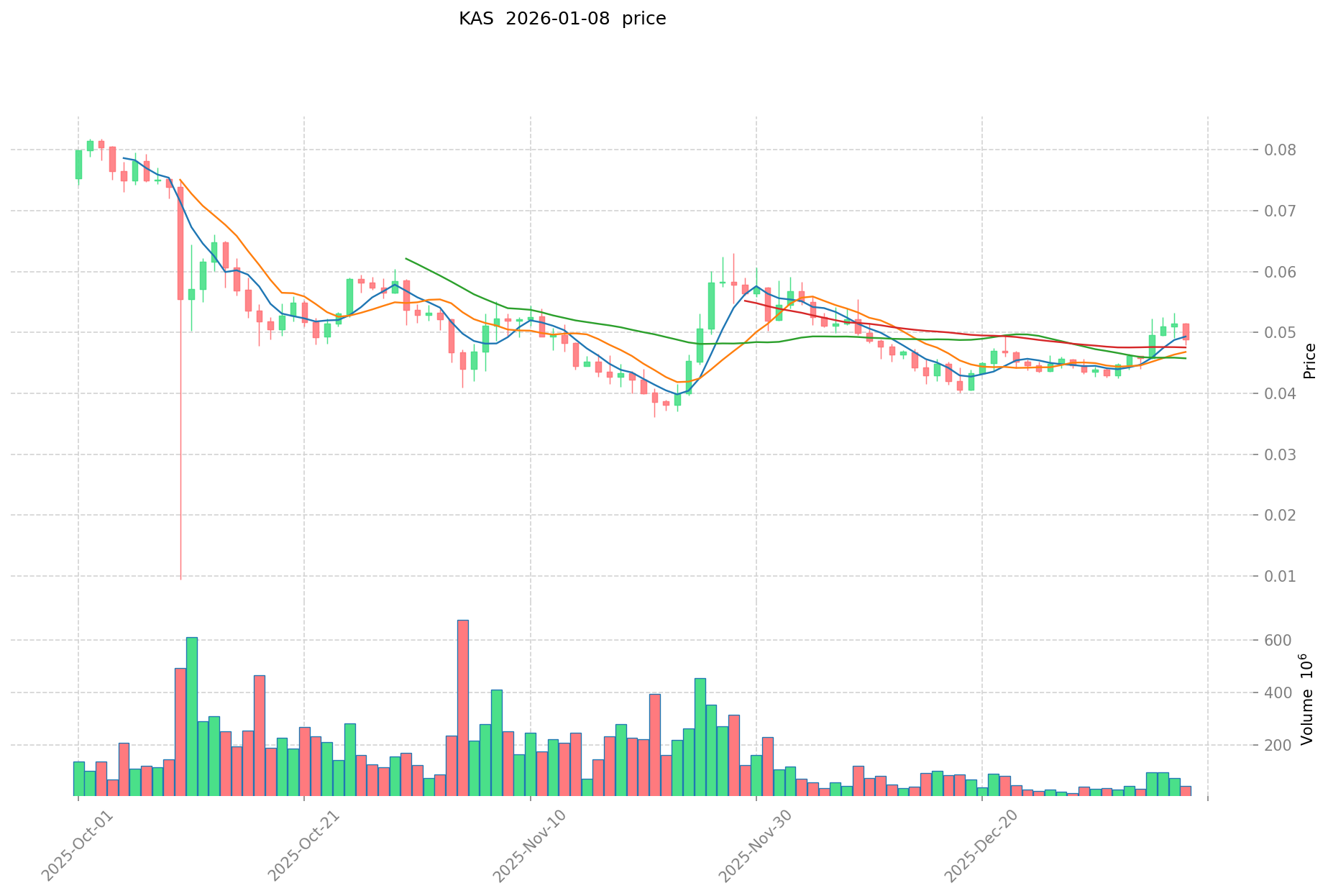 This disconnect between technical progress and market valuation has sparked discussions among analysts and investors about the factors influencing KAS price movements.
The current market conditions suggest that Kaspa's price weakness may be primarily attributed to broader cryptocurrency market dynamics rather than project-specific concerns. Industry analysts emphasize that external market sentiment and macroeconomic factors have played a significant role in suppressing price action across multiple digital assets, with Kaspa being no exception to this trend.
Technical Infrastructure Highlights
Kaspa distinguishes itself through its innovative proof-of-work blockDAG architecture, which represents a significant advancement over traditional blockchain structures. The blockDAG (Directed Acyclic Graph) technology enables parallel block processing, allowing for higher throughput and faster transaction confirmation times compared to conventional linear blockchain designs.
The project incorporates several cutting-edge features that demonstrate its technical sophistication. GhostDAG serves as the consensus mechanism, enabling the network to process multiple blocks simultaneously while maintaining security and decentralization. DagKnight further enhances the protocol's efficiency by optimizing block ordering and conflict resolution. Additionally, vProgs (virtual programs) introduce smart contract functionality to the Kaspa ecosystem, expanding the platform's utility beyond simple value transfers.
These technological components work in concert to create a robust infrastructure that supports high transaction volumes while maintaining the security guarantees of proof-of-work systems. The development team's commitment to advancing these technologies has attracted attention from both technical communities and potential enterprise users.
Liquidation Data Insights
In recent periods, liquidation data analysis from Kaspa Daily has revealed important patterns in market positioning. The data indicates that the majority of liquidity is concentrated above the current price levels, which carries significant implications for potential price movements. This liquidity distribution pattern suggests that downside pressure may be limited, as there are fewer liquidation triggers below current trading ranges.
Financial analyst Andrew J has provided detailed commentary on these market dynamics, noting that the observed price weakness appears disconnected from the project's fundamental trajectory. His analysis suggests that when examining on-chain metrics, development activity, and ecosystem growth indicators, Kaspa demonstrates strong underlying health despite temporary price suppression.
The liquidation data pattern indicates that market participants have positioned themselves with expectations of upward price movement, creating a potential foundation for recovery when broader market conditions become more favorable. This positioning reflects confidence in the project's long-term prospects among informed market participants.
Future Outlook and Recovery Potential
The Kaspa ecosystem continues to demonstrate forward momentum through multiple channels. Industrial pilot programs have begun exploring real-world applications of the blockDAG technology, testing its capabilities in various use cases that could drive future adoption. These pilot initiatives represent important validation of the technology's practical utility beyond speculative trading.
Developer activity within the Kaspa ecosystem has shown consistent growth, with increasing contributions to the codebase and expanding infrastructure development. This rising developer engagement signals healthy ecosystem evolution and suggests that the technical foundation continues to strengthen. The combination of active development, industrial interest, and technological innovation creates a favorable environment for potential price recovery.
Market analysts suggest that when broader cryptocurrency market momentum shifts toward more positive sentiment, projects with strong fundamentals like Kaspa may be well-positioned to benefit from renewed investor interest. The convergence of technological advancement, ecosystem growth, and favorable liquidation patterns could create conditions for KAS price appreciation when market timing aligns with these fundamental strengths.
FAQ
What is Kaspa (KAS)? What are its core technological features?
Kaspa is an innovative cryptocurrency using GhostDAG protocol, a directed acyclic graph (DAG) structure enabling parallel block processing. It achieves high transaction throughput while maintaining security and fast confirmation times, targeting millions of transactions per second for scalable digital payments.
What are Kaspa's advantages compared to Bitcoin and Ethereum?
Kaspa offers faster transaction speeds, lower fees, and instant transactions compared to Bitcoin and Ethereum. Its scalable network design enables efficient daily use while maintaining robust security and decentralization.
What is the current price trend of KAS token? What are the main factors affecting its price?
KAS has declined 3.35% in the past 24 hours, underperforming the broader market. Key factors include weakened technical momentum, profit-taking after recent gains, and rising Bitcoin dominance pressure on altcoins.
What is Kaspa's mining mechanism? Can ordinary users participate in mining?
Kaspa uses Proof-of-Work (PoW) mining. While technically ordinary users can participate, it requires significant capital investment for mining hardware and operational costs. Pool mining offers a more accessible entry point for individual participants.
What risks exist in investing in KAS, and how should one assess its investment value?
KAS investment risks include market volatility and technology uncertainty. Assess value by evaluating Kaspa's technical advantages, transaction speed, community growth, and ecosystem expansion. Strong fundamentals suggest potential for significant long-term price appreciation as adoption increases.
Kaspa生态发展现状如何?有哪些主要应用场景?
Kaspa ecosystem has grown significantly with BlockDAG technology and KRC-20 protocol. Main applications include industrial mining (Marathon Digital), renewable energy trading via Desert Energy Initiative, and carbon emission rights markets. KEF Katalyst Program invests 10 million dollars in ecosystem development, supporting smart contracts and decentralized applications.
What are the main driving factors for potential KAS price recovery?
KAS price recovery is primarily driven by increased user activity, improved exchange liquidity, and ecosystem developments. Whale transfers, technological upgrades, and positive market sentiment also play significant roles in potential price appreciation.
How is Kaspa's competitiveness compared to other Layer 1 blockchain projects?
Kaspa demonstrates strong competitiveness through its innovative GHOSTDAG consensus mechanism, enabling high throughput and scalability. While smaller in market cap than leading Layer 1s, Kaspa's rising rankings reflect growing investor confidence in its technical superiority and real-world performance capabilities.
* The information is not intended to be and does not constitute financial advice or any other recommendation of any sort offered or endorsed by Gate.