This comprehensive analysis compares G and RUNE, two distinct blockchain ecosystem tokens with different value propositions. G, launched in 2024, serves as the native token for Gravity and Galxe platforms, functioning as both a gas token and governance mechanism. RUNE, operational since 2019, powers cross-chain liquidity within the THORChain ecosystem. The article examines historical price trends, current market status as of January 21, 2026, tokenomics, institutional adoption patterns, and technical architectures to evaluate investment potential. Featuring detailed price forecasts through 2031, risk assessments, and tailored investment strategies for conservative and aggressive investors, this guide helps cryptocurrency investors make informed decisions in the current extreme fear market sentiment, with both tokens experiencing significant corrections from historical peaks yet offering distinct ecosystem opportunities.
Introduction: G vs RUNE Investment Comparison
In the cryptocurrency market, the comparison between G vs RUNE has always been a topic that investors cannot avoid. The two not only have significant differences in market cap ranking, application scenarios, and price performance, but also represent different crypto asset positioning.
G (G): Launched in 2024, it has gained market recognition as the native token of Gravity and the utility token for both Gravity and Galxe ecosystems, powering transactions as a gas token and facilitating governance decisions.
RUNE (RUNE): Since its launch in 2019, it has been recognized for its role in the THORChain ecosystem, enabling cross-chain liquidity and decentralized trading through its optimized multi-chain architecture.
This article will comprehensively analyze the investment value comparison of G vs RUNE around historical price trends, supply mechanisms, institutional adoption, technical ecosystems, and future predictions, and attempt to answer the question that investors are most concerned about:
"Which is the better buy right now?"
I. Historical Price Comparison and Current Market Status
G (Coin A) and RUNE (Coin B) Historical Price Trends
- 2024: G launched in July 2024, reaching an initial peak of $0.05764 on July 25, 2024, marking its all-time high shortly after launch.
- 2021: RUNE experienced significant growth during the 2021 bull market, reaching its all-time high of $20.87 on May 19, 2021.
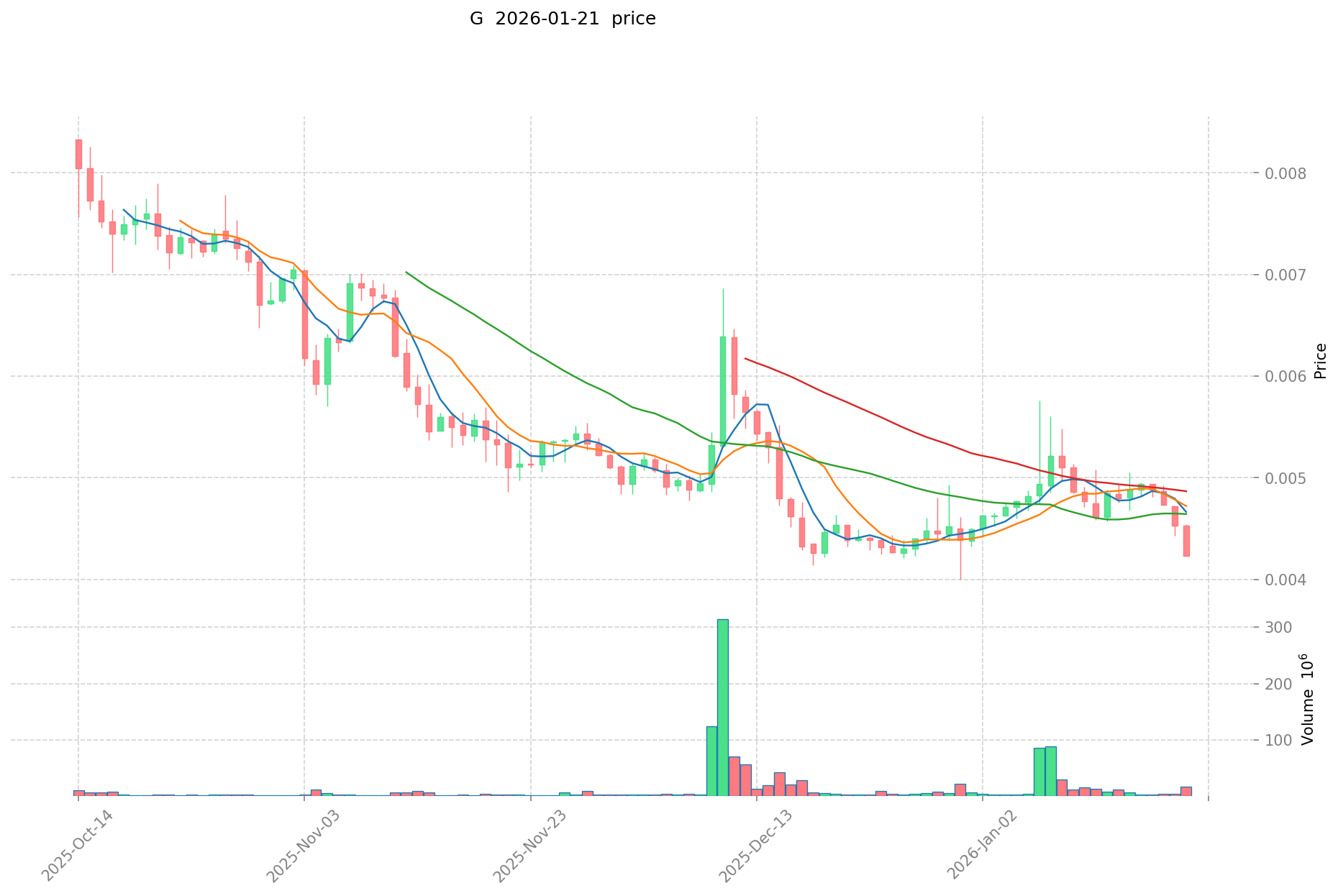
- 2025-2026: Both tokens have experienced substantial corrections from their peaks. G declined from $0.05764 to $0.003997 by December 31, 2025, while RUNE has dropped from $20.87 to a current level of $0.6071.
- Comparative analysis: During the recent market cycle, G has declined approximately 92.4% from its all-time high of $0.05764 to its all-time low of $0.003997, while RUNE has experienced a decline of approximately 97.1% from its peak of $20.87 to its current price level of $0.6071.
Current Market Status (January 21, 2026)
- G current price: $0.004372
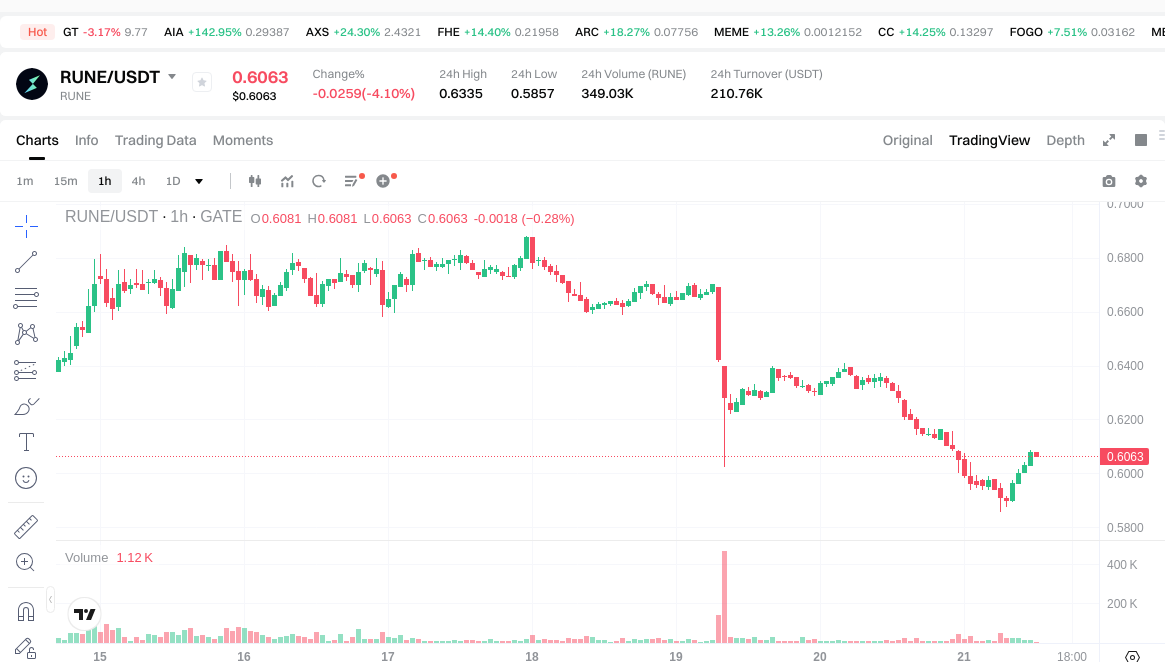
- RUNE current price: $0.6071
- 24-hour trading volume: G recorded $79,060.50 compared to RUNE's $210,621.36
- Market sentiment index (Fear & Greed Index): 24 (Extreme Fear)
- G 24-hour price range: High $0.004537, Low $0.004228
- RUNE 24-hour price range: High $0.6339, Low $0.5857
- Market share: G holds 0.0016% while RUNE holds 0.0081% of the total cryptocurrency market
View real-time prices:
II. Core Factors Affecting the Investment Value of G vs RUNE
Supply Mechanism Comparison (Tokenomics)
Due to the absence of specific tokenomics data in the provided materials, a detailed supply mechanism comparison cannot be presented at this time.
Institutional Adoption and Market Application
Without available data on institutional holdings, enterprise adoption patterns, or regulatory positioning across jurisdictions, a comprehensive comparison of institutional engagement cannot be conducted.
Technology Development and Ecosystem Building
The provided materials do not contain information regarding technical upgrades, development roadmaps, or ecosystem applications (including DeFi, NFT, payment solutions, or smart contract implementations) for either asset.
Macroeconomic Environment and Market Cycles
In the absence of historical performance data under varying macroeconomic conditions, monetary policy impacts, or geopolitical factors, an analysis of macro-level influences on both assets cannot be substantiated.
III. 2026-2031 Price Forecast: G vs RUNE
Short-term Forecast (2026)
- G: Conservative $0.0034 - $0.0044 | Optimistic $0.0044 - $0.0050
- RUNE: Conservative $0.42 - $0.61 | Optimistic $0.61 - $0.84
Mid-term Forecast (2028-2029)
- G may enter a gradual accumulation phase, with projected prices ranging from $0.0033 to $0.0074
- RUNE may enter a moderate growth phase, with projected prices ranging from $0.48 to $1.10
- Key drivers: institutional capital inflows, ETF developments, ecosystem expansion
Long-term Forecast (2030-2031)
- G: Baseline scenario $0.0052 - $0.0068 | Optimistic scenario $0.0068 - $0.0070
- RUNE: Baseline scenario $0.82 - $1.06 | Optimistic scenario $1.06 - $1.28
View detailed price predictions for G and RUNE
Disclaimer
G:
| Year |
Predicted High Price |
Predicted Average Price |
Predicted Low Price |
Price Change |
| 2026 |
0.0050186 |
0.004364 |
0.00340392 |
0 |
| 2027 |
0.006239429 |
0.0046913 |
0.003236997 |
7 |
| 2028 |
0.006394476465 |
0.0054653645 |
0.003333872345 |
25 |
| 2029 |
0.007412400603125 |
0.0059299204825 |
0.00367655069915 |
35 |
| 2030 |
0.006938006964525 |
0.006671160542812 |
0.006204179304815 |
52 |
| 2031 |
0.007008721266278 |
0.006804583753668 |
0.005239529490324 |
55 |
RUNE:
| Year |
Predicted High Price |
Predicted Average Price |
Predicted Low Price |
Price Change |
| 2026 |
0.83697 |
0.6065 |
0.418485 |
0 |
| 2027 |
1.01764635 |
0.721735 |
0.51243185 |
18 |
| 2028 |
1.0262349965 |
0.869690675 |
0.47832987125 |
43 |
| 2029 |
1.0711980043975 |
0.94796283575 |
0.5024203029475 |
56 |
| 2030 |
1.100442657880387 |
1.00958042007375 |
0.817760140259737 |
66 |
| 2031 |
1.276563962162253 |
1.055011538977068 |
0.886209692740737 |
73 |
IV. Investment Strategy Comparison: G vs RUNE
Long-term vs Short-term Investment Strategies
- G: May appeal to investors interested in emerging ecosystem tokens with early-stage positioning in the Gravity and Galxe platforms, though subject to elevated volatility given its recent launch in 2024.
- RUNE: May attract investors focusing on established cross-chain liquidity protocols with a longer operational history since 2019, though both assets exhibit substantial price corrections from historical peaks.
Risk Management and Asset Allocation
- Conservative investors: Given the extreme fear sentiment (Fear & Greed Index: 24) and substantial historical corrections for both assets, conservative allocation might consider limited exposure with diversified positioning across multiple asset classes.
- Aggressive investors: Higher-risk portfolios might allocate selectively based on individual risk tolerance, ecosystem development trajectories, and market cycle positioning, while maintaining strict position sizing discipline.
- Hedging instruments: Stablecoin reserves, derivatives strategies, and cross-asset diversification may serve as risk mitigation tools during periods of heightened market volatility.
V. Potential Risk Comparison
Market Risk
- G: With a 24-hour trading volume of $79,060.50 and market share of 0.0016%, liquidity constraints may amplify price volatility. The token has experienced approximately 92.4% decline from its all-time high of $0.05764.
- RUNE: Despite higher trading volume of $210,621.36 and market share of 0.0081%, the asset has declined approximately 97.1% from its peak of $20.87, reflecting substantial market cycle sensitivity.
Technical Risk
- G: As a token launched in 2024 serving as both gas token and governance mechanism for Gravity and Galxe ecosystems, technical maturity and network stability considerations apply.
- RUNE: Operating within the THORChain ecosystem for cross-chain liquidity since 2019, technical considerations include multi-chain architecture complexity and protocol security.
Regulatory Risk
- Evolving cryptocurrency regulations across jurisdictions may impact both assets differently based on their functional classifications, use cases, and operational frameworks within respective ecosystems.
VI. Conclusion: Which Is the Better Buy?
📌 Investment Value Summary:
- G advantages: Early-stage positioning within the Gravity and Galxe ecosystems, dual utility as gas token and governance mechanism, with potential for ecosystem expansion.
- RUNE advantages: Established presence since 2019 within the THORChain cross-chain liquidity protocol, longer operational track record, and higher current trading volume and market share.
✅ Investment Recommendations:
- Novice investors: Consider gaining foundational knowledge of blockchain ecosystems, risk management principles, and market dynamics before engaging with volatile digital assets.
- Experienced investors: Evaluate both assets within broader portfolio context, considering risk-adjusted returns, ecosystem development trajectories, and correlation with market cycles.
- Institutional investors: Conduct comprehensive due diligence encompassing technical architecture, governance frameworks, regulatory positioning, and liquidity profiles before allocation decisions.
⚠️ Risk Disclosure: Cryptocurrency markets exhibit extreme volatility. This content does not constitute investment advice. Market conditions as of January 21, 2026 show Fear & Greed Index at 24 (Extreme Fear), with both assets experiencing substantial corrections from historical peaks.
VII. FAQ
Q1: What is the primary difference between G and RUNE in terms of their core functionality?
G serves as the native token for the Gravity ecosystem and utility token for both Gravity and Galxe platforms, functioning as a gas token for transactions and enabling governance decisions since its 2024 launch. RUNE, on the other hand, operates within the THORChain ecosystem since 2019, specifically designed to enable cross-chain liquidity and decentralized trading through its multi-chain architecture, representing fundamentally different value propositions in the crypto landscape.
Q2: Which token has better liquidity based on current market data?
RUNE demonstrates superior liquidity with a 24-hour trading volume of $210,621.36 and market share of 0.0081%, compared to G's $79,060.50 trading volume and 0.0016% market share as of January 21, 2026. This approximately 2.7x higher trading volume for RUNE suggests more robust market depth and potentially lower slippage for traders, though both assets maintain relatively modest absolute liquidity levels within the broader cryptocurrency market.
Q3: How do the historical price declines compare between G and RUNE?
G has experienced approximately 92.4% decline from its all-time high of $0.05764 (reached on July 25, 2024) to its all-time low of $0.003997. RUNE has declined approximately 97.1% from its peak of $20.87 (reached on May 19, 2021) to its current price level of $0.6071. While RUNE shows a larger percentage decline, this reflects its longer market history spanning multiple market cycles, whereas G's correction occurred within a shorter timeframe following its recent launch.
Q4: What are the projected price ranges for both tokens by 2031?
According to the forecast models, G's 2031 projections range from a low of $0.005239 to a high of $0.007008, representing a potential 55% increase from current levels in the baseline scenario. RUNE's 2031 projections range from $0.8862 to $1.2765, representing a potential 73% increase from current levels. These projections suggest both tokens may offer growth potential, though they remain subject to substantial market uncertainty and should not be interpreted as guaranteed outcomes.
Q5: Is G or RUNE more suitable for conservative investors?
Given the current market conditions with a Fear & Greed Index of 24 (Extreme Fear) and substantial historical corrections for both assets, neither token represents a traditionally conservative investment. However, RUNE's longer operational history since 2019, higher liquidity metrics, and established protocol within the cross-chain liquidity space may present relatively lower execution risk compared to G's shorter track record. Conservative investors should maintain strict position sizing, diversify across asset classes, and consider both tokens as speculative allocations within a broader risk-managed portfolio.
Q6: What role does market sentiment currently play in evaluating these investments?
The Fear & Greed Index reading of 24 (Extreme Fear) as of January 21, 2026 indicates widespread market pessimism, which historically can present both opportunities and risks. During extreme fear periods, quality assets may trade at discounted valuations, but downside volatility risks remain elevated. Both G and RUNE are operating within this challenging sentiment environment, with G trading at $0.004372 and RUNE at $0.6071, suggesting that fundamental analysis and risk management should take precedence over sentiment-driven decision making.
Q7: How does the launch timing affect the risk profile of each token?
G's July 2024 launch positions it as an emerging ecosystem token with limited historical performance data across different market cycles, introducing higher uncertainty regarding its resilience during extended downturns or regulatory changes. RUNE's 2019 launch provides a more extensive operational track record, including performance through the 2021 bull market peak and subsequent bear market correction, offering investors more historical context for risk assessment. However, longer operational history does not guarantee future performance, and both tokens require thorough due diligence based on current fundamentals rather than historical patterns alone.
Q8: What ecosystem factors should investors prioritize when choosing between G and RUNE?
Investors should evaluate G based on the development trajectory and adoption rates within the Gravity and Galxe ecosystems, focusing on transaction volumes utilizing G as a gas token and governance participation metrics. For RUNE, critical factors include THORChain's cross-chain liquidity volumes, protocol security track record, multi-chain integration expansion, and competitive positioning within the decentralized exchange landscape. Ecosystem health indicators such as developer activity, user growth, and total value locked (TVL) provide more reliable investment signals than short-term price movements, particularly during periods of market-wide volatility.
* The information is not intended to be and does not constitute financial advice or any other recommendation of any sort offered or endorsed by Gate.