This article examines Gemini co-founder Cameron Winklevoss's assertion that Bitcoin below $90,000 represents a critical buying opportunity as the cryptocurrency has declined from its October peak above $126,000. The analysis covers multiple market dynamics: macroeconomic pressures including government shutdown and trade tensions; whale positioning showing short exposure exceeding longs; significant Bitcoin ETF outflows; and derivatives market hedging activity around support levels. Institutional participation, exemplified by MicroStrategy's continued accumulation of 8,178 Bitcoin at $102,171 average, demonstrates sustained investor confidence. The article highlights how Bitcoin now behaves as a traditional macro asset correlated with broader financial markets, with technical support at $93,000 and resistance at $100,000 serving as key indicators. Market participants on Gate and other platforms remain divided on whether current levels signal a healthy correction or deeper bear market, with deeper pullbacks his
Gemini co-founder Cameron Winklevoss recently told investors that he believes Bitcoin under $90,000 may represent a last chance to buy at this price level, as the leading cryptocurrency slipped below that threshold and erased its gains from early 2025. This statement has reignited debate about the current market cycle and whether Bitcoin has entered a prolonged correction phase or is simply experiencing a healthy pullback before the next leg up.
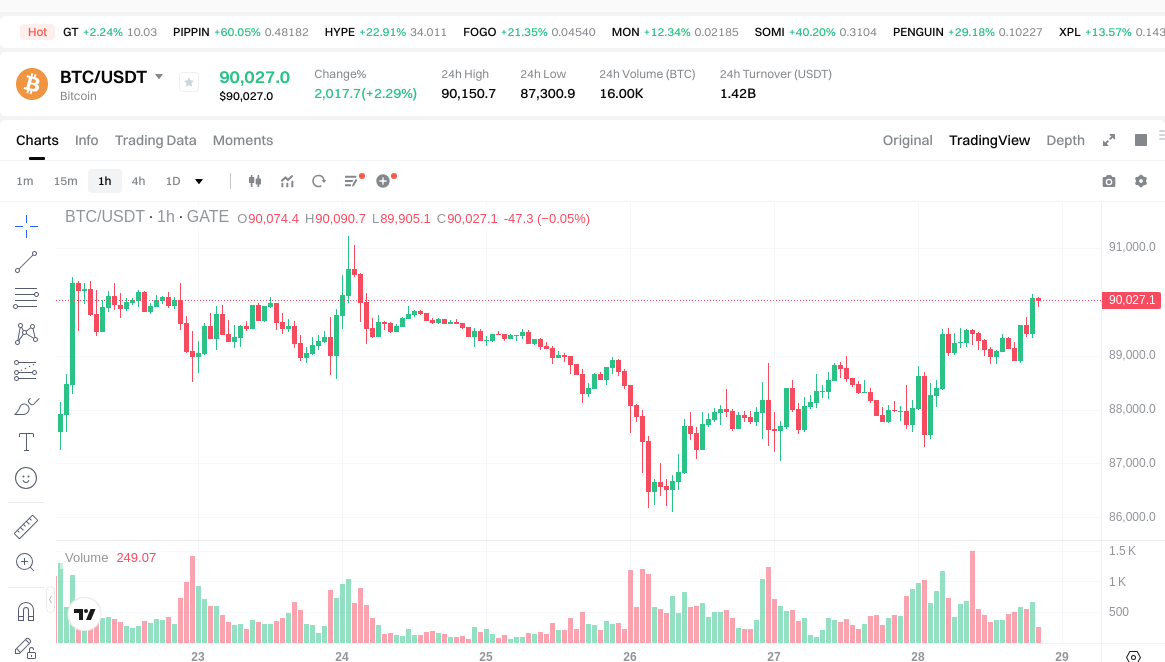
Bitcoin has experienced a significant correction from its record high above $126,000 reached in early October to the low $90,000 range in recent weeks. This sharp decline has wiped approximately $600 billion from Bitcoin's total market capitalization, taking prices back to levels last seen seven months earlier. The magnitude of this correction has revived familiar bull and bear arguments across cryptocurrency trading desks, with market participants divided on whether this represents a buying opportunity or the beginning of a deeper bear market.
On one side of the debate, traders point to what they describe as cycle panic, noting that the sell-off lacks a single clear headline trigger. Many market observers have fallen back on the traditional four-year halving playbook to explain the current price action, even as the increasing presence of deep institutional flows makes that historical framework less applicable than in earlier market eras. The cryptocurrency market has evolved significantly since previous cycles, with institutional participation fundamentally changing market dynamics and liquidity patterns.
Government Shutdown And Trade Tensions Add Pressure To Crypto
Macroeconomic conditions have formed a challenging backdrop for cryptocurrency markets in recent months. A prolonged government shutdown, persistent trade war concerns, and weakened global liquidity have collectively weighed on risk assets across financial markets, leaving cryptocurrency particularly exposed to swings in dollar strength, interest rate expectations, and global growth sentiment. These macro headwinds have contributed to increased volatility in Bitcoin and broader cryptocurrency markets.
Analysts increasingly observe that Bitcoin now trades more like a traditional macro asset than a purely supply-driven commodity, responding to the same economic indicators and policy decisions that move stocks, bonds, and currencies. This evolution reflects Bitcoin's growing integration into the broader financial system, as institutional investors treat it as part of their overall portfolio allocation rather than as a separate asset class. The correlation between Bitcoin and traditional risk assets has strengthened notably over the past year, suggesting that cryptocurrency markets can no longer be analyzed in isolation from global economic conditions.
Leverage has significantly amplified the recent price volatility. Bitcoin sold off sharply after approximately $19 billion in leveraged positions were liquidated in recent weeks, a massive flush that was further amplified by long-term holders taking profits near the cycle peak. This combination of forced liquidations and voluntary profit-taking created intense selling pressure that overwhelmed available buying support. The current correction timeline aligns with the historical window when Bitcoin has often peaked in past market cycles, typically occurring between 400 and 600 days after a halving event, with the most recent halving occurring in April 2024.
Whale Shorts Now Outpace Longs As ETF Outflows Deepen
On-chain data from late 2024 reveals significant movement among large Bitcoin holders, commonly referred to as whales in cryptocurrency markets. A Bitunix analyst identified clusters of wallets holding more than 1,000 Bitcoin executing concentrated sales during this period, pushing the price from below $100,000 toward $97,000. Both exchange data and derivatives market indicators point to synchronized selling pressure from these large holders, suggesting coordinated distribution rather than random profit-taking.
The analysis noted that whale short exposure now significantly exceeds long positions, with on-chain metrics showing approximately $2.17 billion in short positions versus $1.18 billion in long positions. This bearish positioning among sophisticated market participants suggests that large holders are betting on further price declines in the near term. Additionally, Bitcoin exchange-traded funds have experienced several consecutive weeks of net outflows, totaling several billion dollars over a period of several weeks, indicating that institutional investors are reducing their cryptocurrency exposure.
Derivatives traders have been actively buying protection through put options around the $90,000 to $95,000 price area, signaling strong demand for downside hedges at these lower levels. This options market activity suggests that professional traders are preparing for the possibility of additional price declines, even as some view current levels as a potential buying opportunity. The concentration of put option interest at these strike prices indicates that $90,000 represents a psychologically important support level for many market participants.
Reports from prominent blockchain analytics firms such as Glassnode and MarketVector have characterized the recent price action as "scheduled distribution" by long-term holders rather than panic liquidation. However, these same firms stress that the market's ability to absorb this supply has weakened considerably compared to earlier periods. The combination of Bitcoin ETF redemptions and slower institutional allocation means that similar waves of selling can now drive sharper price moves and trigger more cascading liquidations than would have occurred in previous market cycles when institutional participation was less significant.
Deep Pullbacks Have Often Preceded Higher Highs In Bitcoin's History
From a technical analysis perspective, market analysts are closely watching $100,000 as a key resistance level and $93,000 as critical support. A sustained break above $100,000 would likely attract renewed buying interest and potentially trigger short covering, while a decisive move below $93,000 could accelerate selling pressure and lead to a test of lower support levels. These price levels have emerged as important psychological barriers based on recent trading patterns and order book depth.
Bitunix and other market analysis firms view whale wallet flows, ETF trends, and options market positioning as the primary signals to monitor for signs of market direction. A coordinated turn in all three indicators, accompanied by stronger spot market inflows, easing short exposure among large holders, and calmer implied volatility in options markets, would suggest that genuine demand is returning to the market rather than temporary short covering. Until such confirmation appears, market participants remain cautious about calling a definitive bottom.
Despite the challenging market conditions, institutional buyers continue to accumulate Bitcoin in the background. MicroStrategy disclosed in a recent announcement that it had purchased an additional 8,178 Bitcoin at an average price of $102,171, spending approximately $835 million and further expanding a balance sheet position that already makes it one of the largest corporate holders of the cryptocurrency. This continued accumulation by a prominent publicly-traded company demonstrates that some institutional investors view current price levels as attractive entry points for long-term holdings.
Cameron Winklevoss' assertion that this period could represent the last chance to buy Bitcoin below $90,000 speaks to a familiar theme in cryptocurrency markets: that deep drawdowns and corrections are often part of the path to achieving higher price peaks over longer time horizons. However, the route to those potential higher prices appears increasingly dependent on global liquidity conditions, monetary policy decisions, and institutional adoption rates, rather than solely on predictable halving cycles and on-chain supply dynamics that characterized earlier market eras. As Bitcoin continues to mature as an asset class, its price action reflects a complex interplay of traditional financial market forces and cryptocurrency-specific factors, making simple historical comparisons less reliable as predictive tools.
FAQ
Why does Cameron Winklevoss consider Bitcoin below $90K a buying opportunity?
Cameron Winklevoss views Bitcoin below $90K as undervalued relative to its long-term potential and market fundamentals. He believes strategic purchases during price dips present attractive entry points for investors seeking exposure to Bitcoin's future growth.
What is Bitcoin's current price trend and how does it compare to its historical high?
Bitcoin is trading near 100,000 USD, surpassing its 2021 historical high of approximately 68,789 USD. This represents significant market progress and demonstrates strong upward momentum in the current cycle.
What are the main risks of investing in Bitcoin in the current market environment?
Bitcoin investment risks include extreme price volatility due to market sentiment swings, regulatory uncertainty from evolving government policies, and intense competition from alternative cryptocurrencies. These factors can cause significant price fluctuations and potential losses for investors.
Gemini创始人对比特币未来价格的预期是什么?
Gemini创始人预测比特币价格将达百万美元,认为市场仍处于早期阶段,具有巨大增长潜力。
How do institutional investors view the current Bitcoin price level?
Most institutional investors believe Bitcoin is undervalued at $85,000-$95,000. Around 71% see current valuations as low, with 80% planning to hold or buy more if prices drop 10% further. Anticipated monetary easing in 2026 strengthens their bullish outlook on Bitcoin's long-term potential.
* The information is not intended to be and does not constitute financial advice or any other recommendation of any sort offered or endorsed by Gate.