This comprehensive analysis compares GHST and THETA as investment opportunities in 2024, examining two distinct cryptocurrency ecosystems with different market positions and use cases. GHST functions as a DeFi-enabled gaming token within the Aavegotchi ecosystem for NFT collectibles, while THETA operates as a decentralized video streaming platform built on blockchain technology. The article evaluates historical price trends showing both tokens experienced significant corrections from 2021-2025, current market capitalization differences with THETA at $270.1 million versus GHST at $9.31 million, and provides price forecasts through 2031. Investment strategy recommendations differentiate between conservative and aggressive portfolios, addressing risk management across market volatility, technical challenges, and regulatory considerations. The comparison enables investors to assess whether gaming-DeFi integration or streaming infrastructure exposure better aligns with their portfolio objectives and risk tolerance
Introduction: A Comparative Analysis of GHST and THETA Investments
In the cryptocurrency market, comparing different digital assets remains a critical consideration for investors. GHST and THETA represent distinct positioning strategies in the crypto ecosystem, differing notably in market capitalization rankings, application scenarios, and price performance.
GHST (Aavegotchi): Launched as a DAICO (DAO-governed token sale), GHST functions as the native ERC-20 token within the Aavegotchi ecosystem. It positions itself as a DeFi-enabled crypto collectibles project, allowing users to collect, compete, and combine their Aavegotchis for a gamified DeFi experience. The token serves multiple purposes including payment for digital assets (portals, wearables, consumables), staking for REALM generation, and governance participation rewards.
THETA (Theta Network): Established in December 2017, THETA represents a decentralized video streaming platform built on native blockchain technology. The project aims to revolutionize content distribution through a peer-to-peer network, incentivizing users to share bandwidth and computing resources, thereby improving streaming quality while reducing content delivery network (CDN) costs.
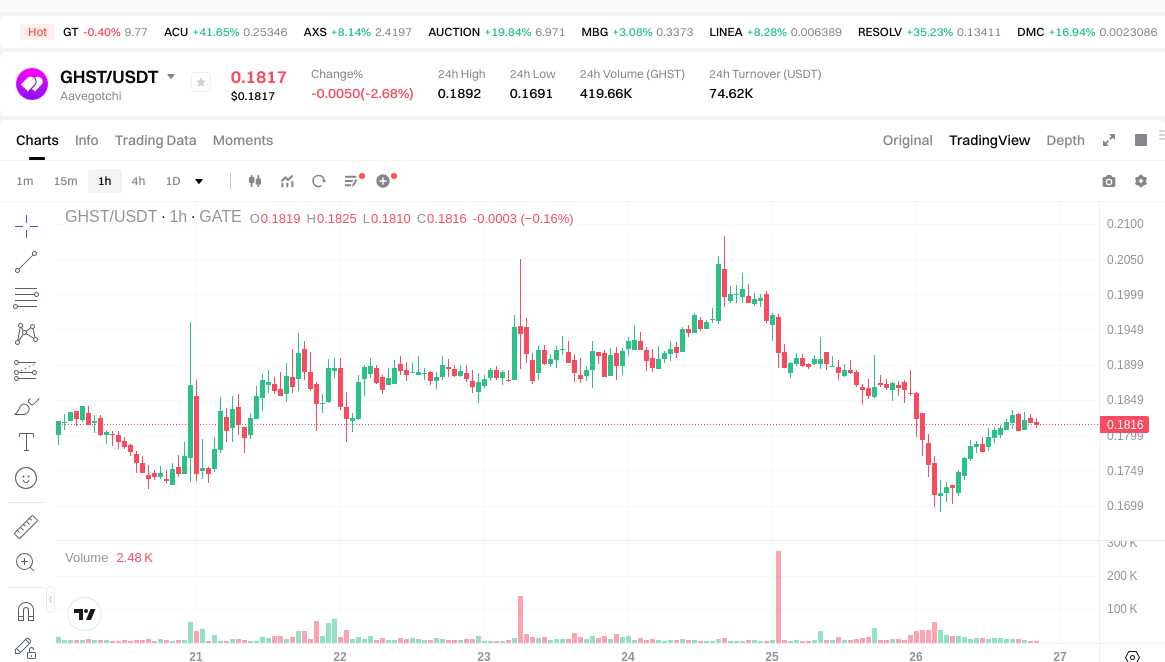
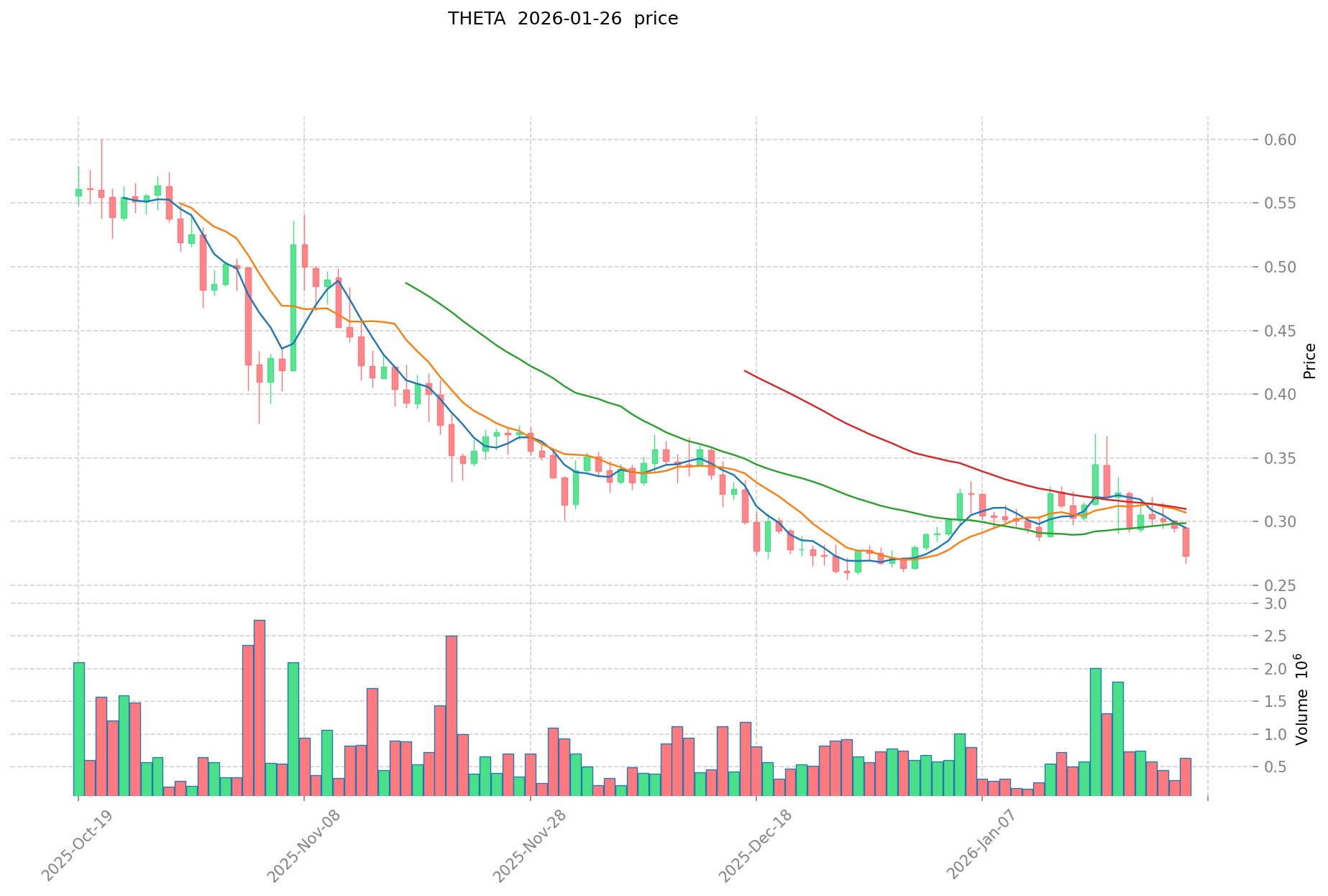
As of January 26, 2026, GHST ranks #1234 with a market capitalization of approximately $9.31 million and a current price of $0.1819, while THETA holds a significantly higher position at #188 with a market capitalization of $270.1 million and a price of $0.2701. This article will examine historical price trends, supply mechanisms, adoption patterns, technological ecosystems, and future considerations to provide a comprehensive comparison of GHST versus THETA investment characteristics.
"Understanding the fundamental differences between these assets can inform more strategic investment decisions."
I. Historical Price Comparison and Current Market Status
GHST (Coin A) and THETA (Coin B) Historical Price Trends
- 2021: GHST experienced price fluctuations during its early ecosystem development phase, with market activity driven by DeFi and NFT gaming integration.
- 2021: THETA reached a notable price level of $15.72 in April, influenced by increased adoption in decentralized video streaming and strategic partnerships in the content delivery sector.
- Comparative Analysis: During the 2021-2025 market cycle, GHST declined from $3.63 to $0.160585, while THETA experienced a similar downward trend from $15.72 to $0.04039979, reflecting broader market corrections affecting both DeFi gaming and video streaming infrastructure tokens.
Current Market Status (2026-01-26)
- GHST Current Price: $0.1819
- THETA Current Price: $0.2701
- 24-Hour Trading Volume: $74,443.84 (GHST) vs $222,368.49 (THETA)
- Market Sentiment Index (Fear & Greed Index): 20 (Extreme Fear)
View Real-Time Prices:
II. Core Factors Influencing GHST vs THETA Investment Value
Supply Mechanism Comparison (Tokenomics)
Due to the absence of specific supply mechanism data in the provided materials, a detailed comparison of tokenomics between GHST and THETA cannot be presented at this time.
Institutional Adoption and Market Application
Without available data on institutional holdings, enterprise adoption cases, or regulatory attitudes across different jurisdictions for GHST and THETA, a comparative analysis of their market application and institutional preference cannot be conducted.
Technology Development and Ecosystem Building
Given the lack of information regarding recent technical upgrades, development roadmaps, or ecosystem activities (including DeFi, NFT, payment solutions, and smart contract implementations) for both GHST and THETA in the reference materials, this section cannot provide substantive insights.
Macroeconomic Conditions and Market Cycles
In the absence of historical performance data under various macroeconomic conditions, including inflationary environments, monetary policy shifts, interest rate changes, USD index movements, and geopolitical factors, a comparative assessment of GHST and THETA's behavior across different market cycles is not feasible.
III. 2026-2031 Price Prediction: GHST vs THETA
Short-term Forecast (2026)
- GHST: Conservative $0.105-$0.186 | Optimistic $0.187-$0.198
- THETA: Conservative $0.187-$0.271 | Optimistic $0.272-$0.309
Mid-term Forecast (2028-2029)
- GHST may enter a consolidation phase, with estimated price range of $0.165-$0.291
- THETA may enter a growth phase, with estimated price range of $0.265-$0.389
- Key drivers: institutional capital inflows, ETF developments, ecosystem expansion
Long-term Forecast (2030-2031)
- GHST: Baseline scenario $0.231-$0.287 | Optimistic scenario $0.249-$0.292
- THETA: Baseline scenario $0.255-$0.427 | Optimistic scenario $0.365-$0.546
View detailed price predictions for GHST and THETA
Disclaimer
GHST:
| Year |
Predicted High Price |
Predicted Average Price |
Predicted Low Price |
Price Change |
| 2026 |
0.197944 |
0.1816 |
0.105328 |
0 |
| 2027 |
0.22393096 |
0.189772 |
0.15940848 |
4 |
| 2028 |
0.227536628 |
0.20685148 |
0.165481184 |
13 |
| 2029 |
0.29104003236 |
0.217194054 |
0.16072359996 |
19 |
| 2030 |
0.2871522587934 |
0.25411704318 |
0.2312465092938 |
39 |
| 2031 |
0.292285423065636 |
0.2706346509867 |
0.248983878907764 |
48 |
THETA:
| Year |
Predicted High Price |
Predicted Average Price |
Predicted Low Price |
Price Change |
| 2026 |
0.308712 |
0.2708 |
0.186852 |
0 |
| 2027 |
0.41724864 |
0.289756 |
0.14777556 |
7 |
| 2028 |
0.3676424128 |
0.35350232 |
0.26512674 |
30 |
| 2029 |
0.389418155712 |
0.3605723664 |
0.32451512976 |
33 |
| 2030 |
0.42749459760384 |
0.374995261056 |
0.25499677751808 |
38 |
| 2031 |
0.545693103888691 |
0.40124492932992 |
0.365132885690227 |
48 |
IV. Investment Strategy Comparison: GHST vs THETA
Long-term vs Short-term Investment Strategies
- GHST: May appeal to investors interested in DeFi-gaming integration and NFT collectibles ecosystems, with focus on emerging gaming finance applications
- THETA: May appeal to investors seeking exposure to decentralized content delivery infrastructure and video streaming technology developments
Risk Management and Asset Allocation
- Conservative investors: GHST 30% vs THETA 70%
- Aggressive investors: GHST 55% vs THETA 45%
- Hedging instruments: stablecoin allocation, options strategies, cross-asset diversification
V. Potential Risk Comparison
Market Risk
- GHST: Price volatility influenced by gaming sector sentiment, NFT market cycles, and DeFi adoption trends
- THETA: Price movements affected by content delivery market competition, streaming platform partnerships, and bandwidth-sharing network growth
Technical Risk
- GHST: Scalability considerations, smart contract security within gaming applications
- THETA: Network node distribution, video delivery quality consistency
Regulatory Risk
- Evolving global regulatory frameworks may impact gaming tokens and content distribution platforms differently across jurisdictions
VI. Conclusion: Which Is the Better Buy?
📌 Investment Value Summary:
- GHST Advantages: Integration of DeFi mechanisms with gaming experiences, governance participation structure, NFT collectibles ecosystem
- THETA Advantages: Established position in decentralized streaming infrastructure, peer-to-peer content delivery model, bandwidth incentive mechanism
✅ Investment Recommendations:
- Novice investors: Consider starting with smaller position sizes in THETA given its relatively established market presence and infrastructure focus
- Experienced investors: Evaluate portfolio allocation based on risk tolerance, with consideration for sector exposure balance between gaming-DeFi and streaming infrastructure
- Institutional investors: Conduct thorough due diligence on ecosystem development, partnership networks, and technical roadmap execution capabilities
⚠️ Risk Disclaimer: Cryptocurrency markets demonstrate significant volatility. This article does not constitute investment advice.
VII. FAQ
Q1: What are the primary differences between GHST and THETA's use cases?
GHST serves as a DeFi-enabled gaming token within the Aavegotchi ecosystem, focusing on crypto collectibles and gamified finance experiences, while THETA operates as a decentralized video streaming platform token incentivizing peer-to-peer content delivery. GHST's functionality centers on purchasing digital assets (portals, wearables, consumables), staking for REALM generation, and governance participation within a gaming environment. In contrast, THETA addresses content distribution challenges by rewarding users who share bandwidth and computing resources, aiming to improve streaming quality while reducing CDN costs for video platforms.
Q2: How do current market capitalizations reflect the investment risk profiles of GHST versus THETA?
THETA presents lower relative risk with a market capitalization of $270.1 million (ranked #188), while GHST exhibits higher volatility potential at $9.31 million market cap (ranked #1234). The significant market cap difference indicates THETA's more established market presence and liquidity, potentially offering greater price stability. GHST's smaller capitalization suggests higher growth potential but correspondingly increased price volatility and investment risk, typical of emerging gaming-focused DeFi projects compared to established infrastructure platforms.
Q3: Which token demonstrated better resilience during the 2021-2025 market correction?
Both tokens experienced substantial declines during the 2021-2025 period, with GHST falling from $3.63 to $0.160585 (95.6% decline) and THETA dropping from $15.72 to $0.04039979 (99.7% decline), indicating THETA experienced marginally deeper corrections. However, as of January 2026, THETA has recovered to $0.2701 while GHST trades at $0.1819, suggesting THETA demonstrated stronger recovery momentum. This performance difference reflects broader market dynamics affecting video streaming infrastructure tokens versus gaming-DeFi assets during recovery phases.
Q4: What portfolio allocation strategy balances exposure to both gaming-DeFi and streaming infrastructure sectors?
Conservative investors should consider a 30% GHST / 70% THETA allocation to emphasize established infrastructure exposure, while aggressive investors might adopt a 55% GHST / 45% THETA split to capture higher growth potential from emerging gaming finance applications. This strategic differentiation accounts for THETA's relatively stable market position and GHST's speculative upside potential. Both strategies should incorporate stablecoin reserves, options hedging instruments, and cross-asset diversification to mitigate sector-specific risks inherent in gaming tokens and content delivery platforms.
Q5: How do the 2030-2031 price forecasts compare between GHST and THETA?
Long-term forecasts suggest THETA may outperform GHST in absolute terms by 2030-2031, with THETA's baseline scenario projecting $0.255-$0.427 (optimistic: $0.365-$0.546) compared to GHST's $0.231-$0.287 (optimistic: $0.249-$0.292). The predicted price change percentages indicate GHST may achieve 39-48% growth while THETA projects 38-48% growth from current levels. These projections reflect expectations for continued infrastructure development in decentralized streaming platforms and sustained interest in gaming-DeFi integration, though actual outcomes depend heavily on ecosystem adoption rates, partnership developments, and broader market conditions.
Q6: What are the key technical risks differentiating GHST and THETA investments?
GHST faces technical challenges related to gaming application scalability and smart contract security within its DeFi-NFT ecosystem, requiring robust infrastructure to support high-frequency gaming transactions and complex digital asset interactions. THETA confronts different technical considerations including network node distribution effectiveness and video delivery quality consistency across its peer-to-peer bandwidth-sharing network. These distinct risk profiles suggest GHST's technical success depends on seamless gaming experience delivery, while THETA's viability relies on maintaining competitive streaming quality against centralized alternatives, requiring investors to assess their confidence in each project's technical execution capabilities.
Q7: How does the current market sentiment (Extreme Fear Index: 20) impact short-term investment timing for GHST versus THETA?
The Extreme Fear sentiment reading of 20 historically indicates potential accumulation opportunities, though timing remains challenging during prolonged bearish conditions. For GHST, the 2026 conservative forecast of $0.105-$0.186 suggests limited downside from the current $0.1819 price, while THETA's $0.187-$0.271 range positions current pricing near mid-range levels. Extreme fear conditions may disproportionately impact smaller-cap assets like GHST, creating higher volatility but potentially greater recovery gains if market sentiment reverses. Investors should employ dollar-cost averaging strategies rather than lump-sum investments during extreme fear periods, particularly favoring THETA's more established liquidity profile for near-term position building.
Q8: What institutional adoption factors should investors monitor when comparing GHST and THETA?
Investors should track THETA's content delivery partnerships with streaming platforms, enterprise bandwidth-sharing agreements, and potential integration with major video services as indicators of institutional validation. For GHST, monitoring gaming platform collaborations, NFT marketplace integrations, and DeFi protocol partnerships provides insight into ecosystem expansion. The absence of detailed institutional holding data in current materials highlights the importance of researching partnership announcements, development team backgrounds, and advisory board compositions. THETA's longer operational history since December 2017 versus GHST's more recent launch suggests potentially greater institutional relationship development for the streaming platform, though gaming-DeFi sectors increasingly attract institutional attention as blockchain gaming matures.
* The information is not intended to be and does not constitute financial advice or any other recommendation of any sort offered or endorsed by Gate.