This comprehensive guide compares GIZA and GRT, two leading decentralized data network protocols attracting investor attention. GIZA, launched in 2025, powers agent-driven financial markets through Web3 and AI integration, while GRT, operational since 2020, serves as The Graph's decentralized protocol for blockchain data indexing and querying. The analysis examines critical investment factors including historical price trends showing both assets declined significantly from peaks, current market status with GIZA at $0.03602 and GRT at $0.03047, tokenomics mechanisms, institutional adoption patterns, and technological ecosystems. Price predictions through 2031 indicate potential growth trajectories for both assets, though with varying volatility profiles and market conditions reflected in extreme fear sentiment. The guide addresses investment strategies tailored to different investor profiles, comprehensive risk assessments encompassing market, technical, and regulatory dimensions, and strategic considerations
Introduction: GIZA vs GRT Investment Comparison
In the cryptocurrency market, the comparison between GIZA vs GRT has been a topic of interest for investors. The two differ significantly in market cap ranking, application scenarios, and price performance, representing different positioning within the crypto asset landscape.
GIZA (GIZA): Launched in 2025, it positions itself as a protocol powering agent-driven financial markets that transcend human cognitive limitations.
GRT (GRT): Since its launch in 2020, The Graph has been recognized as a decentralized protocol for indexing and querying blockchain data, primarily applied to Ethereum, making data queries simple and accessible.
This article will comprehensively analyze the investment value comparison between GIZA vs GRT around historical price trends, supply mechanisms, institutional adoption, technical ecosystems, and future forecasts, attempting to answer the question investors care about most:
"Which is the better buy right now?"
I. Historical Price Comparison and Current Market Status
GIZA (Coin A) and GRT (Coin B) Historical Price Trends
- 2025: GIZA reached its all-time high of $0.50471 in June 2025, reflecting significant market interest following its launch in January 2025.
- 2021: GRT experienced a notable price peak of $2.84 in February 2021, driven by the growing adoption of The Graph protocol within the DeFi ecosystem.
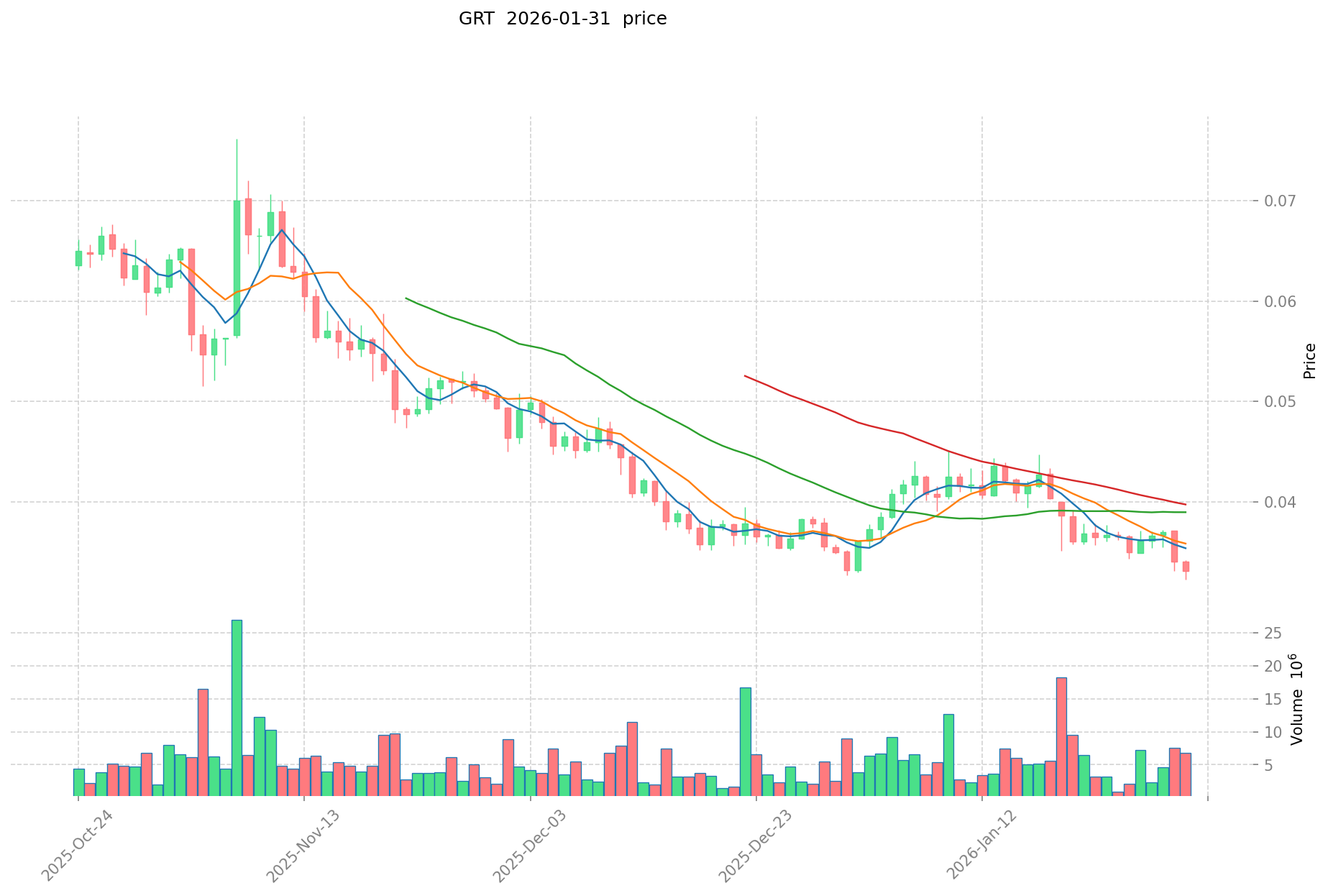
- Comparative Analysis: During the market cycle from 2021 to 2026, GRT declined from its high of $2.84 to a low of $0.03011785 in January 2026, while GIZA dropped from its peak of $0.50471 to $0.03396 in December 2025.
Current Market Status (2026-01-31)
- GIZA Current Price: $0.03602
- GRT Current Price: $0.03047
- 24-Hour Trading Volume: GIZA $41,228.95 vs GRT $208,427.21
- Market Sentiment Index (Fear & Greed Index): 20 (Extreme Fear)
Check real-time prices:
- View GIZA current price Market Price
- View GRT current price Market Price

II. Core Factors Influencing GIZA vs GRT Investment Value
Supply Mechanism Comparison (Tokenomics)
-
GIZA: The complete token supply mechanism has not been fully disclosed in publicly available materials. As of July 2023, GIZA completed a $3 million Pre-Seed funding round led by CoinFund, with participation from StarkWare, TA Ventures, and Arrington Capital. However, detailed tokenomics including total supply, distribution schedule, and emission model remain undisclosed.
-
GRT: Public materials have not revealed a fully disclosed supply mechanism for GRT. Available information indicates the presence of circulating supply data, but comprehensive details regarding fixed supply caps, deflation models, or token burning mechanisms are not adequately documented in the reference sources.
-
📌 Historical Pattern: Supply mechanisms can influence price cycles through factors such as scarcity creation, inflation control, and market liquidity management. However, without complete tokenomics disclosure for both assets, historical supply-driven price patterns cannot be definitively established.
Institutional Adoption and Market Applications
-
Institutional Holdings: Reference materials do not provide comparative data on institutional preference between GIZA and GRT. GIZA's funding from established crypto investment firms (CoinFund, StarkWare, Arrington Capital) suggests institutional interest in its development phase, though this does not directly translate to token holdings.
-
Enterprise Adoption: Available documentation does not contain specific information regarding the application of GIZA or GRT in cross-border payments, settlement systems, or institutional investment portfolios. Direct comparisons of enterprise-level adoption cannot be drawn from the provided sources.
-
National Policy: The reference materials do not include country-specific regulatory attitudes toward GIZA or GRT. Regulatory developments mentioned in general contexts suggest that cryptocurrency values can be influenced by regulatory changes, though specific policy positions toward these two assets are not documented.
Technological Development and Ecosystem Building
-
GIZA Technology: GIZA is positioned within the Web3 + AI sector, though specific technical upgrades or development milestones are not detailed in the available materials. The project has received backing from StarkWare, suggesting potential connection to zero-knowledge proof or Layer 2 scaling technologies, but explicit technical specifications are not provided.
-
GRT Technology: The reference materials do not contain detailed information about GRT's technological development roadmap, protocol upgrades, or technical infrastructure improvements.
-
Ecosystem Comparison: Comparative analysis of DeFi integration, NFT ecosystem participation, payment system implementation, and smart contract deployment for GIZA versus GRT is not available in the provided documentation. Such ecosystem metrics would require more comprehensive data sources.
Macroeconomic Environment and Market Cycles
-
Performance in Inflationary Environments: The reference materials indicate that cryptocurrency values can fluctuate significantly due to market conditions, investor sentiment, regulatory developments, and technological advancements. However, specific comparative performance data for GIZA and GRT during inflationary periods is not documented.
-
Macroeconomic Monetary Policy: General cryptocurrency market dynamics suggest that interest rates and dollar index movements can affect digital asset valuations. The specific impact magnitude on GIZA versus GRT, and their relative sensitivity to monetary policy changes, cannot be determined from available sources.
-
Geopolitical Factors: While cross-border transaction demand and international situations can influence cryptocurrency markets broadly, the reference materials do not provide specific analysis of how geopolitical factors differentially affect GIZA and GRT investment values.
III. 2026-2031 Price Prediction: GIZA vs GRT
Short-term Prediction (2026)
- GIZA: Conservative $0.0214 - $0.0362 | Optimistic $0.0362 - $0.0532
- GRT: Conservative $0.0274 - $0.0305 | Optimistic $0.0305 - $0.0369
Mid-term Prediction (2028-2029)
- GIZA may enter a growth phase, with projected prices ranging from $0.0330 to $0.0734
- GRT may enter a consolidation phase, with projected prices ranging from $0.0229 to $0.0560
- Key drivers: institutional capital inflows, ETF developments, ecosystem expansion
Long-term Prediction (2030-2031)
- GIZA: Baseline scenario $0.0326 - $0.0627 | Optimistic scenario $0.0561 - $0.0782
- GRT: Baseline scenario $0.0280 - $0.0492 | Optimistic scenario $0.0374 - $0.0662
View detailed price predictions for GIZA and GRT
Disclaimer
GIZA:
| Year |
Predicted High Price |
Predicted Average Price |
Predicted Low Price |
Price Change |
| 2026 |
0.0531993 |
0.03619 |
0.0213521 |
0 |
| 2027 |
0.048270222 |
0.04469465 |
0.0263698435 |
24 |
| 2028 |
0.05763822064 |
0.046482436 |
0.03300252956 |
29 |
| 2029 |
0.0734050629312 |
0.05206032832 |
0.0432100725056 |
44 |
| 2030 |
0.070887946056928 |
0.0627326956256 |
0.032621001725312 |
74 |
| 2031 |
0.078168075384278 |
0.066810320841264 |
0.056120669506661 |
85 |
GRT:
| Year |
Predicted High Price |
Predicted Average Price |
Predicted Low Price |
Price Change |
| 2026 |
0.0368566 |
0.03046 |
0.027414 |
0 |
| 2027 |
0.049477701 |
0.0336583 |
0.018512065 |
10 |
| 2028 |
0.04323072052 |
0.0415680005 |
0.022862400275 |
36 |
| 2029 |
0.0559671558732 |
0.04239936051 |
0.0250156227009 |
39 |
| 2030 |
0.065905565976744 |
0.0491832581916 |
0.028034457169212 |
61 |
| 2031 |
0.066176073896797 |
0.057544412084172 |
0.037403867854711 |
88 |
IV. Investment Strategy Comparison: GIZA vs GRT
Long-term vs Short-term Investment Strategies
-
GIZA: May appeal to investors interested in emerging AI-integrated Web3 protocols and early-stage technology ventures. The asset's relatively recent market entry in 2025 suggests a positioning toward growth-oriented investment horizons, though historical performance data remains limited.
-
GRT: May suit investors seeking exposure to established blockchain infrastructure protocols with a longer operational track record since 2020. The asset's role in data indexing services suggests alignment with foundational blockchain utility themes.
Risk Management and Asset Allocation
-
Conservative Investors: A balanced approach might consider modest exposure to both assets as part of a diversified cryptocurrency portfolio, with allocation weighted toward more established market positions. Specific percentage allocations should be determined based on individual risk tolerance and portfolio objectives.
-
Aggressive Investors: Higher-risk portfolios may incorporate increased exposure to assets with growth potential, while maintaining awareness of volatility characteristics demonstrated in historical price movements for both GIZA and GRT.
-
Hedging Tools: Portfolio risk management approaches may include stablecoin allocations for liquidity preservation, options strategies where available, and cross-asset diversification across multiple cryptocurrency categories.
V. Potential Risk Comparison
Market Risk
-
GIZA: The asset has demonstrated significant price volatility, declining from $0.50471 in June 2025 to $0.03396 in December 2025. Limited historical data and relatively low trading volume ($41,228.95 as of January 31, 2026) may contribute to liquidity constraints and price sensitivity.
-
GRT: Historical price movements show substantial fluctuation, with the asset declining from $2.84 in February 2021 to $0.03047 as of January 31, 2026. While trading volume is higher than GIZA at $208,427.21, market conditions reflected in the Fear & Greed Index reading of 20 (Extreme Fear) suggest challenging sentiment environments.
Technical Risk
-
GIZA: Limited publicly available information regarding technical infrastructure, scalability solutions, and network architecture presents evaluation challenges. The project's association with StarkWare suggests potential zero-knowledge proof or Layer 2 technologies, though specific technical specifications are not documented in available materials.
-
GRT: Reference materials do not provide comprehensive details on protocol upgrade roadmaps, network resilience measures, or technical vulnerability assessments. Standard blockchain infrastructure risks may include network congestion, query performance limitations, and indexing accuracy considerations.
Regulatory Risk
- Cryptocurrency regulatory environments continue to evolve across jurisdictions. Both GIZA and GRT may be subject to regulatory developments affecting digital asset classifications, trading restrictions, tax treatments, and compliance requirements. Specific regulatory positions toward either asset are not documented in available sources, and regulatory impacts may vary significantly by jurisdiction and market development stage.
VI. Conclusion: Which Is the Better Buy?
📌 Investment Value Summary
-
GIZA Characteristics: Represents exposure to AI-integrated Web3 protocol development with backing from established crypto investment entities including CoinFund and StarkWare. The asset's recent market introduction reflects early-stage positioning within emerging technology sectors, accompanied by higher volatility patterns and limited historical performance data.
-
GRT Characteristics: Offers exposure to blockchain data infrastructure services with a longer operational history since 2020. The protocol's established role in decentralized data indexing, particularly within Ethereum ecosystems, provides foundational utility positioning, though recent price performance has reflected broader market challenges.
✅ Investment Considerations
-
New Investors: May benefit from comprehensive research into cryptocurrency fundamentals, market dynamics, and risk management principles before considering exposure to either asset. Starting with smaller position sizes and established educational resources can support informed decision-making processes.
-
Experienced Investors: Should evaluate both assets within the context of existing portfolio allocations, risk tolerance parameters, and investment timeframes. Comparative analysis of technological differentiation, market positioning, and growth trajectories may inform strategic allocation decisions.
-
Institutional Investors: May require enhanced due diligence regarding tokenomics transparency, regulatory compliance frameworks, liquidity profiles, and custodial infrastructure availability for both assets. Institutional-grade evaluation criteria should encompass governance structures, audit histories, and counterparty risk assessments.
⚠️ Risk Disclosure: Cryptocurrency markets exhibit extreme volatility characteristics. This content does not constitute investment advice, financial recommendations, or solicitation to buy or sell any digital assets. Investment decisions should be made based on individual circumstances, comprehensive research, and consultation with qualified financial advisors.
VII. FAQ
Q1: What are the main differences between GIZA and GRT in terms of their core functionality?
GIZA positions itself as a protocol powering agent-driven financial markets that transcend human cognitive limitations within the Web3 + AI sector, while GRT serves as a decentralized protocol for indexing and querying blockchain data, primarily applied to Ethereum ecosystems. GIZA represents an emerging AI-integrated financial protocol launched in 2025 with backing from CoinFund and StarkWare, focusing on next-generation autonomous market mechanisms. In contrast, GRT has been operational since 2020, providing foundational blockchain infrastructure services that enable simplified data queries across decentralized applications, establishing itself as essential data indexing infrastructure within the DeFi ecosystem.
Q2: How do the current price levels of GIZA and GRT compare to their historical peaks?
As of January 31, 2026, GIZA trades at $0.03602, representing a 92.9% decline from its all-time high of $0.50471 reached in June 2025, while GRT trades at $0.03047, marking a 98.9% decrease from its peak of $2.84 in February 2021. Both assets have experienced significant price corrections from their respective highs, with GIZA showing a shorter decline period (approximately 7 months) compared to GRT's extended drawdown spanning nearly 5 years. The current price proximity between the two assets ($0.03602 vs $0.03047) contrasts sharply with their historical peak differential, suggesting distinct market cycle patterns and adoption trajectories.
Q3: What are the projected price ranges for GIZA and GRT through 2031?
For GIZA, short-term 2026 projections range from $0.0214 to $0.0532, with mid-term 2028-2029 estimates between $0.0330 and $0.0734, and long-term 2030-2031 baseline scenarios projecting $0.0326 to $0.0627, with optimistic scenarios reaching $0.0561 to $0.0782. For GRT, 2026 predictions span $0.0274 to $0.0369, mid-term 2028-2029 estimates range from $0.0229 to $0.0560, and long-term 2030-2031 baseline projections indicate $0.0280 to $0.0492, with optimistic scenarios extending to $0.0374 to $0.0662. These projections suggest GIZA may demonstrate higher growth potential in optimistic scenarios, though both assets face considerable uncertainty given current market conditions reflected in the Fear & Greed Index reading of 20 (Extreme Fear).
Q4: What are the primary risk factors investors should consider when comparing GIZA and GRT?
Market risk considerations include GIZA's significant volatility (93% decline over 7 months) and relatively low trading volume ($41,228.95), alongside GRT's prolonged price decline (99% over 5 years) despite higher trading volume ($208,427.21). Technical risk factors encompass GIZA's limited publicly available infrastructure documentation and early-stage development status, contrasted with GRT's operational history but undisclosed protocol upgrade details. Regulatory risk affects both assets equally, as evolving cryptocurrency regulations across jurisdictions may impact classifications, trading restrictions, and compliance requirements. Additionally, liquidity constraints pose greater concerns for GIZA given its lower trading volumes, while GRT faces challenges related to sustained market interest after extended price depreciation.
Q5: Which asset might be more suitable for different investor profiles?
Conservative investors may find GRT more aligned with their risk parameters due to its longer operational track record since 2020, established role in blockchain infrastructure, and higher trading volumes, though they should maintain modest allocations within diversified portfolios. Aggressive investors seeking higher-risk exposure might consider GIZA for its positioning in emerging AI-integrated Web3 protocols and backing from prominent crypto investment firms, accepting greater volatility and liquidity constraints. New investors should prioritize comprehensive education on cryptocurrency fundamentals and begin with smaller position sizes in either asset, while experienced investors can evaluate both within existing portfolio contexts considering technological differentiation and growth trajectories. Institutional investors require enhanced due diligence regarding tokenomics transparency, regulatory compliance frameworks, and custodial infrastructure availability before considering either asset.
Q6: How does the trading volume difference between GIZA and GRT impact investment considerations?
The trading volume differential shows GRT at $208,427.21 compared to GIZA's $41,228.95 as of January 31, 2026, representing approximately 5x higher liquidity for GRT. This volume disparity significantly impacts investment execution, as higher trading volumes typically enable better price discovery, reduced slippage on larger orders, and improved entry/exit flexibility for position management. GIZA's lower trading volume may result in wider bid-ask spreads, increased price impact from individual transactions, and potential challenges in executing substantial position sizes without adverse price movements. For investors planning larger allocations or requiring frequent portfolio rebalancing, GRT's superior liquidity profile provides operational advantages, while GIZA's lower volumes may necessitate more patient order execution strategies and acceptance of potentially higher transaction costs.
Q7: What institutional backing exists for GIZA and GRT, and how does this influence investment evaluation?
GIZA completed a $3 million Pre-Seed funding round in July 2023 led by CoinFund, with participation from StarkWare, TA Ventures, and Arrington Capital, indicating institutional interest during its development phase. However, reference materials do not provide comparable institutional backing information for GRT or detailed data on institutional token holdings for either asset. While GIZA's backing from established crypto investment firms suggests credibility in its development trajectory, this early-stage funding does not necessarily translate to current institutional token holdings or ongoing institutional market participation. The absence of comprehensive institutional adoption data for both assets limits comparative evaluation of institutional preference patterns, though GIZA's association with StarkWare may suggest potential technological synergies with zero-knowledge proof or Layer 2 scaling ecosystems.
Q8: What factors should investors monitor when tracking the performance of GIZA versus GRT?
Key monitoring factors include price trend developments relative to projected ranges, trading volume patterns indicating liquidity changes and market interest shifts, and broader market sentiment indicators such as the Fear & Greed Index. Investors should track technological developments including protocol upgrades, ecosystem integrations, and partnership announcements that may influence adoption trajectories. Regulatory developments across major jurisdictions affecting digital asset classifications and compliance requirements warrant continuous monitoring. For GIZA specifically, tokenomics disclosure and supply mechanism transparency updates would significantly enhance evaluation capabilities, while GRT monitoring should focus on data indexing protocol adoption metrics and competitive positioning within blockchain infrastructure services. Macroeconomic conditions including monetary policy changes, inflation trends, and institutional capital flows into cryptocurrency markets represent external factors influencing both assets' performance potential.
* The information is not intended to be and does not constitute financial advice or any other recommendation of any sort offered or endorsed by Gate.













