This comprehensive article compares GLMR and DOT, two significant tokens within the Polkadot ecosystem, providing investors with detailed analysis across multiple dimensions. GLMR (Moonbeam) functions as an EVM-compatible parachain token launched in 2021, while DOT serves as Polkadot's native cross-chain infrastructure token since 2017. The analysis covers historical price trends showing both tokens declined substantially from 2022 peaks, current market status with detailed price comparisons, and investment strategies tailored to different investor profiles. Price forecasts through 2031 are provided alongside risk assessments including market, technology, and regulatory factors. Whether you're a beginner seeking stable cross-chain exposure through DOT or an experienced investor exploring parachain opportunities with GLMR, this guide offers evidence-based allocation recommendations and practical FAQ answers to guide your investment decisions in the Polkadot ecosystem.
Introduction: GLMR vs DOT Investment Comparison
In the cryptocurrency market, the comparison between GLMR and DOT has been a topic that investors cannot avoid. Both have notable differences in market capitalization ranking, application scenarios, and price performance, representing distinct positioning in the crypto asset landscape.
GLMR (Glimmer): Launched in 2021 and deployed on the Polkadot network, GLMR has gained market recognition as a functional and governance token for the Moonbeam parachain, an EVM-compatible blockchain that enables Ethereum-based applications to operate within the Polkadot ecosystem.
DOT (Polkadot): Launched in 2017, DOT serves as the native token of Polkadot, a network designed to facilitate cross-chain communication and interoperability. It is among the cryptocurrencies with substantial trading volume and market presence globally.
This article will comprehensively analyze the investment value comparison between GLMR and DOT around historical price trends, supply mechanisms, institutional adoption, technological ecosystem, and future outlook, attempting to address the question investors care about most:
"Which is the better buy right now?"
I. Historical Price Comparison and Current Market Status
Historical Price Trends of GLMR (Coin A) and DOT (Coin B)
- 2022: GLMR reached a notable price point of $19.5 on January 11, 2022, following its launch and initial parachain slot auction success on Polkadot.
- 2021: DOT experienced significant growth with its price reaching $54.98 on November 4, 2021, driven by parachain auction activity and ecosystem expansion.
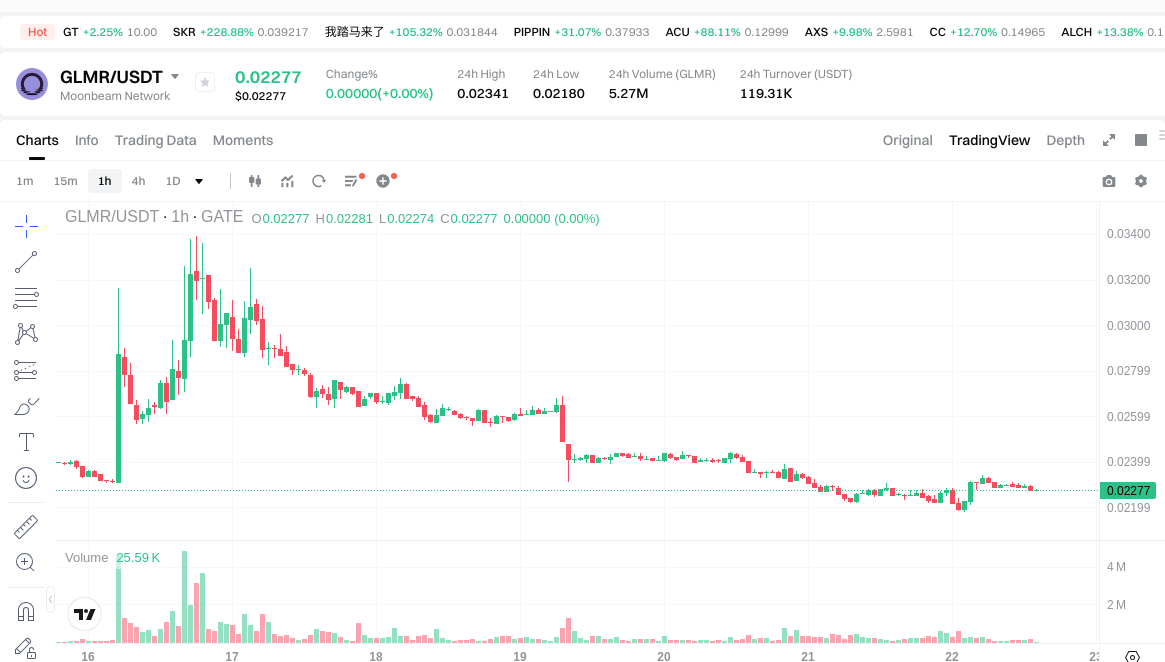
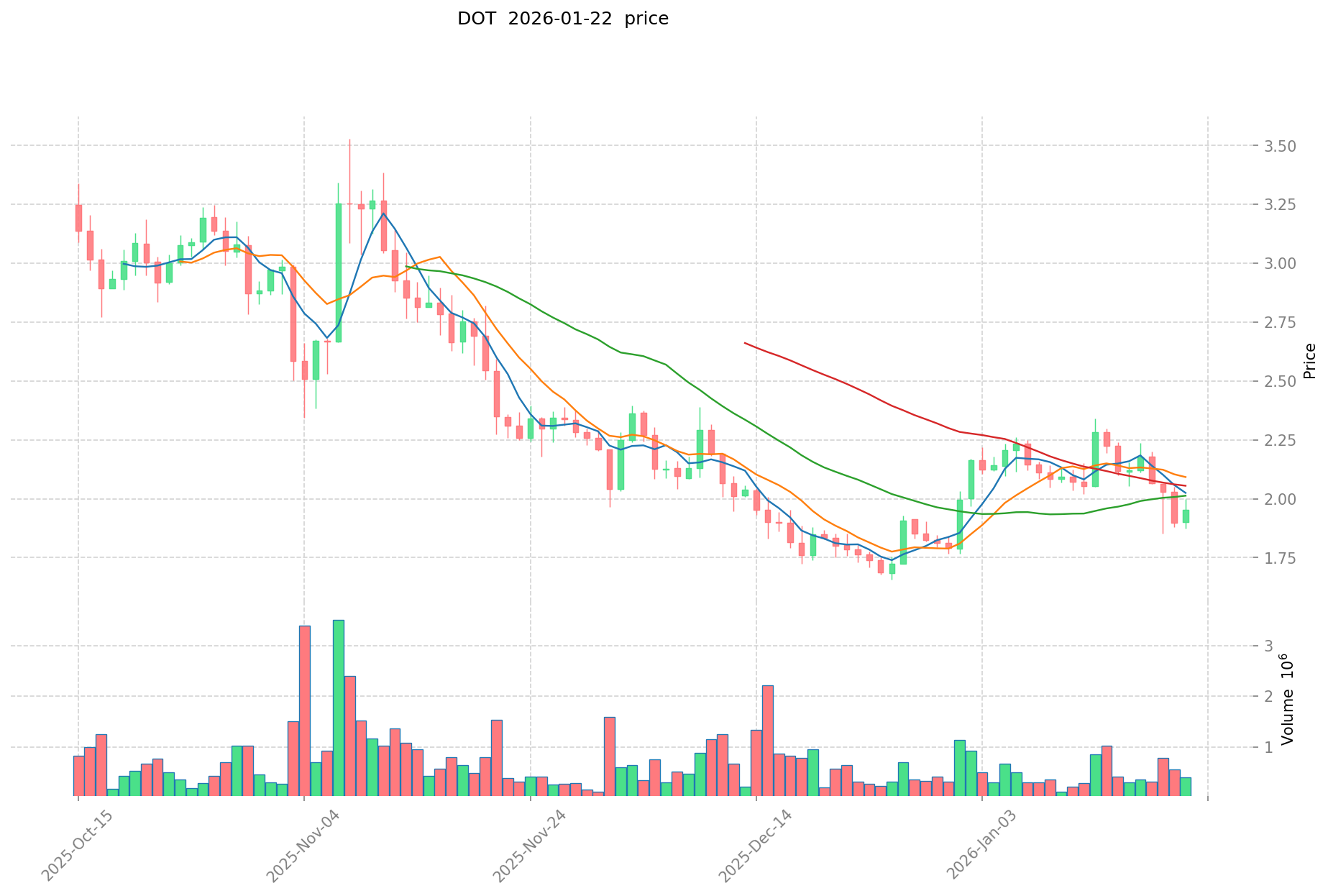
- Comparative Analysis: During the market cycle from 2022 to 2026, GLMR declined from its peak of $19.5 to a level around $0.0219 recorded on January 22, 2026, while DOT decreased from $54.98 to approximately $1.66 on December 26, 2025.
Current Market Status (January 22, 2026)
- GLMR current price: $0.02281
- DOT current price: $1.942
- 24-hour trading volume: GLMR $119,153.53 vs DOT $717,693.35
- Market Sentiment Index (Fear & Greed Index): 20 (Extreme Fear)
View real-time prices:
- Check current GLMR price Market Price
- Check current DOT price Market Price
II. Core Factors Affecting the Investment Value of GLMR vs DOT
Supply Mechanism Comparison (Tokenomics)
Due to the absence of detailed information in the provided materials regarding the specific supply mechanisms of GLMR and DOT, this section cannot be elaborated upon with verifiable data. A comprehensive analysis would require access to official tokenomics documentation, including total supply caps, emission schedules, and inflation rates.
Institutional Adoption and Market Application
Without concrete data on institutional holdings, enterprise adoption cases, or regulatory stances toward GLMR and DOT across different jurisdictions, a comparative assessment cannot be conducted. Market participants should independently verify institutional interest levels, real-world use cases in cross-border payments or settlement systems, and evolving regulatory frameworks in relevant markets.
Technology Development and Ecosystem Construction
The provided materials do not contain information regarding recent or planned technical upgrades for either GLMR or DOT. Similarly, ecosystem metrics such as DeFi protocol activity, NFT marketplace adoption, payment integration, or smart contract deployment statistics are not available for comparison. Stakeholders should refer to official project roadmaps and on-chain analytics platforms for current ecosystem health indicators.
Macroeconomic Context and Market Cycles
An analysis of how GLMR and DOT perform under different macroeconomic conditions—including inflationary environments, interest rate fluctuations, U.S. dollar index movements, or geopolitical tensions affecting cross-border transactions—cannot be provided based on the available materials. Historical price correlations with macroeconomic variables would require quantitative market data not present in the reference sources.
III. 2026-2031 Price Forecast: GLMR vs DOT
Short-term Forecast (2026)
- GLMR: Conservative $0.0196 - $0.0228 | Optimistic $0.0228 - $0.0280
- DOT: Conservative $1.13 - $1.94 | Optimistic $1.94 - $2.56
Mid-term Forecast (2028-2029)
- GLMR may enter a growth phase, with projected prices ranging from $0.0238 to $0.0514
- DOT may enter an expansion phase, with projected prices ranging from $2.02 to $3.86
- Key drivers: institutional capital inflows, ETF developments, ecosystem expansion
Long-term Forecast (2030-2031)
- GLMR: Baseline scenario $0.0279 - $0.0458 | Optimistic scenario $0.0316 - $0.0485
- DOT: Baseline scenario $2.22 - $3.61 | Optimistic scenario $2.38 - $3.86
View detailed price predictions for GLMR and DOT
Disclaimer
GLMR:
| Year |
Predicted High Price |
Predicted Average Price |
Predicted Low Price |
Price Change |
| 2026 |
0.0280071 |
0.02277 |
0.0195822 |
0 |
| 2027 |
0.036559512 |
0.02538855 |
0.0195491835 |
10 |
| 2028 |
0.04305390309 |
0.030974031 |
0.02756688759 |
35 |
| 2029 |
0.05144941419255 |
0.037013967045 |
0.0236889389088 |
61 |
| 2030 |
0.047327908962089 |
0.044231690618775 |
0.027865965089828 |
93 |
| 2031 |
0.048526587777858 |
0.045779799790432 |
0.031588061855398 |
100 |
DOT:
| Year |
Predicted High Price |
Predicted Average Price |
Predicted Low Price |
Price Change |
| 2026 |
2.5608 |
1.94 |
1.1252 |
0 |
| 2027 |
3.353096 |
2.2504 |
1.485264 |
15 |
| 2028 |
2.91381792 |
2.801748 |
2.01725856 |
44 |
| 2029 |
3.858006996 |
2.85778296 |
2.1719150496 |
47 |
| 2030 |
3.8615792247 |
3.357894978 |
2.21621068548 |
72 |
| 2031 |
3.7902239564175 |
3.60973710135 |
2.382426486891 |
85 |
IV. Investment Strategy Comparison: GLMR vs DOT
Long-term vs Short-term Investment Strategies
- GLMR: May appeal to investors focused on parachain ecosystem development and EVM-compatible smart contract platforms within the Polkadot network, with a perspective oriented toward multi-year holding periods
- DOT: May appeal to investors seeking exposure to cross-chain infrastructure and interoperability solutions, with potential for both medium-term and long-term positioning
Risk Management and Asset Allocation
- Conservative investors: GLMR 20-30% vs DOT 70-80%
- Aggressive investors: GLMR 40-50% vs DOT 50-60%
- Hedging instruments: stablecoin allocation, options strategies, cross-asset diversification
V. Potential Risk Comparison
Market Risk
- GLMR: Price volatility influenced by Polkadot parachain activity, ecosystem adoption rates, and EVM-compatible platform competition
- DOT: Price movements affected by cross-chain technology adoption, parachain auction dynamics, and broader Layer 0 protocol market sentiment
Technology Risk
- GLMR: Scalability considerations related to parachain throughput, network stability dependent on Polkadot relay chain performance
- DOT: Network architecture complexity, relay chain security considerations, parachain slot allocation mechanisms
Regulatory Risk
- Global regulatory frameworks may impact GLMR and DOT differently based on their functional classifications, with GLMR's smart contract capabilities and DOT's interoperability infrastructure potentially subject to varying compliance requirements across jurisdictions
VI. Conclusion: Which Is the Better Buy?
📌 Investment Value Summary:
- GLMR advantages: EVM compatibility enabling Ethereum developer migration, parachain-specific use cases, potential for ecosystem-driven growth within Polkadot
- DOT advantages: Established position as a cross-chain infrastructure protocol, broader ecosystem spanning multiple parachains, longer track record since 2017
✅ Investment Recommendations:
- Beginner investors: Consider DOT for exposure to established cross-chain infrastructure with relatively broader market recognition
- Experienced investors: Evaluate portfolio allocation between GLMR and DOT based on risk tolerance, parachain ecosystem conviction, and technical infrastructure preferences
- Institutional investors: Conduct thorough due diligence on tokenomics, on-chain metrics, ecosystem partnerships, and regulatory compliance status before position sizing
⚠️ Risk Warning: Cryptocurrency markets exhibit extreme volatility. This article does not constitute investment advice.
VII. FAQ
Q1: What is the main difference between GLMR and DOT in terms of their core functionality?
GLMR serves as the utility and governance token for Moonbeam, an EVM-compatible parachain on Polkadot, while DOT is the native token of the Polkadot network itself that enables cross-chain interoperability. GLMR specifically focuses on enabling Ethereum-based applications to operate within the Polkadot ecosystem through its parachain, whereas DOT powers the entire Polkadot relay chain infrastructure and facilitates communication between multiple parachains. This fundamental distinction means GLMR targets developers seeking Ethereum compatibility within Polkadot, while DOT addresses broader cross-chain infrastructure needs across the entire network.
Q2: Which cryptocurrency has experienced greater price decline from its all-time high?
GLMR has experienced a more significant percentage decline from its peak. GLMR dropped from $19.5 in January 2022 to approximately $0.0228 as of January 22, 2026, representing a decline of over 99%. In comparison, DOT decreased from $54.98 in November 2021 to around $1.942, representing approximately a 96% decline. Both assets have undergone substantial corrections during the extended market downturn, though GLMR's newer launch date and parachain-specific positioning have contributed to its steeper depreciation relative to DOT's more established market presence.
Q3: What are the projected price ranges for GLMR and DOT by 2030?
For 2030, GLMR is projected to trade between $0.0279 and $0.0485 depending on market conditions, with conservative estimates ranging from $0.0279 to $0.0458 and optimistic scenarios reaching up to $0.0485. DOT's 2030 projections range from $2.22 to $3.86, with baseline scenarios estimating $2.22 to $3.61 and optimistic forecasts suggesting prices up to $3.86. These projections assume various factors including institutional capital inflows, ecosystem expansion, and potential ETF developments, though cryptocurrency price predictions carry inherent uncertainty and should not be considered guaranteed outcomes.
Q4: How should risk-averse investors allocate between GLMR and DOT?
Conservative investors should consider allocating 20-30% to GLMR and 70-80% to DOT within their cryptocurrency portfolio allocation. This weighting reflects DOT's more established market position, longer operational history since 2017, and broader recognition as cross-chain infrastructure. GLMR's smaller allocation acknowledges its higher risk profile as a newer parachain-specific token with greater volatility exposure. Risk management should also incorporate stablecoin holdings, options strategies for downside protection, and cross-asset diversification beyond these two tokens to mitigate cryptocurrency market volatility.
Q5: What technological risks differentiate GLMR from DOT?
GLMR's technological risks center on parachain-specific challenges including throughput scalability limitations, dependency on Polkadot relay chain performance, and competition from other EVM-compatible platforms both within and outside the Polkadot ecosystem. DOT faces different technical considerations including the complexity of its network architecture, relay chain security maintenance, and the ongoing management of parachain slot allocation mechanisms. While GLMR's risks are tied to its specific parachain implementation, DOT's risks involve maintaining the entire cross-chain infrastructure that all parachains, including Moonbeam, depend upon.
Q6: Which token offers better prospects for beginners versus experienced cryptocurrency investors?
Beginner investors may find DOT more suitable due to its established position as cross-chain infrastructure with broader market recognition, longer operational track record, and relatively more straightforward value proposition focused on network interoperability. Experienced investors might consider portfolio diversification across both assets, evaluating GLMR for its EVM compatibility features and parachain ecosystem potential while maintaining DOT exposure for comprehensive Polkadot network participation. The choice ultimately depends on individual risk tolerance, investment timeframe, and conviction regarding specific use cases within the Polkadot ecosystem.
Q7: How does current market sentiment affect short-term investment decisions for GLMR and DOT?
The current Fear & Greed Index reading of 20 (Extreme Fear) as of January 22, 2026, indicates significant market pessimism that historically correlates with both heightened volatility and potential accumulation opportunities. In this environment, both GLMR and DOT face downward price pressure, with 24-hour trading volumes showing DOT at $717,693.35 compared to GLMR's $119,153.53, reflecting DOT's substantially higher liquidity. Short-term investors should recognize that extreme fear conditions often precede either further capitulation or market reversals, requiring careful position sizing and consideration of dollar-cost averaging strategies rather than concentrated entry points.
Q8: What factors should institutional investors prioritize when comparing GLMR and DOT?
Institutional investors should conduct comprehensive due diligence focusing on tokenomics structures including supply schedules and inflation mechanisms, on-chain metrics such as transaction volumes and active addresses, ecosystem partnerships demonstrating real-world adoption, and regulatory compliance status across relevant jurisdictions. For GLMR, institutions should evaluate the competitive positioning of EVM-compatible parachains and developer migration trends from Ethereum. For DOT, assessment should focus on cross-chain protocol adoption rates, parachain auction dynamics, and the network's ability to maintain security while scaling interoperability. Position sizing should reflect liquidity constraints, custody solutions availability, and alignment with broader portfolio mandates regarding cryptocurrency exposure.
* The information is not intended to be and does not constitute financial advice or any other recommendation of any sort offered or endorsed by Gate.