This comprehensive analysis compares GPS and XLM as investment opportunities within the blockchain ecosystem. GPS, launched in 2025, functions as Web3's decentralized security infrastructure providing on-chain risk identification and transaction protection. XLM, established since 2014, specializes in cross-border payment solutions enabling fast, low-cost digital-to-fiat transfers. The article evaluates both assets across historical price performance, tokenomics, institutional adoption, technical ecosystems, and market liquidity. GPS currently trades at $0.007609 with limited trading volume, while XLM demonstrates superior liquidity at $0.20818 with significantly higher market activity. Through detailed price forecasts spanning 2026-2031, strategic allocation recommendations for different investor profiles, and comprehensive risk analysis, this guide helps investors determine which platform aligns with their portfolio objectives. Whether prioritizing emerging security infrastructure or established payment prot
Introduction: GPS vs XLM Investment Comparison
In the cryptocurrency market, the comparison between GPS vs XLM remains a key topic for investors. Both assets differ significantly in market cap ranking, use cases, and price performance, representing distinct positioning within the crypto asset landscape.
GPS (GoPlus Security): Launched in 2025, it has gained market recognition as Web3's first decentralized security layer, providing comprehensive protection for transactions across all blockchain networks.
XLM (Stellar): Since its launch in 2014, it has been positioned as a decentralized gateway for digital-to-fiat currency transfers, enabling fast, stable, and low-cost asset movement among banks, payment institutions, and individuals.
This article will analyze GPS vs XLM investment value comparison through historical price trends, supply mechanisms, institutional adoption, technical ecosystems, and future predictions, attempting to answer investors' most pressing question:
"Which is the better buy right now?"
I. Historical Price Comparison and Current Market Status
GPS (Coin A) and XLM (Coin B) Historical Price Trends
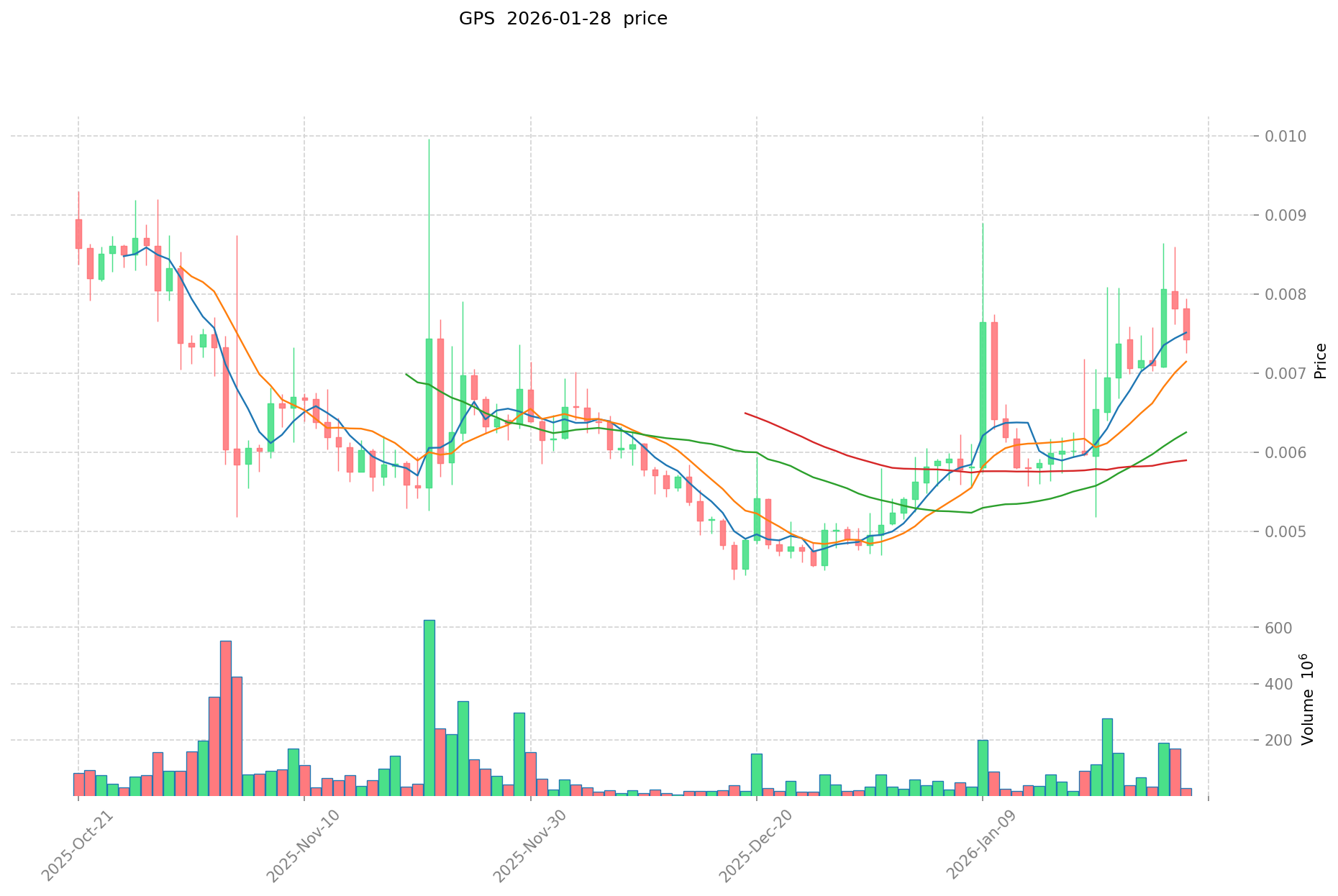
- 2025: GPS experienced notable volatility following its launch in January 2025, with the price reaching a peak of $0.22 on January 31, 2025. The token subsequently entered a correction phase.
- 2018: XLM was influenced by the broader cryptocurrency market boom, with its price reaching an all-time high of $0.875563 on January 3, 2018. Following this peak, the asset entered an extended bear market alongside the broader crypto sector.
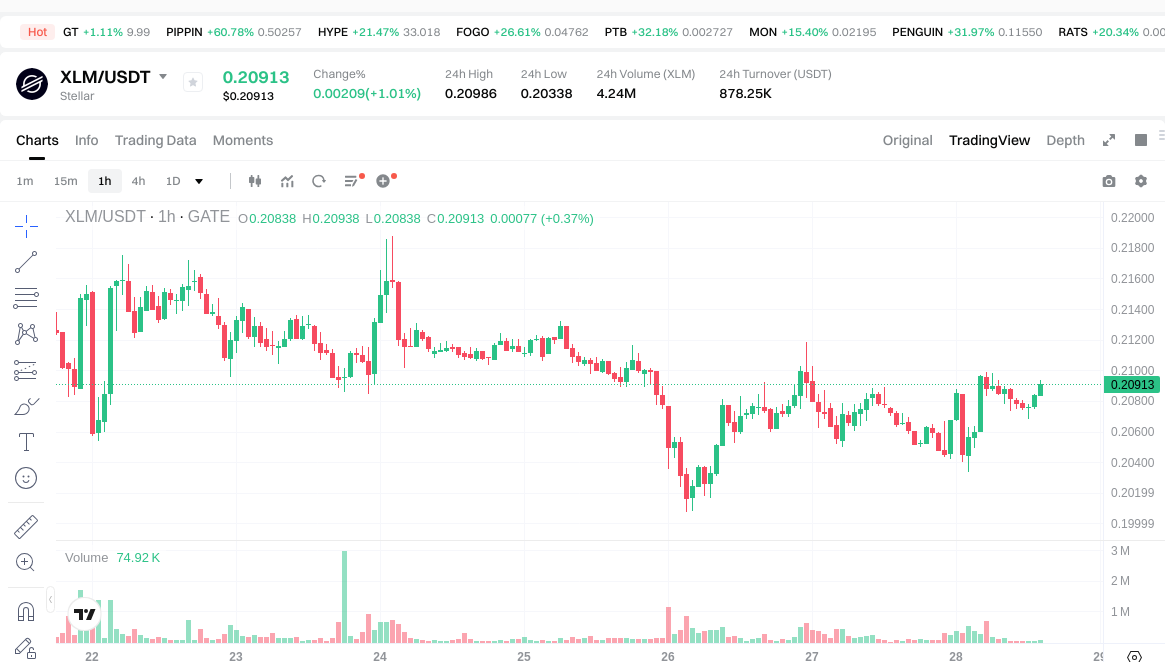
- Comparative Analysis: During the 2025 market cycle, GPS declined from its high of $0.22 to a low of $0.004384 recorded in December 2025, representing significant downward pressure. In contrast, XLM has shown relative stability in recent periods, though it remains considerably below its 2018 all-time high, currently trading at approximately 76% below that peak.
Current Market Status (January 28, 2026)
- GPS Current Price: $0.007609
- XLM Current Price: $0.20818
- 24-Hour Trading Volume: GPS recorded $145,079.03, while XLM demonstrated significantly higher liquidity with $870,213.37
- Market Sentiment Index (Fear & Greed Index): 29 (Fear)
View Real-Time Prices:
- Check GPS Current Price Market Price
- Check XLM Current Price Market Price
II. Core Factors Influencing GPS vs XLM Investment Value
Supply Mechanism Comparison (Tokenomics)
- GPS: GoPlus provides comprehensive security infrastructure for the cryptocurrency space, functioning as on-chain antivirus software and firewalls. Its API and tools help identify high-risk tokens before purchase.
- XLM: The most significant direct driver for XLM is the launch of Protocol 25, called "X-Ray." This major upgrade introduces native cryptographic tools (BN254 and Poseidon hashing) to Stellar's Soroban platform.
- 📌 Historical Pattern: Supply mechanisms drive price cycle changes through technological advancement and security feature implementation.
Institutional Adoption and Market Application
- Institutional Holdings: GPS focuses on security infrastructure adoption across the crypto ecosystem, while XLM emphasizes protocol-level cryptographic tool implementation.
- Enterprise Adoption: GPS serves as risk identification and security infrastructure for the broader cryptocurrency market. XLM's Protocol 25 upgrade enhances native cryptographic capabilities for developers building on Stellar's Soroban platform.
- National Policies: Regulatory attitudes vary by jurisdiction, with security-focused solutions and protocol upgrades subject to different compliance frameworks.
Technical Development and Ecosystem Building
- GPS Technical Upgrade: Comprehensive security infrastructure including risk identification tools, API services, and on-chain security solutions. Potential impact includes enhanced user protection and reduced exposure to high-risk assets.
- XLM Technical Development: Protocol 25 "X-Ray" upgrade introduces BN254 and Poseidon hashing cryptographic tools to Stellar's Soroban platform. Potential impact includes enhanced smart contract capabilities and cryptographic functionality.
- Ecosystem Comparison: GPS emphasizes security infrastructure across DeFi, NFT, and payment sectors. XLM focuses on protocol-level enhancements for smart contract deployment and cryptographic operations.
Macroeconomic Environment and Market Cycles
- Performance in Inflationary Environment: Security infrastructure and protocol upgrades demonstrate different value propositions during various economic conditions.
- Macroeconomic Monetary Policy: Interest rates, dollar index, and liquidity conditions affect technology adoption and development investment.
- Geopolitical Factors: Cross-border transaction demand and international security requirements influence both security infrastructure adoption and protocol development priorities.
III. 2026-2031 Price Forecast: GPS vs XLM
Short-term Forecast (2026)
- GPS: Conservative $0.00567 - $0.00756 | Optimistic $0.00756 - $0.0086184
- XLM: Conservative $0.1693953 - $0.20913 | Optimistic $0.20913 - $0.2802342
Mid-term Forecast (2028-2029)
- GPS may enter a phase of gradual growth, with projected price range of $0.00599 - $0.01559
- XLM may enter a phase of moderate expansion, with projected price range of $0.2510 - $0.4101
- Key drivers: institutional capital inflows, ETF developments, ecosystem growth
Long-term Forecast (2030-2031)
- GPS: Base scenario $0.007905 - $0.01437 | Optimistic scenario $0.01437 - $0.01753
- XLM: Base scenario $0.2412 - $0.4552 | Optimistic scenario $0.4552 - $0.5553
View detailed price predictions for GPS and XLM
Disclaimer
GPS:
| Year |
Predicted High Price |
Predicted Average Price |
Predicted Low Price |
Price Change |
| 2026 |
0.0086184 |
0.00756 |
0.00567 |
0 |
| 2027 |
0.011243988 |
0.0080892 |
0.004934412 |
6 |
| 2028 |
0.01140658092 |
0.009666594 |
0.00599328828 |
27 |
| 2029 |
0.0155941494408 |
0.01053658746 |
0.0081131723442 |
38 |
| 2030 |
0.01567844214048 |
0.0130653684504 |
0.010060333706808 |
71 |
| 2031 |
0.017533724460436 |
0.01437190529544 |
0.007904547912492 |
88 |
XLM:
| Year |
Predicted High Price |
Predicted Average Price |
Predicted Low Price |
Price Change |
| 2026 |
0.2802342 |
0.20913 |
0.1693953 |
0 |
| 2027 |
0.313193088 |
0.2446821 |
0.203086143 |
17 |
| 2028 |
0.39330200754 |
0.278937594 |
0.2510438346 |
33 |
| 2029 |
0.4100661569394 |
0.33611980077 |
0.2722570386237 |
61 |
| 2030 |
0.537253889550768 |
0.3730929788547 |
0.249972295832649 |
79 |
| 2031 |
0.555311589727335 |
0.455173434202734 |
0.241241920127449 |
118 |
IV. Investment Strategy Comparison: GPS vs XLM
Long-term vs Short-term Investment Strategies
- GPS: Suitable for investors focused on emerging security infrastructure, seeking higher risk-reward profiles with exposure to Web3 security solutions. The asset may appeal to those with tolerance for significant volatility and interest in decentralized security layer development.
- XLM: Suitable for investors seeking exposure to established cross-border payment infrastructure and protocol-level developments, with preference for assets demonstrating greater market stability and institutional adoption in the digital payment sector.
Risk Management and Asset Allocation
- Conservative Investors: GPS 10-15% vs XLM 85-90%
- Aggressive Investors: GPS 30-40% vs XLM 60-70%
- Hedging Tools: stablecoin allocation, options strategies, cross-asset portfolio diversification
V. Potential Risk Comparison
Market Risks
- GPS: Exposure to heightened volatility given early-stage market positioning, limited trading volume of $145,079.03 may result in liquidity constraints, price susceptibility to broader market sentiment shifts
- XLM: Subject to competitive pressure from alternative payment-focused protocols, price performance correlated with institutional adoption rates and regulatory developments affecting cross-border transactions
Technical Risks
- GPS: Scalability considerations for security infrastructure deployment, network stability during periods of increased transaction volume, dependency on broader ecosystem adoption
- XLM: Protocol upgrade execution risks associated with Protocol 25 implementation, smart contract security considerations on Soroban platform, network performance under stress conditions
Regulatory Risks
- Global regulatory frameworks may impact GPS and XLM differently, with security infrastructure subject to varying compliance requirements across jurisdictions, while cross-border payment protocols face evolving international regulatory standards and banking sector integration policies
VI. Conclusion: Which Is the Better Buy?
📌 Investment Value Summary:
- GPS Advantages: Positioning in emerging Web3 security infrastructure sector, potential for growth as decentralized security adoption increases, early-stage exposure to on-chain risk identification solutions
- XLM Advantages: Established presence in cross-border payment sector since 2014, Protocol 25 upgrade enhancing cryptographic capabilities, higher liquidity with $870,213.37 in 24-hour trading volume, institutional recognition in digital payment infrastructure
✅ Investment Recommendations:
- Novice Investors: Consider prioritizing XLM allocation given greater market stability, established ecosystem, and higher liquidity profile. Limit GPS exposure to small exploratory positions if interested in security infrastructure sector.
- Experienced Investors: Evaluate portfolio diversification with weighted allocation toward XLM for core exposure, supplemented by GPS positions sized according to risk tolerance and conviction in security infrastructure thesis.
- Institutional Investors: Assess GPS and XLM through framework of strategic sector positioning, with XLM offering payment infrastructure exposure and GPS providing early-stage security layer participation. Consider regulatory implications and liquidity requirements in allocation decisions.
⚠️ Risk Disclosure: Cryptocurrency markets exhibit extreme volatility. This analysis does not constitute investment advice. Conduct independent research and consult qualified financial advisors before making investment decisions.
VII. FAQ
Q1: What are the main differences between GPS and XLM in terms of their core use cases?
GPS focuses on Web3 security infrastructure, serving as decentralized on-chain antivirus and firewall solutions, while XLM specializes in cross-border payment infrastructure enabling digital-to-fiat currency transfers. GPS provides risk identification tools and security APIs for cryptocurrency transactions, whereas XLM facilitates fast, low-cost asset movement among banks, payment institutions, and individuals through its established protocol since 2014.
Q2: Which asset demonstrates higher liquidity and trading activity currently?
XLM shows significantly higher liquidity with $870,213.37 in 24-hour trading volume compared to GPS's $145,079.03 as of January 28, 2026. This approximately 6x difference in trading volume indicates that XLM offers better market depth and potentially lower slippage for larger transactions, making it more suitable for institutional participants and traders requiring immediate position entry or exit.
Q3: How do GPS and XLM differ in their historical price performance?
GPS launched in January 2025 and peaked at $0.22 on January 31, 2025, before experiencing significant correction to a December 2025 low of $0.004384, demonstrating extreme volatility characteristic of newly launched assets. XLM reached its all-time high of $0.875563 in January 2018 and currently trades approximately 76% below that peak at $0.20818, showing more mature market behavior with relatively stable price action in recent periods.
Q4: What are the projected price ranges for GPS and XLM through 2031?
For 2026, GPS projects a conservative range of $0.00567-$0.00756 and optimistic range of $0.00756-$0.0086184, while XLM forecasts conservative $0.1694-$0.2091 and optimistic $0.2091-$0.2802. Long-term projections for 2031 show GPS base scenario of $0.007905-$0.01437 with optimistic $0.01437-$0.01753, compared to XLM's base scenario of $0.2412-$0.4552 and optimistic $0.4552-$0.5553. These forecasts suggest different growth trajectories aligned with their respective market positioning.
Q5: What portfolio allocation strategies are recommended for different investor types?
Conservative investors should consider GPS allocation of 10-15% versus XLM 85-90%, while aggressive investors might allocate GPS 30-40% versus XLM 60-70%. Novice investors are advised to prioritize XLM given its greater market stability and higher liquidity, limiting GPS exposure to small exploratory positions. Experienced and institutional investors should evaluate weighted allocation toward XLM for core exposure, supplemented by GPS positions sized according to risk tolerance and conviction in security infrastructure development.
Q6: What are the primary technical risks associated with GPS and XLM?
GPS faces scalability considerations for security infrastructure deployment, network stability challenges during increased transaction volumes, and dependency on broader ecosystem adoption for value realization. XLM confronts protocol upgrade execution risks related to Protocol 25 "X-Ray" implementation, smart contract security considerations on its Soroban platform, and network performance concerns under stress conditions. Both assets require ongoing technical development to maintain competitive positioning.
Q7: How might regulatory developments impact GPS and XLM differently?
GPS as security infrastructure faces varying compliance requirements across jurisdictions depending on how different regulators classify and oversee decentralized security solutions. XLM's cross-border payment focus subjects it to evolving international regulatory standards, banking sector integration policies, and financial institution compliance frameworks. The regulatory impact differs based on each asset's primary function—security infrastructure versus payment protocol—with XLM potentially facing more direct oversight from traditional financial regulators.
Q8: What key upgrades or developments are driving value for each asset?
GPS value drivers center on comprehensive security infrastructure adoption across DeFi, NFT, and payment sectors, with API services and risk identification tools providing fundamental utility. XLM's primary catalyst is Protocol 25 "X-Ray" upgrade, which introduces native cryptographic tools (BN254 and Poseidon hashing) to Stellar's Soroban platform, enhancing smart contract capabilities and cryptographic functionality for developers building on the network. These distinct development paths reflect each asset's specialized market positioning.
<>
* The information is not intended to be and does not constitute financial advice or any other recommendation of any sort offered or endorsed by Gate.