# Article Overview: GPUAI vs XRP Investment Comparison
This comprehensive analysis compares GPUAI and XRP across market performance, tokenomics, and investment potential in the AI and blockchain era. The article examines historical price trends, institutional adoption, technical ecosystems, and 2026-2031 price forecasts to help investors determine which cryptocurrency aligns better with their portfolio strategy. It addresses critical questions regarding volatility, liquidity, regulatory risks, and long-term growth prospects. Designed for beginner to institutional investors, this guide provides actionable investment recommendations, risk assessment frameworks, and asset allocation strategies tailored to different risk profiles. Through detailed comparison on Gate, the article equips readers with data-driven insights to make informed cryptocurrency investment decisions in emerging AI infrastructure and payment settlement markets.
Introduction: GPUAI vs XRP Investment Comparison
In the cryptocurrency market, the comparison between GPUAI and XRP is a topic investors continuously encounter. The two assets demonstrate significant differences not only in market capitalization ranking, application scenarios, and price performance, but also represent distinct positioning within the crypto asset landscape.
GPUAI (GPUAI): As a decentralized compute orchestration protocol, GPUAI transforms idle GPUs into a global, secure, and trustless AI execution layer. Built for scalability, privacy, and open access, it enables developers, researchers, and enterprises to run real AI workloads across distributed networks.
XRP (XRP): Since its inception, XRP has been recognized as the native digital asset built on the XRP Ledger, an open-source public decentralized blockchain specifically designed for payments—fast (approximately 3 seconds per transaction), cost-efficient ($0.0002 per transaction), scalable (1,500+ tps), and carbon-neutral.
This article will comprehensively analyze the investment value comparison between GPUAI and XRP across historical price trends, supply mechanisms, market positioning, and technical ecosystem, while attempting to answer the question most investors are concerned about:
"Which is the better investment opportunity right now?"
I. Historical Price Comparison and Current Market Status
GPUAI and XRP Historical Price Trends
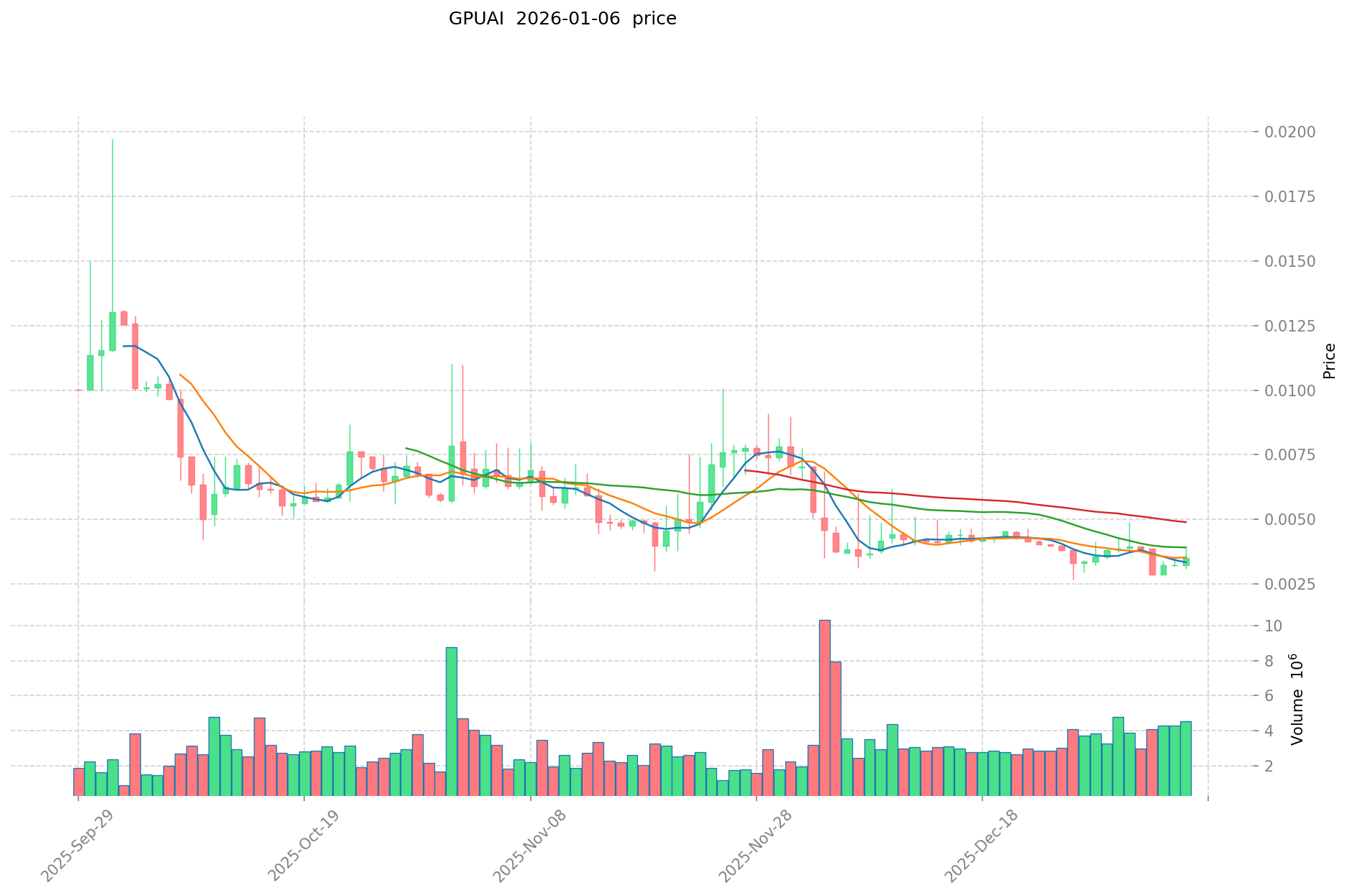
- 2025: GPUAI reached its all-time high of $0.836 on July 11, 2025, reflecting strong market sentiment during the peak trading period.
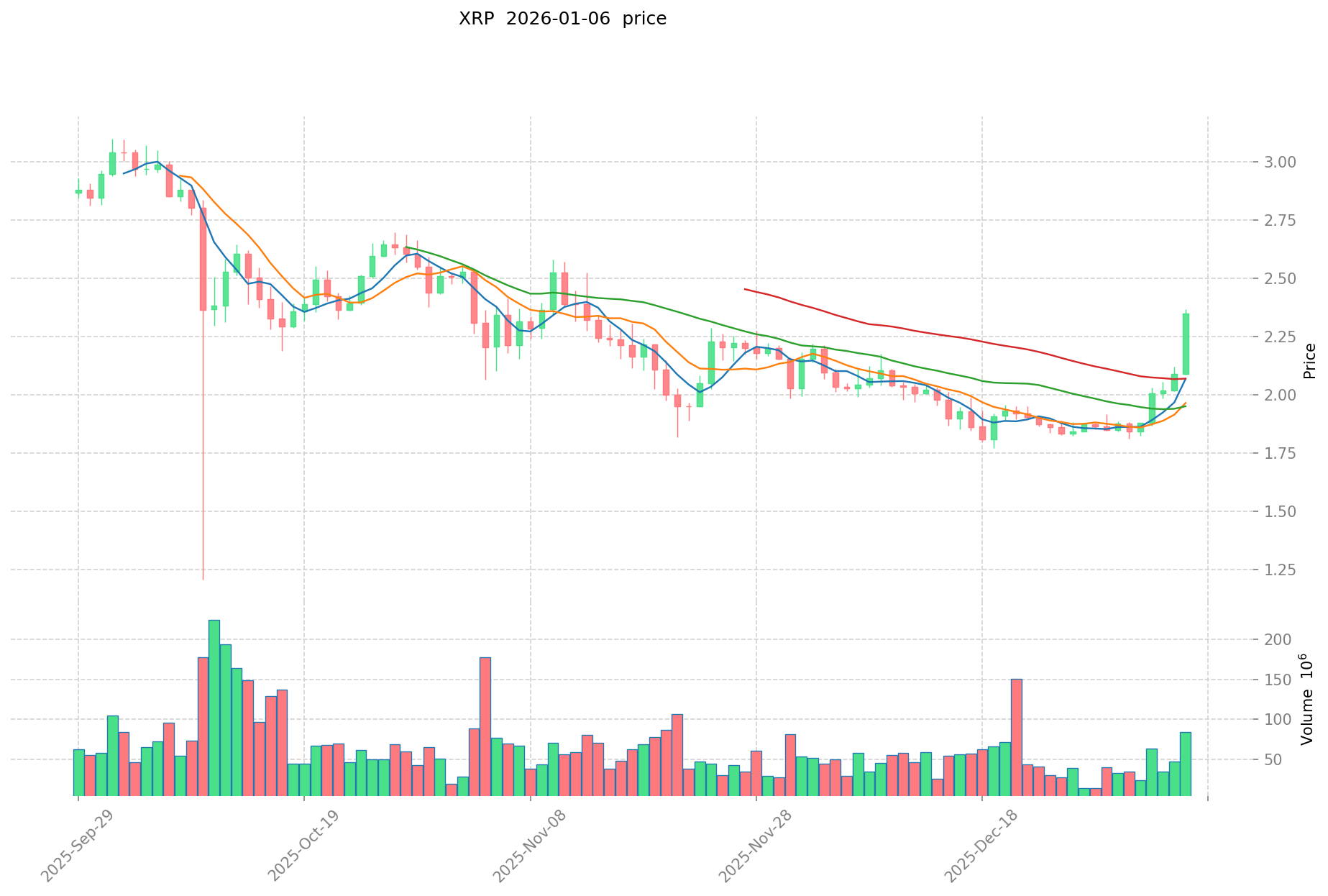
- 2025: XRP achieved its all-time high of $3.65 on July 18, 2025, driven by regulatory clarity and institutional adoption momentum.
- Comparative analysis: Within the 2025 market cycle, GPUAI declined from its peak of $0.836 to a low of $0.002663 (reached on December 26, 2025), representing a significant drawdown. Conversely, XRP demonstrated more resilience, fluctuating from its historical peak of $3.65 to a recent low of $2.087 in the past 24 hours, maintaining relatively higher price stability compared to GPUAI.
Current Market Status (January 6, 2026)
- GPUAI current price: $0.003521
- XRP current price: $2.36
- 24-hour trading volume: GPUAI $15,112.92 vs XRP $187,144,301.13
- Market emotion index (Fear & Greed Index): 26 (Fear)
Click to view real-time prices:
GPUAI vs XRP Investment Value Analysis
II. Core Factors Influencing GPUAI vs XRP Investment Value
Supply Mechanism Comparison (Tokenomics)
- GPUAI: Distributed AI computing protocol with blockchain-coordinated idle GPU resources. The token supply structure is designed to incentivize network participation and resource allocation in decentralized AI training infrastructure.
- XRP: Fixed supply of 100 billion tokens with ongoing distributions managed by the Ripple Foundation. The circulating supply is gradually released through market mechanisms and escrow arrangements.
- 📌 Historical Pattern: XRP's fixed supply model has historically influenced price dynamics through scarcity perception, while GPUAI's supply is tied to network utility and computational resource distribution, creating different value capture mechanisms.
Institutional Adoption and Market Applications
- Institutional Holdings: XRP has established stronger institutional presence through partnerships with financial institutions and payment service providers. GPUAI represents an emerging infrastructure play with growing institutional interest in decentralized AI compute solutions.
- Enterprise Adoption: XRP is utilized for cross-border payment settlements and liquidity provision in the Ripple network ecosystem. GPUAI targets the AI infrastructure market by enabling developers to access decentralized, high-performance, low-cost AI training platforms through idle GPU resource coordination.
- National Policy: Regulatory treatment varies by jurisdiction; XRP faces ongoing regulatory scrutiny regarding its classification and use in payments infrastructure. GPUAI operates within the broader AI and blockchain regulation frameworks that are still evolving globally.
Technology Development and Ecosystem Building
- GPUAI Technical Innovation: Core value proposition centers on the ability to scale GPU resource scheduling and reliably deliver industrial-grade AI tasks. 2025 represents a critical verification period for proving scalability and performance stability.
- XRP Technical Development: Ongoing improvements to the XRP Ledger protocol, including transaction speed optimization and interoperability enhancements for payment settlement networks.
- Ecosystem Comparison: XRP has established payment and settlement ecosystem through Ripple's network partnerships. GPUAI is building Web3 and AI infrastructure integration with focus on computational resource markets and AI development platforms.
Macroeconomic Environment and Market Cycles
- Inflation-Resistant Properties: XRP traditionally functions as a bridge currency in payment systems with utility linked to transaction demand. GPUAI's value proposition is tied to AI compute infrastructure demand, which may demonstrate different inflation-hedging characteristics depending on technology adoption rates and computational resource economics.
- Monetary Policy Effects: Rising interest rates and strengthening USD typically pressure cryptocurrency valuations broadly. XRP's payment utility may provide relative stability during monetary tightening. GPUAI's infrastructure utility is more sensitive to tech sector investment cycles and enterprise AI spending patterns.
- Geopolitical Factors: Cross-border payment demand for XRP is influenced by international trade dynamics and sanctions environments. GPUAI's global GPU resource coordination benefits from increasing demand for decentralized AI computing infrastructure across jurisdictions with varying regulatory environments for computational services.
III. 2026-2031 Price Forecast: GPUAI vs XRP
Short-term Forecast (2026)
- GPUAI: Conservative $0.00259962–$0.003513 | Optimistic $0.003513–$0.00418047
- XRP: Conservative $1.49376–$2.334 | Optimistic $2.334–$2.73078
Medium-term Forecast (2028-2029)
- GPUAI may enter the accumulation phase, with estimated price range $0.00375–$0.00639
- XRP may enter the growth phase, with estimated price range $1.45–$4.03
- Key drivers: institutional capital inflows, ETF adoption, ecosystem development
Long-term Forecast (2030-2031)
- GPUAI: Base case $0.005320–$0.007309 | Optimistic scenario $0.006392–$0.007309
- XRP: Base case $3.08–$5.43 | Optimistic scenario $4.03–$5.43
View detailed price predictions for GPUAI and XRP
GPUAI:
| 年份 |
预测最高价 |
预测平均价格 |
预测最低价 |
涨跌幅 |
| 2026 |
0.00418047 |
0.003513 |
0.00259962 |
0 |
| 2027 |
0.0053084943 |
0.003846735 |
0.0026157798 |
9 |
| 2028 |
0.005035376115 |
0.00457761465 |
0.003753644013 |
30 |
| 2029 |
0.006392638858725 |
0.0048064953825 |
0.003797131352175 |
36 |
| 2030 |
0.00722344158559 |
0.005599567120612 |
0.005319588764581 |
59 |
| 2031 |
0.007309114962535 |
0.006411504353101 |
0.005962699048384 |
82 |
XRP:
| 年份 |
预测最高价 |
预测平均价格 |
预测最低价 |
涨跌幅 |
| 2026 |
2.73078 |
2.334 |
1.49376 |
0 |
| 2027 |
2.6336856 |
2.53239 |
1.2915189 |
7 |
| 2028 |
3.047984604 |
2.5830378 |
1.446501168 |
10 |
| 2029 |
4.02618101886 |
2.815511202 |
2.42133963372 |
20 |
| 2030 |
4.6865591712891 |
3.42084611043 |
3.078761499387 |
45 |
| 2031 |
5.431961538751797 |
4.05370264085955 |
3.405110218322022 |
72 |
IV. Investment Strategy Comparison: GPUAI vs XRP
Long-term vs Short-term Investment Strategy
- GPUAI: Suitable for investors focusing on emerging AI infrastructure potential and willing to accept higher volatility in exchange for exposure to decentralized compute market growth. Best suited for those with 3-5 year investment horizons seeking participation in the AI computing infrastructure narrative.
- XRP: Suitable for investors seeking established payment infrastructure exposure with more stable historical price performance. Better aligned with those prioritizing cross-border payment utility and regulatory clarity milestones.
Risk Management and Asset Allocation
- Conservative investors: GPUAI 15% vs XRP 85%
- Aggressive investors: GPUAI 40% vs XRP 60%
- Hedging tools: Stablecoin allocation for volatility protection, options strategies for downside risk management, cross-asset diversification with Bitcoin and Ethereum to reduce idiosyncratic risk
V. Potential Risk Comparison
Market Risk
- GPUAI: Significantly higher price volatility evidenced by 2025 performance (decline from $0.836 to $0.002663). Extreme drawdown represents substantial liquidity risk and concentration risk given lower 24-hour trading volume ($15,112.92). Early-stage asset with limited price discovery mechanisms and potential for sudden depreciations during market stress periods.
- XRP: Moderate volatility with relatively stable price floor maintained above $2.087. Larger trading volume ($187,144,301.13) provides better liquidity and price stability. However, regulatory developments remain a key risk factor affecting sentiment and valuations.
Technical Risk
- GPUAI: Scalability verification remains critical in 2025-2026; failure to demonstrate reliable GPU resource scheduling and industrial-grade AI task delivery could undermine technology thesis. Network security and oracle reliability in coordinating decentralized GPU resources present operational risks.
- XRP: Ongoing XRP Ledger protocol optimization requires continuous development oversight. Interoperability enhancements for payment settlement may face technical implementation challenges. Competitive pressure from other payment infrastructure solutions poses long-term technical differentiation risk.
Regulatory Risk
- Global regulatory frameworks for AI and blockchain continue evolving; GPUAI faces uncertainty regarding computational resource commoditization and cross-border AI compute services classification. XRP remains subject to ongoing regulatory scrutiny regarding asset classification and payment infrastructure compliance, though recent regulatory clarity in select jurisdictions has reduced some uncertainty.
VI. Conclusion: Which Is the Better Buy?
📌 Investment Value Summary:
- GPUAI Advantages: Exposure to high-growth AI infrastructure market; potential for significant upside if network scalability and adoption targets materialize; positioned at intersection of two major trends (AI and blockchain). Lower entry valuation provides asymmetric risk-reward for longer-term investors.
- XRP Advantages: Established payment infrastructure with proven institutional adoption; more resilient price performance and higher liquidity; regulatory progress provides clearer pathway for institutional capital flows. Stronger ecosystem maturity and demonstrated use cases in cross-border settlements.
✅ Investment Recommendations:
- Beginner investors: Prioritize XRP for core allocation due to lower volatility, established track record, and clearer regulatory landscape. Allocate smaller experimental position to GPUAI only if comfortable with emerging technology risk.
- Experienced investors: Consider complementary positioning with larger XRP allocation (60-70%) for stability and income-generating opportunities through staking/lending; maintain GPUAI position (20-30%) for exposure to AI infrastructure upside with defined risk management and rebalancing discipline.
- Institutional investors: XRP presents more suitable entry point for large capital deployment given market depth and regulatory framework maturity. GPUAI remains a forward-looking infrastructure allocation requiring higher due diligence on technical scalability and ecosystem development before substantial commitment.
⚠️ Risk Disclaimer: Cryptocurrency markets demonstrate extreme volatility, and historical performance does not guarantee future results. This article does not constitute investment advice. Investors should conduct independent research and consult qualified financial advisors before making investment decisions.
FAQ
GPUAI和XRP分别是什么?它们的核心功能有什么区别?
GPUAI是区块链GPU协处理器,专注于链上复杂计算与性能提升。XRP是Ripple跨境支付加密货币。两者核心功能完全不同,GPUAI赋能计算,XRP用于支付转账。
GPUAI和XRP在技术架构上有哪些主要差异?
GPUAI采用高并行计算架构,专为GPU芯片和AI任务优化;XRP基于分布式共识账本技术。前者重点在计算效率,后者重点在交易结算和互操作性。
GPUAI和XRP的应用场景分别是什么?各自的优势和劣势是什么?
GPUAI专注AI计算加速,优势是高效处理复杂任务,劣势是应用生态待完善。XRP主要用于跨境支付,优势是交易速度快、成本低,劣势是面临监管风险且应用场景相对单一。
从投资角度看,GPUAI和XRP哪个更值得关注?风险分别是什么?
GPUAI受益于AI算力需求增长,潜力更大。XRP面临监管风险。GPUAI主要风险是技术竞争,XRP则是法律不确定性。选择取决于你的风险偏好。
GPUAI和XRP的市场表现和流动性如何对比?
XRP市场表现稳定,流动性充足,交易额大;GPUAI市场表现相对较弱,流动性较低,交易额有限。整体而言,XRP在市场成熟度和流动性方面表现更优。
GPUAI和XRP在生态建设和社区支持方面有什么区别?
GPUAI专注AI计算生态,吸引开发者和算力提供者;XRP侧重支付网络,拥有更广泛的金融机构和银行支持。两者生态方向差异明显。
* The information is not intended to be and does not constitute financial advice or any other recommendation of any sort offered or endorsed by Gate.