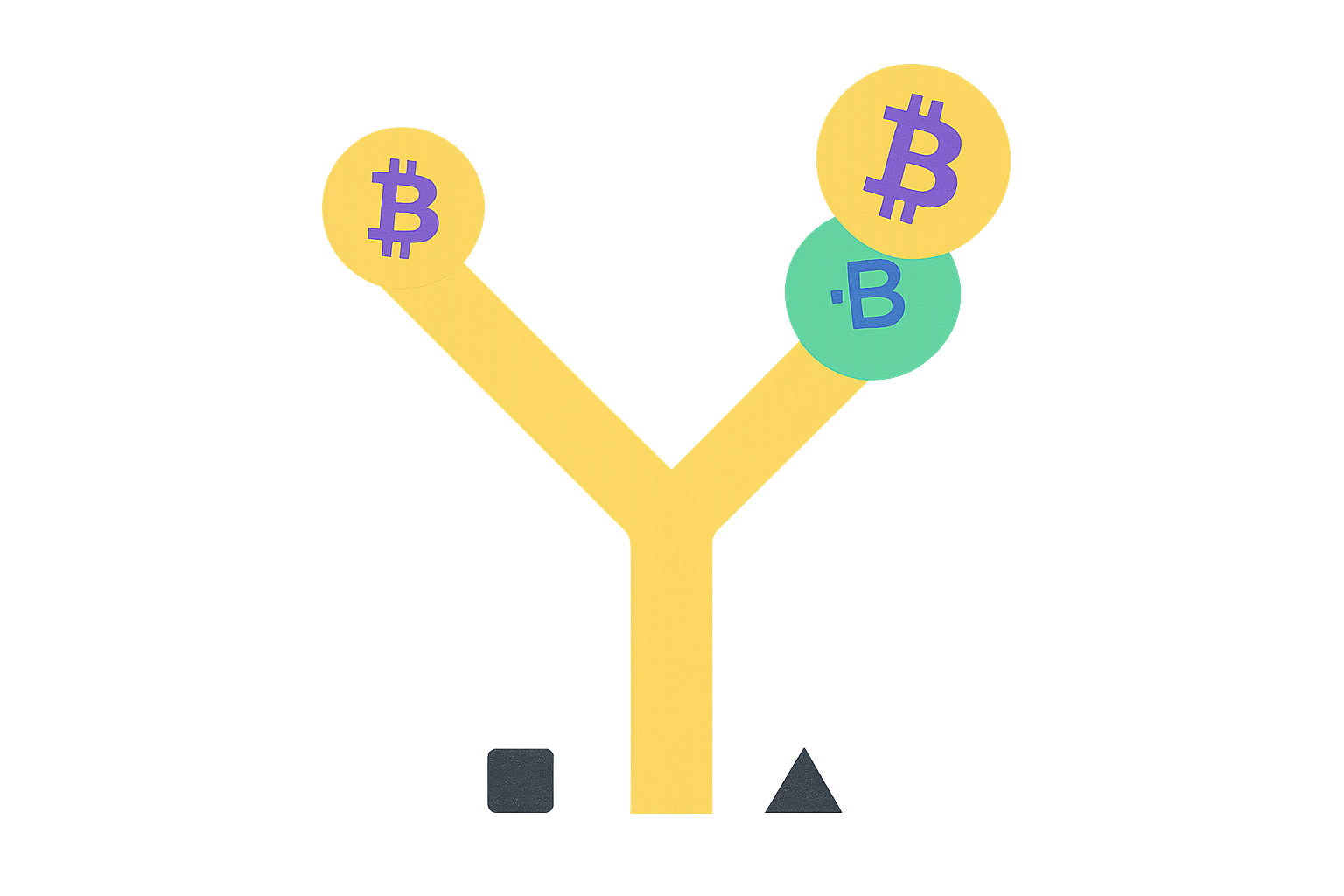
Explore the fundamental distinctions between Hard Forks and Soft Forks in blockchain. Learn how protocol upgrades operate, how they affect the Bitcoin network and other cryptocurrencies, and why forks play a vital role in the decentralized evolution of blockchain networks.
Introduction
When you get a notification to update your digital banking app, you probably don't hesitate to accept it. But with open-source cryptocurrencies, it's a different story. There’s no central authority or bank to push updates or make changes at will. That means adding new features to blockchain networks can be a major challenge.
This article explores how cryptocurrency networks can be upgraded even without a central authority. Two key mechanisms enable this: Hard Forks and Soft Forks. Understanding these concepts is crucial for anyone looking to grasp how blockchains evolve and adapt to community needs.
Who Makes Decisions in a Blockchain Network?
To understand how forks work, you first need to know who participates in blockchain network governance and decision-making.
Developers
Developers create and update the network’s source code. For most cryptocurrencies, anyone can contribute. The code is open for public review, enabling the community to suggest and implement improvements. Developers collaborate to introduce new features and security enhancements.
Miners
Miners secure the blockchain and validate transactions. They run the cryptocurrency’s code and dedicate significant computing power to add new blocks. Block rewards and transaction fees incentivize miners economically to maintain network security.
Full Node Users
Full nodes form the backbone of a cryptocurrency network. They validate, send, and receive blocks and transactions to ensure data integrity. Full nodes also store a complete copy of the blockchain, safeguarding the network’s historical record.
Many believe real control of the network lies with full nodes. Since participation is voluntary—users choose which software to run—the community ultimately holds decision-making power.
What Is a Fork?
A fork occurs when software is copied and substantially modified. The original project continues, but the new project moves in a different direction. This concept is fundamental to understanding blockchain evolution.
Forked projects share a common origin and development history. Like a road that splits, the projects permanently diverge. This split can be either temporary or permanent, depending on the type of fork.
Hard Forks vs. Soft Forks
What Is a Hard Fork?
A Hard Fork is a software update that isn’t compatible with previous versions. This typically happens when nodes adopt new rules that conflict with older ones. New nodes can only communicate with others running the same new version. The result is a blockchain split, creating two separate networks: one with the old rules and one with the new.
Because both networks share the same history, if you held coins before the fork, you’ll have coins on both chains. This means you receive equivalent tokens on the new chain as well.
A major real-world Hard Fork occurred in 2017, splitting the Bitcoin blockchain into Bitcoin (BTC) and Bitcoin Cash (BCH). The fork followed intense technical and community debate about how best to solve Bitcoin’s scalability challenges.
What Is a Soft Fork?
A Soft Fork is a backward-compatible update. Nodes that have upgraded can still communicate with those running the old version. Soft forks introduce new rules that don’t conflict with existing ones. This backwards compatibility is what sets soft forks apart.
A prime example is Segregated Witness (SegWit). Older nodes could still validate blocks and transactions, but didn’t interpret them fully. SegWit changed how signature data is stored, increasing transaction capacity while preserving compatibility with older nodes.
Hard Forks vs. Soft Forks – Which Is Better?
Each type of fork serves distinct purposes as blockchains evolve. Highly contentious Hard Forks can fracture a community and the network itself. But well-planned, widely supported forks allow for major upgrades when consensus is reached.
Soft Forks are less disruptive and generally safer. Their scope is more limited, though, since updates can’t conflict with existing rules. If an upgrade can be made compatible with older versions, there’s no risk of splitting the network or community.
Deciding between a Hard Fork and a Soft Fork depends on the scope of the proposed changes and the level of community agreement. Minor, compatible updates are better suited for Soft Forks, while fundamental changes may require a Hard Fork.
Final Thoughts
Hard Forks and Soft Forks are essential for the long-term growth of blockchain networks. They allow decentralized systems to evolve and upgrade—even in the absence of a central authority. These mechanisms ensure blockchains remain flexible and responsive to the community’s needs.
Forks let blockchains and cryptocurrencies add new features over time, boosting security, scalability, and usability. Without these upgrade paths, blockchains would require centralized, top-down control—contradicting the very principles of decentralized crypto. Understanding these processes is key to grasping how blockchain networks work and evolve.
FAQ
What’s the difference between a Hard Fork and a Soft Fork?
A Hard Fork changes the blockchain protocol so older nodes become incompatible, while a Soft Fork retains compatibility with previous versions. A Hard Fork is a permanent split; a Soft Fork enables gradual expansion.
Why do blockchain projects use hard forks or soft forks?
Projects use hard forks or soft forks to update protocols and improve network performance and security. Hard forks enable structural changes, while soft forks refine existing rules. Both approaches support innovation built on community consensus.
During a hard fork, everyone holding tokens on the original chain receives an equal amount of tokens on the new chain. Your assets are duplicated, giving you access to both versions.
What are the major hard fork events in blockchain history?
Key hard forks include Ethereum’s 2016 split after the DAO incident, which created Ethereum Classic (ETC). Other major examples are the 2017 launch of Bitcoin Cash, driven by disagreements over block size, and the Ethereum Merge in 2022, which shifted consensus from PoW to PoS.
Yes, soft forks retain backward compatibility. They add new rules while maintaining compatibility with the existing protocol, so non-upgraded nodes can continue operating as usual.
How should a typical user prepare for an upcoming hard fork or soft fork?
Update your client or wallet to a version that supports the new protocol. Make sure your exchange or service provider supports the upgrade. Keep your private keys secure and follow official updates.
Does a hard fork create a new coin? How do I get the new coin from the fork?
Yes, a hard fork produces a new coin. If you hold the original coin, you’ll automatically receive the new coin in the same wallet—no extra steps needed. The amount of new coins matches your balance at the time of the fork.
* The information is not intended to be and does not constitute financial advice or any other recommendation of any sort offered or endorsed by Gate.