This comprehensive guide compares HAEDAL and ETC investment characteristics across multiple dimensions. HAEDAL, a 2025 liquid staking protocol on Sui blockchain, enables staking with liquidity maintenance through LST tokens, while ETC operates as an established smart contract platform since 2015 with code-is-law principles. Current market data shows HAEDAL at $0.03875 with $7.56M market cap versus ETC at $11.327 with $1.76B market cap, reflecting different maturity levels and volatility profiles. The analysis examines historical price trends, tokenomics, institutional adoption, technical ecosystems, and market positioning to address which asset suits different investor profiles. Price range forecasts through 2031 indicate HAEDAL's potential 141% growth and ETC's 85% growth, with varied scenarios based on ecosystem expansion and institutional capital inflows. Risk assessments cover market volatility, technical infrastructure, and regulatory frameworks to guide conservative, aggressive, and institutional invest
Introduction: Investment Comparison Between HAEDAL and ETC
In the cryptocurrency market, the comparison between HAEDAL and ETC has become a topic of interest for investors. Both assets demonstrate notable differences in market capitalization ranking, application scenarios, and price performance, representing distinct positioning within the crypto ecosystem.
HAEDAL: Launched in 2025 as a liquid staking protocol natively built on Sui, it provides infrastructure allowing users to stake SUI and Walrus tokens while maintaining liquidity through liquid staking tokens (LST) for DeFi participation.
ETC (Ethereum Classic): Operating since 2015 as a continuation of the original Ethereum chain, it serves as a decentralized platform for smart contract execution, maintaining the "code is law" principle and supporting programmable digital asset management.
This analysis examines historical price trends, supply mechanisms, institutional adoption, technical ecosystems, and future projections to provide a comprehensive comparison of HAEDAL vs ETC investment characteristics, addressing investors' fundamental question:
"Which asset presents a more suitable investment opportunity based on current market conditions?"
I. Historical Price Comparison and Current Market Landscape
HAEDAL and ETC Historical Price Trends
- 2025: HAEDAL reached its highest price of $0.3059 on July 17, 2025, following its initial market launch. The token experienced significant volatility in its early trading period.
- 2025: HAEDAL recorded its lowest price of $0.03495 on December 18, 2025, reflecting broader market corrections and early-stage price discovery.
- 2021: ETC reached its all-time high of $167.09 on May 7, 2021, during the broader cryptocurrency market rally.
- 2016: ETC was launched following the DAO incident and Ethereum hard fork, establishing itself as the continuation of the original Ethereum blockchain with the "code is law" principle.
- Comparative Analysis: During recent market cycles, HAEDAL has demonstrated high volatility with an 87.33% decline from its peak ($0.3059) to current levels, while ETC has experienced a 93.22% decline from its historical high ($167.09) to current trading levels, reflecting its longer market history and multiple cycle exposure.
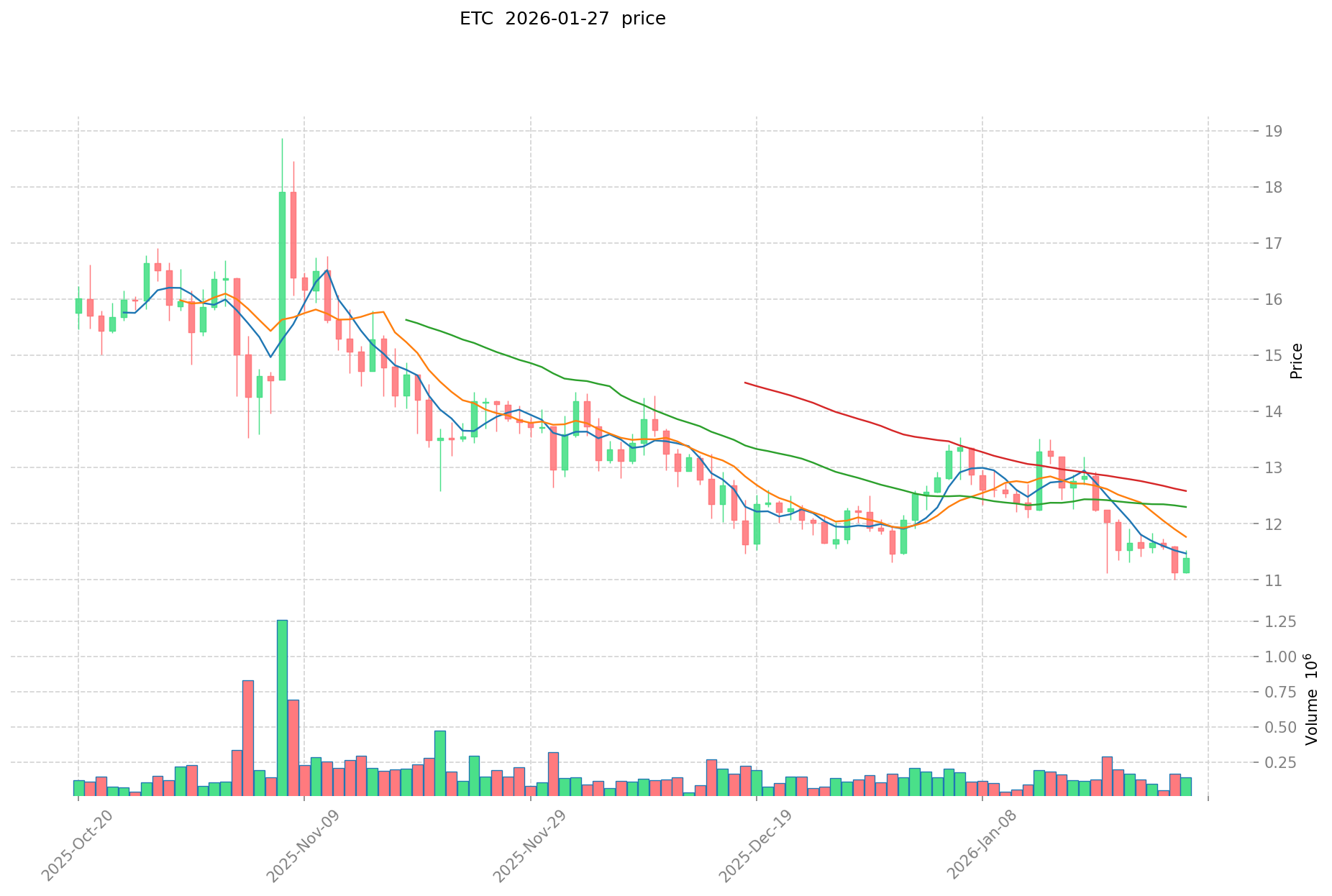
Current Market Status (January 27, 2026)
- HAEDAL current price: $0.03875
- ETC current price: $11.327
- 24-hour trading volume: HAEDAL $281,444 vs ETC $1,308,767
- Market sentiment index (Fear & Greed Index): 29 (Fear)
- HAEDAL 24-hour price change: -3.51%
- ETC 24-hour price change: -0.43%
- Market capitalization: HAEDAL $7.56M vs ETC $1.76B
View real-time prices:

II. Core Factors Influencing HAEDAL vs ETC Investment Value
Tokenomics Comparison
-
HAEDAL: The protocol operates within the liquid staking sector, optimizing value and capital efficiency on the SUI chain through liquid staking derivatives. The supply mechanism aims to maximize on-chain value creation while providing flexible infrastructure for decentralized finance projects.
-
ETC: As a blockchain platform, ETC's value dynamics are influenced by its underlying supply structure and network economics. The platform maintains focus on network security and continued development efforts.
-
📌 Historical Pattern: Supply mechanisms and tokenomics design play a role in shaping price cycles and value accumulation patterns over time.
Institutional Adoption and Market Application
-
Institutional Holdings: Market data suggests varying levels of institutional interest in liquid staking protocols versus established blockchain platforms.
-
Enterprise Adoption: HAEDAL focuses on providing secure and flexible infrastructure for DeFi projects within its ecosystem. ETC's adoption relates to its platform capabilities and dApp deployment potential.
-
Regulatory Environment: Different jurisdictions maintain varying approaches toward liquid staking protocols and blockchain platforms, affecting their respective market positions.
Technology Development and Ecosystem Building
-
HAEDAL Technology: The protocol continues to optimize its infrastructure, focusing on enhancing security and flexibility for DeFi applications. The team emphasizes ongoing protocol improvements to maintain competitiveness within the liquid staking space.
-
ETC Technology: Platform development priorities include active upgrades and maintaining network security. The focus remains on supporting dApp deployment and use case expansion.
-
Ecosystem Comparison: HAEDAL concentrates on DeFi infrastructure and liquid staking applications within the SUI ecosystem. ETC supports broader platform capabilities including smart contract deployment and various decentralized applications.
Macroeconomic Environment and Market Cycles
-
Performance Under Inflation: Different asset categories within the crypto space may exhibit varying characteristics during inflationary periods, influenced by their utility and market positioning.
-
Monetary Policy Impact: Market trends, including bull and bear cycles, represent primary drivers affecting both liquid staking protocols and blockchain platforms. Interest rate policies and broader financial market conditions can influence investor behavior across crypto assets.
-
Geopolitical Factors: Market demand, adoption rates of decentralized applications, and overall cryptocurrency market trends serve as key drivers for both assets, though their specific sensitivities may differ based on their respective use cases and positioning.
III. 2026-2031 Price Forecast: HAEDAL vs ETC
Short-term Forecast (2026)
- HAEDAL: Conservative $0.0325 - $0.0387 | Optimistic $0.0387 - $0.0569
- ETC: Conservative $8.57 - $11.28 | Optimistic $11.28 - $13.99
Mid-term Forecast (2028-2029)
- HAEDAL may enter a growth phase, with estimated price range of $0.052 - $0.086
- ETC may enter an expansion phase, with estimated price range of $8.93 - $19.25
- Key drivers: institutional capital inflows, ETF developments, ecosystem expansion
Long-term Forecast (2031)
- HAEDAL: Base scenario $0.054 - $0.094 | Optimistic scenario $0.094 - $0.110
- ETC: Base scenario $11.32 - $20.96 | Optimistic scenario $20.96 - $22.21
View detailed price predictions for HAEDAL and ETC
Disclaimer
HAEDAL:
| Year |
Predicted High Price |
Predicted Average Price |
Predicted Low Price |
Price Change |
| 2026 |
0.0569037 |
0.03871 |
0.0325164 |
0 |
| 2027 |
0.059280494 |
0.04780685 |
0.0310744525 |
23 |
| 2028 |
0.07549657752 |
0.053543672 |
0.05193736184 |
38 |
| 2029 |
0.0858117659308 |
0.06452012476 |
0.0587133135316 |
66 |
| 2030 |
0.111997258564646 |
0.0751659453454 |
0.059381096822866 |
93 |
| 2031 |
0.110426290306927 |
0.093581601955023 |
0.054277329133913 |
141 |
ETC:
| Year |
Predicted High Price |
Predicted Average Price |
Predicted Low Price |
Price Change |
| 2026 |
13.98844 |
11.281 |
8.57356 |
0 |
| 2027 |
16.1724416 |
12.63472 |
9.9814288 |
11 |
| 2028 |
14.979724032 |
14.4035808 |
8.930220096 |
27 |
| 2029 |
19.24606466496 |
14.691652416 |
13.07557065024 |
29 |
| 2030 |
24.9442220545056 |
16.96885854048 |
13.4053982469792 |
49 |
| 2031 |
22.213932715342368 |
20.9565402974928 |
11.316531760646112 |
85 |
IV. Investment Strategy Comparison: HAEDAL vs ETC
Long-term vs Short-term Investment Strategies
-
HAEDAL: May suit investors focused on liquid staking infrastructure and DeFi ecosystem exposure within the Sui blockchain environment. The protocol's emphasis on capital efficiency through liquid staking derivatives positions it within the specialized DeFi infrastructure segment.
-
ETC: May appeal to investors seeking exposure to established blockchain platforms with smart contract capabilities and a longer operational history. The platform's positioning as a continuation of the original Ethereum blockchain offers characteristics associated with mature blockchain infrastructure.
Risk Management and Asset Allocation
-
Conservative Investors: Consider lower allocation to emerging protocols like HAEDAL (10-15%) versus established platforms like ETC (20-30%), with remaining portfolio distributed across diversified crypto assets and risk management instruments.
-
Aggressive Investors: May explore higher allocation to growth-oriented assets like HAEDAL (25-35%) balanced with established platforms like ETC (30-40%), while maintaining risk management protocols.
-
Hedging Tools: Portfolio risk management approaches may include stablecoin reserves for liquidity management, options strategies for downside protection, and cross-asset diversification to manage correlation risks.
V. Potential Risk Comparison
Market Risk
-
HAEDAL: As a protocol launched in 2025, HAEDAL exhibits characteristics typical of newer market entrants, including price volatility and limited historical performance data. The 87.33% decline from peak levels reflects sensitivity to market sentiment shifts and liquidity conditions.
-
ETC: Historical performance shows exposure to broader cryptocurrency market cycles, with a 93.22% decline from peak levels. Market positioning as an established blockchain platform influences its response to sector-wide trends and institutional participation patterns.
Technical Risk
-
HAEDAL: Infrastructure security and protocol optimization represent ongoing development priorities. The focus on flexible DeFi infrastructure requires continued technical refinement and ecosystem integration.
-
ETC: Network maintenance and security considerations remain focal points for platform development. The emphasis on supporting dApp deployment necessitates continuous technical improvements and network stability measures.
Regulatory Risk
- Global regulatory frameworks continue to evolve regarding liquid staking protocols and blockchain platforms. Different jurisdictions maintain varying approaches that may affect operational parameters, market access, and institutional participation for both HAEDAL and ETC, though specific impacts depend on regulatory developments and compliance frameworks in respective markets.
VI. Conclusion: Which Is the Better Buy?
📌 Investment Value Summary:
-
HAEDAL Characteristics: Focuses on liquid staking infrastructure within the Sui ecosystem, providing DeFi-oriented capital efficiency solutions. The protocol represents exposure to emerging liquid staking technology with associated growth potential and volatility characteristics.
-
ETC Characteristics: Operates as an established blockchain platform with smart contract capabilities and longer operational history. The platform's positioning offers exposure to mature blockchain infrastructure with associated stability and ecosystem depth.
✅ Investment Considerations:
-
New Investors: Consider starting with established platforms offering longer track records and greater market liquidity, while maintaining strict risk management protocols and diversification principles. Thorough research and understanding of underlying technology and market dynamics remains essential.
-
Experienced Investors: May explore portfolio strategies incorporating both emerging protocols and established platforms, balancing growth exposure with established infrastructure. Regular portfolio review and risk assessment practices support informed decision-making.
-
Institutional Investors: Evaluation frameworks may emphasize regulatory compliance considerations, liquidity requirements, custody solutions, and alignment with institutional investment mandates. Due diligence processes typically encompass technical assessment, market analysis, and regulatory landscape evaluation.
⚠️ Risk Disclosure: Cryptocurrency markets demonstrate substantial volatility and risk characteristics. This analysis does not constitute investment advice. Market participants should conduct independent research, assess personal risk tolerance, and consult qualified financial advisors before making investment decisions.
VII. FAQ
Q1: What are the primary differences between HAEDAL and ETC in terms of their core functionality?
HAEDAL is a liquid staking protocol launched in 2025 on the Sui blockchain, while ETC is an established blockchain platform operating since 2015. HAEDAL allows users to stake SUI and Walrus tokens while maintaining liquidity through liquid staking tokens (LST) for DeFi participation, focusing on capital efficiency and DeFi infrastructure. ETC operates as a decentralized platform for smart contract execution, maintaining the "code is law" principle and supporting programmable digital asset management with broader platform capabilities including dApp deployment.
Q2: How do the price volatility patterns compare between HAEDAL and ETC?
Both assets have experienced significant price declines from their peaks, with HAEDAL showing an 87.33% decline from its 2025 high of $0.3059 to current levels around $0.03875, while ETC has declined 93.22% from its 2021 all-time high of $167.09 to approximately $11.327. HAEDAL demonstrates higher short-term volatility typical of newly launched protocols with a 24-hour price change of -3.51%, compared to ETC's -0.43%. The market capitalization disparity is substantial, with ETC at $1.76B versus HAEDAL at $7.56M, reflecting different levels of market maturity and liquidity.
Q3: What investment allocation strategies are recommended for different investor profiles?
Conservative investors may consider allocating 10-15% to emerging protocols like HAEDAL and 20-30% to established platforms like ETC, with remaining portfolio distributed across diversified crypto assets. Aggressive investors may explore higher allocation to growth-oriented assets like HAEDAL (25-35%) balanced with established platforms like ETC (30-40%), while maintaining risk management protocols. Portfolio risk management approaches should include stablecoin reserves for liquidity management, options strategies for downside protection, and cross-asset diversification to manage correlation risks.
Q4: What are the projected price ranges for HAEDAL and ETC through 2031?
For 2026, HAEDAL's conservative forecast ranges from $0.0325 to $0.0387, with optimistic scenarios reaching $0.0569, while ETC's conservative forecast spans $8.57 to $11.28, with optimistic projections up to $13.99. By 2031, HAEDAL's base scenario projects $0.054 to $0.094 (optimistic: $0.110), representing a potential 141% price change from current levels. ETC's 2031 base scenario estimates $11.32 to $20.96 (optimistic: $22.21), indicating a potential 85% price change, with key drivers including institutional capital inflows, ETF developments, and ecosystem expansion.
Q5: What are the main technical and regulatory risks associated with each asset?
HAEDAL faces technical risks related to infrastructure security and protocol optimization as an emerging liquid staking protocol, requiring continued refinement and ecosystem integration. ETC's technical considerations focus on network maintenance, security, and supporting dApp deployment capabilities. Regulatory risks vary for both assets as global frameworks continue to evolve regarding liquid staking protocols and blockchain platforms. Different jurisdictions maintain varying approaches that may affect operational parameters, market access, and institutional participation, though specific impacts depend on regulatory developments and compliance frameworks in respective markets.
Q6: How do institutional adoption patterns differ between HAEDAL and ETC?
Market data suggests varying levels of institutional interest between liquid staking protocols and established blockchain platforms. HAEDAL focuses on providing secure and flexible infrastructure for DeFi projects within the Sui ecosystem, targeting institutional participants interested in liquid staking derivatives and capital efficiency solutions. ETC's institutional adoption relates to its platform capabilities, dApp deployment potential, and positioning as an established blockchain infrastructure with longer operational history. Institutional evaluation frameworks typically emphasize regulatory compliance considerations, liquidity requirements, custody solutions, and alignment with institutional investment mandates for both assets.
Q7: Which asset is more suitable for new versus experienced cryptocurrency investors?
New investors should consider starting with established platforms like ETC that offer longer track records, greater market liquidity ($1.76B market cap versus $7.56M for HAEDAL), and more historical performance data for analysis. This approach supports learning while maintaining risk management protocols and diversification principles. Experienced investors may explore portfolio strategies incorporating both emerging protocols like HAEDAL and established platforms like ETC, balancing growth exposure with infrastructure stability. Both investor categories should conduct thorough research, understand underlying technology and market dynamics, assess personal risk tolerance, and maintain regular portfolio review practices before making investment decisions.
* The information is not intended to be and does not constitute financial advice or any other recommendation of any sort offered or endorsed by Gate.