This comprehensive analysis compares HAEDAL and SNX, two distinct DeFi protocols operating across different blockchains and use cases. HAEDAL, a liquid staking protocol launched on Sui in 2025, enables users to stake SUI and Walrus tokens while maintaining liquidity. SNX, an established synthetic asset platform since 2018, facilitates trading of fiat currencies, metals, indices, and cryptocurrencies. The article examines historical price trends, tokenomics, technical development, and ecosystem positioning to help investors evaluate investment opportunities. HAEDAL currently trades at $0.03868 with higher volatility, while SNX stands at $0.4116 with established market presence. Through 2031 price projections, risk assessment, and tailored investment strategies for different investor profiles, this guide addresses critical concerns for selecting appropriate allocations between emerging and established DeFi infrastructure protocols.
Introduction: HAEDAL vs SNX Investment Comparison
In the cryptocurrency market, the comparison between HAEDAL and SNX has become a topic of interest for investors. These two projects exhibit notable differences in market capitalization ranking, application scenarios, and price performance, representing distinct positioning within the crypto asset landscape.
HAEDAL (HAEDAL): Launched in 2025, this protocol has gained recognition as a liquid staking infrastructure natively built on Sui, enabling users to stake SUI and Walrus tokens while maintaining liquidity through liquid staking tokens (LST).
SNX (SNX): Introduced in 2018, Synthetix has established itself as a decentralized protocol supporting synthetic assets, including fiat currencies pegged to the US dollar, precious metals, indices, and other cryptocurrencies.
This article will analyze the investment value comparison between HAEDAL and SNX through historical price trends, supply mechanisms, technical ecosystem, and future outlook, attempting to address investors' key concerns:
"Which asset presents a more compelling investment opportunity at this time?"
I. Historical Price Comparison and Current Market Status
HAEDAL (Haedal Protocol) vs SNX (Synthetix) Historical Price Trends
- 2025: HAEDAL experienced notable price volatility following its launch in late April 2025, reaching a peak of $0.3059 in July 2025.
- 2021: SNX recorded significant gains during the broader market expansion, achieving an all-time high of $28.53 in February 2021.
- Comparative Analysis: During the recent market cycle, HAEDAL declined from its peak of $0.3059 to a low of $0.03495, representing a substantial correction. In contrast, SNX has undergone a prolonged downtrend from its historical peak, with its current valuation significantly below previous highs.
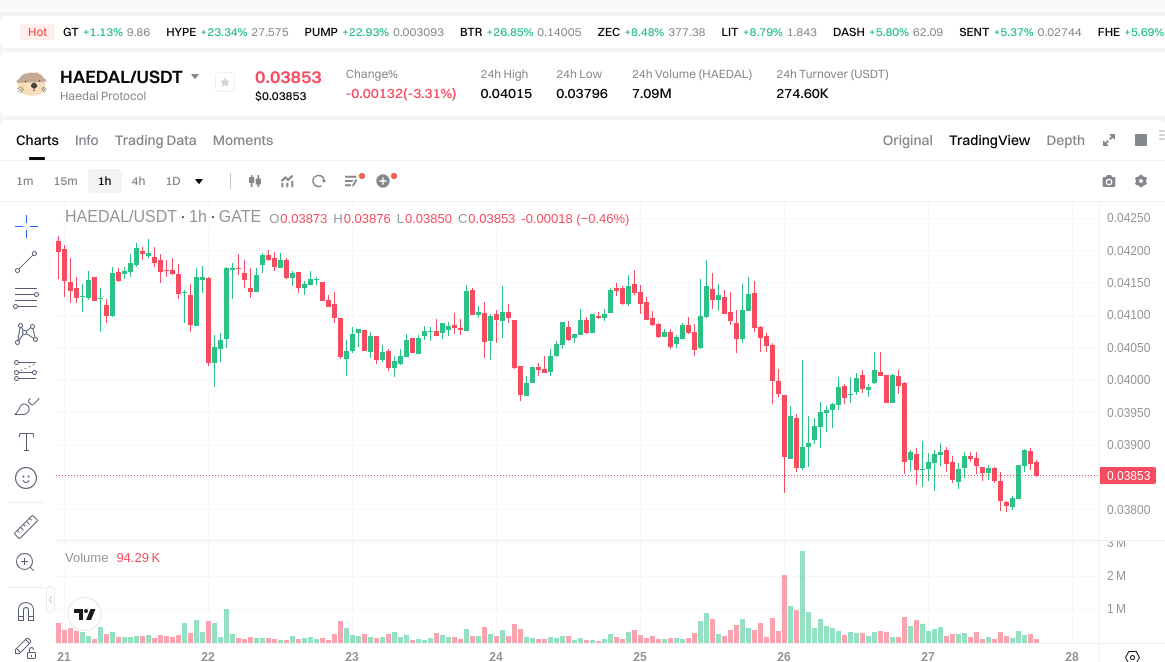
Current Market Status (2026-01-27)
- HAEDAL current price: $0.03868
- SNX current price: $0.4116
- 24-hour trading volume: HAEDAL $272,440.87 vs SNX $942,868.33
- Market Sentiment Index (Fear & Greed Index): 29 (Fear)
Check real-time prices:

II. Core Factors Influencing HAEDAL vs SNX Investment Value
Supply Mechanism Comparison (Tokenomics)
- HAEDAL: The reference materials do not provide specific information about HAEDAL's supply mechanism or tokenomics structure.
- SNX: The reference materials do not provide detailed information about SNX's supply mechanism or tokenomics structure.
- 📌 Historical Pattern: Supply mechanisms can play a role in shaping price cycles through factors such as scarcity dynamics and distribution schedules.
Institutional Adoption and Market Application
- Institutional Holdings: The reference materials do not contain comparative data on institutional preference between HAEDAL and SNX.
- Enterprise Adoption: The materials indicate that SNX has been working on solutions to address Ethereum network constraints, with experimental data suggesting transaction processing capabilities exceeding 100,000 TPS and the potential for zero-gas transactions. HAEDAL has been noted for its focus on reducing transaction costs. However, specific applications in cross-border payments, settlements, or investment portfolios are not detailed in the provided materials.
- National Policies: The reference materials do not provide information on different countries' regulatory stances toward either asset.
Technical Development and Ecosystem Building
- HAEDAL Technical Development: According to the materials, HAEDAL has been associated with efforts to reduce transaction costs. The project was scheduled to be listed on Binance Alpha on April 29 at 20:00, with eligible users holding at least 80 Alpha points receiving allocations within 10 minutes of trading commencement.
- SNX Technical Development: The materials indicate that SNX has been developing solutions to address Ethereum mainnet's high transaction fees and low TPS limitations. Experimental data suggests the potential for transaction processing exceeding 100,000 TPS with zero-gas transaction capabilities.
- Ecosystem Comparison: The reference materials do not provide detailed information on the implementation status of DeFi, NFT, payment systems, or smart contracts for either project.
Macroeconomic and Market Cycles
- Performance in Inflationary Environments: The reference materials do not contain information comparing the anti-inflation properties of HAEDAL and SNX.
- Macroeconomic Monetary Policy: The materials do not provide analysis on how interest rates or the US dollar index impact either asset.
- Geopolitical Factors: The reference materials do not discuss cross-border transaction demand or international situation impacts on these assets.
III. 2026-2031 Price Prediction: HAEDAL vs SNX
Short-term Prediction (2026)
- HAEDAL: Conservative $0.027-$0.039 | Optimistic $0.039-$0.043
- SNX: Conservative $0.30-$0.41 | Optimistic $0.41-$0.48
Mid-term Prediction (2028-2029)
- HAEDAL may enter a growth phase, with estimated prices ranging from $0.025 to $0.064
- SNX may enter an expansion phase, with estimated prices ranging from $0.30 to $0.87
- Key drivers: institutional capital inflows, ETF adoption, ecosystem development
Long-term Prediction (2030-2031)
- HAEDAL: Base scenario $0.048-$0.070 | Optimistic scenario $0.064-$0.095
- SNX: Base scenario $0.42-$0.84 | Optimistic scenario $0.76-$1.00
View detailed price predictions for HAEDAL and SNX
Disclaimer: Price predictions are based on historical data analysis and market trends. Cryptocurrency markets are highly volatile and subject to various risks. These projections should not be considered as investment advice. Always conduct your own research and consult with financial professionals before making investment decisions.
HAEDAL:
| Year |
Predicted High Price |
Predicted Average Price |
Predicted Low Price |
Price Change |
| 2026 |
0.0431312 |
0.03851 |
0.0273421 |
0 |
| 2027 |
0.04286163 |
0.0408206 |
0.031840068 |
5 |
| 2028 |
0.05648550525 |
0.041841115 |
0.02468625785 |
8 |
| 2029 |
0.0639123031625 |
0.049163310125 |
0.02900635297375 |
27 |
| 2030 |
0.08367595383275 |
0.05653780664375 |
0.048057135647187 |
46 |
| 2031 |
0.094644288321637 |
0.07010688023825 |
0.063797261016807 |
81 |
SNX:
| Year |
Predicted High Price |
Predicted Average Price |
Predicted Low Price |
Price Change |
| 2026 |
0.482508 |
0.4124 |
0.301052 |
0 |
| 2027 |
0.54589388 |
0.447454 |
0.42060676 |
8 |
| 2028 |
0.7400441706 |
0.49667394 |
0.298004364 |
20 |
| 2029 |
0.871886267973 |
0.6183590553 |
0.451402110369 |
50 |
| 2030 |
0.93885455366199 |
0.7451226616365 |
0.424719917132805 |
81 |
| 2031 |
1.001966443102601 |
0.841988607649245 |
0.75778974688432 |
104 |
IV. Investment Strategy Comparison: HAEDAL vs SNX
Long-term vs Short-term Investment Strategies
- HAEDAL: May be suitable for investors focusing on emerging liquid staking infrastructure within the Sui ecosystem, with tolerance for higher volatility and longer development timelines
- SNX: May be suitable for investors interested in established decentralized synthetic asset protocols, seeking exposure to DeFi infrastructure with a longer operational history
Risk Management and Asset Allocation
- Conservative Investors: HAEDAL 20-30% vs SNX 70-80%
- Aggressive Investors: HAEDAL 50-60% vs SNX 40-50%
- Hedging Tools: Stablecoin allocation, options strategies, cross-asset portfolio diversification
V. Potential Risk Comparison
Market Risks
- HAEDAL: Higher volatility risk due to recent launch in 2025, limited price history, and developing market presence; susceptibility to broader sentiment shifts in the liquid staking sector
- SNX: Exposure to DeFi sector volatility, price correlation with broader market trends, and potential impact from synthetic asset adoption cycles
Technical Risks
- HAEDAL: Scalability considerations as the protocol develops, network stability dependent on Sui infrastructure maturity
- SNX: Network performance dependent on underlying blockchain constraints, potential smart contract vulnerabilities inherent in complex DeFi protocols
Regulatory Risks
- Global regulatory developments may affect both assets differently: liquid staking protocols like HAEDAL could face scrutiny around staking mechanisms and token classifications, while synthetic asset platforms like SNX may encounter regulatory attention regarding derivative products and securities frameworks
VI. Conclusion: Which Is the Better Buy?
📌 Investment Value Summary:
- HAEDAL Advantages: Native integration with emerging Sui ecosystem, focus on liquid staking infrastructure, potential for growth in early development phase
- SNX Advantages: Established operational history since 2018, developed synthetic asset protocol infrastructure, longer track record in the DeFi sector
✅ Investment Recommendations:
- Novice Investors: Consider starting with smaller allocations to both assets while gaining familiarity with their respective ecosystems; prioritize understanding liquid staking mechanics (HAEDAL) and synthetic asset protocols (SNX) before committing substantial capital
- Experienced Investors: May explore portfolio diversification strategies incorporating both assets based on risk tolerance, with consideration for HAEDAL's emerging protocol status versus SNX's established market position
- Institutional Investors: Conduct comprehensive due diligence on protocol maturity, liquidity profiles, and regulatory compliance frameworks for both assets; evaluate allocation based on investment mandates and risk parameters
⚠️ Risk Warning: The cryptocurrency market exhibits extreme volatility. This content does not constitute investment advice.
VII. FAQ
Q1: What are the main differences between HAEDAL and SNX in terms of their core functionalities?
HAEDAL is a liquid staking protocol built natively on Sui, while SNX is a synthetic asset protocol on Ethereum. HAEDAL enables users to stake SUI and Walrus tokens while maintaining liquidity through liquid staking tokens (LST), representing a more recent innovation in the staking infrastructure space launched in 2025. SNX, launched in 2018, focuses on creating and trading synthetic assets including fiat currencies, precious metals, indices, and cryptocurrencies through its decentralized protocol. The fundamental difference lies in their use cases: HAEDAL optimizes staking efficiency and liquidity, whereas SNX provides exposure to various asset classes through synthetic derivatives.
Q2: Which asset has shown better price stability historically?
SNX has demonstrated relatively more established price patterns with a longer historical track record. SNX reached an all-time high of $28.53 in February 2021 and currently trades at $0.4116, reflecting the broader market cycles since 2018. HAEDAL, launched in late April 2025, experienced significant volatility with a peak of $0.3059 in July 2025 before declining to $0.03495, and currently trades at $0.03868. The limited price history of HAEDAL (less than two years) compared to SNX's seven-year track record means SNX offers more historical data for analysis, though neither asset can be characterized as particularly stable given cryptocurrency market volatility.
Q3: How do the technical development roadmaps differ between these two projects?
SNX has focused on addressing Ethereum network constraints with experimental data suggesting transaction processing capabilities exceeding 100,000 TPS and potential for zero-gas transactions. HAEDAL has concentrated on reducing transaction costs within the Sui ecosystem and underwent a Binance Alpha listing in April 2025, with eligible users holding at least 80 Alpha points receiving allocations. While SNX has a more mature technical infrastructure addressing scalability challenges on Ethereum, HAEDAL benefits from being built natively on Sui, a newer blockchain designed with higher throughput in mind. The reference materials do not provide comprehensive details on DeFi, NFT, or smart contract implementations for either project.
Q4: What are the projected price ranges for both assets through 2031?
For 2026, HAEDAL's conservative estimate ranges from $0.027-$0.039 with an optimistic scenario of $0.039-$0.043, while SNX's conservative range is $0.30-$0.41 with optimistic projections of $0.41-$0.48. By 2031, HAEDAL's base scenario projects $0.048-$0.070 (optimistic: $0.064-$0.095), representing an 81% potential increase from current levels. SNX's 2031 base scenario estimates $0.42-$0.84 (optimistic: $0.76-$1.00), indicating a potential 104% increase. These projections suggest SNX may offer higher absolute growth potential, though HAEDAL's emerging status in the liquid staking sector could present different risk-reward dynamics.
Q5: How should different investor profiles approach portfolio allocation between HAEDAL and SNX?
Conservative investors may consider a 20-30% HAEDAL allocation versus 70-80% SNX allocation, prioritizing SNX's longer operational history and more established market presence. Aggressive investors might allocate 50-60% to HAEDAL and 40-50% to SNX, accepting higher volatility in exchange for potential growth from HAEDAL's emerging protocol status. Novice investors should start with smaller allocations to both assets while developing understanding of liquid staking mechanics and synthetic asset protocols. Institutional investors require comprehensive due diligence on protocol maturity, liquidity profiles, and regulatory compliance frameworks, with allocations determined by specific investment mandates and risk parameters rather than generalized ratios.
Q6: What are the primary risk factors investors should monitor for each asset?
HAEDAL faces higher volatility risk due to its recent 2025 launch, limited price history, and developing market presence, along with scalability considerations as the protocol matures and network stability dependent on Sui infrastructure. SNX encounters exposure to DeFi sector volatility, price correlation with broader market trends, potential smart contract vulnerabilities in complex protocols, and network performance dependent on underlying blockchain constraints. Both assets face regulatory risks: HAEDAL could encounter scrutiny around staking mechanisms and token classifications, while SNX may face regulatory attention regarding derivative products and securities frameworks. The cryptocurrency market's extreme volatility affects both assets, though their risk profiles differ based on development stage and protocol maturity.
Q7: How do current market conditions affect the investment thesis for both assets?
The current market sentiment index stands at 29 (Fear), indicating cautious market conditions that typically affect newer assets like HAEDAL more significantly due to lower liquidity and less established investor base. HAEDAL's 24-hour trading volume of $272,440.87 compared to SNX's $942,868.33 reflects this liquidity differential. In fearful market environments, established protocols like SNX may demonstrate more resilience due to their longer operational history and larger user base, while emerging protocols like HAEDAL could experience amplified volatility. However, market downturns also present potential accumulation opportunities for investors with higher risk tolerance, particularly for assets in early development phases with longer-term growth potential tied to ecosystem expansion rather than immediate market sentiment.
Q8: What role do institutional adoption and ecosystem development play in the long-term value proposition?
Institutional adoption represents a critical factor for both assets' long-term trajectories, though the reference materials lack specific comparative data on institutional holdings. SNX's established presence since 2018 provides a longer track record for institutional evaluation, while HAEDAL's native integration with the Sui ecosystem positions it within an emerging blockchain infrastructure that may attract institutional interest as Sui matures. Ecosystem development drives value through network effects: SNX benefits from its position in the established DeFi sector with synthetic asset trading infrastructure, while HAEDAL's growth depends on Sui ecosystem expansion and liquid staking adoption. The mid-term predictions (2028-2029) incorporate assumptions about institutional capital inflows and ecosystem development as key drivers for both assets' price appreciation potential.
* The information is not intended to be and does not constitute financial advice or any other recommendation of any sort offered or endorsed by Gate.