This comprehensive analysis compares HMT and RUNE tokens across critical investment dimensions. HMT, launched in 2021, focuses on AI-powered data labeling and human-machine collaboration, while RUNE, introduced in 2019, operates as a decentralized cross-chain liquidity protocol. Both tokens experienced severe corrections—HMT declining 99% from $1.37 to $0.00476, and RUNE falling 97% from $20.87 to $0.514 as of January 2026. RUNE demonstrates superior liquidity with $312,437.42 in daily volume versus HMT's $13,791.81. The article evaluates price forecasts through 2031, risk profiles, and tailored investment strategies across conservative, aggressive, and institutional investor categories. Current extreme market fear conditions present both opportunities and heightened volatility considerations for HMT and RUNE investments on Gate exchange.
Introduction: Investment Comparison Between HMT and RUNE
In the cryptocurrency market, the comparison between HMT vs RUNE has consistently been a topic investors cannot overlook. The two tokens exhibit notable differences in market cap ranking, application scenarios, and price performance, representing distinct positioning within the crypto asset landscape.
HUMAN (HMT): Launched in 2021, it has gained market recognition through its focus on human-machine collaboration and AI-powered data labeling services.
RUNE (RUNE): Since its introduction in 2019, it has been positioned as a decentralized cross-chain liquidity protocol, becoming one of the widely traded cryptocurrencies with substantial ecosystem presence.
This article will comprehensively analyze the investment value comparison of HMT vs RUNE across historical price trends, supply mechanisms, institutional adoption, technological ecosystems, and future predictions, attempting to answer the question investors care about most:
"Which is the better buy right now?"
I. Historical Price Comparison and Current Market Status
HMT (Coin A) and RUNE (Coin B) Historical Price Trends
- 2021: HMT reached its all-time high of $1.37 on August 14, 2021, amid broader market momentum during the crypto bull cycle.
- 2021: RUNE experienced significant growth, with its all-time high of $20.87 recorded on May 19, 2021, driven by increased adoption of decentralized cross-chain liquidity protocols.
- 2019-2026: RUNE recorded its all-time low of $0.00851264 on September 28, 2019, while HMT reached its historical low of $0.00451353 on January 30, 2026.
- Comparative Analysis: During the 2021-2026 market cycle, HMT declined from $1.37 to $0.00476, representing a substantial correction of over 99%, while RUNE fell from $20.87 to $0.514, also experiencing a decline of approximately 97%.
Current Market Status (January 30, 2026)
- HMT Current Price: $0.00476
- RUNE Current Price: $0.514
- 24-Hour Trading Volume: HMT recorded $13,791.81, compared to RUNE's $312,437.42
- Market Sentiment Index (Fear & Greed Index): 16 (Extreme Fear)
View real-time prices:
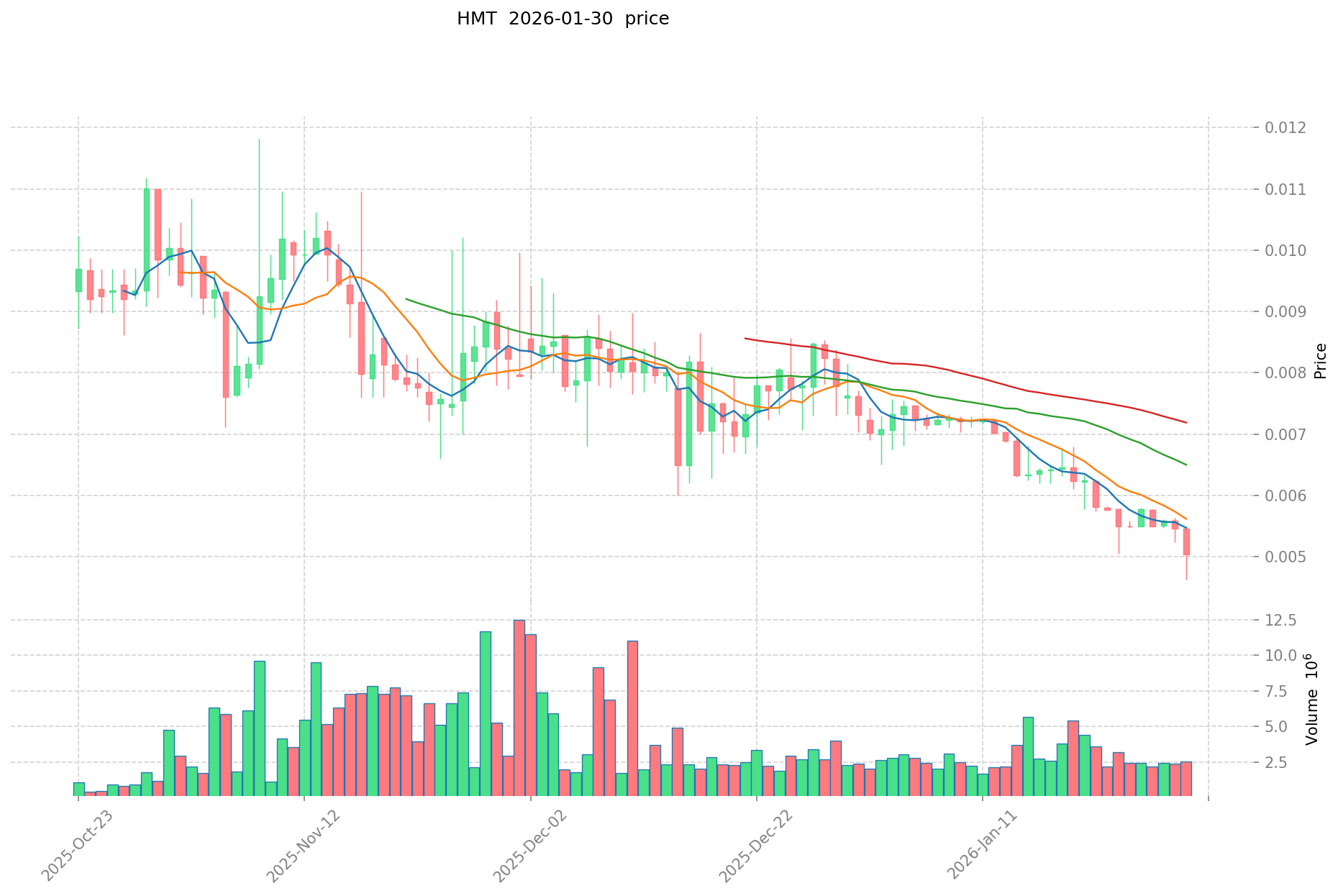
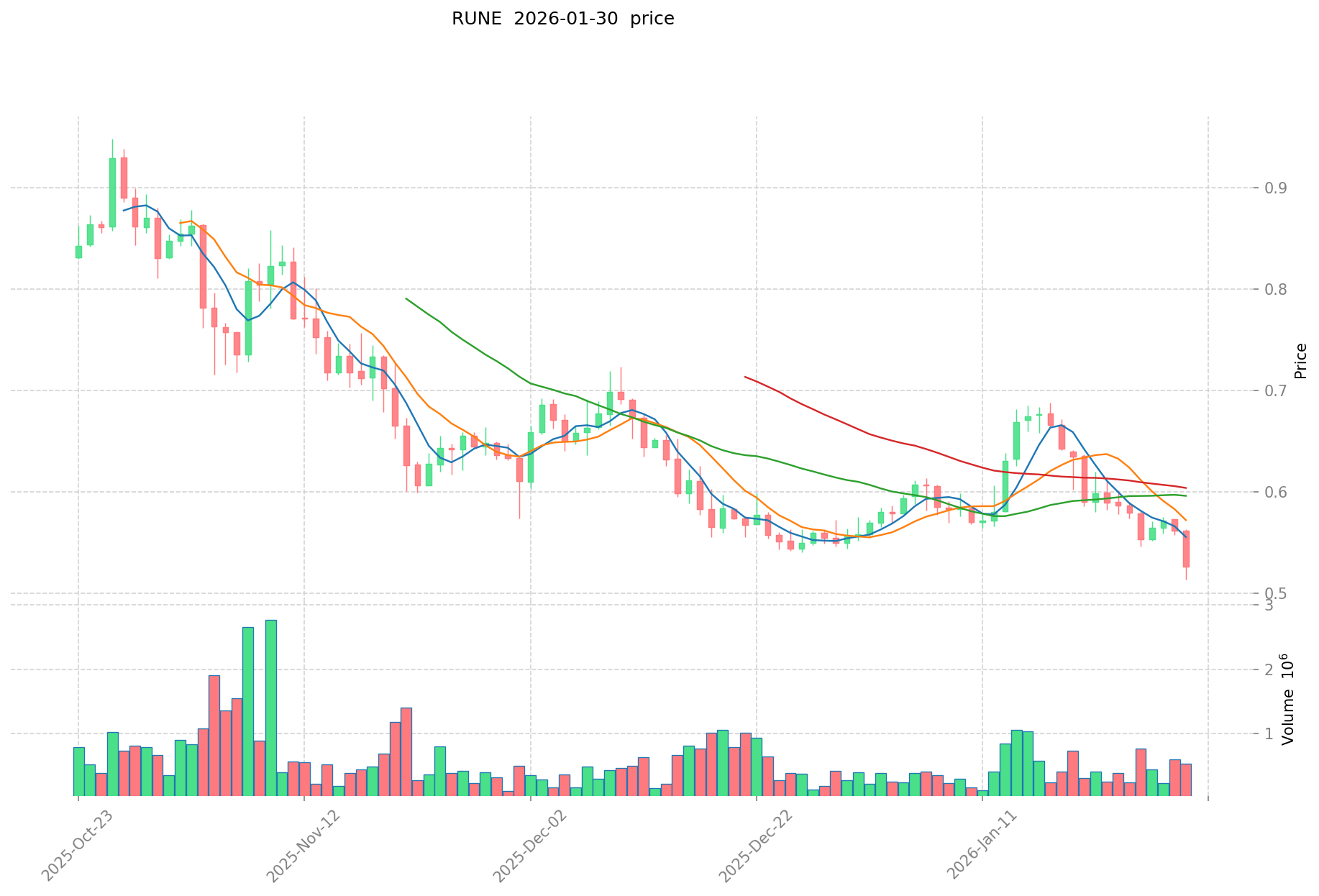
II. Core Factors Affecting HMT vs RUNE Investment Value
Supply Mechanism Comparison (Tokenomics)
The provided materials do not contain specific information regarding the supply mechanisms of HMT or RUNE tokens. Without verifiable data on fixed supply models, deflationary mechanisms, halving schedules, or emission rates for either asset, a comparative analysis of their tokenomics cannot be conducted at this time.
Institutional Adoption and Market Application
The reference materials do not provide information about institutional holdings, enterprise adoption in cross-border payments or settlement systems, or specific regulatory stances toward HMT or RUNE in different jurisdictions. Analysis of institutional preference and corporate implementation remains unavailable based on the current data.
Technical Development and Ecosystem Building
Regarding technical upgrades and ecosystem development:
-
The materials reference decentralized exchange infrastructure focused on on-chain margin trading and perpetual futures, which represents a shift from centralized finance to DeFi platforms. However, specific technical developments for HMT or RUNE are not detailed in the provided sources.
-
Ecosystem comparison across DeFi applications, NFT integration, payment systems, and smart contract deployment for either HMT or RUNE cannot be substantiated from the available materials.
Macroeconomic Environment and Market Cycles
The provided materials do not contain analysis of how HMT or RUNE perform under inflationary conditions, their correlation with monetary policy changes such as interest rate adjustments or U.S. dollar index movements, or their behavior during periods of geopolitical tension. Assessment of anti-inflation properties and macroeconomic sensitivity for either asset requires additional data beyond what is currently available.
III. 2026-2031 Price Forecast: HMT vs RUNE
Short-term Forecast (2026)
- HMT: Conservative $0.00399 - $0.00448 | Optimistic $0.00448 - $0.00627
- RUNE: Conservative $0.452 - $0.513 | Optimistic $0.513 - $0.703
Mid-term Forecast (2028-2029)
- HMT may enter a gradual expansion phase, with estimated price ranging from $0.00615 to $0.0111
- RUNE may enter a moderate growth stage, with estimated price ranging from $0.587 to $0.851
- Key drivers: institutional capital inflows, ETF developments, ecosystem expansion
Long-term Forecast (2030-2031)
- HMT: Base scenario $0.00658 - $0.0103 | Optimistic scenario $0.00952 - $0.0128
- RUNE: Base scenario $0.439 - $0.814 | Optimistic scenario $0.783 - $1.05
View detailed price predictions for HMT and RUNE
Disclaimer
HMT:
| Year |
Predicted High Price |
Predicted Average Price |
Predicted Low Price |
Price Change |
| 2026 |
0.0062706 |
0.004479 |
0.00398631 |
-5 |
| 2027 |
0.007578468 |
0.0053748 |
0.003117384 |
12 |
| 2028 |
0.0093911193 |
0.006476634 |
0.0061528023 |
36 |
| 2029 |
0.01110742731 |
0.00793387665 |
0.0069024726855 |
66 |
| 2030 |
0.0110439562968 |
0.00952065198 |
0.0073309020246 |
100 |
| 2031 |
0.012750057131616 |
0.0102823041384 |
0.006580674648576 |
116 |
RUNE:
| Year |
Predicted High Price |
Predicted Average Price |
Predicted Low Price |
Price Change |
| 2026 |
0.703084 |
0.5132 |
0.451616 |
0 |
| 2027 |
0.6689562 |
0.608142 |
0.50475786 |
18 |
| 2028 |
0.791800884 |
0.6385491 |
0.587465172 |
24 |
| 2029 |
0.85105824048 |
0.715174992 |
0.58644349344 |
39 |
| 2030 |
0.8457659455392 |
0.78311661624 |
0.4385453050944 |
52 |
| 2031 |
1.050629252347584 |
0.8144412808896 |
0.790008042462912 |
58 |
IV. Investment Strategy Comparison: HMT vs RUNE
Long-term vs Short-term Investment Strategies
- HMT: May be suitable for investors with higher risk tolerance who focus on emerging AI and human-machine collaboration applications, seeking potential long-term appreciation from early-stage technology adoption
- RUNE: May appeal to investors interested in decentralized cross-chain liquidity infrastructure and DeFi ecosystem expansion, with established market presence since 2019
Risk Management and Asset Allocation
- Conservative Investors: HMT 20-30% vs RUNE 70-80%
- Aggressive Investors: HMT 40-50% vs RUNE 50-60%
- Hedging Tools: Stablecoin allocation, options strategies, cross-asset portfolio diversification
V. Potential Risk Comparison
Market Risk
- HMT: Experiences significant price volatility with limited trading volume ($13,791.81 in 24-hour volume as of January 30, 2026), which may result in liquidity constraints and price impact during transactions
- RUNE: Demonstrates higher trading activity with 24-hour volume of $312,437.42, though still subject to broader cryptocurrency market fluctuations and sentiment shifts
Technical Risk
- HMT: Scalability considerations and network stability factors relevant to AI-powered data labeling infrastructure
- RUNE: Cross-chain protocol complexity, potential security vulnerabilities in decentralized liquidity mechanisms
Regulatory Risk
- Global regulatory developments may impact both assets differently based on their functional classifications—AI/data services versus DeFi infrastructure—with evolving compliance requirements across jurisdictions
VI. Conclusion: Which Is the Better Buy?
📌 Investment Value Summary:
- HMT Characteristics: Positioned in AI and human-machine collaboration sector with early-stage growth potential, though experiencing extended price consolidation with limited current liquidity
- RUNE Characteristics: Established presence in decentralized cross-chain liquidity protocols with broader trading activity and longer market track record since 2019
✅ Investment Considerations:
- Novice Investors: Consider starting with established assets demonstrating higher liquidity and trading volume, employing gradual position building and strict risk management protocols
- Experienced Investors: May evaluate portfolio diversification across both assets based on individual risk tolerance, market cycle positioning, and sector exposure preferences
- Institutional Investors: Conduct comprehensive due diligence on liquidity profiles, ecosystem development trajectories, and regulatory compliance frameworks before allocation decisions
⚠️ Risk Disclosure: Cryptocurrency markets exhibit substantial volatility. This analysis does not constitute investment advice. Current market sentiment indicates Extreme Fear (Fear & Greed Index: 16). Investors should conduct independent research and consider their financial circumstances before making investment decisions.
VII. FAQ
Q1: What are the main differences between HMT and RUNE in terms of their core functions?
HMT focuses on AI-powered data labeling and human-machine collaboration services, while RUNE operates as a decentralized cross-chain liquidity protocol. HMT, launched in 2021, targets the emerging AI and data services sector, positioning itself within the intersection of artificial intelligence and blockchain technology. RUNE, introduced in 2019, has established itself as infrastructure for cross-chain liquidity provision within the DeFi ecosystem, enabling asset swaps across different blockchain networks without centralized intermediaries.
Q2: Which token demonstrates better liquidity based on current market data?
RUNE demonstrates significantly better liquidity with a 24-hour trading volume of $312,437.42 compared to HMT's $13,791.81 as of January 30, 2026. This represents approximately 22 times higher trading activity for RUNE. Higher liquidity generally translates to reduced price slippage during transactions, easier entry and exit positions, and potentially lower transaction costs—factors that may be particularly important for investors requiring flexibility in position management.
Q3: How have HMT and RUNE performed since their respective all-time highs?
Both tokens have experienced substantial corrections from their peak values. HMT declined approximately 99% from its all-time high of $1.37 (August 14, 2021) to its current price of $0.00476, while RUNE fell approximately 97% from its peak of $20.87 (May 19, 2021) to $0.514. These significant drawdowns reflect broader cryptocurrency market cycles and sector-specific dynamics, with both assets experiencing extended consolidation periods following the 2021 bull market.
Q4: What are the projected price ranges for HMT and RUNE by 2031?
According to the forecasts provided, HMT's projected 2031 range spans from $0.00658 (base scenario low) to $0.0128 (optimistic scenario high), representing potential increases of 38% to 169% from current levels. RUNE's 2031 projections range from $0.439 (base scenario low) to $1.05 (optimistic scenario high), indicating potential changes of -15% to +104%. These forecasts assume various market conditions, institutional adoption rates, and ecosystem development trajectories, though actual outcomes may vary significantly based on unforeseen market dynamics.
Q5: What risk management approach should investors consider when comparing HMT and RUNE?
Investors should implement differentiated allocation strategies based on their risk tolerance profiles. Conservative investors might consider a 20-30% HMT allocation versus 70-80% RUNE allocation, recognizing RUNE's established market presence and higher liquidity. Aggressive investors with higher risk tolerance may adopt a more balanced 40-50% HMT and 50-60% RUNE split, capturing potential upside from HMT's early-stage positioning while maintaining exposure to RUNE's DeFi infrastructure. Regardless of allocation strategy, incorporating hedging tools such as stablecoin reserves, options strategies, and cross-asset diversification remains essential for managing cryptocurrency market volatility.
Q6: How does the current market sentiment affect investment decisions between HMT and RUNE?
The current Fear & Greed Index stands at 16, indicating "Extreme Fear" in the cryptocurrency market as of January 30, 2026. Historically, extreme fear conditions have occasionally presented accumulation opportunities for long-term investors, though they also signal heightened volatility and potential for further downside. In such environments, both HMT and RUNE may experience continued price pressure regardless of their fundamental characteristics. Investors should exercise heightened caution, consider dollar-cost averaging strategies rather than lump-sum investments, and maintain sufficient capital reserves to manage potential adverse price movements.
Q7: What are the key factors that could drive future price appreciation for HMT versus RUNE?
For HMT, potential catalysts include broader adoption of AI-powered data services, expansion of human-machine collaboration use cases, strategic partnerships within the artificial intelligence sector, and increased institutional recognition of AI-blockchain integration projects. For RUNE, growth drivers may include expansion of cross-chain liquidity demand, integration with additional blockchain networks, growth in DeFi total value locked (TVL), development of complementary DeFi protocols, and institutional adoption of decentralized liquidity solutions. Both assets remain sensitive to broader cryptocurrency market cycles, regulatory developments, and macroeconomic conditions affecting risk asset appetite.
Q8: Which token is more suitable for different investor profiles?
Novice investors should prioritize assets with established liquidity and trading history, making RUNE potentially more accessible given its higher 24-hour volume and longer market presence since 2019. Experienced investors comfortable with elevated risk and early-stage project dynamics might allocate to HMT for its positioning in the AI-data services sector, while maintaining RUNE exposure for diversification. Institutional investors require comprehensive due diligence on both assets' liquidity profiles, regulatory compliance frameworks, and ecosystem development roadmaps before allocation. Regardless of experience level, investors should conduct independent research aligned with their specific financial circumstances, investment objectives, and risk tolerance parameters before committing capital to either asset.
* The information is not intended to be and does not constitute financial advice or any other recommendation of any sort offered or endorsed by Gate.