This comprehensive analysis compares HNT and NEAR, two leading blockchain projects launched in 2020. HNT focuses on decentralized physical infrastructure networks for IoT connectivity, currently priced at $1.3658, while NEAR operates as a scalable blockchain platform at $1.7991. The article examines critical investment factors including historical price performance, tokenomics differences, institutional adoption patterns, technological ecosystems, and market risks. HNT features a deflationary model with 83.55% circulating supply, while NEAR demonstrates superior liquidity with $6.6M daily volume versus HNT's $735K. Long-term projections through 2031 suggest both assets hold growth potential, though with distinct risk profiles. The guide provides tailored investment strategies for conservative and aggressive investors on Gate, alongside regulatory considerations and portfolio allocation recommendations.
Introduction: HNT vs NEAR Investment Comparison
In the cryptocurrency market, the comparison of HNT vs NEAR has always been a topic that investors cannot avoid. The two not only have obvious differences in market cap ranking, application scenarios and price performance, but also represent different crypto asset positioning.
HNT (Helium): Since its launch in 2020, it has gained market recognition with its positioning as a decentralized wireless network for IoT devices.
NEAR (NEAR Protocol): Since its launch in 2020, it has been known as a highly scalable blockchain protocol, and is one of the cryptocurrencies with significant development activity and ecosystem growth.
This article will comprehensively analyze the investment value comparison of HNT vs NEAR around historical price trends, supply mechanisms, institutional adoption, technical ecosystem and future predictions, and attempt to answer the question that investors are most concerned about:
"Which is the better buy right now?"
I. Historical Price Comparison and Current Market Landscape
Historical Price Trends of HNT (Coin A) and NEAR (Coin B)
- 2021: HNT experienced significant price appreciation, reaching an all-time high of $54.88 on November 13, 2021, driven by growing interest in decentralized wireless network infrastructure.
- 2020: NEAR launched its mainnet in October 2020 with an initial offering price of $0.0375 and subsequently reached its peak price of $20.44 on January 17, 2022, supported by strong developer adoption and ecosystem expansion.
- Comparative Analysis: During the 2021-2022 market cycle, HNT declined from its peak of $54.88 to $1.3658, representing a decline of approximately 97.5%, while NEAR decreased from $20.44 to $1.7991, representing a decline of approximately 91.2%.
Current Market Status (January 15, 2026)
- HNT Current Price: $1.3658
- NEAR Current Price: $1.7991
- 24-Hour Trading Volume: HNT recorded $735,157.37, while NEAR showed significantly higher liquidity with $6,619,934.37
- Market Sentiment Index (Fear & Greed Index): 61 (Greed)
View Real-Time Prices:
- Check HNT Current Price Market Price
- Check NEAR Current Price Market Price
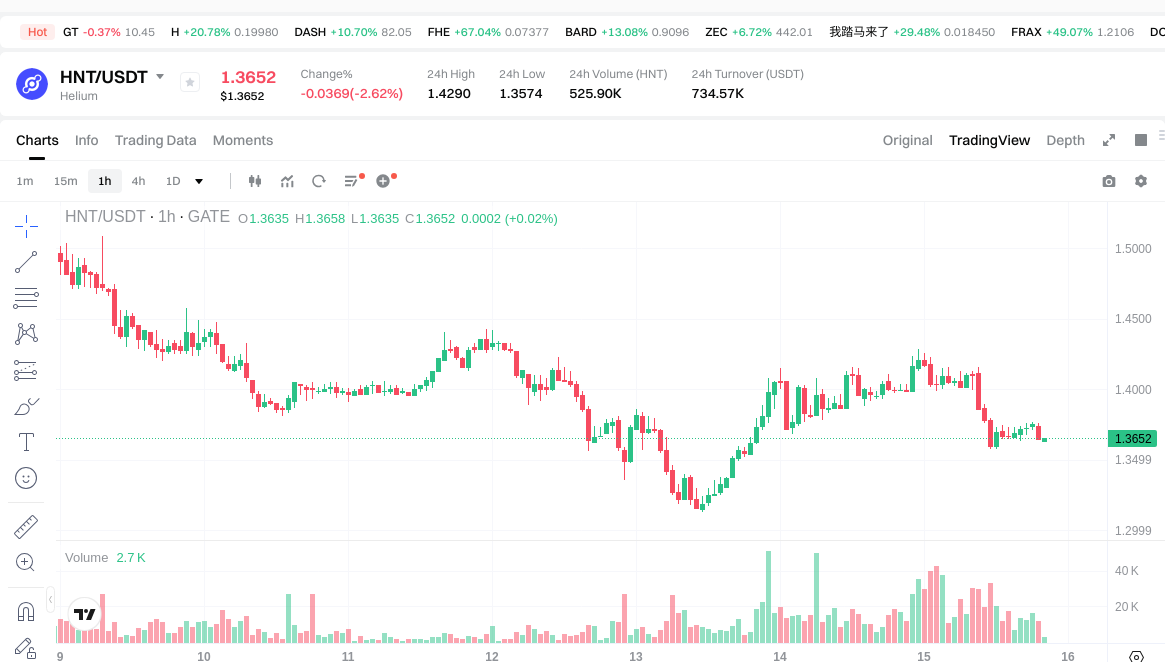
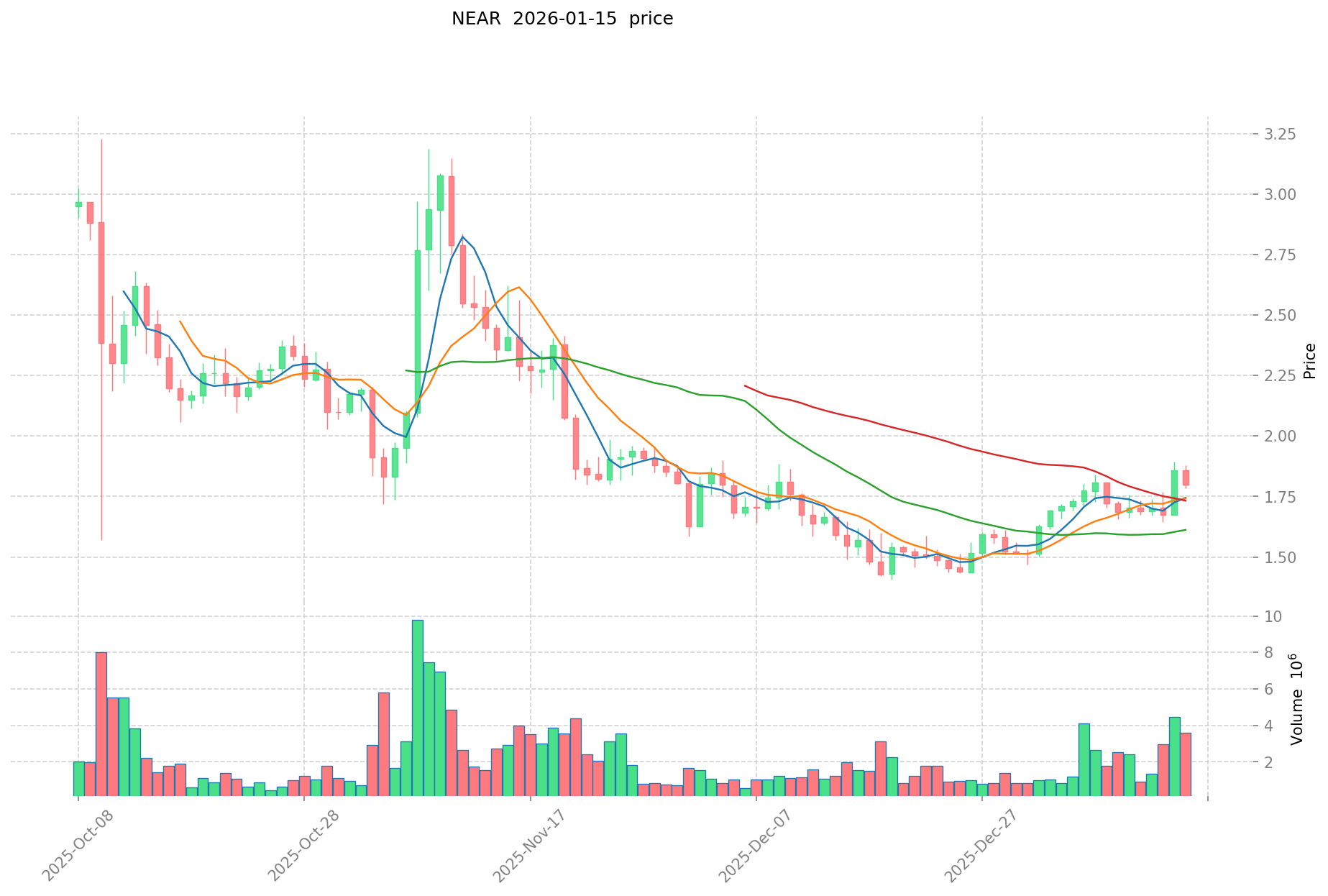
II. Core Factors Influencing HNT vs NEAR Investment Value
Supply Mechanism Comparison (Tokenomics)
-
HNT: Helium features a deflationary economic model with a total supply of 223 million tokens and a circulating supply of approximately 186.32 million tokens, representing 83.55% of the total. HNT is utilized within the network's operational framework, where its scarcity characteristics are designed to support long-term value preservation through controlled emission schedules.
-
NEAR: NEAR Protocol operates with a different supply structure focused on ecosystem growth and staking mechanisms. The token economics incorporate validator rewards and network participation incentives, with supply dynamics tied to protocol development milestones and community governance decisions.
-
📌 Historical Pattern: Supply mechanisms have historically influenced price cycles through scarcity effects and emission rate changes, with deflationary models potentially creating upward pressure during periods of increased network adoption.
Institutional Adoption and Market Application
-
Institutional Holdings: Material differences exist in institutional positioning between the two assets, with varying levels of engagement from traditional financial entities.
-
Enterprise Adoption: HNT focuses on decentralized physical infrastructure networks (DePIN), particularly in wireless connectivity and IoT applications, while NEAR emphasizes decentralized application development and blockchain scalability solutions for enterprise use cases.
-
National Policies: Regulatory frameworks for both assets vary significantly across jurisdictions, with considerations around telecommunications infrastructure for HNT and blockchain platform regulations for NEAR.
Technological Development and Ecosystem Construction
-
HNT Technology Upgrades: Network expansion and the addition of new users represent key drivers for HNT demand and value growth. The platform's evolution centers on physical infrastructure deployment and wireless network coverage enhancement.
-
NEAR Technology Development: NEAR Protocol's advancement focuses on ecosystem growth and technological improvements, including sharding technology implementation, developer tooling enhancements, and cross-chain interoperability features.
-
Ecosystem Comparison: HNT concentrates on physical infrastructure networks and wireless connectivity applications, while NEAR develops capabilities across DeFi protocols, decentralized applications, and smart contract platforms with emphasis on scalability and user experience.
Macroeconomic Environment and Market Cycles
-
Performance Under Inflation: Both cryptocurrencies exhibit characteristics associated with high volatility assets. Their relationship to traditional inflation hedges requires careful consideration of multiple market variables including adoption rates, technological progress, and regulatory developments.
-
Macroeconomic Monetary Policy: Interest rate fluctuations, U.S. dollar index movements, and global liquidity conditions influence capital flows into cryptocurrency markets, affecting both HNT and NEAR through risk appetite adjustments and alternative asset allocation decisions.
-
Geopolitical Factors: Cross-border transaction requirements and international developments may impact adoption trajectories differently for infrastructure-focused networks versus application-layer blockchain platforms.
III. 2026-2031 Price Forecast: HNT vs NEAR
Short-term Forecast (2026)
- HNT: Conservative $1.02-$1.37 | Optimistic $1.80-$1.98
- NEAR: Conservative $0.94-$1.80 | Optimistic $1.80-$2.28
Mid-term Forecast (2028-2029)
- HNT may enter a consolidation phase with projected price range of $1.67-$2.40
- NEAR may enter a growth phase with projected price range of $1.92-$2.62
- Key drivers: institutional capital inflows, ETF developments, ecosystem expansion
Long-term Forecast (2030-2031)
- HNT: Baseline scenario $1.95-$2.21 | Optimistic scenario $2.13-$3.11
- NEAR: Baseline scenario $1.58-$2.92 | Optimistic scenario $2.56-$3.28
View detailed price predictions for HNT and NEAR
Disclaimer
HNT:
| Year |
Predicted High Price |
Predicted Average Price |
Predicted Low Price |
Price Change |
| 2026 |
1.979395 |
1.3651 |
1.023825 |
0 |
| 2027 |
1.956529575 |
1.6722475 |
1.5384677 |
22 |
| 2028 |
1.905107964375 |
1.8143885375 |
1.741812996 |
32 |
| 2029 |
2.399075243709375 |
1.8597482509375 |
1.67377342584375 |
36 |
| 2030 |
2.214588217216375 |
2.129411747323437 |
2.001647042484031 |
55 |
| 2031 |
3.105959974645966 |
2.171999982269906 |
1.954799984042915 |
59 |
NEAR:
| Year |
Predicted High Price |
Predicted Average Price |
Predicted Low Price |
Price Change |
| 2026 |
2.284984 |
1.7992 |
0.935584 |
0 |
| 2027 |
2.87934972 |
2.042092 |
1.96040832 |
13 |
| 2028 |
2.5345424858 |
2.46072086 |
1.9193622708 |
36 |
| 2029 |
2.622513256545 |
2.4976316729 |
2.322797455797 |
38 |
| 2030 |
3.2768927548448 |
2.5600724647225 |
1.612845652775175 |
42 |
| 2031 |
3.122776392468505 |
2.91848260978365 |
1.575980609283171 |
62 |
IV. Investment Strategy Comparison: HNT vs NEAR
Long-term vs Short-term Investment Strategies
-
HNT: May appeal to investors focused on decentralized physical infrastructure network development and IoT connectivity expansion, with consideration for network adoption milestones and physical infrastructure deployment progress.
-
NEAR: May appeal to investors interested in blockchain scalability solutions and decentralized application ecosystems, with attention to developer activity and cross-chain interoperability developments.
Risk Management and Asset Allocation
-
Conservative Investors: HNT 30-40% vs NEAR 60-70%, emphasizing the relatively established ecosystem and higher trading volume characteristics of NEAR while maintaining exposure to infrastructure network opportunities through HNT.
-
Aggressive Investors: HNT 50-60% vs NEAR 40-50%, reflecting higher risk tolerance for infrastructure network growth potential while balancing with blockchain platform scalability opportunities.
-
Hedging Tools: Stablecoin allocation for portfolio stability, derivatives instruments where available, and cross-asset diversification strategies to manage exposure across different cryptocurrency segments.
V. Potential Risk Comparison
Market Risk
-
HNT: Exhibits characteristics associated with network adoption dependency, physical infrastructure expansion challenges, and lower trading volume of $735,157.37, which may affect liquidity conditions during market volatility.
-
NEAR: Demonstrates exposure to blockchain platform competition dynamics, developer ecosystem sustainability requirements, and correlation with broader cryptocurrency market cycles, though supported by higher trading volume of $6,619,934.37.
Technical Risk
-
HNT: Network expansion requirements, wireless coverage sustainability, and infrastructure maintenance considerations represent ongoing operational factors affecting long-term viability.
-
NEAR: Platform scalability implementation, smart contract security considerations, and cross-chain bridge vulnerabilities require continuous monitoring and protocol upgrades.
Regulatory Risk
- Regulatory frameworks affect both assets through different mechanisms: HNT faces telecommunications and wireless infrastructure regulations, while NEAR encounters blockchain platform and securities classification considerations across multiple jurisdictions.
VI. Conclusion: Which Is the Better Buy?
📌 Investment Value Summary:
-
HNT Characteristics: Decentralized physical infrastructure network positioning, IoT connectivity focus, deflationary token economics with 83.55% circulating supply, and network expansion-driven value proposition.
-
NEAR Characteristics: Blockchain scalability platform positioning, decentralized application ecosystem development, higher current trading volume indicating enhanced liquidity, and technological innovation in sharding implementation.
✅ Investment Considerations:
-
Beginning Investors: Consider starting with assets demonstrating higher liquidity characteristics and established trading patterns, with allocation adjustments based on personal risk tolerance and investment timeframe.
-
Experienced Investors: Evaluate portfolio diversification opportunities across different cryptocurrency segments, incorporating both infrastructure networks and blockchain platforms with attention to technological development trajectories and ecosystem growth indicators.
-
Institutional Investors: Assess allocation strategies considering liquidity requirements, regulatory compliance frameworks, and risk management protocols appropriate for different asset categories within the cryptocurrency space.
⚠️ Risk Disclosure: Cryptocurrency markets exhibit substantial volatility. This content does not constitute investment advice. All investment decisions should be made after comprehensive research and consideration of individual financial circumstances.
VII. FAQ
Q1: What is the main difference between HNT and NEAR in terms of their core technology and use cases?
HNT focuses on decentralized physical infrastructure networks (DePIN) for IoT wireless connectivity, while NEAR is a blockchain scalability platform for decentralized applications. HNT operates as a decentralized wireless network launched in 2020, enabling IoT device connectivity through physical infrastructure deployment and network coverage expansion. NEAR Protocol, also launched in 2020, functions as a highly scalable blockchain platform implementing sharding technology, smart contracts, and cross-chain interoperability features to support DeFi protocols and decentralized application development.
Q2: Which cryptocurrency has better liquidity characteristics?
NEAR demonstrates significantly better liquidity with a 24-hour trading volume of $6,619,934.37 compared to HNT's $735,157.37. This nearly 9x difference in trading volume indicates that NEAR offers enhanced liquidity conditions, which can be particularly important during market volatility periods. Higher liquidity generally facilitates easier entry and exit positions, tighter bid-ask spreads, and reduced price slippage for investors executing larger transactions.
Q3: How do the supply mechanisms of HNT and NEAR differ?
HNT operates with a deflationary economic model featuring a fixed total supply of 223 million tokens, with approximately 186.32 million tokens (83.55%) currently in circulation. This controlled emission schedule creates scarcity characteristics designed to support long-term value preservation. NEAR Protocol utilizes a different supply structure focused on ecosystem growth and staking mechanisms, with supply dynamics tied to validator rewards, network participation incentives, and protocol development milestones determined through community governance.
Q4: What are the price performance differences between HNT and NEAR since their peaks?
Both cryptocurrencies experienced significant corrections from their all-time highs during the 2021-2022 market cycle. HNT declined approximately 97.5% from its peak of $54.88 (November 13, 2021) to its current price of $1.3658, while NEAR decreased approximately 91.2% from its peak of $20.44 (January 17, 2022) to its current price of $1.7991. NEAR demonstrated relatively better price resilience during the market downturn, maintaining a smaller percentage decline from its peak compared to HNT.
Q5: What are the recommended portfolio allocation strategies for HNT vs NEAR?
For conservative investors, a recommended allocation might be 30-40% HNT and 60-70% NEAR, emphasizing NEAR's established ecosystem and higher trading volume while maintaining exposure to infrastructure network opportunities through HNT. For aggressive investors with higher risk tolerance, a 50-60% HNT and 40-50% NEAR allocation may be appropriate, reflecting increased exposure to infrastructure network growth potential while balancing with blockchain platform scalability opportunities. Both strategies should incorporate stablecoin allocations for portfolio stability and regular rebalancing based on market conditions.
Q6: What are the key risk factors to consider when investing in HNT versus NEAR?
HNT faces risks related to network adoption dependency, physical infrastructure expansion challenges, and lower liquidity conditions that may affect trading during volatility. NEAR encounters blockchain platform competition dynamics, developer ecosystem sustainability requirements, and correlation with broader cryptocurrency market cycles. Both assets face distinct regulatory considerations: HNT is subject to telecommunications and wireless infrastructure regulations, while NEAR faces blockchain platform and potential securities classification issues across multiple jurisdictions. Investors should carefully evaluate their risk tolerance and conduct comprehensive research before allocation decisions.
Q7: What are the long-term price projections for HNT and NEAR through 2031?
According to baseline scenarios, HNT is projected to reach $1.95-$2.21 by 2030-2031, with an optimistic scenario of $2.13-$3.11, representing potential growth of 55-59% from current levels. NEAR is projected to reach $1.58-$2.92 in the baseline scenario and $2.56-$3.28 in the optimistic scenario by 2030-2031, representing potential growth of 42-62% from current levels. These projections consider factors including institutional capital inflows, ETF developments, ecosystem expansion, and technological advancement milestones. However, cryptocurrency markets remain highly volatile, and actual performance may differ significantly from forecasts.
Q8: Which cryptocurrency is more suitable for beginning investors?
Beginning investors should generally consider starting with assets demonstrating higher liquidity characteristics and more established trading patterns. Based on current metrics, NEAR's significantly higher 24-hour trading volume of $6,619,934.37 and more established blockchain platform ecosystem may present more suitable entry characteristics for new investors. However, the ultimate decision should be based on individual risk tolerance, investment timeframe, and comprehensive understanding of each project's technology and value proposition. Both assets require thorough research and consideration of personal financial circumstances before investment.
* The information is not intended to be and does not constitute financial advice or any other recommendation of any sort offered or endorsed by Gate.