This comprehensive guide compares HOLDSTATION and VET as cryptocurrency investment opportunities across multiple critical dimensions. HOLDSTATION, launched in 2024, positions itself as an emerging DeFi infrastructure platform built on zkSync with Account Abstraction technology and AI agent deployment capabilities, currently ranked 1603 with a 4.4 million USD market cap. VET, established in 2015, serves as an enterprise-grade Layer-1 blockchain for supply chain management and transparency, validated through partnerships with DNV, Walmart, and BCG, currently ranked 92 with an 845.5 million USD market cap. The article examines historical price trends, tokenomics structures, institutional adoption patterns, technological ecosystems, macroeconomic influences, and detailed risk assessments to address investor concerns about value propositions and risk-reward profiles. Price predictions through 2031 suggest HOLDSTATION potential growth to 0.60-1.59 USD while VET may reach 0.014-0.019 USD. Investment suitability vari
Introduction: Investment Comparison Between HOLDSTATION and VET
In the cryptocurrency market, the comparison between HOLDSTATION and VET continues to attract investor attention. These two assets exhibit notable differences in market capitalization ranking, application scenarios, and price performance, representing distinct positioning within the crypto asset landscape.
HOLDSTATION: Launched in 2024, this platform positions itself as a "Product-Fit-Community" solution for seamless trading and asset management. Built primarily on zkSync with expansion to Berachain and Worldchain, it integrates Account Abstraction technology with its wallet, DeFutures, and zkStarter launchpad to deliver an intuitive DeFi experience. The platform supports dApp interactions, token swaps, and leveraged futures trading, while its A(i)gentFi component enables users to co-own and deploy revenue-generating AI agents.
VET (Vechain): Established in 2015 by Sunny Lu, VeChain initially focused on blockchain solutions for supply chain transparency and anti-counterfeiting. The VeChainThor blockchain emerged as an enterprise-grade Layer-1 network, validated through partnerships with organizations including DNV, Walmart, and BCG. As part of its Renaissance roadmap, VeChain is implementing Ethereum-compatible infrastructure, dPoS consensus, dynamic VTHO tokenomics, and enhanced interoperability features.
This article examines the investment comparison between HOLDSTATION and VET across multiple dimensions: historical price trends, supply mechanisms, institutional adoption, technological ecosystems, and future outlook. We aim to address the key question that concerns investors:
"Which presents a more compelling investment opportunity at this time?"
As of January 29, 2026, HOLDSTATION ranks 1603rd with a market capitalization of approximately 4.4 million USD, while VET holds the 92nd position with a market cap of around 845.5 million USD. Both projects operate within different segments of the blockchain ecosystem, offering distinct value propositions and risk-reward profiles for consideration.
I. Historical Price Comparison and Current Market Status
Historical Price Trends of HOLDSTATION (Coin A) and VET (Coin B)
-
2024: HOLDSTATION experienced significant volatility following its launch on 26 November 2024, with an initial price of $1.00. The token reached a peak of $16.445 on 27 December 2024, representing a substantial increase in its early trading period.
-
2021: VET witnessed notable price movement during the broader crypto market expansion in 2021, reaching $0.280991 on 19 April 2021, which marked a significant milestone in its trading history.
-
2015-2020: VET, founded in 2015 by Sunny Lu, initially focused on supply chain transparency solutions. The project gained momentum through early enterprise adoption and backing from Fenbushi Capital, culminating in a 2017 token offering that paved the way for the VeChainThor blockchain launch.
-
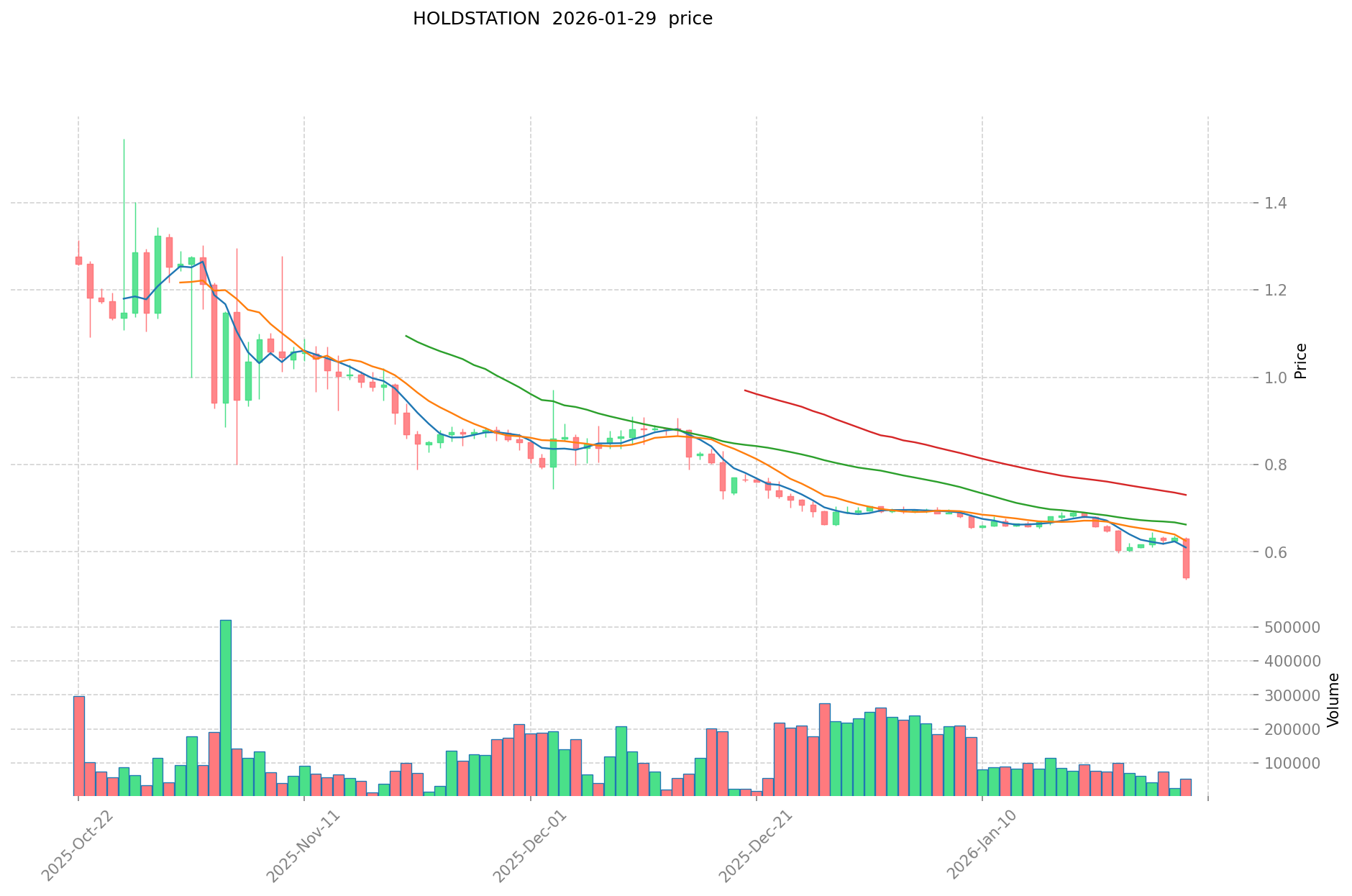
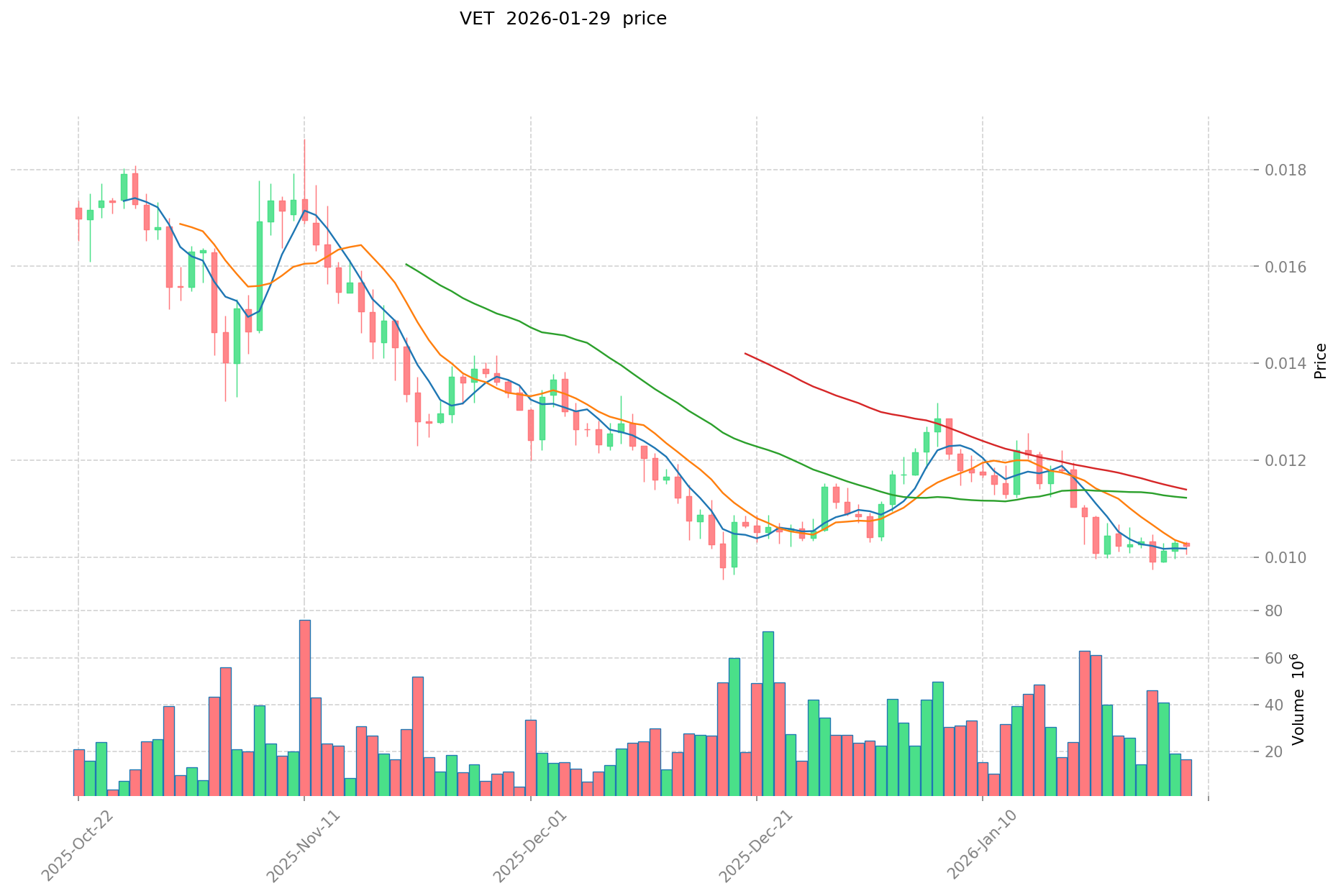
Comparative Analysis: During recent market cycles, HOLDSTATION declined from its peak of $16.445 to $0.5567 (as of 29 January 2026), representing a decline of approximately 96.6%. Meanwhile, VET has experienced fluctuations from its historical high of $0.280991 to the current level of $0.009833, showing a decline of approximately 96.5% from its peak.
Current Market Status (29 January 2026)
- HOLDSTATION current price: $0.5567
- VET current price: $0.009833
- 24-hour trading volume: HOLDSTATION recorded $55,343.401608 compared to VET's $238,150.846219
- Market Sentiment Index (Fear & Greed Index): 26 (Fear)
View real-time prices:
II. Core Factors Influencing HOLDSTATION vs VET Investment Value
Supply Mechanism Comparison (Tokenomics)
The tokenomics structure of crypto assets plays a fundamental role in long-term value proposition. While specific supply details for HOLDSTATION and VET require direct verification from their respective technical documentation, understanding supply dynamics remains essential for investment evaluation.
- Supply Framework: Different cryptocurrencies adopt varying supply models, ranging from fixed maximum supplies to algorithmic adjustment mechanisms. These structural choices influence scarcity perception and potential price trajectories over time.
- Token Distribution: The initial allocation and release schedules of tokens impact market circulation and liquidity patterns. Vesting periods for team tokens, treasury allocations, and community distribution mechanisms all contribute to supply-side dynamics.
- 📌 Historical Patterns: Supply mechanisms have historically influenced price cycles in crypto markets. Assets with transparent, predictable supply schedules tend to exhibit different volatility characteristics compared to those with dynamic issuance models.
Institutional Adoption and Market Application
Institutional participation has emerged as a significant factor in cryptocurrency investment value assessment.
- Institutional Holdings: The level of institutional interest varies considerably across different crypto assets. Larger market cap cryptocurrencies generally attract more institutional capital due to liquidity considerations and regulatory clarity.
- Enterprise Utilization: Practical applications in cross-border payments, settlement systems, and corporate treasury management influence fundamental value. Real-world adoption by enterprises provides utility beyond speculative trading.
- Regulatory Landscape: Different jurisdictions maintain varying stances on cryptocurrency regulation. Regulatory clarity or uncertainty in major markets can significantly impact institutional participation and, consequently, asset valuation.
Technological Development and Ecosystem Construction
The technological foundation and ecosystem vitality of crypto projects constitute essential valuation factors.
- Technology Evolution: Ongoing development activities, protocol upgrades, and technical innovations affect network capabilities and competitive positioning. Network scalability, transaction efficiency, and security enhancements represent key technological considerations.
- Ecosystem Maturity: The breadth and depth of applications built on a blockchain platform indicate ecosystem health. Factors include DeFi protocol integration, NFT marketplace activity, payment infrastructure deployment, and smart contract functionality.
- Developer Activity: Active developer communities and consistent code contributions suggest sustained project momentum and innovation potential.
Macroeconomic Environment and Market Cycles
Broader economic conditions exert considerable influence on cryptocurrency valuations.
- Inflation Context: Crypto assets exhibit varying characteristics as potential inflation hedges. The relationship between monetary inflation and crypto asset prices remains complex and influenced by multiple factors including real interest rates and currency stability.
- Monetary Policy Impact: Central bank policies, particularly interest rate adjustments and liquidity conditions, affect risk asset valuations. Higher interest rates typically increase the opportunity cost of holding non-yielding assets, potentially impacting crypto valuations.
- Geopolitical Considerations: International tensions, capital control measures, and cross-border transaction needs can influence cryptocurrency adoption patterns. However, these relationships vary by asset and require careful analysis rather than broad generalizations.
Investment decisions should incorporate thorough due diligence across these dimensions, recognizing that past patterns may not reliably predict future outcomes in rapidly evolving crypto markets.
III. 2026-2031 Price Prediction: HOLDSTATION vs VET
Short-term Prediction (2026)
- HOLDSTATION: Conservative $0.37-$0.56 | Optimistic $0.56-$0.81
- VET: Conservative $0.0094-$0.0098 | Optimistic $0.0098-$0.013
Mid-term Prediction (2028-2029)
- HOLDSTATION may enter a growth phase, with projected price range of $0.52-$1.08
- VET may enter a stabilization phase, with projected price range of $0.011-$0.019
- Key drivers: institutional capital inflows, ETF developments, ecosystem expansion
Long-term Prediction (2030-2031)
- HOLDSTATION: Baseline scenario $0.60-$1.01 | Optimistic scenario $1.01-$1.59
- VET: Baseline scenario $0.014-$0.017 | Optimistic scenario $0.017-$0.019
View detailed price predictions for HOLDSTATION and VET
Disclaimer
HOLDSTATION:
| Year |
Predicted High Price |
Predicted Average Price |
Predicted Low Price |
Price Change |
| 2026 |
0.814388 |
0.5578 |
0.373726 |
0 |
| 2027 |
1.00169724 |
0.686094 |
0.63120648 |
23 |
| 2028 |
1.0801863936 |
0.84389562 |
0.5232152844 |
51 |
| 2029 |
1.05824510748 |
0.9620410068 |
0.7215307551 |
72 |
| 2030 |
1.363693127139 |
1.01014305714 |
0.5959844037126 |
81 |
| 2031 |
1.59047024346693 |
1.1869180921395 |
0.842711845419045 |
113 |
VET:
| Year |
Predicted High Price |
Predicted Average Price |
Predicted Low Price |
Price Change |
| 2026 |
0.01286682 |
0.009822 |
0.00942912 |
0 |
| 2027 |
0.0165628386 |
0.01134441 |
0.0086217516 |
15 |
| 2028 |
0.018837392805 |
0.0139536243 |
0.010604754468 |
41 |
| 2029 |
0.017215283980125 |
0.0163955085525 |
0.01475595769725 |
66 |
| 2030 |
0.019326205706259 |
0.016805396266312 |
0.014116532863702 |
70 |
| 2031 |
0.0189690910356 |
0.018065800986285 |
0.015536588848205 |
83 |
IV. Investment Strategy Comparison: HOLDSTATION vs VET
Long-term vs Short-term Investment Strategies
-
HOLDSTATION: May appeal to investors interested in emerging DeFi ecosystems and Account Abstraction technology adoption. The platform's integration across zkSync, Berachain, and Worldchain presents exposure to multiple Layer-2 scaling solutions. Given its recent launch in 2024 and current early-stage market positioning, this asset may suit those with higher risk tolerance seeking exposure to innovative DeFi infrastructure development.
-
VET: May suit investors seeking exposure to enterprise blockchain applications and supply chain transparency solutions. With established partnerships including DNV, Walmart, and BCG, VeChain offers exposure to real-world blockchain adoption. The ongoing Renaissance roadmap implementation and Ethereum-compatible infrastructure development may appeal to those interested in established Layer-1 networks with practical utility.
Risk Management and Asset Allocation
Asset allocation strategies vary based on individual risk profiles and investment objectives:
-
Conservative Investors: May consider limiting exposure to early-stage assets like HOLDSTATION (10-20%) while allocating larger portions to more established cryptocurrencies like VET (30-40%), with significant holdings in stablecoins or traditional assets for capital preservation.
-
Aggressive Investors: Might allocate higher percentages to emerging platforms like HOLDSTATION (30-50%) while maintaining positions in VET (20-30%), accepting increased volatility for potential growth opportunities.
-
Hedging Instruments: Consider diversification through stablecoin allocations for liquidity management, options strategies where available, and cross-asset portfolio construction to mitigate concentration risk.
V. Potential Risk Comparison
Market Risks
-
HOLDSTATION: As a recently launched platform (November 2024) with a market capitalization of approximately 4.4 million USD, this asset exhibits characteristics common to lower market cap cryptocurrencies, including reduced liquidity and heightened price volatility. The token experienced significant fluctuation from $16.445 to $0.5567, representing considerable price variation over a short period.
-
VET: With a market capitalization around 845.5 million USD and ranking 92nd, VET demonstrates characteristics of mid-tier cryptocurrencies. Historical price movements show substantial variation from peaks to current levels. Trading volume patterns and market depth influence liquidity conditions.
Technical Risks
-
HOLDSTATION: Built primarily on zkSync with expansion to Berachain and Worldchain, the platform's multi-chain architecture introduces technical considerations regarding cross-chain interoperability, smart contract security across different environments, and Account Abstraction implementation stability. As an emerging platform, the ecosystem remains in early development stages.
-
VET: Operating as a Layer-1 blockchain network, VeChain's technical considerations include network consensus mechanism reliability, validator distribution patterns, and smart contract platform security. The ongoing Renaissance roadmap implementation, including Ethereum-compatible infrastructure and dynamic VTHO tokenomics, introduces upgrade execution risks.
Regulatory Risks
Regulatory frameworks for cryptocurrency assets continue evolving across jurisdictions:
-
Different regulatory approaches toward DeFi platforms, enterprise blockchain solutions, and token classifications may impact both assets differently. HOLDSTATION's DeFi-focused features and VET's enterprise partnership model may face distinct regulatory considerations.
-
Changes in securities regulations, taxation policies, and cross-border transaction rules could affect operational models and adoption patterns for both platforms.
-
Compliance requirements for centralized exchange listings and institutional custody solutions may influence market accessibility.
VI. Conclusion: Which Is the Better Buy?
📌 Investment Value Summary
-
HOLDSTATION Characteristics: Represents exposure to emerging DeFi infrastructure with Account Abstraction technology integration. Built across multiple Layer-2 platforms (zkSync, Berachain, Worldchain) with features including dApp interactions, leveraged futures trading, and AI agent deployment capabilities. Currently positioned as an early-stage project with a market cap of approximately 4.4 million USD (rank 1603).
-
VET Characteristics: Offers exposure to enterprise blockchain adoption with established partnerships in supply chain management and transparency solutions. Operating as a Layer-1 network with ongoing Renaissance roadmap development, including Ethereum-compatible infrastructure implementation. Currently maintains a market cap of approximately 845.5 million USD (rank 92).
✅ Investment Considerations
-
New Investors: May benefit from thorough research into cryptocurrency fundamentals, risk management principles, and portfolio diversification strategies before making allocation decisions. Consider starting with smaller position sizes to understand market dynamics and volatility patterns.
-
Experienced Investors: Might evaluate these assets within the context of existing portfolio composition, considering factors such as correlation with other holdings, exposure to specific blockchain ecosystems, and alignment with investment thesis regarding DeFi infrastructure versus enterprise blockchain adoption.
-
Institutional Investors: Could assess these assets based on liquidity requirements, regulatory compliance considerations, custody solutions availability, and alignment with institutional investment mandates regarding market capitalization thresholds and due diligence standards.
⚠️ Risk Disclosure: Cryptocurrency markets exhibit substantial volatility and price fluctuations. Past performance does not indicate future results. This analysis does not constitute financial advice, investment recommendations, or solicitation to buy or sell any assets. Investors should conduct independent research, consult qualified financial advisors, and carefully evaluate their risk tolerance and investment objectives before making any investment decisions.
VII. FAQ
Q1: What are the primary differences between HOLDSTATION and VET in terms of their core use cases?
HOLDSTATION focuses on DeFi infrastructure with Account Abstraction technology, while VET specializes in enterprise blockchain solutions for supply chain management. HOLDSTATION, launched in 2024, operates across multiple Layer-2 platforms (zkSync, Berachain, Worldchain) and provides features like leveraged futures trading, token swaps, and AI agent deployment through its A(i)gentFi component. In contrast, VET, established in 2015, serves as a Layer-1 blockchain designed for supply chain transparency and anti-counterfeiting, with validated partnerships including DNV, Walmart, and BCG. This fundamental difference reflects distinct market segments: HOLDSTATION targets retail DeFi users seeking advanced trading tools, while VET addresses enterprise needs for transparent supply chain verification.
Q2: How significant is the market capitalization gap between these two assets?
VET maintains a substantially larger market presence with approximately $845.5 million market cap (rank 92) compared to HOLDSTATION's $4.4 million market cap (rank 1603). This approximately 192x difference in market capitalization reflects VET's eight-year operational history versus HOLDSTATION's recent November 2024 launch. The market cap disparity typically correlates with liquidity characteristics, trading volume stability, and institutional accessibility. VET's 24-hour trading volume of $238,150.85 significantly exceeds HOLDSTATION's $55,343.40, indicating more robust market depth. Investors should consider that lower market cap assets like HOLDSTATION generally exhibit higher volatility and liquidity constraints compared to more established projects like VET.
Q3: What technological advantages does each platform offer?
HOLDSTATION's technological edge lies in its multi-chain Account Abstraction implementation across zkSync, Berachain, and Worldchain, enabling seamless user experiences through wallet integration, DeFutures platform, and zkStarter launchpad. Its A(i)gentFi component represents innovation in AI agent deployment for revenue generation. VET's technological strength centers on its enterprise-grade VeChainThor blockchain with proven scalability for supply chain applications. The ongoing Renaissance roadmap introduces Ethereum-compatible infrastructure, dPoS consensus mechanisms, and dynamic VTHO tokenomics with enhanced interoperability features. While HOLDSTATION emphasizes retail DeFi accessibility through Account Abstraction, VET prioritizes enterprise reliability through established validator networks and real-world deployment experience.
Q4: How do the price prediction trajectories differ between HOLDSTATION and VET through 2031?
HOLDSTATION shows projected growth from current $0.5567 to a predicted range of $0.60-$1.59 by 2031 (baseline to optimistic scenarios), representing potential increases of 8% to 186%. VET's projections indicate movement from current $0.009833 to $0.014-$0.019 by 2031, suggesting potential increases of 42% to 93%. However, both assets remain significantly below their historical peaks (HOLDSTATION: -96.6% from $16.445; VET: -96.5% from $0.280991). The mid-term predictions (2028-2029) suggest HOLDSTATION may reach $0.52-$1.08, while VET stabilizes at $0.011-$0.019. These projections incorporate factors including ecosystem expansion, institutional adoption patterns, and macroeconomic conditions, though cryptocurrency price predictions carry inherent uncertainty and should not be considered guaranteed outcomes.
Q5: What risk factors should investors prioritize when comparing these assets?
Market risk considerations differ substantially between the two assets. HOLDSTATION's lower market cap ($4.4M) and recent launch create heightened liquidity risk and price volatility, as evidenced by its dramatic price swing from $16.445 to $0.5567 within approximately two months. VET's larger market cap ($845.5M) provides relatively better liquidity but still experienced substantial historical volatility. Technical risks for HOLDSTATION include multi-chain architecture complexity, smart contract security across different environments, and early-stage ecosystem development. VET faces Layer-1 network considerations including consensus mechanism reliability and ongoing Renaissance roadmap implementation risks. Regulatory risks affect both assets differently: HOLDSTATION's DeFi features may encounter evolving DeFi regulations, while VET's enterprise partnerships face corporate blockchain compliance frameworks. Investors should assess their risk tolerance regarding market cap exposure, technological maturity, and regulatory environments.
Q6: Which asset better suits different investor profiles?
Conservative investors may find VET more appropriate due to its established market position (rank 92), eight-year operational history, validated enterprise partnerships, and relatively higher liquidity. The platform's focus on real-world supply chain applications provides tangible utility beyond speculative trading. Aggressive investors with higher risk tolerance might consider HOLDSTATION for its exposure to emerging DeFi infrastructure, Account Abstraction technology adoption, and multi-chain ecosystem positioning, accepting significantly higher volatility for potential growth opportunities. New cryptocurrency investors should approach both assets cautiously, starting with smaller allocations to understand market dynamics. Institutional investors likely face constraints regarding HOLDSTATION's limited liquidity and market cap, making VET potentially more suitable for institutional mandates requiring minimum market capitalization thresholds and established custody solutions. Portfolio allocation should align with individual investment objectives, risk capacity, and time horizons.
Q7: How do current market sentiment indicators affect investment timing for these assets?
As of January 29, 2026, the Fear & Greed Index registers 26 (Fear), indicating cautious market sentiment across the cryptocurrency sector. Historically, periods of market fear may present accumulation opportunities for long-term investors, though timing market bottoms remains challenging. HOLDSTATION's recent launch timing coincided with late 2024 market conditions, and its subsequent price decline from $16.445 to $0.5567 reflects both broader market sentiment and early-stage project volatility. VET's current price of $0.009833 represents significant distance from its 2021 peak of $0.280991, suggesting prolonged consolidation. The 24-hour trading volume ratio (VET: $238,150.85 vs HOLDSTATION: $55,343.40) indicates more active participation in VET markets. Investors should recognize that fear-based market conditions may persist or intensify, and sentiment indicators alone do not constitute investment signals. Dollar-cost averaging strategies may help mitigate timing risk during uncertain market conditions.
Q8: What partnership and adoption factors distinguish these projects?
VET demonstrates substantial enterprise adoption through validated partnerships with global organizations including DNV (quality assurance), Walmart China (food traceability), and Boston Consulting Group (strategic consulting). These partnerships provide practical blockchain implementation case studies in supply chain transparency, anti-counterfeiting, and logistics management. VET's eight-year operational history allowed development of these enterprise relationships and real-world deployment experience. HOLDSTATION, launched in November 2024, operates in an earlier partnership development phase, focusing on technical integration with Layer-2 platforms (zkSync, Berachain, Worldchain) rather than enterprise partnerships. Its ecosystem construction emphasizes DeFi protocol integration, DEX functionality, and launchpad services through zkStarter. The partnership distinction reflects fundamentally different go-to-market strategies: VET pursues enterprise blockchain adoption through corporate partnerships, while HOLDSTATION targets retail DeFi users through protocol integrations and multi-chain accessibility.
* The information is not intended to be and does not constitute financial advice or any other recommendation of any sort offered or endorsed by Gate.