This comprehensive article compares HOOK and BCH, two distinct cryptocurrency assets with different market positioning and investment profiles. HOOK, launched in 2022, focuses on Web3 infrastructure and gamified learning ecosystems, currently trading at $0.03587 with $106,285 daily volume, appealing to high-risk-tolerance investors seeking emerging opportunities. BCH, established in 2017 as peer-to-peer electronic cash, trades at $587.11 with significantly higher liquidity at $1,418,382 daily volume on Gate, suitable for conservative investors preferring established assets. The article analyzes historical price trends, current market status, investment strategies, risk factors, and price predictions through 2031 to help investors determine optimal asset allocation. It provides specific allocation recommendations: conservative investors should favor BCH 80-90%, while aggressive investors can balance exposure 40-60% each. Amidst current extreme fear sentiment, investors should prioritize thorough due diligence,
Introduction: Investment Comparison Between HOOK and BCH
In the cryptocurrency market, the comparison between HOOK vs BCH has been an unavoidable topic for investors. The two differ significantly in market capitalization ranking, application scenarios, and price performance, and represent different positioning of crypto assets.
Hooked Protocol (HOOK): Launched in 2022, it has gained market recognition by establishing infrastructure for Web3 mass adoption, focusing on gamified learning experiences and community-driven ecosystem development.
BitcoinCash (BCH): Since its emergence in 2017, it has been regarded as a solution for peer-to-peer electronic cash, following on-chain scaling philosophy and aiming for global adoption as a payment method.
This article will comprehensively analyze the investment value comparison of HOOK vs BCH around historical price trends, supply mechanisms, institutional adoption, technical ecosystems, and future predictions, and attempt to answer the question that investors are most concerned about:
"Which is the better buy right now?"
I. Historical Price Comparison and Current Market Status
HOOK (Coin A) and BCH (Coin B) Historical Price Trends
-
2017: BCH emerged from a hard fork of Bitcoin, launching at approximately $555.89 and experiencing significant volatility during its initial market entry.
-
2017: BCH reached a price peak of $3,785.82 in December 2017, coinciding with the broader cryptocurrency market surge.
-
2018: BCH recorded its lowest price point of $76.93 in December 2018, reflecting the general market downturn.
-
2022: HOOK launched in November 2022 at an initial price of $0.10, entering the market during a period of reduced cryptocurrency market activity.
-
2023: HOOK reached $4.07 in February 2023, representing notable early-stage price appreciation.
-
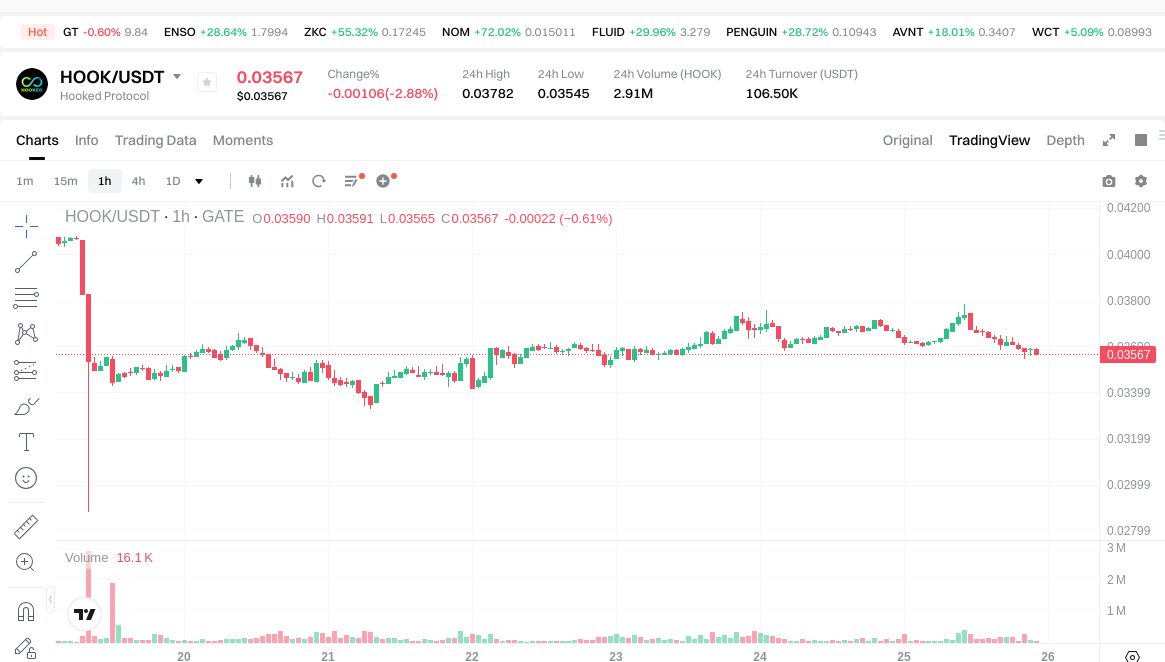
2025: HOOK recorded a low of $0.02786378 in October 2025, reflecting significant price adjustment from previous levels.
-
Comparative Analysis: During various market cycles, HOOK moved from $4.07 to $0.02786378, while BCH demonstrated more established price ranges, moving from $3,785.82 to $76.93 across a longer historical period.
Current Market Status (2026-01-25)
- HOOK current price: $0.03587
- BCH current price: $587.11
- 24-hour trading volume: HOOK $106,285.15 vs BCH $1,418,382.24
- Market sentiment index (Fear & Greed Index): 25 (Extreme Fear)
View real-time prices:
- View HOOK current price Market Price
- View BCH current price Market Price

II. Core Factors Affecting HOOK vs BCH Investment Value
Due to the absence of relevant reference materials, this section cannot provide a detailed comparative analysis of the supply mechanisms, institutional adoption, technical development, and macroeconomic factors between HOOK and BCH. A comprehensive assessment would require specific data on tokenomics, market applications, technological roadmaps, and historical performance metrics for both assets.
Without verifiable information from the provided materials, it would be inappropriate to make claims about supply models, institutional preferences, regulatory positions, technical upgrades, ecosystem development, or macroeconomic correlations for either HOOK or BCH.
III. 2026-2031 Price Prediction: HOOK vs BCH
Short-term Forecast (2026)
- HOOK: Conservative $0.0225-$0.0357 | Optimistic $0.0357-$0.0521
- BCH: Conservative $328.35-$586.34 | Optimistic $586.34-$633.25
Medium-term Forecast (2028-2029)
- HOOK may enter a consolidation phase with projected price range of $0.0277-$0.0534
- BCH may enter a growth phase with projected price range of $454.58-$738.70
- Key drivers: institutional capital inflows, ETF adoption, ecosystem development
Long-term Forecast (2031)
- HOOK: Base scenario $0.0317-$0.0587 | Optimistic scenario $0.0587-$0.0752
- BCH: Base scenario $704.86-$749.85 | Optimistic scenario $749.85-$1064.79
View detailed price predictions for HOOK and BCH
Disclaimer
HOOK:
| Year |
Predicted High Price |
Predicted Average Price |
Predicted Low Price |
Price Change |
| 2026 |
0.0520782 |
0.03567 |
0.0224721 |
0 |
| 2027 |
0.045629064 |
0.0438741 |
0.028518165 |
22 |
| 2028 |
0.04743667692 |
0.044751582 |
0.02774598084 |
24 |
| 2029 |
0.0534691901736 |
0.04609412946 |
0.0405628339248 |
28 |
| 2030 |
0.067703057350848 |
0.0497816598168 |
0.047790393424128 |
38 |
| 2031 |
0.075190218987294 |
0.058742358583824 |
0.031720873635264 |
63 |
BCH:
| Year |
Predicted High Price |
Predicted Average Price |
Predicted Low Price |
Price Change |
| 2026 |
633.2472 |
586.34 |
328.3504 |
0 |
| 2027 |
756.144064 |
609.7936 |
530.520432 |
3 |
| 2028 |
737.60633856 |
682.968832 |
491.73755904 |
16 |
| 2029 |
738.6990886912 |
710.28758528 |
454.5840545792 |
20 |
| 2030 |
775.207870574592 |
724.4933369856 |
463.675735670784 |
23 |
| 2031 |
1064.78785736773632 |
749.850603780096 |
704.85956755329024 |
27 |
IV. Investment Strategy Comparison: HOOK vs BCH
Long-term vs Short-term Investment Strategies
- HOOK: May be suitable for investors with higher risk tolerance who focus on emerging Web3 infrastructure and gamified learning ecosystem development, considering short to medium-term opportunities within the volatility range.
- BCH: May be suitable for investors interested in established peer-to-peer electronic cash systems and on-chain payment scenarios, considering longer-term positioning based on its historical market presence since 2017.
Risk Management and Asset Allocation
- Conservative investors: HOOK 10-20% vs BCH 80-90%, prioritizing established assets with longer track records and larger market capitalization.
- Aggressive investors: HOOK 40-60% vs BCH 40-60%, balancing exposure between emerging ecosystem opportunities and established payment-focused infrastructure.
- Hedging tools: Stablecoin allocation for liquidity management, options strategies for downside protection, cross-asset portfolio diversification.
V. Potential Risk Comparison
Market Risks
- HOOK: Price volatility reflected in the movement from $4.07 in February 2023 to $0.02786378 in October 2025, with current 24-hour trading volume of $106,285.15 indicating relatively lower liquidity compared to more established assets.
- BCH: Historical price fluctuation from $3,785.82 in December 2017 to $76.93 in December 2018, with current 24-hour trading volume of $1,418,382.24, demonstrating established market presence but continued exposure to broader cryptocurrency market cycles.
Technical Risks
- HOOK: Considerations related to ecosystem scalability, network stability, and the development maturity of Web3 infrastructure for mass adoption.
- BCH: Considerations related to network hash rate distribution, on-chain scaling implementation, and security maintenance.
Regulatory Risks
- Global regulatory developments may impact both assets differently based on their respective use cases, with payment-focused cryptocurrencies and Web3 ecosystem tokens potentially facing distinct regulatory frameworks across different jurisdictions.
VI. Conclusion: Which Is the Better Buy?
📌 Investment Value Summary:
- HOOK advantages: Entry into Web3 infrastructure development sector, launched in 2022 with focus on gamified learning experiences and community-driven ecosystem, current price of $0.03587 representing potential early-stage positioning.
- BCH advantages: Established since 2017 with longer market history, positioning as peer-to-peer electronic cash solution with on-chain scaling philosophy, current price of $587.11 with higher trading volume of $1,418,382.24 indicating greater market liquidity.
✅ Investment Recommendations:
- Beginner investors: Consider starting with smaller position sizes, prioritizing understanding of each asset's fundamental use case, and avoiding concentration in single assets during periods of extreme fear sentiment (current Fear & Greed Index: 25).
- Experienced investors: Evaluate portfolio allocation based on risk tolerance, consider diversification between established assets like BCH and emerging ecosystem projects like HOOK, and implement appropriate risk management strategies including stop-loss levels.
- Institutional investors: Conduct comprehensive due diligence on tokenomics, ecosystem development roadmaps, regulatory compliance status, and market liquidity before making allocation decisions, considering both assets' distinct positioning within the broader cryptocurrency landscape.
⚠️ Risk Disclaimer: The cryptocurrency market exhibits significant volatility. This article does not constitute investment advice. Investors should conduct independent research and consult with qualified financial professionals before making investment decisions.
VII. FAQ
Q1: What is the main difference between HOOK and BCH in terms of their fundamental use cases?
HOOK focuses on Web3 infrastructure for mass adoption through gamified learning experiences and community-driven ecosystem development, while BCH positions itself as a peer-to-peer electronic cash solution emphasizing on-chain payment scalability. HOOK launched in 2022 as an emerging ecosystem project targeting the Web3 education and engagement sector, whereas BCH emerged in 2017 from a Bitcoin hard fork with the specific goal of becoming a global payment method through larger block sizes and lower transaction fees. This fundamental distinction means HOOK serves the decentralized application and user onboarding space, while BCH operates primarily in the digital currency and payment processing domain.
Q2: How do the trading volumes of HOOK and BCH compare, and what does this indicate?
BCH has significantly higher trading volume at $1,418,382.24 compared to HOOK's $106,285.15 in the 24-hour period. This substantial difference indicates that BCH enjoys greater market liquidity, meaning investors can enter and exit positions more easily with less price impact. Higher liquidity generally reduces slippage costs and provides more stable price discovery, making BCH potentially more suitable for larger position sizes. HOOK's lower trading volume suggests it may experience higher volatility and wider bid-ask spreads, which could present both opportunities and risks for traders depending on their strategy and position sizing.
Q3: Which asset experienced greater historical price volatility?
HOOK demonstrated more extreme percentage-based volatility, moving from $4.07 in February 2023 to $0.02786378 in October 2025, representing approximately a 99% decline from its peak. BCH, while also experiencing significant volatility, moved from $3,785.82 in December 2017 to $76.93 in December 2018, representing approximately a 98% decline. However, when considering the time periods and current market positions, HOOK's recent volatility appears more pronounced given its shorter market history. This higher volatility in HOOK reflects its status as a newer, smaller-cap asset with less established price discovery, whereas BCH's volatility occurs within a longer historical context and larger market capitalization.
Q4: What should conservative investors prioritize when choosing between HOOK and BCH?
Conservative investors should prioritize BCH with an 80-90% allocation compared to HOOK's 10-20% allocation. The rationale behind this recommendation includes BCH's longer track record since 2017, significantly higher trading volume providing better liquidity, larger market capitalization indicating more established market acceptance, and more predictable volatility patterns based on historical data. Conservative portfolios benefit from assets with proven market resilience, lower liquidity risk, and clearer regulatory positioning. BCH's established presence in the cryptocurrency ecosystem and its specific use case as a payment method provide more historical reference points for risk assessment compared to HOOK's emerging Web3 infrastructure focus.
Q5: How do the 2031 price predictions compare between HOOK and BCH?
For 2031, HOOK's price predictions range from $0.0317 (base scenario low) to $0.0752 (optimistic scenario high), while BCH's predictions range from $704.86 (base scenario low) to $1064.79 (optimistic scenario high). In percentage terms from current prices, HOOK shows potential growth ranging from -12% to 110%, whereas BCH demonstrates potential growth ranging from 20% to 81%. These projections suggest that while HOOK offers potentially higher percentage returns in optimistic scenarios, it also carries downside risk even in base case scenarios. BCH's predictions indicate more consistent upward trajectory across scenarios, reflecting its established market position and lower baseline risk profile.
Q6: What role does the current Fear & Greed Index play in investment decisions for HOOK vs BCH?
The current Fear & Greed Index of 25 (Extreme Fear) indicates heightened market anxiety and risk aversion. During extreme fear periods, investors typically favor established assets with stronger fundamentals and higher liquidity, which would relatively benefit BCH over HOOK. However, extreme fear can also create entry opportunities for risk-tolerant investors, as assets may be undervalued due to sentiment-driven selling rather than fundamental deterioration. For HOOK, extreme fear may amplify its volatility given lower liquidity, potentially creating both higher risk and opportunity. For BCH, extreme fear typically results in more measured price movements due to its larger market cap and established trading patterns. Investors should avoid making impulsive decisions during extreme sentiment periods and instead focus on fundamental analysis and risk-appropriate position sizing.
Q7: How should beginners approach investing in HOOK versus BCH?
Beginners should start with smaller position sizes in both assets, prioritizing education about each asset's fundamental purpose and market dynamics before increasing exposure. For BCH, beginners should understand its role as a peer-to-peer payment system, its relationship to Bitcoin, and its on-chain scaling approach. For HOOK, beginners should research Web3 infrastructure concepts, gamified learning models, and ecosystem development metrics. Given the current extreme fear sentiment (Fear & Greed Index: 25), beginners should avoid concentration in either single asset and consider dollar-cost averaging to reduce timing risk. Starting with BCH may provide a more stable learning experience due to its higher liquidity and longer price history, while HOOK exposure should be limited until investors develop better understanding of emerging ecosystem valuations and volatility management strategies.
Q8: What are the key risk considerations specific to each asset?
HOOK's primary risks include ecosystem development uncertainty, lower liquidity creating higher volatility, relatively short operating history limiting historical risk assessment, and dependence on Web3 adoption trends. Its movement from $4.07 to current levels demonstrates significant downside risk potential. BCH's key risks include ongoing debates about its positioning relative to Bitcoin, network security considerations related to hash rate distribution, competition from other payment-focused cryptocurrencies, and regulatory scrutiny specific to payment tokens. Both assets face broader cryptocurrency market risks including regulatory changes, macroeconomic factors, and market sentiment shifts. Investors should implement appropriate risk management including position sizing limits, stop-loss strategies, and portfolio diversification across multiple assets and asset classes beyond HOOK and BCH.
* The information is not intended to be and does not constitute financial advice or any other recommendation of any sort offered or endorsed by Gate.