This comprehensive guide compares HOT and DOGE meme coins to help investors determine which offers better opportunities in the next bull market. HOT, a decentralized hosting platform launched in 2018, contrasts with DOGE, an established payment cryptocurrency since 2013. The analysis examines critical differences including tokenomics (DOGE's unlimited supply vs HOT's unspecified mechanism), trading volume (DOGE: $22.6B vs HOT: $13.6M daily), and institutional adoption levels. Price projections through 2031 suggest DOGE ranges from $0.112-$0.317 while HOT ranges from $0.000401-$0.001115. The article provides tailored investment strategies for conservative and aggressive investors, comprehensive risk assessments covering market, technical, and regulatory factors, and detailed FAQs addressing liquidity, supply mechanisms, and portfolio allocation decisions. Whether you're a new investor seeking established security or an experienced trader pursuing emerging infrastructure opportunities, this guide delivers the d
Introduction: Investment Comparison Between HOT and DOGE
In the cryptocurrency market, the comparison between HOT vs DOGE has consistently been a topic of interest for investors. The two differ significantly in market cap ranking, application scenarios, and price performance, representing distinct positioning within the crypto asset landscape.
HOT (Holo): Launched in 2018, it has gained market recognition as a distributed peer-to-peer hosting platform for Holochain applications, positioning itself as a bridge to a new internet infrastructure.
DOGE (DogeCoin): Since its inception in 2013, it has been characterized as a fun and light-hearted cryptocurrency, becoming one of the globally traded digital assets with substantial user adoption.
This article will provide a comprehensive analysis of HOT vs DOGE investment value comparison, covering historical price trends, supply mechanisms, institutional adoption, technical ecosystem, and future projections, attempting to address investors' most pressing question:
"Which is the better buy right now?"
I. Historical Price Comparison and Current Market Status
HOT and DOGE Historical Price Trends
- 2021: HOT reached its all-time high of $0.03126682 in April, driven by increased interest in decentralized hosting platforms. The price later experienced significant volatility throughout the year.
- 2021: DOGE recorded its all-time high of $0.731578 in May, influenced by social media momentum and endorsements from prominent figures. Following this peak, the token entered a prolonged correction phase.
- Comparative Analysis: During the 2021-2022 market cycle, HOT declined from its peak of $0.03126682 to lower levels, while DOGE experienced a similar downward trajectory from $0.731578, reflecting broader market corrections affecting altcoins.
Current Market Status (2026-01-17)
- HOT Current Price: $0.000526
- DOGE Current Price: $0.13769
- 24-Hour Trading Volume: HOT recorded $13,644.35 thousand compared to DOGE's $22,597,954.71 thousand
- Market Sentiment Index (Fear & Greed Index): 50 (Neutral)
View Real-Time Prices:
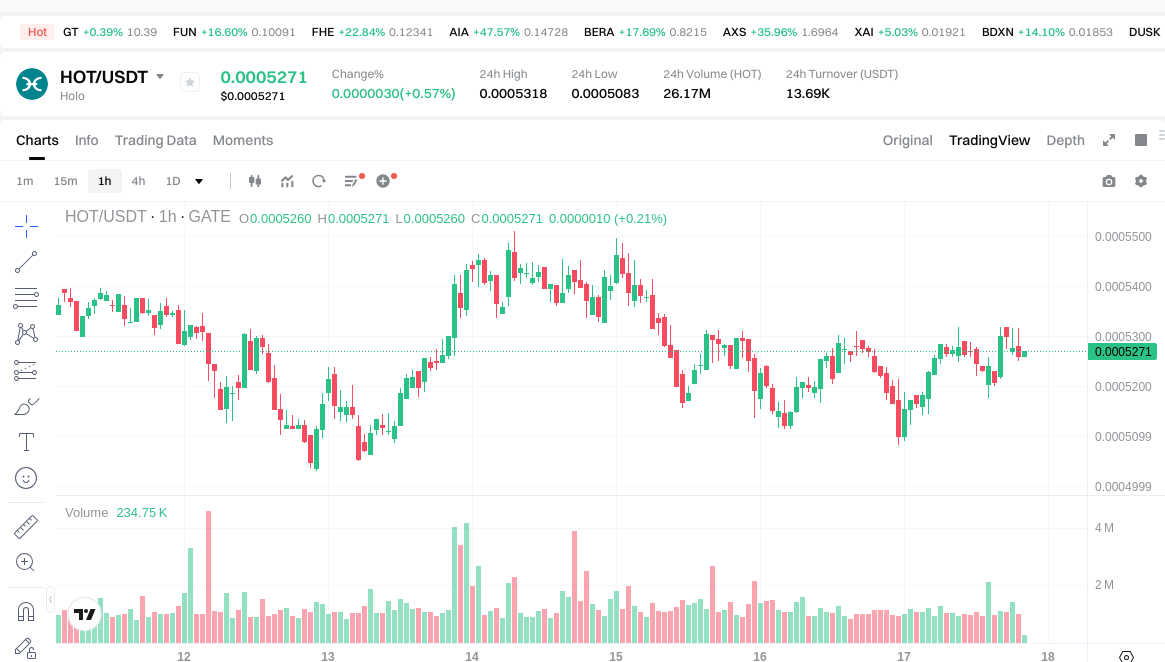
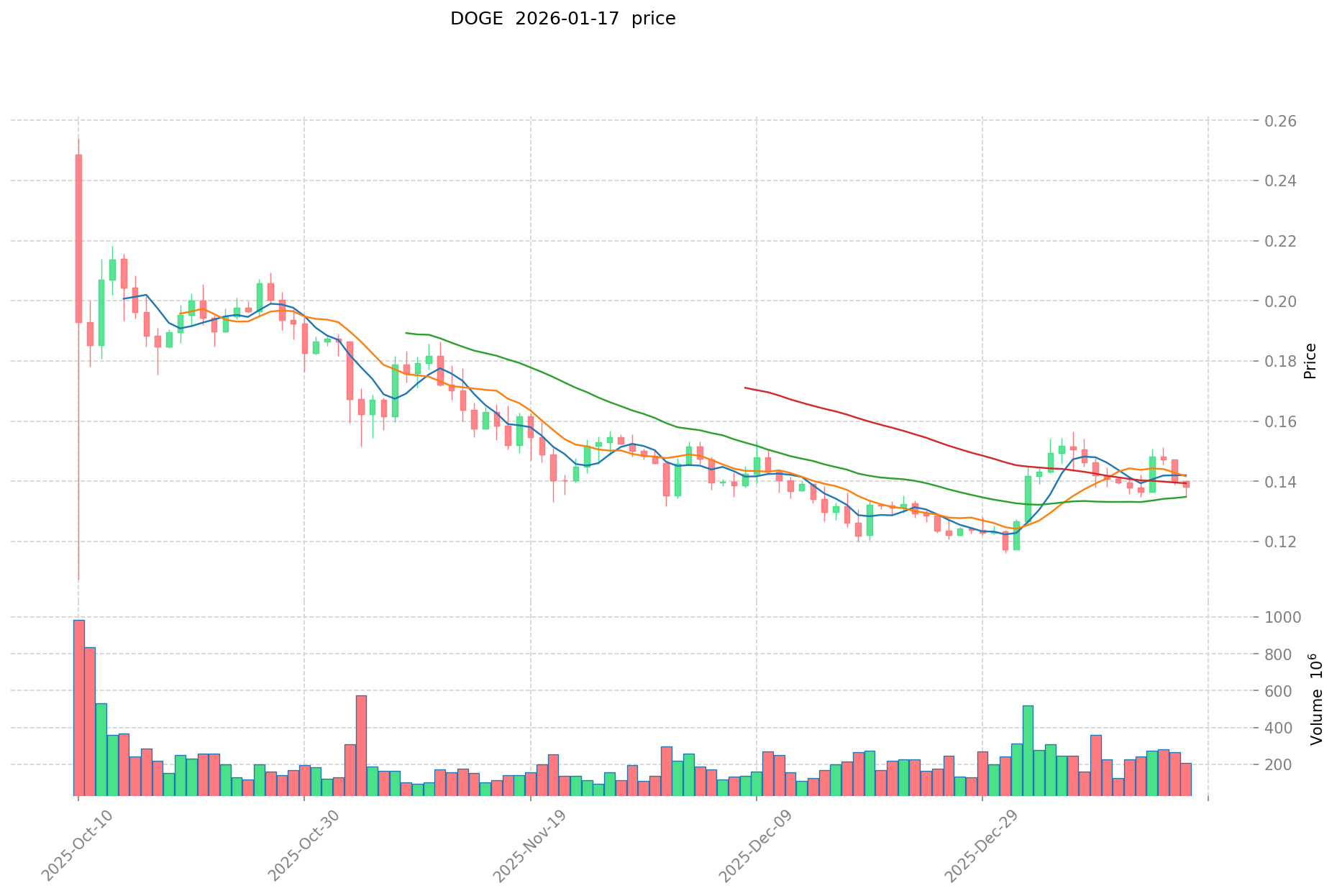
II. Core Factors Influencing HOT vs DOGE Investment Value
Supply Mechanism Comparison (Tokenomics)
-
DOGE: Operates with an unlimited supply model, adding approximately 5 billion new DOGE tokens annually through mining rewards. This inflationary structure contrasts with deflationary cryptocurrency models, as the token lacks a fixed maximum supply cap. The unlimited issuance approach was designed to maintain accessibility and stable pricing dynamics.
-
HOT: Reference materials do not provide specific information regarding HOT's supply mechanism or tokenomics structure.
-
📌 Historical Pattern: DOGE's supply mechanism has contributed to notable price volatility cycles. Historical data shows price movements from $0.00026 in December 2013 to peaks reaching $0.74 in May 2021, demonstrating how community sentiment and external factors can drive significant value fluctuations despite the inflationary supply model.
Institutional Adoption and Market Applications
-
Institutional Holdings: Reference materials indicate growing institutional attention toward DOGE, particularly following endorsements from prominent figures. Several major cryptocurrency exchanges including Coinbase, Gemini, and Binance have listed DOGE for trading.
-
Enterprise Adoption: DOGE has gained traction in specific commercial applications. Companies such as Tesla have accepted DOGE for merchandise purchases, highlighting its utility in payment scenarios. The token has also been utilized for online content creator tipping, facilitating micro-payments, and business transactions. HOT's enterprise adoption status is not documented in the provided materials.
-
Regulatory Environment: Reference materials do not provide detailed information comparing regulatory attitudes toward HOT and DOGE across different jurisdictions.
Technology Development and Ecosystem Construction
-
DOGE Technical Infrastructure: Built on Litecoin's codebase, DOGE employs a Proof-of-Work (PoW) consensus mechanism using the Scrypt algorithm. The blockchain generates blocks approximately every minute, offering faster transaction confirmation compared to Bitcoin's 10-minute interval. Transaction fees typically remain low within the network.
-
HOT Technical Development: Reference materials do not contain specific information regarding HOT's technical architecture or development roadmap.
-
Ecosystem Comparison: DOGE has established presence in social media platforms including Reddit and Twitter for tipping and donations. The token's ecosystem continues expanding as more platforms integrate DOGE payment support. The Dogecoin Foundation's governance structure includes founder Billy Markus, core developer Max Keller, Ethereum founder Vitalik Buterin as crypto advisor, and Jared Birchall representing legal and financial guidance. Information regarding HOT's DeFi integration, NFT ecosystem, or smart contract capabilities is not available in the reference materials.
Macroeconomic Environment and Market Cycles
-
Performance During Inflationary Conditions: Reference materials do not provide comparative analysis of HOT and DOGE performance characteristics during inflationary economic environments or their respective inflation-hedging properties.
-
Macroeconomic Monetary Policy: The materials do not contain specific analysis regarding how interest rate changes, US dollar index movements, or broader monetary policy decisions impact HOT and DOGE valuations.
-
Geopolitical Factors: While reference materials mention DOGE's use in cross-border scenarios and international payment applications, detailed analysis of how geopolitical developments, international trade dynamics, or regional conflicts specifically affect HOT and DOGE demand is not provided in the available documentation.
III. 2026-2031 Price Prediction: HOT vs DOGE
Short-term Forecast (2026)
- HOT: Conservative $0.000401 - $0.000527 | Optimistic $0.000527 - $0.000754
- DOGE: Conservative $0.112 - $0.138 | Optimistic $0.138 - $0.160
Mid-term Forecast (2028-2029)
- HOT may enter a moderate growth phase, with projected prices ranging from $0.000621 to $0.001016 in 2028, and $0.000747 to $0.000883 in 2029
- DOGE may enter a consolidation and expansion phase, with projected prices ranging from $0.107 to $0.225 in 2028, and $0.133 to $0.248 in 2029
- Key drivers: institutional capital flows, ETF developments, ecosystem expansion
Long-term Forecast (2031)
- HOT: Baseline scenario $0.000591 - $0.000953 | Optimistic scenario $0.000953 - $0.001115
- DOGE: Baseline scenario $0.131 - $0.257 | Optimistic scenario $0.257 - $0.317
View detailed price predictions for HOT and DOGE
Disclaimer
HOT:
| Year |
Predicted High Price |
Predicted Average Price |
Predicted Low Price |
Price Change |
| 2026 |
0.000753753 |
0.0005271 |
0.000400596 |
0 |
| 2027 |
0.000723681945 |
0.0006404265 |
0.000582788115 |
21 |
| 2028 |
0.001016260791525 |
0.0006820542225 |
0.000620669342475 |
29 |
| 2029 |
0.000883123807293 |
0.000849157507012 |
0.000747258606171 |
61 |
| 2030 |
0.001039368788583 |
0.000866140657152 |
0.000753542371722 |
64 |
| 2031 |
0.001114723025755 |
0.000952754722868 |
0.000590707928178 |
81 |
DOGE:
| Year |
Predicted High Price |
Predicted Average Price |
Predicted Low Price |
Price Change |
| 2026 |
0.1598248 |
0.13778 |
0.1116018 |
0 |
| 2027 |
0.162194616 |
0.1488024 |
0.09672156 |
8 |
| 2028 |
0.2254728366 |
0.155498508 |
0.10729397052 |
12 |
| 2029 |
0.24763137399 |
0.1904856723 |
0.13333997061 |
38 |
| 2030 |
0.29572900624575 |
0.219058523145 |
0.20372442652485 |
59 |
| 2031 |
0.316594330575311 |
0.257393764695375 |
0.131270819994641 |
86 |
IV. Investment Strategy Comparison: HOT vs DOGE
Long-term vs Short-term Investment Strategies
-
HOT: May suit investors interested in decentralized hosting infrastructure and peer-to-peer application platforms. The token's price projections suggest potential growth patterns over multi-year horizons, with predicted ranges expanding from $0.000401-$0.000754 in 2026 to $0.000591-$0.001115 by 2031.
-
DOGE: May appeal to investors focused on payment adoption scenarios and community-driven digital assets. Price forecasts indicate potential appreciation from $0.112-$0.160 in 2026 to $0.131-$0.317 by 2031, reflecting established market presence and broader recognition.
Risk Management and Asset Allocation
-
Conservative Investors: A balanced approach might consider HOT allocation at 30-40% versus DOGE at 60-70%, prioritizing DOGE's established market liquidity and broader exchange availability.
-
Aggressive Investors: Portfolio weighting could shift toward 50-60% HOT versus 40-50% DOGE, reflecting higher risk tolerance for emerging infrastructure projects alongside established digital assets.
-
Hedging Tools: Risk management strategies may include stablecoin reserves for capital preservation, options contracts where available for downside protection, and cross-asset diversification across multiple cryptocurrency categories.
V. Potential Risk Comparison
Market Risk
-
HOT: Trading volume of $13,644.35 thousand indicates lower liquidity compared to major cryptocurrencies, potentially leading to increased price volatility during market stress periods. The token's concentration in specific use cases may expose holders to sector-specific demand fluctuations.
-
DOGE: Despite substantial trading volume of $22,597,954.71 thousand, DOGE has demonstrated significant price swings historically, moving from peaks near $0.731578 to current levels around $0.13769. The unlimited supply mechanism creates ongoing inflation pressure that may affect long-term value retention.
Technical Risk
-
HOT: Reference materials do not provide detailed information regarding HOT's technical architecture, scalability solutions, or network stability characteristics, which may represent information gaps for technical due diligence.
-
DOGE: Operating on Proof-of-Work consensus using Scrypt algorithm, the network faces considerations related to mining concentration patterns and computational resource requirements. The blockchain's security model depends on sustained miner participation and hash rate distribution.
Regulatory Risk
- Global regulatory frameworks continue evolving regarding cryptocurrency classification, taxation, and trading restrictions. Payment-focused tokens like DOGE may face different regulatory scrutiny compared to infrastructure tokens like HOT. Jurisdictional variations in securities laws, anti-money laundering requirements, and consumer protection regulations could impact both assets differently based on their respective use cases and market positioning.
VI. Conclusion: Which Is the Better Buy?
📌 Investment Value Summary:
-
HOT Characteristics: Positioned within decentralized hosting infrastructure sector with peer-to-peer application platform focus. Price projections suggest potential multi-year appreciation patterns, though current trading volume indicates developing market liquidity.
-
DOGE Characteristics: Established market presence since 2013 with substantial trading volume and broader exchange availability. Demonstrated utility in payment scenarios and micro-transactions, supported by community engagement and selective merchant adoption.
✅ Investment Considerations:
-
New Investors: May consider starting with DOGE due to higher liquidity, broader exchange support, and established market recognition. Understanding the unlimited supply mechanism and historical price volatility patterns represents essential foundational knowledge.
-
Experienced Investors: Could evaluate portfolio diversification strategies incorporating both assets based on risk tolerance and sector exposure preferences. Technical analysis of trading patterns, volume trends, and ecosystem developments may inform position sizing decisions.
-
Institutional Investors: Assessment frameworks might emphasize liquidity depth, regulatory clarity, custody solutions availability, and correlation patterns with broader cryptocurrency markets. Due diligence regarding governance structures, development roadmaps, and market infrastructure maturity remains essential.
⚠️ Risk Disclosure: Cryptocurrency markets exhibit substantial volatility characteristics. This analysis does not constitute investment advice, financial guidance, or recommendations for specific trading actions. Market participants should conduct independent research and consult qualified financial advisors before making investment decisions.
VII. FAQ
Q1: What are the main differences between HOT and DOGE in terms of their core use cases?
HOT focuses on decentralized hosting infrastructure for peer-to-peer applications, while DOGE serves primarily as a payment and tipping cryptocurrency. HOT, launched in 2018, positions itself as a distributed hosting platform for Holochain applications, acting as a bridge to new internet infrastructure. In contrast, DOGE, established in 2013, has evolved into a widely recognized payment token with adoption by companies like Tesla for merchandise purchases, micro-payment applications, and online content creator tipping systems.
Q2: How do the supply mechanisms of HOT and DOGE differ, and what implications does this have for long-term value?
DOGE operates with an unlimited supply model adding approximately 5 billion tokens annually, while HOT's supply mechanism details are not documented in available materials. DOGE's inflationary structure lacks a maximum supply cap, which creates ongoing inflation pressure that may affect long-term value retention. This unlimited issuance approach was designed to maintain accessibility and stable pricing dynamics, though it contrasts sharply with deflationary cryptocurrency models that feature fixed supply caps.
Q3: Which token demonstrates better liquidity and trading volume?
DOGE exhibits significantly higher liquidity with 24-hour trading volume of $22,597,954.71 thousand compared to HOT's $13,644.35 thousand. This substantial difference indicates that DOGE offers greater market depth, potentially resulting in tighter bid-ask spreads and reduced slippage during large transactions. HOT's lower trading volume suggests developing market liquidity, which may lead to increased price volatility during market stress periods and potential challenges when entering or exiting positions.
Q4: What are the price projections for HOT vs DOGE through 2031?
Short-term (2026): HOT ranges from $0.000401-$0.000754, while DOGE ranges from $0.112-$0.160. Long-term (2031): HOT baseline scenario projects $0.000591-$0.000953 (optimistic $0.000953-$0.001115), while DOGE baseline scenario projects $0.131-$0.257 (optimistic $0.257-$0.317). These projections suggest HOT may experience growth patterns within its infrastructure sector niche, while DOGE's forecasts reflect its established market presence and broader recognition in payment adoption scenarios.
Q5: What portfolio allocation strategies might investors consider for HOT vs DOGE?
Conservative investors might consider 30-40% HOT allocation versus 60-70% DOGE, prioritizing DOGE's established market liquidity and broader exchange availability. Aggressive investors could shift toward 50-60% HOT versus 40-50% DOGE, reflecting higher risk tolerance for emerging infrastructure projects. Portfolio weighting decisions should account for HOT's position in decentralized hosting infrastructure against DOGE's established utility in payment scenarios, along with individual risk tolerance and investment timeframes.
Q6: What are the primary risks associated with investing in HOT compared to DOGE?
HOT faces liquidity risk due to lower trading volume, potential sector-specific demand fluctuations, and limited publicly available technical documentation. DOGE risks include significant historical price volatility (peak $0.731578 to current $0.13769), unlimited supply creating inflation pressure, and dependency on sustained community engagement. Both tokens face evolving regulatory frameworks, though payment-focused tokens like DOGE may encounter different regulatory scrutiny compared to infrastructure tokens like HOT based on their respective use cases and market positioning.
Q7: Which cryptocurrency is more suitable for different investor profiles?
New investors may find DOGE more accessible due to higher liquidity, broader exchange support, and established market recognition, though understanding its unlimited supply mechanism and volatility patterns remains essential. Experienced investors might evaluate diversification strategies incorporating both assets based on risk tolerance and sector exposure preferences. Institutional investors should emphasize liquidity depth assessment, regulatory clarity, custody solutions availability, and correlation patterns with broader cryptocurrency markets when comparing these assets.
Q8: How does institutional adoption compare between HOT and DOGE?
DOGE demonstrates growing institutional attention with listings on major exchanges including Coinbase, Gemini, and Binance, plus adoption by companies like Tesla for merchandise purchases. The Dogecoin Foundation includes notable figures such as Ethereum founder Vitalik Buterin as crypto advisor. HOT's institutional adoption status and enterprise integration details are not documented in available materials, suggesting potential information gaps for institutional due diligence processes. This difference in documented institutional engagement may influence investment decisions for institutional capital allocators.
* The information is not intended to be and does not constitute financial advice or any other recommendation of any sort offered or endorsed by Gate.