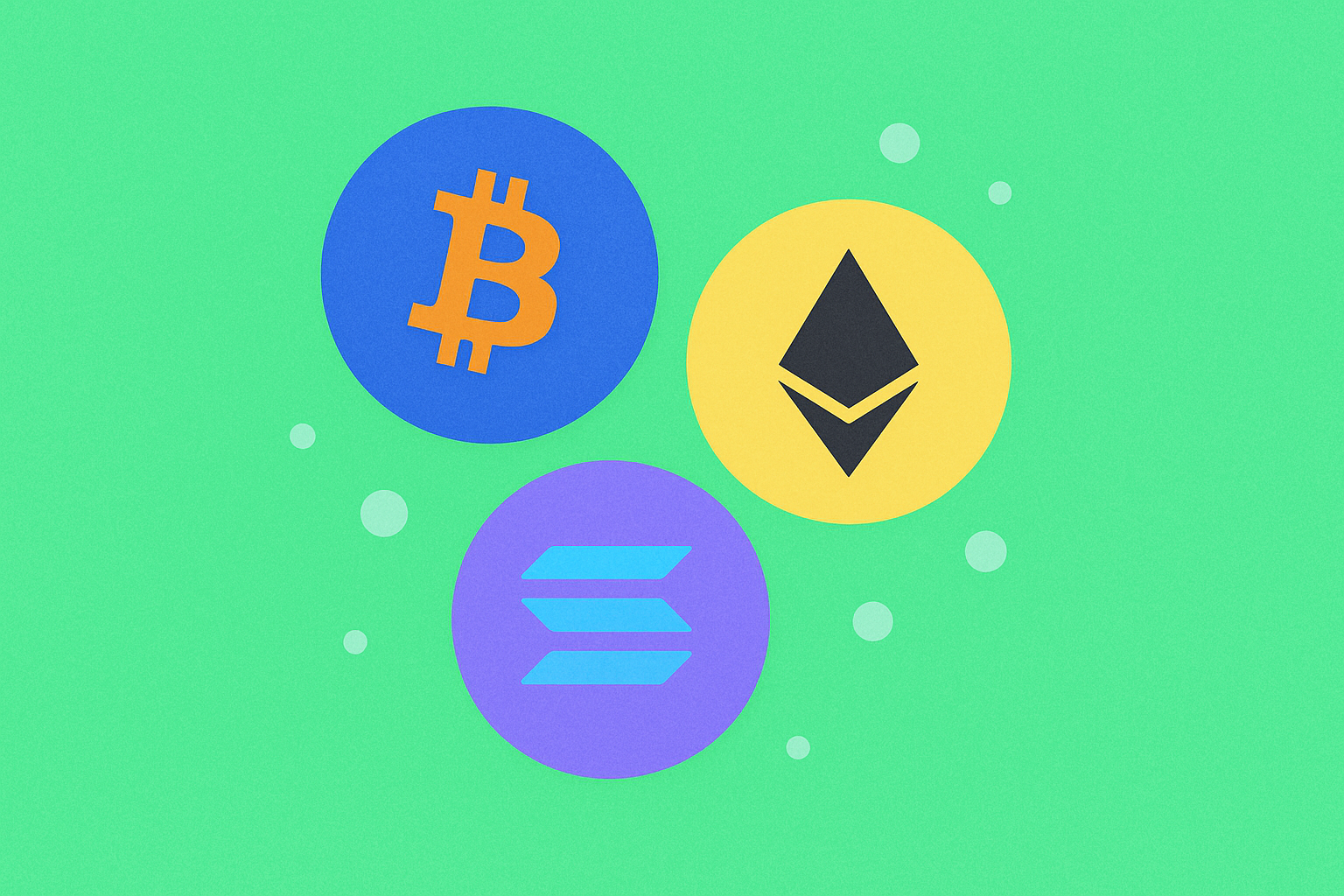
This article provides a comprehensive comparative analysis of three major blockchains dominating the $2 trillion cryptocurrency ecosystem. Bitcoin maintains $1.2 trillion market dominance as a digital reserve asset, while Ethereum commands 64% of global DeFi total value locked through sophisticated smart contract infrastructure. Solana emerges as the performance leader, processing 4,000 transactions per second with significantly lower fees, capturing high-volume NFT trading. The article examines how each blockchain addresses distinct market segments—Bitcoin for institutional security, Ethereum for complex financial protocols, and Solana for speed-optimized consumer applications. Additionally, it explores Asia-Pacific's 10 percentage point market share surge, institutional capital flows, and regulatory framework maturation reshaping cryptocurrency exchange competition through 2025.
Bitcoin's $1.2 Trillion Market Dominance vs. Ethereum's 64% DeFi TVL Leadership and Solana's 4000 TPS NFT Trading Advantage
The cryptocurrency market continues to exhibit distinct competitive dynamics in 2026, with each major blockchain carving unique positions within the $2 trillion digital asset ecosystem. Bitcoin maintains commanding market capitalization presence at $1.2 trillion, translating to 40% market dominance that underscores its role as the sector's foundational value store. This substantial market share reflects Bitcoin's established security infrastructure and unmatched network resilience, attracting institutional capital seeking stable cryptocurrency exposure.
Ethereum has consolidated its position through decentralized finance expansion, commanding 64% of total value locked across all blockchain protocols. This DeFi TVL leadership demonstrates Ethereum's strategic dominance in complex financial applications, smart contract sophistication, and institutional-grade liquidity infrastructure. Layer 2 solutions like Arbitrum and Optimism further strengthen this position by reducing transaction costs while maintaining Ethereum's security foundations.
Solana has emerged as the performance alternative, processing approximately 4,000 transactions per second compared to Ethereum's 15-20 TPS on mainnet. This transaction throughput advantage, combined with substantially lower fees, positioned Solana as the leading platform for NFT trading efficiency and retail-oriented blockchain applications. The network's ability to handle high-frequency transactions attracted institutional partnerships and developer migration. Rather than representing zero-sum competition, these three blockchains address distinct market segments—Bitcoin serving as digital reserve asset, Ethereum enabling sophisticated financial protocols, and Solana optimizing for speed and consumer accessibility within the evolving cryptocurrency landscape.
Differentiated Positioning: How Ethereum Maintains 63% Global DeFi Liquidity While Solana Captures High-Frequency NFT Trading
Ethereum's dominance in decentralized finance stems from its mature infrastructure and institutional confidence. With $99 billion in total value locked across DeFi protocols, Ethereum commands approximately 68% of global DeFi liquidity—more than nine times larger than competing Layer 1 ecosystems. This leadership is reinforced by stablecoins, decentralized exchanges (DEXs), and Layer 2 rollups that together create deep liquidity pools for traders seeking capital efficiency and security. Institutional adoption and regulatory clarity have further strengthened Ethereum's position, attracting billions in managed assets to its ecosystem.
Solana has carved a distinct market niche through technical specialization rather than competing directly. Its architecture, combining Proof of History with parallel execution, enables unprecedented transaction throughput at fractional-cent fees—5,200 times lower than Ethereum during comparable network congestion. This performance advantage drives high-frequency NFT and token trading, where speed and cost determine profitability. In 2025, Solana processed $108 billion in trading platform volume and $782 billion in stablecoin trading, demonstrating how scalability attracts velocity-sensitive traders. By early 2025, Solana surpassed Ethereum in daily active users and transaction volumes, revealing how differentiated positioning serves distinct market segments rather than creating zero-sum competition between the ecosystems.
Asia-Pacific's 10 Percentage Point Market Share Surge Reshaping the 2025 Cryptocurrency Exchange Competition Landscape
The Asia-Pacific region's 10 percentage point market share surge represents a fundamental structural shift in global cryptocurrency exchange dynamics during 2025. This expansion extends far beyond simple trading volume metrics, fundamentally reshaping how institutional capital flows through Bitcoin and digital asset markets. According to recent market analysis, Asia has emerged as the fastest-growing driver of crypto activity globally, with institutional investors now accounting for 68.8% of transactions in Southeast Asia alone—a significant departure from retail-dominated trading patterns observed in Western markets.
This regional surge directly correlates with increased trading volume that has skyrocketed approximately 70% year-over-year, dramatically improving market liquidity across cryptocurrency exchanges. Enhanced liquidity means larger trades execute more smoothly, attracting sophisticated institutional players previously hesitant about slippage and execution challenges. The competitive landscape has intensified accordingly, with regional exchanges gaining market share from established global platforms by offering tailored services for institutional clients.
RegulatoryFramework maturation has substantially catalyzed this institutional influx. As Asia-Pacific regulators provide greater clarity on digital asset classification and custody requirements, institutional investors gain confidence to allocate meaningful capital. This regulatory evolution directly amplifies cryptocurrency exchange competition in the region, forcing platforms to innovate around compliance, settlement efficiency, and asset custody solutions. The resulting competitive pressure subsequently influences global market dynamics, particularly affecting Bitcoin's dominance metrics as regional capital reallocation occurs.
FAQ
What is Bitcoin's $1.2 trillion market share percentage in cryptocurrency? Which has more advantages compared to Ethereum?
Bitcoin's $1.2 trillion market cap represents approximately 55% of total cryptocurrency market share. Bitcoin dominates as primary value storage, while Ethereum leads DeFi with 64% TVL. Both maintain distinct advantages: Bitcoin for institutional adoption and security, Ethereum for smart contract ecosystem and DeFi applications.
What are Ethereum's core competitive advantages in DeFi compared to other blockchains? Will it maintain its leading position in 2025?
Ethereum dominates DeFi through its robust smart contract ecosystem, largest developer community, and deep liquidity. Its deflationary tokenomics and established infrastructure provide structural advantages. It maintained leadership through 2025 with expanding Layer 2 solutions and institutional adoption.
What are Solana's advantages compared to Ethereum in NFT trading? How significant are the differences in transaction costs and speed?
Solana offers significantly lower transaction costs and faster speeds than Ethereum for NFT trading. Solana processes thousands of transactions per second with minimal fees, while Ethereum's network is more congested and expensive. This makes Solana more efficient for high-volume NFT trading activities.
What are the essential differences in technical architecture and application scenarios among Bitcoin, Ethereum, and Solana?
Bitcoin is designed for peer-to-peer digital payments with a simple UTXO model. Ethereum supports smart contracts and decentralized applications through its account-based architecture. Solana prioritizes high-speed transactions and low fees using a Proof-of-History consensus mechanism for different use cases.
Which of these three projects has the greatest growth potential in 2025? How will market share change?
Solana shows the strongest growth potential due to expanding NFT infrastructure and gaming adoption. Bitcoin maintains dominance through institutional adoption, while Ethereum leads DeFi innovation. Market share will gradually shift toward layer-2 solutions and specialized blockchains, with Solana capturing increased trading volume share.
How should ordinary investors choose to allocate assets between Bitcoin, Ethereum, and Solana?
Choose Bitcoin for stability as digital gold, Ethereum for smart contract ecosystem growth, and Solana for high-speed transaction advantages based on your risk tolerance and investment objectives.
* The information is not intended to be and does not constitute financial advice or any other recommendation of any sort offered or endorsed by Gate.