This comprehensive guide compares IMX and ARB, two leading Layer 2 scaling solutions for Ethereum, helping investors determine which asset aligns with their investment strategy. IMX focuses on blockchain gaming and NFT infrastructure with zero gas fees, while ARB serves broader DeFi applications across the Ethereum ecosystem. As of January 2026, IMX trades at $0.2672 with $301.35 million daily volume, while ARB trades at $0.2089 with significantly higher liquidity at $1.95 billion daily volume. The article analyzes historical price performance, tokenomics, institutional adoption, technical development, and provides price predictions through 2031. Conservative investors may favor ARB's diversified ecosystem exposure, whereas gaming-focused investors might prefer IMX's specialized positioning. Investment strategies vary by risk tolerance, with detailed allocation recommendations and comprehensive risk analysis provided through 2031 forecasts on Gate exchange.
Introduction: IMX vs ARB Investment Comparison
In the cryptocurrency market, the comparison between IMX vs ARB has consistently been a topic investors cannot avoid. Both demonstrate notable differences in market cap ranking, application scenarios, and price performance, while representing distinct positioning within the crypto asset landscape.
Immutable (IMX): Since its launch, this token has gained market recognition through its positioning as a Layer-2 scaling solution for NFTs on Ethereum, featuring instant transactions, massive scalability, and zero gas fees for minting and trading.
Arbitrum (ARB): Introduced in March 2023, this token represents a technology suite designed to scale Ethereum, enabling users to perform all Ethereum activities with lower costs and faster transaction speeds through its flagship Optimistic Rollup protocol.
This article will comprehensively analyze the investment value comparison of IMX vs ARB through historical price trends, supply mechanisms, institutional adoption, technical ecosystems, and future predictions, attempting to answer the question investors care about most:
"Which is the better buy right now?"
I. Historical Price Comparison and Current Market Status
IMX and ARB Historical Price Trends
-
2021: IMX experienced significant volatility following its launch, with the token reaching a peak of $9.52 in November 2021 as the NFT market gained momentum and investor interest surged in Layer-2 scaling solutions.
-
2024: ARB reached its all-time high of $2.39 in January 2024, driven by increased adoption of the Arbitrum network and growing usage of its Layer-2 scaling solution for Ethereum.
-
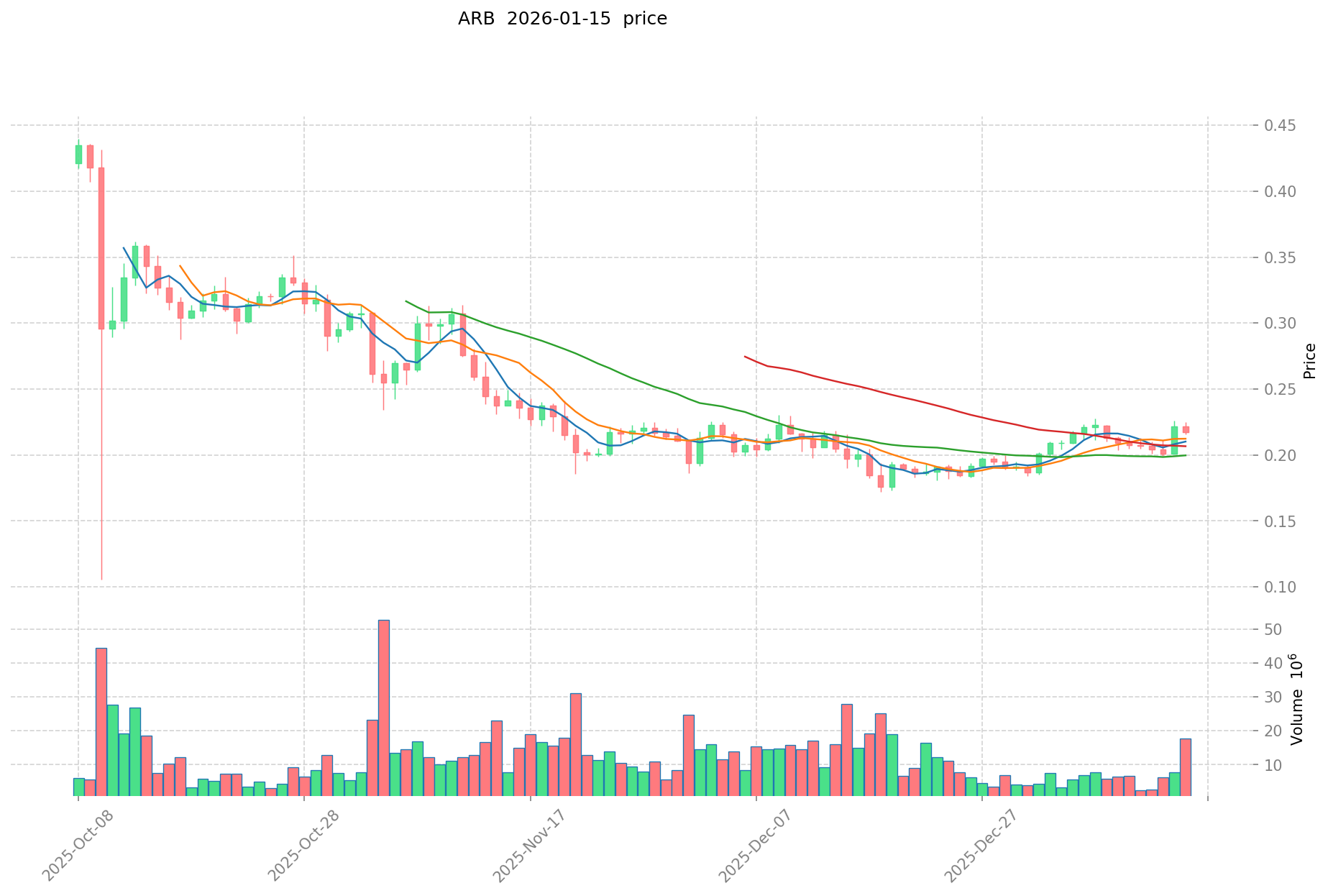
Comparative Analysis: During the recent market cycle, IMX declined from its historical high of $9.52 to a low of $0.215226 in December 2025, representing a substantial correction. In contrast, ARB fell from its peak of $2.39 to a low of $0.172637 during the same period, demonstrating similar downward pressure across Layer-2 tokens.
Current Market Conditions (January 16, 2026)
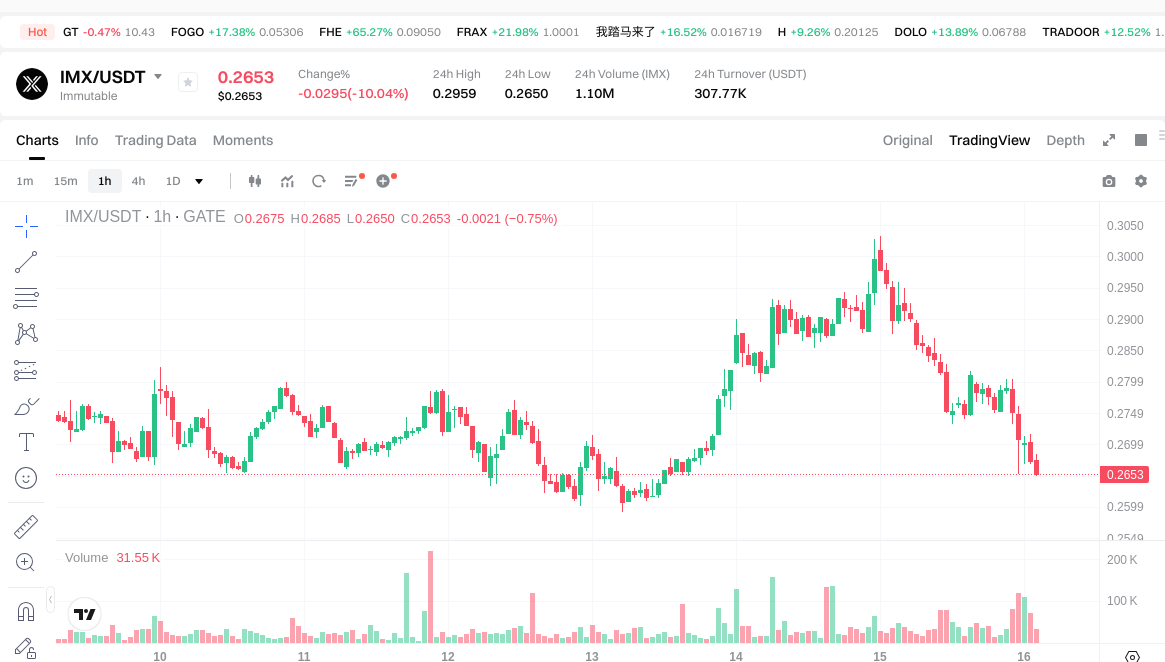
- IMX current price: $0.2672
- ARB current price: $0.2089
- 24-hour trading volume: IMX $301.35 million vs ARB $1.95 billion
- Market sentiment index (Fear & Greed Index): 61 (Greed)
View real-time prices:
II. Core Factors Influencing IMX vs ARB Investment Value
Tokenomics Comparison
-
IMX: IMX has a maximum supply of 2 billion tokens with a circulating supply of approximately 826.31 million tokens as of recent data. The token follows a structured unlocking schedule, with notable unlock events that may impact market dynamics. Token unlocks can create selling pressure, though they also present accumulation opportunities for long-term investors.
-
ARB: ARB serves as the governance token for the Arbitrum ecosystem and operates within Ethereum's Layer 2 scaling framework. The token's supply mechanism is designed to incentivize network participation and governance, with distribution allocated across ecosystem development, team members, and community initiatives.
-
📌 Historical Pattern: Supply mechanisms and token unlock schedules have historically influenced price cycles, with concentrated unlock events potentially creating short-term volatility while long-term value correlates with ecosystem adoption and utility.
Institutional Adoption and Market Application
-
Institutional Holdings: ARB demonstrates stronger correlation with ETH movements, suggesting it may attract institutional investors focused on Ethereum ecosystem exposure. This correlation positions ARB as a potential proxy for institutional participation in Layer 2 scaling solutions.
-
Enterprise Adoption: IMX focuses specifically on gaming and NFT sectors, establishing partnerships within the Immutable ecosystem including projects like OVERTAKE, Immortal Rising 2, and Somnis. ARB serves broader Ethereum Layer 2 applications across DeFi protocols including GMX, MAGIC, and RDNT within the Arbitrum ecosystem.
-
Regulatory Landscape: Both assets operate within the evolving regulatory framework for Layer 2 solutions, with their adoption influenced by jurisdictional approaches to digital assets and blockchain scaling technologies.
Technical Development and Ecosystem Building
-
IMX Technical Upgrades: IMX continues development within the Immutable X ecosystem, with ongoing releases and updates to gaming projects and NFT collections. The platform emphasizes zero gas fees for NFT minting and trading, positioning itself as infrastructure for blockchain gaming.
-
ARB Technical Development: ARB benefits from Ethereum's broader technical roadmap, particularly upgrades that enhance Layer 2 efficiency and reduce transaction costs. The Arbitrum ecosystem integrates with various DeFi protocols and applications, expanding its utility beyond single-sector focus.
-
Ecosystem Comparison: ARB demonstrates broader ecosystem integration across DeFi applications, while IMX maintains concentrated focus on gaming and NFT markets. DeFi activity on Arbitrum includes protocols like AAVE, SNX, and various DEX platforms, whereas IMX's ecosystem centers on gaming-specific applications and NFT marketplaces.
Macroeconomic Factors and Market Cycles
-
Performance in Inflationary Environments: Both assets exhibit characteristics tied to Ethereum's ecosystem performance rather than serving as direct inflation hedges. Their value propositions relate more to technological adoption and scaling solution demand than traditional store-of-value narratives.
-
Macroeconomic Monetary Policy: Interest rate changes and dollar index movements impact both assets through their effects on overall cryptocurrency market liquidity and risk appetite. Layer 2 solutions may benefit from periods of high Ethereum network congestion and elevated gas fees, making them more attractive during periods of increased blockchain activity.
-
Geopolitical Factors: Cross-border transaction demand and international blockchain adoption influence both assets' long-term prospects, though IMX's gaming focus may show different sensitivity to regional market preferences compared to ARB's broader DeFi applications.
III. 2026-2031 Price Prediction: IMX vs ARB
Short-term Forecast (2026)
- IMX: Conservative $0.18-$0.27 | Optimistic $0.27-$0.34
- ARB: Conservative $0.17-$0.21 | Optimistic $0.21-$0.25
Medium-term Forecast (2028-2029)
- IMX may enter an expansion phase, with estimated price range of $0.17-$0.55
- ARB may enter a consolidation phase, with estimated price range of $0.18-$0.29
- Key drivers: institutional capital inflows, ETF developments, ecosystem growth
Long-term Forecast (2030-2031)
- IMX: Base scenario $0.31-$0.56 | Optimistic scenario $0.47-$0.68
- ARB: Base scenario $0.17-$0.28 | Optimistic scenario $0.21-$0.39
View detailed price predictions for IMX and ARB
Disclaimer
IMX:
| Year |
Predicted High Price |
Predicted Average Price |
Predicted Low Price |
Price Change |
| 2026 |
0.335412 |
0.2662 |
0.183678 |
0 |
| 2027 |
0.33690272 |
0.300806 |
0.19853196 |
12 |
| 2028 |
0.4336419296 |
0.31885436 |
0.1689928108 |
19 |
| 2029 |
0.54555980996 |
0.3762481448 |
0.31981092308 |
40 |
| 2030 |
0.6498746081058 |
0.46090397738 |
0.3134147046184 |
72 |
| 2031 |
0.677574937146338 |
0.5553892927429 |
0.466527005904036 |
107 |
ARB:
| Year |
Predicted High Price |
Predicted Average Price |
Predicted Low Price |
Price Change |
| 2026 |
0.24662 |
0.209 |
0.16929 |
0 |
| 2027 |
0.2688158 |
0.22781 |
0.1663013 |
9 |
| 2028 |
0.270661061 |
0.2483129 |
0.178785288 |
18 |
| 2029 |
0.288030548355 |
0.2594869805 |
0.251702371085 |
24 |
| 2030 |
0.281971527360325 |
0.2737587644275 |
0.172468021589325 |
31 |
| 2031 |
0.386232552792538 |
0.277865145893912 |
0.213956162338312 |
33 |
IV. Investment Strategy Comparison: IMX vs ARB
Long-term vs Short-term Investment Strategies
-
IMX: Suitable for investors focused on gaming and NFT sector growth potential. The token's positioning within blockchain gaming infrastructure may appeal to those seeking exposure to Web3 gaming adoption trends. Short-term strategies should account for token unlock schedules and gaming project launch cycles, while long-term approaches may benefit from sustained ecosystem development in the Immutable platform.
-
ARB: Suitable for investors seeking broader Ethereum Layer 2 exposure across DeFi applications. The token's correlation with ETH movements and integration across multiple DeFi protocols positions it for investors prioritizing ecosystem diversity. Short-term strategies may capitalize on network usage spikes during high Ethereum gas fee periods, whereas long-term positioning aligns with Ethereum scaling solution adoption trajectories.
Risk Management and Asset Allocation
-
Conservative Investors: IMX 30% vs ARB 70% - This allocation reflects ARB's broader ecosystem integration and lower concentration risk compared to IMX's gaming-focused approach. Conservative portfolios may favor ARB's diversified application base across DeFi protocols.
-
Aggressive Investors: IMX 60% vs ARB 40% - Higher IMX allocation targets potential upside from gaming sector expansion and NFT market recovery. This strategy accepts higher volatility associated with sector-specific exposure in exchange for concentrated growth opportunities within blockchain gaming.
-
Hedging Tools: Stablecoin allocation for liquidity management, options strategies for downside protection, cross-asset combinations including ETH exposure to hedge Layer 2 concentration risk. Portfolio construction should consider correlation patterns between Layer 2 tokens and underlying Ethereum network performance.
V. Potential Risk Comparison
Market Risks
-
IMX: Exposure to gaming sector cyclicality and NFT market sentiment shifts. Token performance demonstrates sensitivity to gaming project launch success rates and broader blockchain gaming adoption trends. Market volatility may intensify during concentrated unlock events, creating liquidity challenges during adverse market conditions.
-
ARB: Correlation with broader Ethereum ecosystem performance creates systemic exposure to Layer 1 network developments. Market dynamics influenced by competing Layer 2 solutions and Ethereum scaling roadmap adjustments. Trading volume fluctuations across integrated DeFi protocols may impact token demand patterns.
Technical Risks
-
IMX: Scalability considerations within the Immutable X network, particularly regarding transaction throughput during peak gaming activity periods. Network stability dependencies on infrastructure supporting zero gas fee mechanisms for NFT operations. Platform performance during high-volume NFT minting and trading events.
-
ARB: Technical dependencies on Ethereum base layer upgrades and Optimistic Rollup security assumptions. Network performance influenced by fraud proof mechanisms and withdrawal timeframes. Integration complexity across multiple DeFi protocols creates interdependency risks within the Arbitrum ecosystem.
Regulatory Risks
- Global Regulatory Policy Impact: Both assets face evolving regulatory frameworks for Layer 2 scaling solutions and their respective application domains. IMX encounters gaming-specific regulatory considerations across jurisdictions with varying approaches to blockchain gaming and digital asset rewards. ARB faces DeFi regulatory developments affecting protocol integrations and decentralized exchange operations. Jurisdictional differences in digital asset classification may create disparate compliance requirements, influencing network adoption patterns and institutional participation levels.
VI. Conclusion: Which Is the Better Buy?
📌 Investment Value Summary:
-
IMX Advantages: Concentrated positioning within blockchain gaming and NFT infrastructure, offering targeted exposure to Web3 gaming adoption. Zero gas fee mechanism for NFT operations provides competitive differentiation within gaming applications. Ecosystem partnerships across gaming projects create specialized use case focus.
-
ARB Advantages: Broader ecosystem integration across DeFi protocols demonstrates diversified application base. Correlation with Ethereum network activity provides exposure to Layer 2 scaling solution demand. Larger trading volume suggests enhanced liquidity characteristics compared to sector-specific alternatives.
✅ Investment Recommendations:
-
Novice Investors: Consider ARB for broader ecosystem exposure with lower sector concentration risk. Begin with smaller position sizes within diversified cryptocurrency portfolios, maintaining significant stablecoin allocations for risk management. Focus on understanding Layer 2 scaling fundamentals before expanding exposure.
-
Experienced Investors: Evaluate portfolio allocation between IMX and ARB based on sector preference and risk tolerance. Gaming-focused strategies may favor IMX positioning, while DeFi-oriented approaches align with ARB allocation. Consider dynamic rebalancing strategies responding to ecosystem development milestones and market cycle positioning.
-
Institutional Investors: ARB may provide more suitable liquidity profiles for larger position sizes given higher trading volumes. Assess correlation characteristics within broader Ethereum ecosystem exposure strategies. Evaluate unlock schedules and token distribution patterns when structuring positions across extended timeframes.
⚠️ Risk Warning: Cryptocurrency markets exhibit extreme volatility characteristics. This content does not constitute investment advice.
VII. FAQ
Q1: Which token has better liquidity for trading - IMX or ARB?
ARB demonstrates significantly better liquidity with a 24-hour trading volume of $1.95 billion compared to IMX's $301.35 million as of January 16, 2026. This substantial volume difference means ARB offers tighter bid-ask spreads, reduced slippage on larger orders, and more efficient entry and exit opportunities for traders. The higher liquidity makes ARB particularly suitable for institutional investors requiring larger position sizes, while IMX's lower trading volume may present challenges during periods of market stress or when executing significant trades.
Q2: How do token unlock schedules affect IMX and ARB price performance?
Token unlock events create potential selling pressure that can impact short-term price movements for both assets. IMX follows a structured unlocking schedule with notable unlock events that may introduce volatility, particularly given its lower trading volume which amplifies price impacts from supply increases. ARB's token distribution spans ecosystem development, team allocations, and community initiatives, with unlock timelines potentially creating periodic headwinds. Investors should monitor upcoming unlock schedules when planning entry points, as concentrated releases often present accumulation opportunities for long-term holders if fundamental ecosystem growth remains intact.
Q3: What makes IMX specifically suited for gaming investors compared to ARB?
IMX provides concentrated exposure to blockchain gaming infrastructure through its zero gas fee mechanism for NFT minting and trading, positioning it as specialized infrastructure for Web3 gaming projects. The ecosystem includes gaming-focused partnerships like OVERTAKE, Immortal Rising 2, and Somnis, offering targeted exposure to gaming sector adoption trends. In contrast, ARB serves broader Ethereum Layer 2 applications across DeFi protocols, making it less concentrated in gaming but more diversified across application types. Gaming-focused investors seeking pure-play exposure to blockchain gaming infrastructure may find IMX's specialized positioning more aligned with sector-specific investment theses.
Q4: How does correlation with Ethereum affect investment strategies for ARB?
ARB demonstrates stronger correlation with ETH movements due to its position as Ethereum's Layer 2 scaling solution, meaning its performance tends to track broader Ethereum ecosystem dynamics. This correlation creates both opportunities and risks: during periods of high Ethereum network activity and elevated gas fees, ARB becomes more attractive as users seek cost-effective alternatives, potentially driving demand. However, this relationship also means ARB inherits systemic exposure to Ethereum base layer developments and scaling roadmap adjustments. Investors should consider ARB as complementary to ETH holdings rather than a diversification away from Ethereum ecosystem exposure.
Q5: What are the key risk differences between investing in IMX versus ARB?
IMX carries higher sector concentration risk due to its gaming and NFT focus, making it more sensitive to gaming adoption cycles and NFT market sentiment shifts. This specialization creates both higher potential upside during gaming sector expansion and greater downside during sector-specific downturns. ARB faces broader ecosystem integration risks across multiple DeFi protocols, with performance influenced by competing Layer 2 solutions and Ethereum scaling developments. IMX's lower liquidity amplifies volatility during market stress, while ARB's higher trading volume provides better risk management capabilities through easier position adjustments. Conservative investors typically favor ARB's diversified risk profile, whereas aggressive investors may accept IMX's concentrated exposure for potential sector-specific returns.
Q6: How should investors interpret the price predictions for 2026-2031?
The price forecasts present conservative and optimistic scenarios reflecting different adoption trajectories for both assets. IMX's wider predicted range ($0.18-$0.68 by 2031) suggests higher uncertainty associated with gaming sector adoption rates, while ARB's relatively tighter range ($0.17-$0.39) reflects its established position across DeFi applications. These predictions should serve as analytical frameworks rather than precise targets, as actual performance will depend on ecosystem development milestones, regulatory developments, and broader cryptocurrency market cycles. Investors should regularly reassess positioning based on fundamental progress within each ecosystem rather than rigidly adhering to price targets established during different market conditions.
Q7: What portfolio allocation strategy balances exposure to both IMX and ARB?
Conservative investors may consider a 30% IMX / 70% ARB allocation, favoring ARB's broader ecosystem integration and lower concentration risk. This approach provides substantial Layer 2 exposure while limiting gaming sector-specific volatility through ARB's diversified DeFi applications. Aggressive investors seeking higher growth potential might reverse this to 60% IMX / 40% ARB, accepting increased volatility for concentrated gaming infrastructure exposure. Moderate strategies could implement equal 50/50 weighting with periodic rebalancing based on relative performance and ecosystem development progress. All allocations should maintain significant stablecoin reserves for liquidity management and opportunistic rebalancing during market dislocations.
Q8: When is the optimal timing to accumulate IMX or ARB positions?
Optimal accumulation periods typically occur during broader cryptocurrency market corrections, token unlock events creating temporary selling pressure, or sector-specific downturns affecting either gaming (IMX) or DeFi (ARB) applications. For IMX, monitoring gaming project launch cycles and NFT market sentiment indicators provides timing signals, with accumulation opportunities arising during gaming sector pessimism if fundamental ecosystem development continues. For ARB, periods of low Ethereum network congestion and reduced gas fees may create temporary demand weakness, presenting entry opportunities before subsequent activity spikes. Dollar-cost averaging strategies help mitigate timing risk while building positions across different market conditions, particularly suitable given both assets' historical volatility patterns.
* The information is not intended to be and does not constitute financial advice or any other recommendation of any sort offered or endorsed by Gate.