This comprehensive guide compares IO and MANA, two distinct blockchain assets with contrasting value propositions. IO, a decentralized AI computing platform launched in June 2024, aggregates GPU resources for machine learning startups at reduced costs. MANA powers Decentraland's metaverse ecosystem since 2017, enabling virtual property ownership and creator monetization. The article examines historical price trends, tokenomics, institutional adoption, and technological development across both assets. As of January 2026, MANA holds a larger market capitalization of $304.75M versus IO's $41.56M. The analysis provides allocation strategies for conservative and aggressive investors, price forecasts through 2031, and risk assessments to help investors determine which asset aligns with their investment objectives. Check real-time prices on Gate for both tokens.
Introduction: Investment Comparison Between IO and MANA
In the cryptocurrency market, the comparison between IO vs MANA has consistently drawn investor attention. These two assets exhibit notable differences in market capitalization ranking, application scenarios, and price performance, representing distinct positioning within the crypto asset landscape.
IO.NET (IO): Launched in June 2024, this decentralized AI computing and cloud platform has gained market recognition through its cost-effective GPU aggregation model, enabling machine learning startups to access computing power at a fraction of traditional cloud costs.
Decentraland (MANA): Since its inception in 2017, MANA has been positioned as a blockchain-based virtual world platform, eliminating intermediary fees between content creators and users while enabling permanent virtual property ownership.
This article provides a comprehensive analysis of IO vs MANA across historical price trends, supply mechanisms, institutional adoption, technological ecosystems, and future forecasts, addressing the key question investors frequently ask:
"Which asset presents more favorable investment characteristics at this time?"
By examining market data as of January 20, 2026, we evaluate how IO's AI infrastructure focus compares with MANA's metaverse positioning, considering their respective market capitalizations ($41.56M vs $304.75M), circulating supply ratios (33.65% vs 87.50%), and year-over-year price movements.
I. Historical Price Comparison and Current Market Status
IO (Coin A) and MANA (Coin B) Historical Price Trends
- 2024: IO experienced significant price volatility following its launch in June, with the token reaching an all-time high of $6.5 on June 12, 2024. Subsequently, the price declined substantially throughout the year.
- 2021: MANA was influenced by the metaverse boom and NFT market expansion, with its price reaching an all-time high of $5.85 on November 25, 2021. The token benefited from increased interest in virtual reality platforms and digital land ownership.
- Comparative Analysis: During the recent market cycle, IO declined from its high of $6.5 to a low of $0.1003 recorded on October 10, 2025, representing a significant correction. Meanwhile, MANA has demonstrated a different trajectory, with its all-time low of $0.00923681 occurring much earlier on October 31, 2017, and experiencing various market cycles since its 2017 launch.
Current Market Status (January 20, 2026)
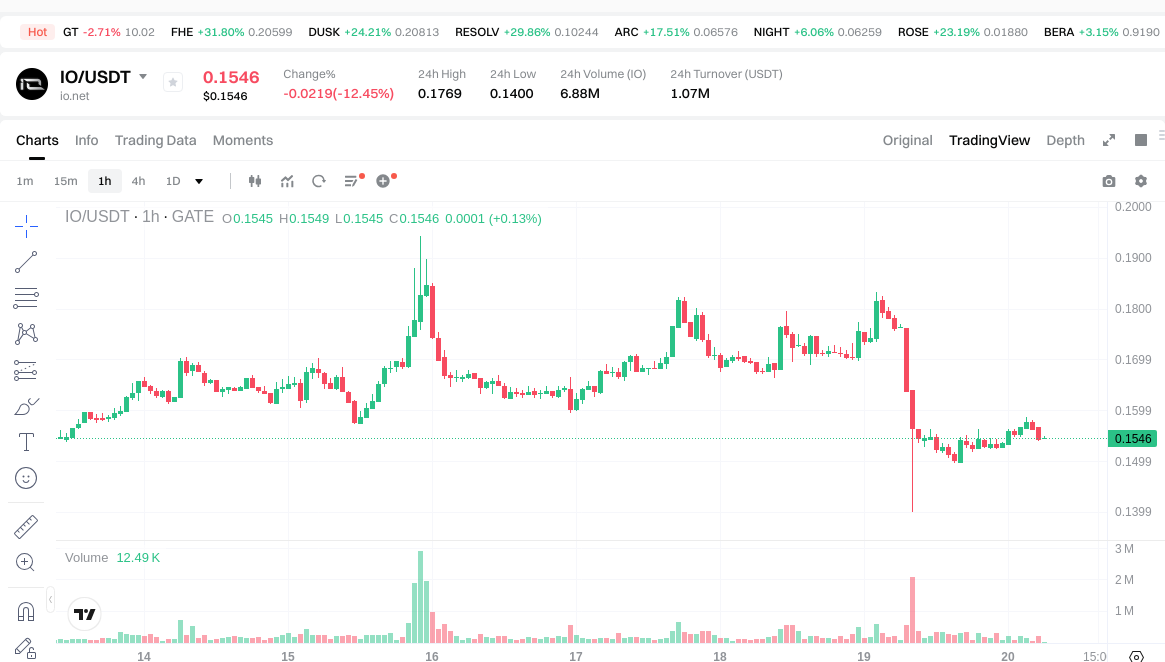
- IO Current Price: $0.1544
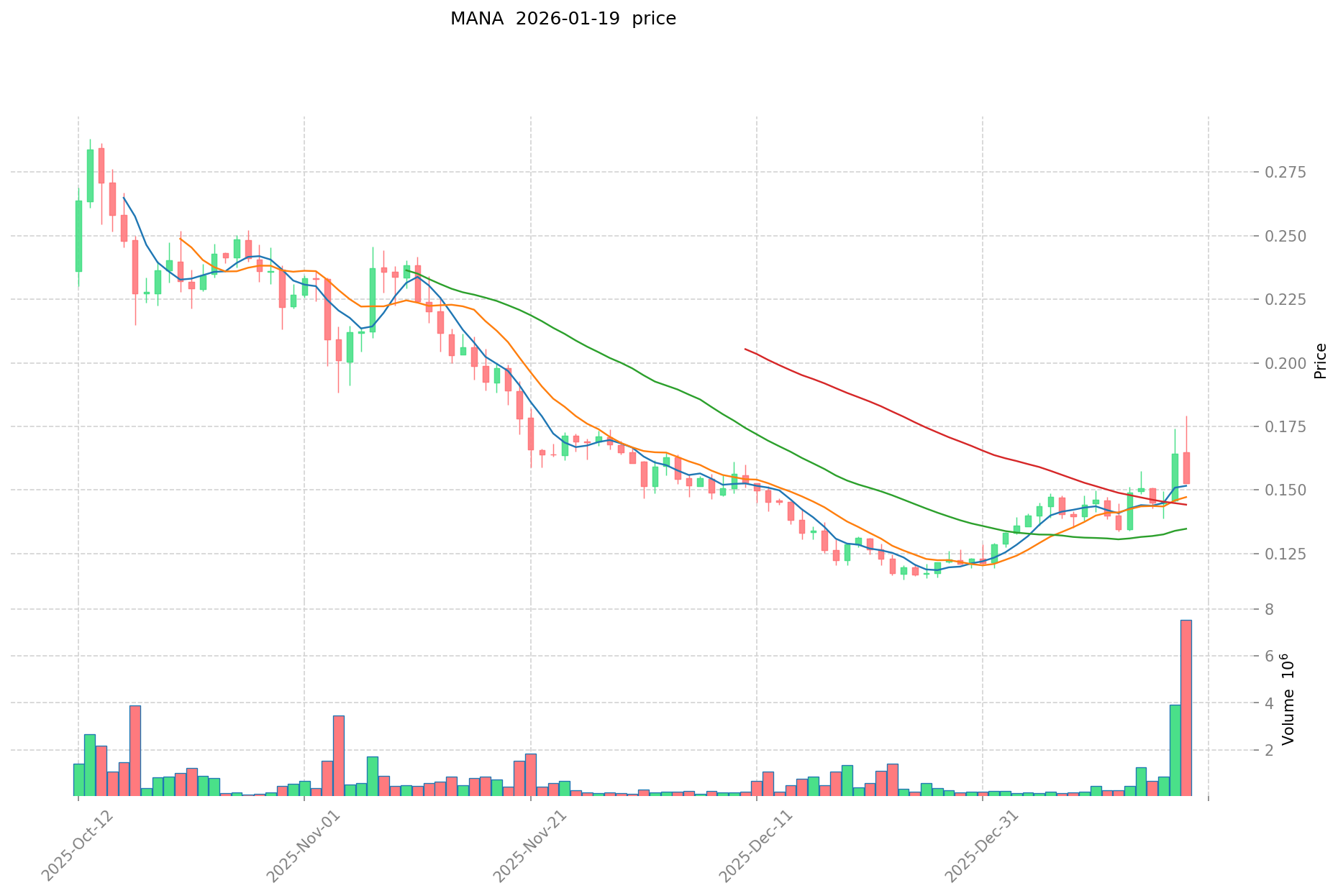
- MANA Current Price: $0.1588
- 24-Hour Trading Volume: IO recorded $1,069,882.82 compared to MANA's $755,323.60
- Market Sentiment Index (Fear & Greed Index): 44 (Fear)
View real-time prices:
II. Core Factors Influencing IO vs MANA Investment Value
Supply Mechanism Comparison (Tokenomics)
- IO: Based on the provided materials, specific supply mechanism details for IO are not available.
- MANA: Features an unlimited supply model, contrasting with tokens that have fixed supply caps. This unlimited supply structure may influence long-term valuation dynamics.
- 📌 Historical Pattern: Supply mechanisms play a role in shaping price cycles, with fixed-supply tokens potentially demonstrating different value trajectories compared to unlimited-supply models.
Institutional Adoption and Market Application
- Institutional Holdings: The materials indicate that MANA has received attention from institutional investors, though comparative data for IO is not provided.
- Enterprise Adoption: MANA's value is connected to Decentraland's virtual real estate ecosystem and metaverse applications. IO's blockchain governance and ecosystem integration represent its primary application areas.
- National Policies: Specific regulatory attitudes toward these tokens vary across jurisdictions, though detailed comparative policy analysis is not available in the materials.
Technological Development and Ecosystem Building
- IO Technical Upgrades: IO's value depends on its blockchain governance capabilities and ecosystem integration, though specific technical upgrade details are not provided in the materials.
- MANA Technical Development: MANA operates within the Decentraland virtual world platform, supporting NFT display, virtual real estate transactions, and social interactions within the metaverse environment.
- Ecosystem Comparison: MANA has established presence in the crypto art community and NFT sector, with applications in virtual galleries and digital asset display. The materials indicate MANA's ecosystem includes virtual real estate, social spaces, and monetization opportunities for creators.
Macroeconomic and Market Cycles
- Performance in Inflationary Environments: The materials indicate both tokens experienced "extreme fear" market sentiment (index 11) as of December 16, 2025, suggesting sensitivity to broader market conditions.
- Macroeconomic Monetary Policy: Interest rates, dollar index, and broader economic factors influence crypto asset valuations, though specific comparative impacts on IO versus MANA are not detailed in the materials.
- Geopolitical Factors: Cross-border transaction demands and international developments may affect adoption, though specific comparative analysis is not available in the provided materials.
III. 2026-2031 Price Prediction: IO vs MANA
Short-term Forecast (2026)
- IO: Conservative $0.097-$0.155 | Optimistic $0.155-$0.218
- MANA: Conservative $0.121-$0.161 | Optimistic $0.161-$0.232
Mid-term Forecast (2028-2029)
- IO may enter a consolidation phase with projected price range of $0.180-$0.296
- MANA may enter a growth phase with projected price range of $0.155-$0.358
- Key drivers: institutional capital inflows, ETF developments, ecosystem expansion
Long-term Forecast (2030-2031)
- IO: Base scenario $0.175-$0.325 | Optimistic scenario $0.250-$0.465
- MANA: Base scenario $0.209-$0.337 | Optimistic scenario $0.284-$0.404
View detailed price predictions for IO and MANA
Disclaimer
IO:
| Year |
Predicted High Price |
Predicted Average Price |
Predicted Low Price |
Price Change |
| 2026 |
0.217986 |
0.1546 |
0.097398 |
0 |
| 2027 |
0.27757657 |
0.186293 |
0.09687236 |
20 |
| 2028 |
0.2690443506 |
0.231934785 |
0.22497674145 |
50 |
| 2029 |
0.295577690004 |
0.2504895678 |
0.180352488816 |
62 |
| 2030 |
0.37678640788476 |
0.273033628902 |
0.17474152249728 |
76 |
| 2031 |
0.464621326302533 |
0.32491001839338 |
0.250180714162902 |
110 |
MANA:
| Year |
Predicted High Price |
Predicted Average Price |
Predicted Low Price |
Price Change |
| 2026 |
0.231984 |
0.1611 |
0.120825 |
1 |
| 2027 |
0.24764292 |
0.196542 |
0.12578688 |
23 |
| 2028 |
0.2687318766 |
0.22209246 |
0.2021041386 |
39 |
| 2029 |
0.358301765718 |
0.2454121683 |
0.154609666029 |
54 |
| 2030 |
0.37128406942107 |
0.301856967009 |
0.28374554898846 |
90 |
| 2031 |
0.403884621858042 |
0.336570518215035 |
0.208673721293321 |
111 |
IV. Investment Strategy Comparison: IO vs MANA
Long-term vs Short-term Investment Strategies
-
IO: May appeal to investors focusing on decentralized AI computing infrastructure and blockchain governance ecosystems. The token's short operating history since June 2024 and recent price consolidation suggest a higher-risk profile that may suit those willing to monitor emerging technology sectors.
-
MANA: May appeal to investors interested in metaverse development and virtual real estate applications. With its establishment since 2017 and presence in the NFT ecosystem, MANA represents a more mature project within the virtual world sector.
Risk Management and Asset Allocation
-
Conservative Investors: Consider allocation frameworks such as IO 30-40% vs MANA 60-70%, reflecting MANA's longer operational track record and established ecosystem.
-
Aggressive Investors: May explore allocation structures such as IO 50-60% vs MANA 40-50%, incorporating higher exposure to emerging AI infrastructure narratives.
-
Hedging Instruments: Diversification strategies may include stablecoin allocations, options contracts where available, and cross-asset portfolio construction to manage volatility exposure.
V. Potential Risk Comparison
Market Risk
-
IO: The token demonstrated substantial price volatility following its June 2024 launch, declining from $6.5 to $0.1003 by October 2025. The relatively small market capitalization of $41.56M and low circulating supply ratio of 33.65% may contribute to price sensitivity during market fluctuations.
-
MANA: With a market capitalization of $304.75M and circulating supply ratio of 87.50%, MANA has experienced multiple market cycles since 2017. The token's all-time high of $5.85 in November 2021 during the metaverse expansion period illustrates exposure to sector-specific trends and broader crypto market movements.
Technical Risk
-
IO: As a blockchain governance and ecosystem integration platform, considerations may include network development progress, ecosystem adoption rates, and technical infrastructure scalability.
-
MANA: The Decentraland platform's technical infrastructure, virtual world performance capabilities, and NFT integration functionality represent areas of technical consideration. Network stability and user experience within the metaverse environment may influence platform adoption.
Regulatory Risk
- Global regulatory frameworks continue to evolve regarding crypto assets, with potential differential impacts on AI infrastructure tokens versus metaverse-focused platforms. Jurisdictional approaches to virtual property, NFT regulations, and decentralized computing services may affect both projects differently based on their respective use cases and operational structures.
VI. Conclusion: Which Is the Better Buy?
📌 Investment Value Summary
-
IO Characteristics: Positioned in the emerging decentralized AI computing sector with a cost-effective GPU aggregation model. The project's short operational history since mid-2024 and recent price consolidation from peak levels suggest early-stage positioning with associated volatility characteristics.
-
MANA Characteristics: Established presence in the metaverse and virtual real estate sector since 2017, with applications spanning NFT display, virtual social spaces, and creator monetization. The project's longer operational track record and ecosystem development in crypto art communities represent its positioning.
✅ Investment Considerations
-
Newer Investors: May consider starting with smaller position sizes in either asset, prioritizing risk management and portfolio diversification. Understanding each project's use case, market positioning, and volatility characteristics remains important before allocation decisions.
-
Experienced Investors: May evaluate allocation strategies based on sector exposure preferences, with IO representing AI infrastructure narratives and MANA representing metaverse development themes. Technical analysis, on-chain metrics, and ecosystem development tracking may inform position management.
-
Institutional Investors: May assess factors including liquidity profiles, market depth, regulatory clarity, and long-term sector growth trajectories when considering exposure to either decentralized computing infrastructure or metaverse platforms.
⚠️ Risk Disclosure: Cryptocurrency markets exhibit substantial volatility. This analysis does not constitute investment advice. Market conditions, project developments, and regulatory environments may change. Individuals should conduct independent research and consider their risk tolerance before making investment decisions.
VII. FAQ
Q1: What are the key differences between IO and MANA's core use cases?
IO focuses on decentralized AI computing infrastructure through GPU aggregation for machine learning applications, while MANA powers the Decentraland virtual world platform enabling virtual real estate ownership and metaverse interactions. IO addresses computational resource accessibility for AI startups at reduced costs compared to traditional cloud services, whereas MANA facilitates NFT display, virtual property transactions, and creator monetization within an immersive digital environment. These distinct applications position IO within the AI infrastructure sector and MANA within the metaverse ecosystem.
Q2: How do the market capitalizations and supply structures compare between these assets?
As of January 20, 2026, MANA holds a significantly larger market capitalization of $304.75M compared to IO's $41.56M. MANA features an unlimited supply model with 87.50% of tokens currently circulating, while IO maintains a circulating supply ratio of just 33.65%. The supply mechanism differences indicate that MANA has achieved broader token distribution since its 2017 launch, whereas IO's lower circulation ratio suggests substantial tokens remain locked or unvested following its mid-2024 launch.
Q3: Which asset demonstrates greater price stability based on historical performance?
MANA exhibits relatively greater historical stability, having operated through multiple market cycles since 2017 with its all-time low of $0.00923681 occurring in October 2017 and peak of $5.85 in November 2021. In contrast, IO launched in June 2024 at higher initial valuations, reaching $6.5 before declining to $0.1003 by October 2025—representing more pronounced volatility within a compressed timeframe. MANA's longer operational track record provides more historical price data across various market conditions compared to IO's limited price history.
Q4: What allocation strategy might suit different investor profiles for IO vs MANA?
Conservative investors might consider a 30-40% IO and 60-70% MANA allocation, reflecting MANA's established ecosystem and longer operational history. Aggressive investors exploring higher exposure to emerging AI infrastructure narratives might evaluate a 50-60% IO and 40-50% MANA structure. These allocation frameworks should incorporate individual risk tolerance, sector exposure preferences, and portfolio diversification objectives. Both conservative and aggressive strategies benefit from ongoing monitoring of project developments, market conditions, and regulatory changes.
Q5: How do institutional adoption levels differ between these two projects?
The available materials indicate that MANA has received attention from institutional investors and established presence within crypto art communities and NFT sectors since 2017. Specific institutional adoption metrics for IO are not detailed in the reference materials, though the project's focus on cost-effective AI computing infrastructure represents a distinct value proposition for machine learning enterprises. MANA's longer operational period has facilitated broader institutional awareness and ecosystem partnerships compared to IO's recent market entry in mid-2024.
Q6: What are the primary technical risks associated with each platform?
IO's technical considerations include blockchain governance infrastructure development, ecosystem adoption rates, and computing network scalability as the platform aggregates distributed GPU resources. MANA faces technical considerations related to Decentraland's virtual world performance capabilities, NFT integration functionality, network stability, and user experience within the metaverse environment. Both platforms require ongoing technical development to maintain competitive positioning within their respective sectors—decentralized computing infrastructure for IO and virtual world platforms for MANA.
Q7: How might regulatory developments impact IO and MANA differently?
Regulatory frameworks may affect these assets distinctly based on their use cases. IO's positioning in decentralized computing services faces evolving regulations regarding AI infrastructure, data processing, and distributed network operations. MANA's focus on virtual property ownership, NFT transactions, and metaverse applications encounters regulatory considerations surrounding digital assets, virtual real estate classification, and creator economy frameworks. Jurisdictional approaches to these emerging technology sectors continue developing, with potential differential impacts on AI infrastructure tokens versus metaverse-focused platforms.
Q8: What factors should investors monitor for future price movements in these assets?
For IO, key monitoring factors include AI sector adoption trends, computing network growth metrics, ecosystem development progress, and competitive positioning within decentralized infrastructure markets. For MANA, relevant indicators include metaverse user engagement statistics, virtual real estate transaction volumes, NFT ecosystem developments, and Decentraland platform updates. Both assets require attention to broader cryptocurrency market conditions, Bitcoin price movements, regulatory announcements, institutional investment flows, and macroeconomic factors including interest rate policies and risk-asset sentiment indicators.
* The information is not intended to be and does not constitute financial advice or any other recommendation of any sort offered or endorsed by Gate.