This comprehensive analysis compares IOST and BCH, two distinct blockchain assets addressing different market needs. IOST operates as a blockchain application platform leveraging Proof-of-Believability consensus for high throughput and scalability, while BCH functions as a payment-focused cryptocurrency with expanded block capacity for low-fee transactions. The article examines historical price performance, tokenomics differences, institutional adoption patterns, and technical ecosystems to guide investment decisions. IOST demonstrates higher volatility and platform-dependent value growth potential, whereas BCH offers established market recognition with Bitcoin heritage and clearer payment utility. For conservative investors, BCH allocation of 70-80% suits established positioning; aggressive investors may explore IOST's speculative growth potential. Current market data sourced from Gate shows IOST at $0.001576 and BCH at $590.69, with detailed price projections through 2031 supporting informed portfolio const
Introduction: Investment Comparison Between IOST and BCH
In the cryptocurrency market, the comparison between IOST and BCH remains a central topic for investors. The two assets demonstrate notable differences in market capitalization ranking, application scenarios, and price performance, representing distinct positioning within the crypto ecosystem.
IOST: Launched in 2017, this blockchain application platform has positioned itself as a solution for online service providers, emphasizing horizontal scalability and high throughput through its Proof-of-Believability (PoB) consensus mechanism.
BitcoinCash (BCH): Emerging in 2017 through a hard fork from Bitcoin, BCH has established itself as one of the prominent cryptocurrencies globally, focusing on on-chain scaling and following an approach oriented toward widespread adoption.
This article will examine historical price movements, supply mechanisms, institutional adoption patterns, technical ecosystems, and future outlook to provide a comprehensive analysis of the investment considerations between IOST and BCH, addressing the question many investors contemplate:
"Which represents a more suitable investment option at the current time?"
I. Historical Price Comparison and Current Market Status
IOST (Coin A) and BCH (Coin B) Historical Price Trends
- 2018: IOST reached an all-time high of $0.129829 on January 24, 2018, during the broader cryptocurrency market rally.
- 2017: BCH emerged from a hard fork of Bitcoin, launching at $555.89 and reaching an all-time high of $3,785.82 on December 20, 2017, driven by significant community interest in on-chain scaling solutions.
- Comparative Analysis: During the 2021-2025 market cycle, IOST declined from its historical peak of $0.129829 to an all-time low of $0.00142755 recorded on December 19, 2025, representing a substantial decline. In contrast, BCH experienced a comparatively moderate decline, moving from its all-time high of $3,785.82 to a recorded low of $76.93 on December 16, 2018.
Current Market Status (2026-01-19)
- IOST current price: $0.001576
- BCH current price: $590.69
- 24-hour trading volume: IOST $28,825.52 vs BCH $6,924,525.77
- Market sentiment index (Fear & Greed Index): 44 (Fear)
Check real-time prices:
- View IOST current price Market Price
- View BCH current price Market Price
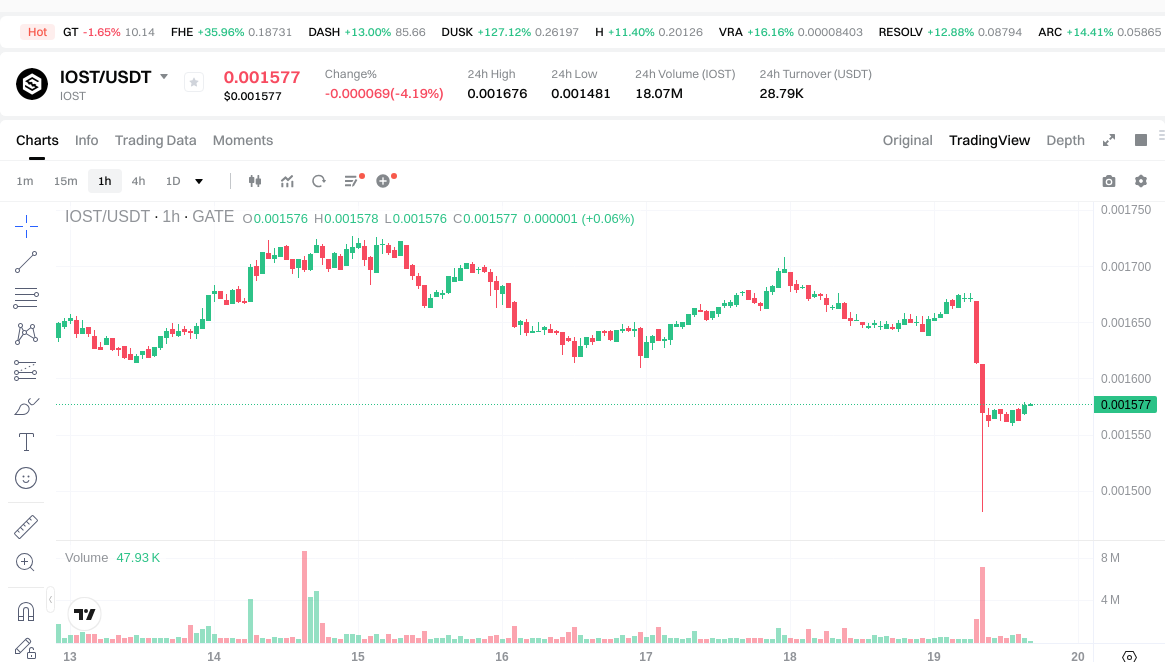
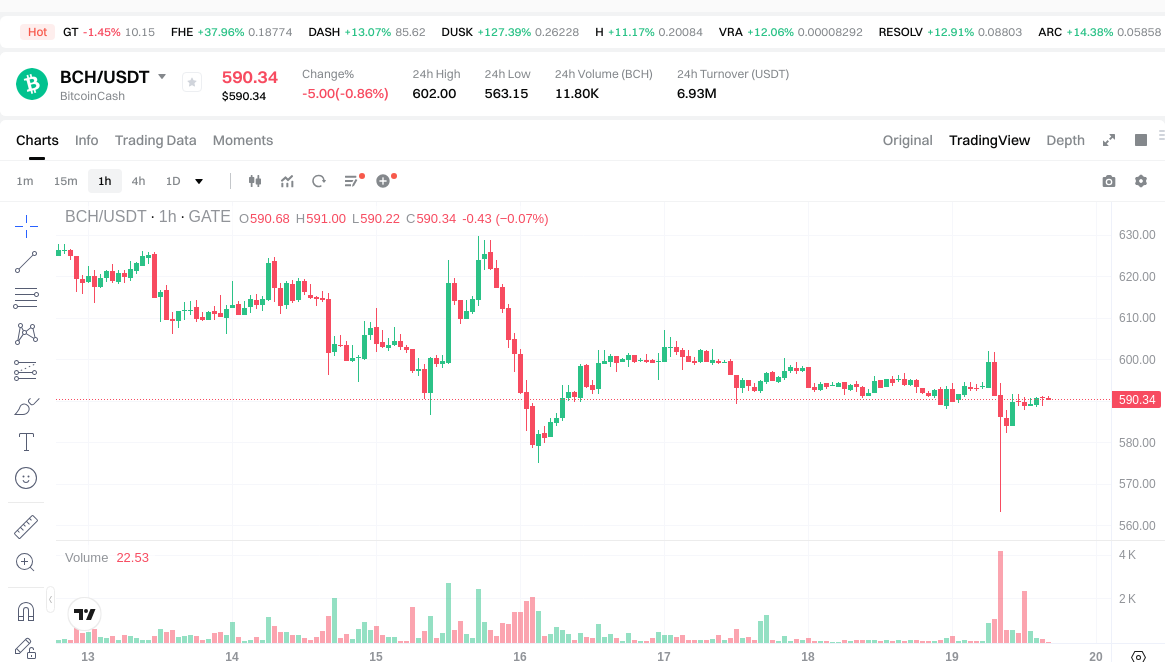
II. Core Factors Influencing IOST vs BCH Investment Value
Supply Mechanism Comparison (Tokenomics)
-
IOST: Implements four interrelated token burn mechanisms to maintain economic balance and introduce deflationary factors. The platform's supply dynamics are designed to support network security and privacy protection while managing circulation.
-
BCH: Follows a fixed supply model similar to Bitcoin, with a predetermined issuance schedule. The supply mechanism inherits Bitcoin's halving protocol, which occurs approximately every four years, reducing block rewards and creating scarcity over time.
-
📌 Historical Pattern: Supply mechanisms influence price cycles through scarcity dynamics. BCH's halving events have historically correlated with multi-year market cycles, while IOST's burn mechanisms aim to create gradual deflationary pressure based on network activity.
Institutional Adoption and Market Application
-
Institutional Holdings: BCH maintains stronger institutional recognition due to its Bitcoin heritage and established market position. The correlation coefficient between BCH and Bitcoin prices remains around 0.8, indicating institutional investors often treat them as related assets.
-
Enterprise Adoption:
- BCH focuses on payment applications, including e-commerce platforms, retail stores, online payments, and cross-border remittances. Its low transaction fees make it suitable for micropayments in gaming, streaming platforms, and content creator revenue.
- IOST emphasizes adoption rate and network usage, with developers building applications on the platform driving potential value growth.
-
Regulatory Attitudes: Different jurisdictions have varied approaches to both assets. BCH benefits from clearer regulatory frameworks in regions where it's positioned as a payment instrument, while IOST's regulatory landscape depends on local policies regarding blockchain platforms and token usage.
Technology Development and Ecosystem Building
-
IOST Technical Upgrades: The platform focuses on increasing adoption rates and network usage as primary drivers for potential value appreciation. Enhanced developer activity on the IOST platform may positively influence token valuation.
-
BCH Technical Development: Key upgrades include block size expansion from Bitcoin's 1MB to 8MB and subsequently to 32MB, enabling higher transaction throughput. Hard forks, network upgrades, and protocol improvements directly impact market confidence. Updates perceived as beneficial may drive price increases, while controversial changes could trigger selling pressure.
-
Ecosystem Comparison:
- BCH prioritizes payment functionality, cross-border settlements, and peer-to-peer electronic cash systems, with limited but growing support for decentralized applications (DApps).
- IOST positions itself as a blockchain infrastructure supporting application development, though specific DeFi, NFT, and smart contract implementations depend on ecosystem growth and developer adoption.
Macroeconomic Environment and Market Cycles
-
Performance Under Inflation: BCH is viewed by some investors as a diversified asset allocation option for hedging against traditional financial market uncertainty, though Bitcoin itself maintains stronger recognition as "digital gold." Both assets may benefit from capital flows seeking inflation protection.
-
Macroeconomic Monetary Policy: Interest rates, inflation pressures, and U.S. dollar strength affect capital allocation between traditional and crypto assets. When investors seek alternative stores of value, funds may shift to crypto markets, potentially benefiting both BCH and IOST.
-
Geopolitical Factors: Traditional market turbulence, economic sanctions, and international situations influence overall capital flows and market risk appetite. Cross-border transaction demand, particularly in regions with currency instability or remittance needs, may favor BCH's payment-focused positioning. Global events such as financial crises or geopolitical tensions indirectly drive price volatility for both assets.
III. 2026-2031 Price Prediction: IOST vs BCH
Short-term Forecast (2026)
- IOST: Conservative $0.00104148 - $0.001578 | Optimistic $0.001578 - $0.00179892
- BCH: Conservative $472.184 - $590.23 | Optimistic $590.23 - $808.6151
Mid-term Forecast (2028-2029)
- IOST may enter a consolidation phase with projected prices ranging from $0.001638819276 to $0.001923831324 in 2028, potentially reaching $0.00168584626392 to $0.00226014554064 by 2029
- BCH may enter a growth phase with projected prices ranging from $538.905074775 to $981.28983765 in 2028, potentially reaching $464.262700239 to $1169.58487944825 by 2029
- Key drivers: institutional capital inflows, ETF developments, ecosystem expansion
Long-term Forecast (2030-2031)
- IOST: Baseline scenario $0.001974107449267 - $0.00205636192632 (2030) | Optimistic scenario $0.00163881763718 - $0.003515145076851 (2031)
- BCH: Baseline scenario $876.51904992238125 - $1031.198882261625 (2030) | Optimistic scenario $992.580484120927143 - $1099.309568435005331 (2031)
View detailed price predictions for IOST and BCH
Disclaimer
IOST:
| Year |
Predicted High Price |
Predicted Average Price |
Predicted Low Price |
Price Change |
| 2026 |
0.00179892 |
0.001578 |
0.00104148 |
0 |
| 2027 |
0.0018741906 |
0.00168846 |
0.0010299606 |
7 |
| 2028 |
0.001923831324 |
0.0017813253 |
0.001638819276 |
13 |
| 2029 |
0.00226014554064 |
0.001852578312 |
0.00168584626392 |
17 |
| 2030 |
0.002693834123479 |
0.00205636192632 |
0.001974107449267 |
30 |
| 2031 |
0.003515145076851 |
0.002375098024899 |
0.00163881763718 |
50 |
BCH:
| Year |
Predicted High Price |
Predicted Average Price |
Predicted Low Price |
Price Change |
| 2026 |
808.6151 |
590.23 |
472.184 |
0 |
| 2027 |
909.249315 |
699.42255 |
657.457197 |
18 |
| 2028 |
981.28983765 |
804.3359325 |
538.905074775 |
36 |
| 2029 |
1169.58487944825 |
892.812885075 |
464.262700239 |
51 |
| 2030 |
1103.38280401993875 |
1031.198882261625 |
876.51904992238125 |
74 |
| 2031 |
1099.309568435005331 |
1067.290843140781875 |
992.580484120927143 |
80 |
IV. Investment Strategy Comparison: IOST vs BCH
Long-term vs Short-term Investment Strategies
-
IOST: May appeal to investors focusing on platform ecosystem development and adoption-driven growth potential. The token's value proposition centers on network usage expansion and developer activity, which typically requires extended timeframes to materialize. Investors considering IOST should evaluate their tolerance for higher volatility and longer development cycles.
-
BCH: May suit investors seeking exposure to established payment infrastructure and Bitcoin-adjacent assets. With its focus on transaction utility and cross-border settlement capabilities, BCH presents a positioning oriented toward practical application rather than speculative growth. The asset's correlation with Bitcoin markets provides some degree of familiar market behavior patterns.
Risk Management and Asset Allocation
-
Conservative Investors: A potential allocation framework might consider BCH at 70-80% with IOST at 20-30% within a crypto portfolio segment, reflecting BCH's comparatively established market position and lower relative volatility.
-
Aggressive Investors: Those accepting higher risk parameters might explore reversed allocations, such as IOST at 60-70% and BCH at 30-40%, acknowledging the elevated volatility profile and speculative nature of platform tokens versus payment-focused cryptocurrencies.
-
Hedging Instruments: Portfolio risk management approaches include stablecoin allocation for liquidity management, options contracts where available for downside protection, and cross-asset diversification across different blockchain use cases and market cap segments.
V. Potential Risk Comparison
Market Risk
-
IOST: Exhibits substantial price volatility, having declined from $0.129829 to $0.00142755 between peak and trough levels. The lower market capitalization and trading volume ($28,825.52 24-hour volume) indicate limited liquidity, which may amplify price movements during market stress periods. Platform token valuations remain sensitive to adoption metrics and ecosystem development progress.
-
BCH: Demonstrates volatility inherent to cryptocurrency markets, with historical price ranging from $3,785.82 to $76.93. Despite higher trading volumes ($6,924,525.77 24-hour volume) relative to IOST, BCH remains subject to broader crypto market cycles and sentiment shifts. The 0.8 correlation coefficient with Bitcoin means BCH price movements often reflect Bitcoin market dynamics.
Technical Risk
-
IOST: Platform scalability depends on continued technical development and network stability maintenance. The Proof-of-Believability consensus mechanism requires ongoing validation of its security properties and performance characteristics under various network conditions. Developer engagement levels directly influence ecosystem viability.
-
BCH: Block size expansion to 32MB addresses transaction throughput but introduces considerations regarding node operation requirements and network decentralization. Mining concentration patterns and hashrate distribution affect network security parameters. Protocol governance through hard forks presents coordination challenges and potential community fragmentation risks.
Regulatory Risk
- Regulatory frameworks continue evolving globally, with differing approaches across jurisdictions. BCH's positioning as a payment instrument may encounter specific money transmission and financial service regulations in various regions. IOST's classification as a platform token subjects it to securities regulations in certain jurisdictions. Both assets face uncertainty regarding future policy developments, tax treatment clarifications, and compliance requirement changes across different markets.
VI. Conclusion: Which Is the Better Buy?
📌 Investment Value Summary:
-
IOST Characteristics: Focuses on blockchain platform infrastructure with potential value tied to ecosystem adoption and developer activity. The token economics incorporate burn mechanisms aimed at creating deflationary dynamics. Current market positioning reflects significant price decline from historical levels, presenting both risk and potential opportunity perspectives depending on future platform development trajectories.
-
BCH Characteristics: Emphasizes payment functionality and transaction utility with established market recognition stemming from Bitcoin heritage. Benefits from clearer positioning in payment use cases, cross-border settlements, and peer-to-peer transaction scenarios. Fixed supply model following Bitcoin's halving schedule provides predictable issuance dynamics.
✅ Investment Considerations:
-
New Investors: May find BCH's established market position and clearer use case proposition more accessible for initial cryptocurrency exposure. Understanding fundamental blockchain concepts through payment-focused assets can provide foundational knowledge before exploring platform tokens.
-
Experienced Investors: Should evaluate both assets within broader portfolio construction frameworks, considering allocation percentages based on individual risk tolerance, investment timeframes, and thesis regarding platform development versus payment utility positioning in crypto markets.
-
Institutional Investors: Require comprehensive due diligence on regulatory compliance, custody solutions, liquidity profiles, and correlation dynamics with existing portfolio holdings. BCH's stronger institutional recognition may align with conservative mandates, while IOST exposure would constitute higher-risk, growth-oriented allocation segments.
⚠️ Risk Disclosure: Cryptocurrency markets exhibit extreme volatility. This content does not constitute investment advice. Investors should conduct independent research and consult qualified financial professionals before making investment decisions.
VII. FAQ
Q1: What are the main differences between IOST and BCH in terms of their fundamental purposes?
BCH functions primarily as a payment-focused cryptocurrency for peer-to-peer transactions and cross-border settlements, while IOST operates as a blockchain application platform emphasizing horizontal scalability and developer ecosystem growth. BCH emerged from Bitcoin's hard fork in 2017 with expanded block sizes (from 1MB to 32MB) to handle higher transaction volumes at lower fees, positioning itself for everyday payment applications, e-commerce, and remittances. IOST, launched in 2017, utilizes a Proof-of-Believability consensus mechanism designed to support decentralized applications (DApps) and provide infrastructure for online service providers requiring high throughput and scalability.
Q2: How do the supply mechanisms differ between IOST and BCH?
BCH follows a fixed supply model with predetermined issuance similar to Bitcoin, incorporating halving events approximately every four years that reduce block rewards and create scarcity over time. IOST implements four interrelated token burn mechanisms designed to maintain economic balance and introduce deflationary factors based on network activity. BCH's halving protocol provides predictable supply dynamics that historically correlate with multi-year market cycles, while IOST's burn mechanisms aim to create gradual deflationary pressure tied to platform usage levels. These fundamental differences in tokenomics directly influence each asset's scarcity dynamics and potential price behavior patterns.
Q3: Which asset exhibits higher volatility and liquidity risks?
IOST demonstrates substantially higher volatility and liquidity risk compared to BCH. IOST experienced a decline from its all-time high of $0.129829 to an all-time low of $0.00142755, with current 24-hour trading volume of $28,825.52, indicating limited market depth. BCH, despite significant price fluctuations between $3,785.82 and $76.93 historically, maintains considerably higher liquidity with $6,924,525.77 in 24-hour trading volume as of January 19, 2026. Lower liquidity in IOST markets may amplify price movements during periods of market stress, creating challenges for position entry and exit, particularly for larger transaction sizes.
Q4: How do institutional adoption patterns differ between IOST and BCH?
BCH maintains stronger institutional recognition due to its Bitcoin heritage and established market position, with a correlation coefficient of approximately 0.8 with Bitcoin prices. Institutional investors often treat BCH as a related asset to Bitcoin, benefiting from clearer regulatory frameworks in regions where it's positioned as a payment instrument. IOST's institutional adoption depends primarily on platform ecosystem development and developer activity, with value proposition centered on network usage expansion rather than established payment infrastructure. BCH's focus on payment applications provides more accessible institutional investment thesis, while IOST requires evaluation of longer-term platform development trajectories and ecosystem growth metrics.
Q5: What are the projected price ranges for IOST and BCH through 2031?
For IOST, short-term 2026 projections range from conservative $0.00104148-$0.001578 to optimistic $0.001578-$0.00179892, with long-term 2031 baseline scenario of $0.001974107449267-$0.00205636192632 and optimistic scenario reaching $0.00163881763718-$0.003515145076851. For BCH, 2026 projections range from conservative $472.184-$590.23 to optimistic $590.23-$808.6151, with 2031 baseline scenario of $876.51904992238125-$1031.198882261625 and optimistic scenario reaching $992.580484120927143-$1099.309568435005331. These projections reflect different growth trajectories, with BCH showing potential for 80% price change by 2031 versus IOST's 50% change under optimistic scenarios, though both remain subject to extreme market volatility and ecosystem development uncertainties.
Q6: What allocation strategies suit different investor risk profiles?
Conservative investors might consider BCH allocation at 70-80% with IOST at 20-30% within their cryptocurrency portfolio segment, reflecting BCH's comparatively established market position and lower relative volatility profile. Aggressive investors accepting higher risk parameters could explore reversed allocations such as IOST at 60-70% and BCH at 30-40%, acknowledging elevated volatility and speculative nature of platform tokens versus payment-focused cryptocurrencies. Risk management approaches include stablecoin allocation for liquidity management, options contracts where available for downside protection, and cross-asset diversification across different blockchain use cases and market capitalization segments. All investors should conduct independent research and evaluate allocations based on individual risk tolerance, investment timeframes, and thesis regarding platform development versus payment utility positioning.
Q7: What regulatory considerations affect IOST and BCH investments?
BCH's positioning as a payment instrument may encounter money transmission regulations and financial service compliance requirements in various jurisdictions, though it benefits from clearer regulatory frameworks where recognized as a payment tool. IOST's classification as a platform token subjects it to securities regulations in certain jurisdictions, with regulatory treatment depending on local policies regarding blockchain platforms and token usage. Both assets face uncertainty regarding future policy developments, tax treatment clarifications, and compliance requirement changes across different markets. Regulatory frameworks continue evolving globally with differing approaches across jurisdictions, requiring investors to monitor developments in their specific regions and consult qualified legal professionals regarding compliance obligations.
Q8: How do macroeconomic factors differently impact IOST and BCH?
BCH is viewed by some investors as a diversified asset allocation option for hedging against traditional financial market uncertainty, though Bitcoin maintains stronger recognition as digital gold. Cross-border transaction demand, particularly in regions with currency instability or remittance needs, may favor BCH's payment-focused positioning during periods of economic turbulence. IOST's value correlation depends more heavily on technology sector capital flows and risk appetite for platform development investments. Both assets remain subject to macroeconomic monetary policy impacts including interest rates, inflation pressures, and U.S. dollar strength affecting capital allocation between traditional and crypto assets. Geopolitical factors and international situations influence overall capital flows, with BCH potentially benefiting from practical payment use cases while IOST depends on continued technology sector investment sentiment.
* The information is not intended to be and does not constitute financial advice or any other recommendation of any sort offered or endorsed by Gate.