This comprehensive investment analysis compares IoTeX (IOTX) and Ethereum Classic (ETC) across critical dimensions including market positioning, tokenomics, technical ecosystems, and price projections through 2031. IOTX, ranked 415th with $0.008543 current price, focuses on DePIN and IoT infrastructure with emerging growth potential but lower liquidity ($45K daily volume). ETC, ranked 51st at $12.874, operates as an established smart contract platform with substantially higher market depth ($1.5M+ daily volume) and capped monetary policy. The analysis provides segmented investment strategies: conservative investors should emphasize ETC (80-90% allocation) for stability, while aggressive investors may balance both assets to capture infrastructure innovation alongside platform maturity. Price forecasts suggest ETC reaching $12.38-$32.56 by 2031 versus IOTX's $0.0133-$0.0177, reflecting distinct risk-return profiles. Investors should evaluate personal risk tolerance, diversification objectives, and liquidity req
Introduction: IOTX vs ETC Investment Comparison
In the cryptocurrency market, the comparison between IOTX and ETC continues to attract investor attention. Both assets differ significantly in market capitalization ranking, application scenarios, and price performance, representing distinct positioning within the crypto asset landscape.
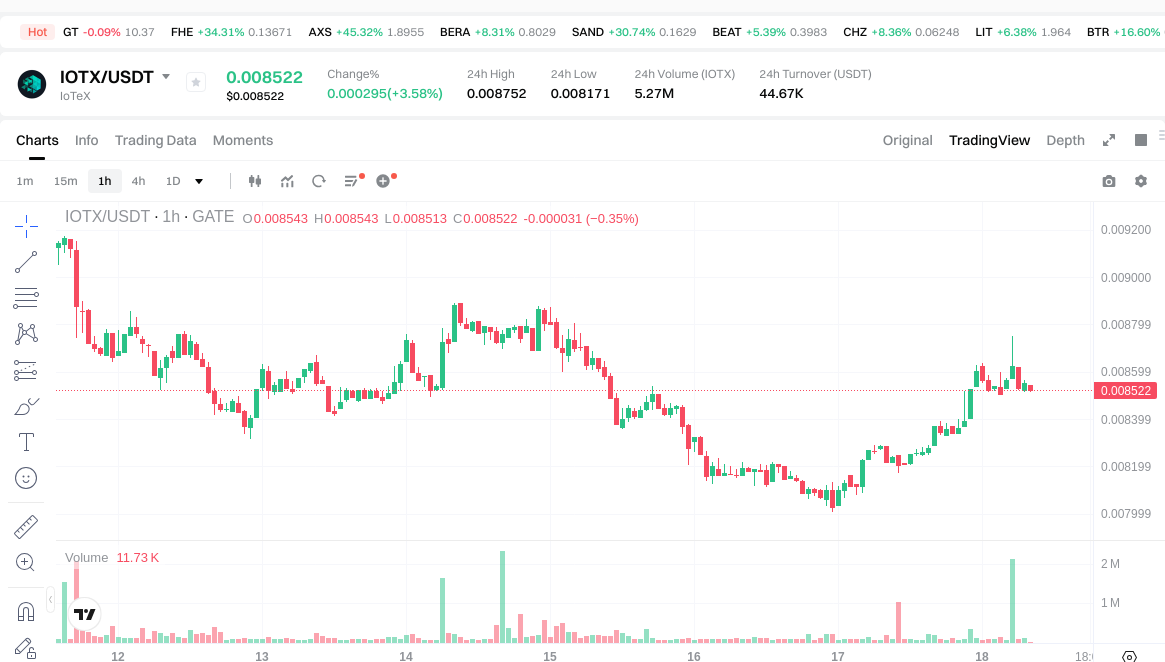
IoTeX (IOTX): Launched in 2018, this project has gained recognition for its focus on Internet of Things (IoT) infrastructure with privacy-centric blockchain technology. As of January 18, 2026, IOTX ranks 415th by market cap with a price of $0.008543 and a circulating supply of 9.44 billion tokens.
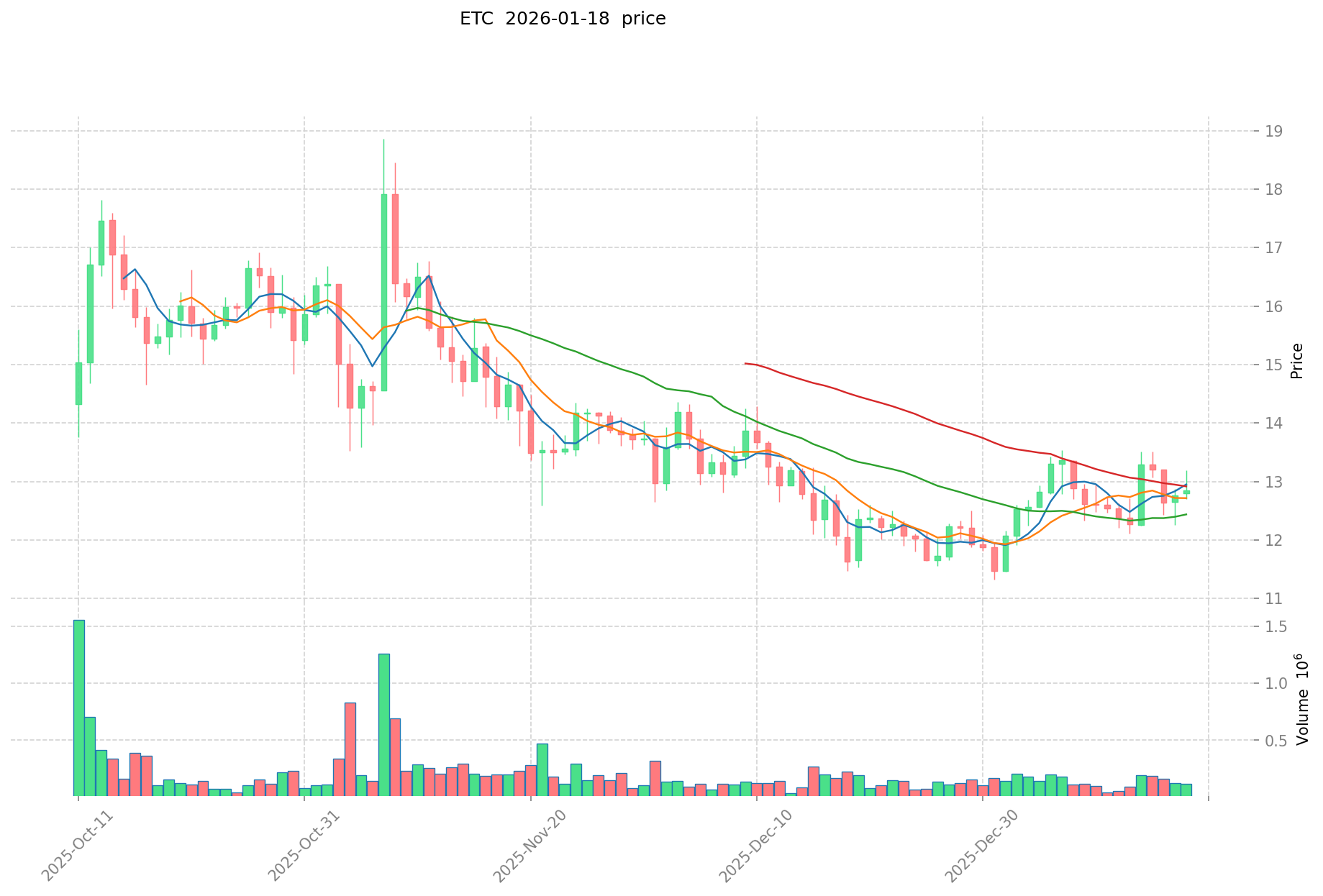
Ethereum Classic (ETC): Originating in 2015 as a continuation of the original Ethereum chain, ETC has established itself as a decentralized platform for smart contracts, adhering to the "code is law" principle. Currently ranked 51st with a price of $12.874 and a circulating supply of 155.16 million tokens, it maintains significantly higher market presence compared to IOTX.
This article will provide a comprehensive analysis comparing IOTX vs ETC across multiple dimensions including historical price trends, supply mechanisms, technical ecosystems, and future outlook, addressing the fundamental question investors frequently ask:
"Which is the better buy right now?"
I. Historical Price Comparison and Current Market Status
IOTX and ETC Historical Price Trends
- 2021: IOTX reached its historical high of $0.255593 in November, driven by market momentum during the crypto bull cycle.
- 2020: IOTX recorded its historical low of $0.00121576 in March, reflecting broader market corrections during the early pandemic period.
- 2021: ETC reached its historical high of $167.09 in May, supported by renewed interest following Ethereum's network developments and mining migration discussions.
- 2016: ETC recorded its historical low of $0.615038 in July, shortly after the network split from Ethereum.
- Comparative Analysis: During the 2021 bull market cycle, IOTX surged from its low point to $0.255593, representing significant percentage gains, while ETC demonstrated more substantial absolute price movement, rising from multi-year lows to $167.09 before subsequent market corrections.
Current Market Status (2026-01-18)
- IOTX current price: $0.008543
- ETC current price: $12.874
- 24-hour trading volume: IOTX $45,326.94 vs ETC $1,529,070.08
- Market Sentiment Index (Fear & Greed Index): 50 (Neutral)
View real-time prices:
II. Core Factors Influencing IOTX vs ETC Investment Value
Supply Mechanism Comparison (Tokenomics)
-
IOTX: IoTeX operates with a supply mechanism designed to support its DePIN (Decentralized Physical Infrastructure Network) ecosystem. The token serves as the native currency for its IoT-focused blockchain infrastructure.
-
ETC: Ethereum Classic maintains a fixed monetary policy with a capped supply, implementing periodic emission reductions that create a deflationary pressure over time.
-
📌 Historical Pattern: Supply mechanisms have historically influenced price cycles by affecting token scarcity and market perception of long-term value retention.
Institutional Adoption and Market Applications
-
Institutional Holdings: Current reference materials indicate limited specific data on direct institutional holdings comparison between IOTX and ETC.
-
Enterprise Adoption: IOTX demonstrates application within the DePIN sector, with FutureMoney Group and IoTeX Foundation launching a $5 million DePIN accelerator program. The token's utility extends to IoT automation and data connectivity infrastructure.
-
Regulatory Landscape: Different jurisdictions maintain varying regulatory approaches toward both assets, though specific comparative policy frameworks are subject to ongoing evolution.
Technical Development and Ecosystem Building
-
IOTX Technical Advancement: IoTeX positions itself within the DePIN sector with deep technical infrastructure supporting IoT connectivity, automation systems, and AI integration. The platform aligns with emerging trends in autonomous systems and intelligent device networks.
-
ETC Technical Development: Ethereum Classic continues development as a blockchain platform, though specific recent upgrade information requires verification from primary sources.
-
Ecosystem Comparison: IOTX focuses on physical infrastructure networks and IoT applications, while ETC maintains broader smart contract functionality. Both platforms support varying degrees of DeFi integration and decentralized application development.
Macroeconomic Environment and Market Cycles
-
Performance Under Inflation: The relationship between inflation environments and performance characteristics for both assets depends on multiple variables including market sentiment, technological adoption rates, and broader cryptocurrency market dynamics.
-
Macroeconomic Monetary Policy: Interest rate adjustments, US dollar index fluctuations, and central bank policies create indirect effects on cryptocurrency valuations through capital flow patterns and risk appetite changes.
-
Geopolitical Factors: Cross-border transaction requirements and international regulatory developments may influence adoption patterns, though specific impacts vary based on regional implementation and use case scenarios.
III. 2026-2031 Price Forecast: IOTX vs ETC
Short-term Forecast (2026)
- IOTX: Conservative $0.0062-$0.0085 | Optimistic $0.0085-$0.0123
- ETC: Conservative $8.24-$12.88 | Optimistic $12.88-$14.81
Mid-term Forecast (2028-2029)
- IOTX may enter a consolidation phase, with estimated price range of $0.0071-$0.0131
- ETC may enter a growth phase, with estimated price range of $11.21-$23.62
- Key drivers: institutional capital inflows, ETF developments, ecosystem expansion
Long-term Forecast (2030-2031)
- IOTX: Baseline scenario $0.0083-$0.0146 | Optimistic scenario $0.0133-$0.0177
- ETC: Baseline scenario $11.15-$22.93 | Optimistic scenario $12.38-$32.56
View detailed price forecasts for IOTX and ETC
Disclaimer
IOTX:
| Year |
Predicted High Price |
Predicted Average Price |
Predicted Low Price |
Price Change |
| 2026 |
0.01227168 |
0.008522 |
0.00622106 |
0 |
| 2027 |
0.011956366 |
0.01039684 |
0.0079015984 |
21 |
| 2028 |
0.01307662551 |
0.011176603 |
0.01061777285 |
30 |
| 2029 |
0.01273294496775 |
0.012126614255 |
0.00715470241045 |
41 |
| 2030 |
0.016780202475356 |
0.012429779611375 |
0.008327952339621 |
45 |
| 2031 |
0.017672039162472 |
0.014604991043365 |
0.013290541849462 |
70 |
ETC:
| Year |
Predicted High Price |
Predicted Average Price |
Predicted Low Price |
Price Change |
| 2026 |
14.8074 |
12.876 |
8.24064 |
0 |
| 2027 |
17.302125 |
13.8417 |
9.135522 |
7 |
| 2028 |
21.333520125 |
15.5719125 |
11.211777 |
20 |
| 2029 |
23.61947688 |
18.4527163125 |
13.839537234375 |
43 |
| 2030 |
24.822593983575 |
21.03609659625 |
11.1491311960125 |
63 |
| 2031 |
32.55967031167575 |
22.9293452899125 |
12.38184645655275 |
78 |
IV. Investment Strategy Comparison: IOTX vs ETC
Long-term vs Short-term Investment Strategies
-
IOTX: Suitable for investors focusing on emerging DePIN infrastructure and IoT ecosystem development. The asset demonstrates potential alignment with technological trends in physical infrastructure networks and autonomous systems integration. Investors with higher risk tolerance and interest in early-stage blockchain infrastructure projects may find IOTX relevant to portfolio diversification strategies.
-
ETC: Suitable for investors seeking exposure to established smart contract platforms with longer operational history. The asset maintains positioning within the broader Ethereum ecosystem narrative while operating independently. Investors interested in blockchain platforms with defined monetary policy and multi-year market presence may consider ETC as part of cryptocurrency allocation strategies.
Risk Management and Asset Allocation
-
Conservative Investors: IOTX 10-20% vs ETC 80-90%
- Emphasis on established market presence and liquidity considerations
- Lower allocation to emerging infrastructure tokens
- Focus on assets with historical price stability patterns
-
Aggressive Investors: IOTX 40-50% vs ETC 50-60%
- Higher exposure to emerging technology sectors
- Balanced approach incorporating both established and development-stage assets
- Increased allocation flexibility based on market cycle positioning
-
Hedging Instruments: Stablecoin allocation for liquidity management, options strategies for downside protection, cross-asset portfolio construction incorporating multiple cryptocurrency categories
V. Potential Risk Comparison
Market Risks
-
IOTX: Lower market capitalization (ranked 415th) correlates with reduced liquidity and potentially higher price volatility. Trading volume of $45,326.94 reflects limited market depth compared to larger-cap assets. Price movements may experience amplified percentage changes during market-wide fluctuations.
-
ETC: Mid-tier market positioning (ranked 51st) with trading volume of $1,529,070.08 indicates relatively higher liquidity. Historical price patterns show correlation with broader cryptocurrency market cycles. Market sentiment shifts and Ethereum ecosystem developments may create indirect price influences.
Technical Risks
-
IOTX: Scalability requirements for IoT infrastructure networks present ongoing technical challenges. Network stability depends on continued development of DePIN ecosystem and adoption of physical infrastructure integration. Early-stage technology implementation carries inherent execution risks.
-
ETC: Network security considerations related to consensus mechanism and computational resource distribution. Platform competition within smart contract ecosystem creates ongoing technical differentiation requirements. Historical network incidents require continued security infrastructure investment.
Regulatory Risks
- Global regulatory frameworks continue evolving with varying approaches toward cryptocurrency assets across jurisdictions. Classification differences between utility tokens and platform assets may result in distinct regulatory treatment. Cross-border operational requirements and compliance standards present ongoing adaptation challenges for both networks. Regional policy developments in cryptocurrency taxation, reporting requirements, and institutional custody frameworks may affect market accessibility and adoption patterns differently based on asset characteristics and use case positioning.
VI. Conclusion: Which Is the Better Buy?
📌 Investment Value Summary
-
IOTX Characteristics: Focus on DePIN infrastructure development with IoT ecosystem positioning. Support from initiatives including $5 million accelerator program. Alignment with emerging trends in physical infrastructure networks and autonomous systems. Lower market capitalization presents both growth potential and elevated volatility profile.
-
ETC Characteristics: Established blockchain platform with multi-year operational history. Higher market capitalization and liquidity compared to IOTX. Defined monetary policy with supply cap mechanism. Positioning within broader smart contract platform category with independent operational trajectory.
✅ Investment Considerations
-
New Investors: Consider allocation emphasis on assets with established market presence and higher liquidity profiles. Evaluate risk tolerance carefully before exposure to lower-cap assets. Implement gradual position building rather than concentrated entry points. Maintain diversification across multiple asset categories within cryptocurrency portfolios.
-
Experienced Investors: Assess portfolio allocation based on existing cryptocurrency exposure and risk parameters. Consider market cycle positioning when evaluating entry timing. Evaluate technical development trajectories and ecosystem growth metrics. Implement risk management protocols including position sizing limits and rebalancing thresholds.
-
Institutional Investors: Conduct comprehensive due diligence on custody solutions, liquidity infrastructure, and regulatory compliance frameworks. Evaluate assets within broader portfolio construction methodology incorporating correlation analysis and risk factor exposure. Consider operational requirements for position management and reporting infrastructure. Assess counterparty risks and execution venue selection based on institutional standards.
⚠️ Risk Disclosure: Cryptocurrency markets demonstrate substantial price volatility and investment risk. Historical performance does not indicate future results. This analysis does not constitute investment advice, financial guidance, or recommendation to buy or sell any asset. Investors should conduct independent research and consult qualified financial professionals before making investment decisions.
VII. FAQ
Q1: What is the main difference between IOTX and ETC in terms of their use cases?
IOTX focuses on DePIN (Decentralized Physical Infrastructure Network) and IoT ecosystem development, while ETC serves as an established smart contract platform. IOTX specifically targets Internet of Things infrastructure with privacy-centric blockchain technology, supporting IoT automation and data connectivity. In contrast, ETC operates as a decentralized platform for smart contracts following the "code is law" principle, continuing the original Ethereum chain's mission with broader application scenarios beyond IoT-specific use cases.
Q2: Which asset has higher liquidity - IOTX or ETC?
ETC demonstrates significantly higher liquidity compared to IOTX. As of January 18, 2026, ETC's 24-hour trading volume reaches $1,529,070.08, approximately 33 times higher than IOTX's $45,326.94. Additionally, ETC ranks 51st by market capitalization while IOTX ranks 415th, indicating ETC maintains substantially deeper market depth and more readily available trading opportunities for investors seeking position entry or exit.
Q3: What is the supply mechanism difference between IOTX and ETC?
ETC maintains a fixed monetary policy with a capped supply and implements periodic emission reductions that create deflationary pressure over time. IOTX operates with a supply mechanism designed to support its DePIN ecosystem, with a current circulating supply of 9.44 billion tokens. ETC's deflationary model contrasts with IOTX's ecosystem-focused approach, where token utility centers on IoT infrastructure applications rather than strict supply limitation as the primary value driver.
Q4: Which asset is more suitable for conservative investors?
ETC is generally more suitable for conservative investors. The asset maintains higher market capitalization (ranked 51st), substantially greater trading volume ($1.5+ million daily), and longer operational history since 2015. Conservative portfolio allocation strategies suggest 80-90% ETC versus 10-20% IOTX for risk-averse investors. ETC's established market presence and improved liquidity profile align better with conservative investment principles compared to IOTX's lower-cap, emerging infrastructure positioning.
Q5: What are the primary risk factors investors should consider for IOTX?
IOTX faces three major risk categories: market risks including lower liquidity (ranked 415th) and higher price volatility due to limited market depth; technical risks related to scalability requirements for IoT infrastructure networks and early-stage technology implementation challenges; and regulatory risks stemming from evolving global frameworks for utility tokens. The $45,326.94 daily trading volume indicates limited market depth, potentially causing amplified percentage price changes during market-wide fluctuations.
Q6: How do the price forecasts for 2026-2031 compare between IOTX and ETC?
ETC demonstrates stronger projected price appreciation in absolute terms. For 2026, ETC's optimistic scenario forecasts $12.88-$14.81 compared to IOTX's $0.0085-$0.0123. By 2031, ETC's optimistic scenario projects $12.38-$32.56 versus IOTX's $0.0133-$0.0177. However, IOTX shows higher percentage growth potential from current levels due to its lower base price. ETC's forecasts suggest 78% price increase by 2031, while IOTX projects approximately 70% growth, though both carry substantial uncertainty inherent in long-term cryptocurrency predictions.
Q7: What role does institutional adoption play in the investment comparison?
Institutional adoption differs significantly between the two assets. IOTX benefits from specific sector initiatives including the $5 million DePIN accelerator program launched by FutureMoney Group and IoTeX Foundation, targeting enterprise adoption within IoT infrastructure. ETC maintains broader institutional recognition as an established blockchain platform, though specific institutional holding data remains limited in available references. The difference reflects ETC's longer operational history and higher market capitalization versus IOTX's focused approach within emerging DePIN infrastructure development.
Q8: Should investors choose one asset over the other, or consider both?
Portfolio allocation should depend on individual risk tolerance and investment objectives rather than exclusive selection. Conservative investors might emphasize ETC (80-90% allocation) with limited IOTX exposure (10-20%) for diversification. Aggressive investors could adopt balanced approaches (40-50% IOTX versus 50-60% ETC) to capture both established platform stability and emerging infrastructure growth potential. Diversification across multiple cryptocurrency categories provides risk management benefits, and the distinct positioning of IOTX (DePIN/IoT focus) versus ETC (smart contract platform) offers complementary exposure within cryptocurrency portfolios.
* The information is not intended to be and does not constitute financial advice or any other recommendation of any sort offered or endorsed by Gate.