This comprehensive analysis evaluates whether 0xProject (ZRX) represents a viable investment opportunity by examining token fundamentals, market performance, and risk factors. Currently trading at $0.1497 with a market cap of $127 million, ZRX serves as open-source infrastructure for decentralized exchange operations on Ethereum. The article reviews historical price volatility, institutional adoption metrics, and tokenomic structure featuring 84.84% of maximum supply in circulation. Future price forecasts range from $0.143 to $0.394 through 2031 across various scenarios. Investment strategies for different investor profiles include long-term holding and active trading approaches with detailed risk management frameworks. Key challenges include high market volatility, regulatory uncertainty, and technical vulnerabilities. The analysis provides practical guidance on secure storage solutions, asset allocation ratios, and identification of growth catalysts, helping investors make informed decisions within the DeFi
Introduction: 0xProject (ZRX) Investment Position and Market Outlook
ZRX is a significant asset in the cryptocurrency space, having been launched in 2017 and achieving notable progress in decentralized exchange infrastructure. As of January 2026, ZRX maintains a market capitalization of approximately $127 million, with a circulating supply of around 848 million tokens, and the current price stands at approximately $0.15. Positioned as an open-source protocol facilitating peer-to-peer trading of ERC20 tokens on the Ethereum blockchain, ZRX has gradually become a focal point for investors discussing "Is 0xProject (ZRX) a good investment?" This article will comprehensively analyze ZRX's investment value, historical performance, future price outlook, and associated risks to provide reference for investors.
The protocol serves as an open standard and common building block designed to promote interoperability between decentralized applications (DApps) that incorporate exchange functionality. Transactions are executed through Ethereum smart contracts, which are publicly accessible and free to use. DApps built on the protocol can access public liquidity pools or create their own, charging transaction fees on volume. The protocol employs decentralized governance to integrate updates in a continuous and secure manner without disrupting higher-level processes.
As of January 17, 2026, ZRX ranks 318th by market capitalization, representing approximately 0.0044% market dominance. The token has shown recent price movements with a 24-hour change of 3.09%, a 7-day increase of 4.18%, and a 30-day gain of 19.66%. The asset is available on 43 exchanges and has approximately 189,327 holders. With 84.84% of its maximum supply already in circulation, ZRX presents a mature tokenomic structure for evaluation by market participants.
I. ZRX Price History Review and Current Investment Value
- 2018: ZRX reached a notable price level of $2.5 in January → subsequent market correction led to significant price adjustments
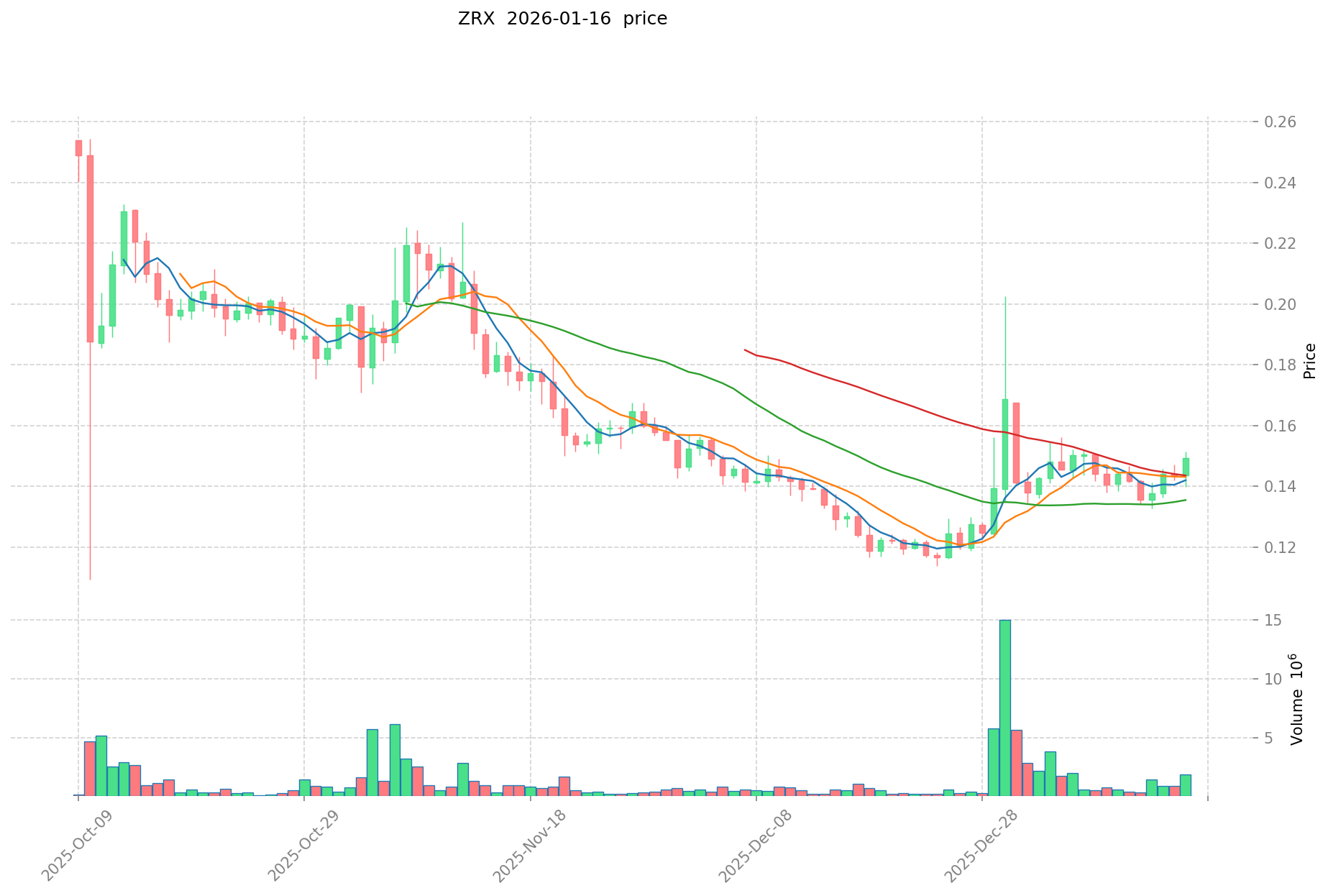
- 2025: Market volatility intensified → ZRX experienced a low point of $0.11448 in December
- Recent period: Price recovery from December 2025 lows → upward movement to current levels showing increased trading activity
Current ZRX Investment Market Status (January 2026)
- ZRX current price: $0.1497
- Market sentiment (Fear & Greed Index): Data shows positive momentum with short-term gains
- 24-hour trading volume: $241,628.998497
- Market capitalization: $127,004,965.46715336 with circulating supply of 848,396,562.906836 ZRX tokens
Click to view real-time ZRX market price
II. Core Factors Affecting Whether ZRX is a Good Investment
Supply Mechanism and Scarcity (ZRX Investment Scarcity)
- Fixed Supply Structure → ZRX has a maximum supply of 1,000,000,000 tokens with a current circulating supply of 848,396,562.906836 tokens (84.84% of max supply). This predetermined supply cap creates a supply-side constraint that may influence long-term value dynamics.
- Historical Price Context → ZRX has experienced significant price movements, with historical data showing a price of $2.5 on January 13, 2018, compared to the current price of $0.1497 as of January 17, 2026. The token has demonstrated volatility across different market cycles.
- Investment Implications → The fixed supply mechanism combined with increasing token circulation suggests that scarcity dynamics may play a role in future valuation, though market demand and utility remain primary drivers.
Institutional Investment and Mainstream Adoption (Institutional Investment in ZRX)
- Market Presence → ZRX maintains a market capitalization of $127,004,965.46715336 with trading activity across 43 exchanges. The token holds 189,327 holders, indicating a distributed ownership structure.
- Protocol Usage → The 0x protocol serves as infrastructure for decentralized exchanges (DEX) and facilitates ERC20 token trading on the Ethereum blockchain. DApps built on the protocol can access public liquidity pools or create proprietary pools while charging transaction fees.
- Ecosystem Integration → The protocol's open-source nature and interoperability focus position it as infrastructure within the decentralized finance ecosystem, though specific institutional adoption metrics were not detailed in available materials.
Macroeconomic Environment Impact on ZRX Investment
- Market Volatility Correlation → Cryptocurrency assets including ZRX may experience price movements influenced by broader macroeconomic conditions such as monetary policy adjustments and interest rate changes, which can affect investor risk appetite.
- Digital Asset Positioning → As an ERC-20 token focused on decentralized exchange infrastructure, ZRX's investment appeal may be influenced by overall trends in blockchain adoption and digital asset integration into financial systems.
- Market Sentiment Factors → Price predictions from various sources suggest potential ranges between $0.139 to $2.04 for 2025, reflecting diverse perspectives on market conditions and adoption trajectories.
Technology and Ecosystem Development (Technology & Ecosystem for ZRX Investment)
- Protocol Infrastructure → The 0x protocol provides an open standard and common building blocks for decentralized applications (DApps) with exchange functionality. Transactions are executed through Ethereum smart contracts with public accessibility and free usage.
- Decentralized Governance → The protocol employs decentralized governance mechanisms to integrate updates in a continuous and secure manner without disrupting higher-level processes, potentially supporting long-term protocol sustainability.
- ERC20 Token Ecosystem → ZRX operates within the Ethereum ecosystem as an ERC-20 token, benefiting from Ethereum's network effects and existing DeFi infrastructure. The protocol enables DApps to access shared liquidity pools or establish custom pools with fee structures.
- Market Position → With a fully diluted market cap of $149,700,000 and market dominance of 0.0044%, ZRX represents a niche position within the broader cryptocurrency market, with investment value tied to the protocol's adoption and utility within decentralized exchange infrastructure.
III. ZRX Future Investment Forecast and Price Outlook (Is 0xProject(ZRX) worth investing in 2026-2031)
Short-term Investment Forecast (2026, short-term ZRX investment outlook)
- Conservative Forecast: $0.1437 - $0.1580
- Neutral Forecast: $0.1497 - $0.1796
- Optimistic Forecast: $0.1796 - $0.2096
Mid-term Investment Outlook (2027-2029, mid-term 0xProject(ZRX) investment forecast)
- Market Stage Expectation: The token shows potential for gradual growth as the decentralized exchange infrastructure continues to evolve, with anticipated improvements in liquidity pool accessibility and protocol adoption among DApps.
- Investment Return Forecast:
- 2027: $0.1581 - $0.2425
- 2028: $0.1140 - $0.2385
- 2029: $0.2158 - $0.3305
- Key Catalysts: Protocol upgrades, expansion of DApp integrations, improvements in gas efficiency, and broader DeFi ecosystem development.
Long-term Investment Outlook (Is ZRX a good long-term investment?)
- Base Scenario: $0.2610 - $0.3369 (assuming steady protocol development and moderate market conditions)
- Optimistic Scenario: $0.3369 - $0.3942 (assuming enhanced protocol adoption and favorable market environment)
- Risk Scenario: $0.1140 - $0.2158 (in case of intensified competition or unfavorable regulatory developments)
Click to view ZRX long-term investment and price forecast: Price Prediction
2026-01-17 to 2031 Long-term Outlook
- Base Scenario: $0.2520 - $0.3369 (corresponding to steady progress and gradual mainstream application growth)
- Optimistic Scenario: $0.3369 - $0.3942 (corresponding to large-scale adoption and favorable market conditions)
- Transformative Scenario: Above $0.3942 (if the ecosystem achieves breakthrough developments and mainstream adoption)
- 2031-12-31 Predicted High: $0.3695 (based on optimistic development assumptions)
Disclaimer: The forecasts presented are based on historical data analysis and predictive models. Cryptocurrency markets are highly volatile and subject to various external factors. These projections should not be considered as investment advice, and actual results may differ substantially from predictions.
| Year |
Predicted High Price |
Predicted Average Price |
Predicted Low Price |
Price Change |
| 2026 |
0.20958 |
0.1497 |
0.143712 |
0 |
| 2027 |
0.242514 |
0.17964 |
0.1580832 |
20 |
| 2028 |
0.23851701 |
0.211077 |
0.11398158 |
41 |
| 2029 |
0.33045159735 |
0.224797005 |
0.2158051248 |
50 |
| 2030 |
0.3942265076685 |
0.277624301175 |
0.2609668431045 |
85 |
| 2031 |
0.369517944863925 |
0.33592540442175 |
0.251944053316312 |
124 |
IV. ZRX Investment Strategy and Risk Management (How to invest in 0x Protocol)
Investment Methodology (ZRX investment strategy)
Long-term Holding (HODL ZRX)
For conservative investors seeking exposure to decentralized exchange infrastructure, long-term holding may be suitable. This approach focuses on the protocol's fundamental role in facilitating peer-to-peer ERC20 token trading and its potential as interoperability infrastructure for decentralized applications. Investors following this strategy typically maintain positions through market cycles, focusing on the protocol's adoption and ecosystem development rather than short-term price movements.
Active Trading
Active trading strategies rely on technical analysis and swing trading operations. Given ZRX's 24-hour volatility of 3.09% and recent price range between $0.1438 and $0.1526, traders may identify entry and exit points based on technical indicators, chart patterns, and volume analysis. This approach requires continuous market monitoring and understanding of support and resistance levels.
Risk Management (Risk management for ZRX investment)
Asset Allocation Ratios
- Conservative investors: May limit ZRX exposure to 1-3% of total cryptocurrency portfolio, focusing on established assets with proven track records
- Aggressive investors: Could allocate 5-10% to protocol tokens like ZRX, accepting higher volatility for potential growth
- Professional investors: May incorporate ZRX as part of a diversified DeFi infrastructure thesis, with allocation dependent on comprehensive portfolio strategy
Risk Hedging Solutions
- Multi-asset portfolio: Combining ZRX with other asset classes including stablecoins, major cryptocurrencies, and traditional assets to reduce concentration risk
- Hedging instruments: Utilizing derivatives, stop-loss orders, and portfolio rebalancing strategies to manage downside exposure
Secure Storage
- Hot wallets: For active trading and frequent transactions, though with inherent online security risks
- Cold wallets: For long-term storage, keeping private keys offline and away from network vulnerabilities
- Hardware wallet recommendations: Physical devices providing enhanced security for storing ZRX tokens, protecting against online threats and unauthorized access
V. ZRX Investment Risks and Challenges (Risks of investing in 0x Protocol)
Market Risks
High volatility: ZRX has demonstrated significant price fluctuations, with a 1-year change of -71.21% and 30-day change of 19.66%. The current price of $0.1497 represents substantial distance from its historical high of $2.50 recorded on January 13, 2018. Such volatility can result in rapid capital appreciation or depreciation.
Price manipulation concerns: With a 24-hour trading volume of approximately $241,629 and market capitalization of around $127 million, relatively lower liquidity compared to major cryptocurrencies may expose the token to potential price manipulation risks in certain market conditions.
Regulatory Risks
Policy uncertainty across jurisdictions: Different countries maintain varying regulatory frameworks for cryptocurrency exchanges and DeFi protocols. Changes in regulatory stance or new compliance requirements could impact the protocol's operations and token utility. Investors should monitor regulatory developments in their respective jurisdictions and major crypto markets.
Technical Risks
Network security vulnerabilities: As a protocol facilitating smart contract-based transactions on Ethereum, ZRX faces potential risks related to smart contract bugs, security exploits, or vulnerabilities in the underlying infrastructure. While the protocol operates on Ethereum's established network, any technical issues could affect functionality and user confidence.
Upgrade implementation challenges: Protocol updates and improvements require careful implementation to maintain continuous operation without disrupting higher-level processes. Failed upgrades or contentious protocol changes could temporarily affect service availability or community consensus.
VI. Conclusion: Is 0x Protocol a Good Investment?
Investment Value Summary
ZRX represents exposure to decentralized exchange infrastructure with a circulating supply of 848,396,562 tokens (84.84% of maximum supply). The protocol serves as open-source infrastructure for peer-to-peer ERC20 token trading, designed to promote interoperability among decentralized applications. However, the token has experienced substantial price fluctuations, with current trading levels significantly below historical peaks.
Investor Recommendations
✅ Beginners: Consider dollar-cost averaging approaches combined with secure wallet storage solutions. Focus on understanding the protocol's fundamentals and ecosystem role before committing significant capital.
✅ Experienced investors: May explore swing trading opportunities while maintaining diversified portfolio allocation. Technical analysis and monitoring of DeFi sector trends can inform position management.
✅ Institutional investors: Could evaluate ZRX as part of strategic long-term allocation to decentralized exchange infrastructure, subject to comprehensive due diligence and risk assessment frameworks.
⚠️ Notice: Cryptocurrency investments carry substantial risks including high volatility, regulatory uncertainty, and potential capital loss. This content is provided for informational purposes only and does not constitute investment advice. Investors should conduct independent research and consider their individual risk tolerance before making investment decisions.
VII. FAQ
Q1: Is 0x Protocol (ZRX) a good investment for beginners?
ZRX may be suitable for beginners who understand the risks and use conservative strategies like dollar-cost averaging. As an ERC-20 token with infrastructure-focused utility in decentralized exchanges, ZRX requires investors to grasp both the protocol's technical fundamentals and the broader DeFi ecosystem. Beginners should start with limited exposure (1-3% of their crypto portfolio), use secure cold wallet storage, and avoid investing more than they can afford to lose. The token's significant volatility—with a 1-year change of -71.21% and current price at $0.1497 compared to its historical high of $2.50—demonstrates the importance of risk management and long-term perspective for new investors.
Q2: What is the realistic price prediction for ZRX by 2031?
Based on current analysis, ZRX's predicted average price for 2031 stands at approximately $0.336, with a potential high of $0.370 and low of $0.252 under base scenario assumptions. These projections assume continued protocol development, gradual DeFi ecosystem expansion, and moderate market conditions. The optimistic scenario suggests prices could reach above $0.394 if the protocol achieves breakthrough adoption and favorable market dynamics. However, cryptocurrency predictions carry substantial uncertainty, and actual outcomes may differ significantly based on technological developments, regulatory changes, competition intensity, and overall market sentiment.
Q3: How does ZRX compare to other DEX protocols as an investment?
ZRX distinguishes itself as open-source infrastructure facilitating peer-to-peer ERC-20 token trading rather than operating as a standalone DEX. The protocol serves as a common building block for DApps with exchange functionality, allowing applications to access shared liquidity pools or create custom pools with transaction fees. With 84.84% of maximum supply already circulating and approximately 189,327 holders, ZRX maintains a mature tokenomic structure. However, its market capitalization of $127 million and 0.0044% market dominance indicate a relatively niche position compared to larger DEX protocols. Investment value depends on the protocol's continued adoption by DApp developers and its ability to maintain relevance in an evolving DeFi landscape.
Q4: What are the main risks of investing in 0x Protocol (ZRX)?
The primary risks include: (1) High market volatility, with ZRX demonstrating significant price fluctuations including a 71.21% decline over one year; (2) Regulatory uncertainty across jurisdictions that could impact protocol operations and token utility; (3) Technical vulnerabilities related to smart contract security and upgrade implementation challenges; (4) Price manipulation concerns due to relatively lower liquidity compared to major cryptocurrencies, with 24-hour trading volume of approximately $241,629; (5) Competition from other DEX infrastructure providers and evolving DeFi technologies; (6) Ethereum network dependencies, as protocol functionality relies on the underlying blockchain's performance and security. Investors should implement proper risk management including diversified allocation, secure storage practices, and continuous monitoring of protocol developments.
Q5: What factors could drive ZRX price growth in the future?
Key growth catalysts include: (1) Increased protocol adoption by decentralized applications requiring exchange functionality; (2) Expansion of public liquidity pools and improved interoperability within the DeFi ecosystem; (3) Successful protocol upgrades that enhance efficiency and security without disrupting operations; (4) Growing demand for decentralized exchange infrastructure as blockchain adoption expands; (5) Favorable regulatory developments supporting DeFi protocols and peer-to-peer trading solutions; (6) Ethereum network improvements that reduce gas fees and increase transaction throughput; (7) Strategic partnerships and integrations with major DApp developers. However, growth depends on execution of protocol roadmap, competitive positioning, and overall cryptocurrency market conditions.
Q6: How should investors store ZRX tokens securely?
Investors have several storage options based on their usage patterns: (1) Hot wallets suit active traders requiring frequent transaction access, though they carry inherent online security risks and exposure to potential hacks; (2) Cold wallets provide optimal security for long-term holders, keeping private keys offline and protected from network vulnerabilities; (3) Hardware wallets offer the most robust security solution, using physical devices to store ZRX tokens and protect against unauthorized access and online threats. Regardless of storage method, investors should implement security best practices including strong passwords, two-factor authentication, regular backup of recovery phrases, and avoiding disclosure of private keys. For significant holdings, distributing assets across multiple wallets can provide additional security through redundancy.
Q7: What is the optimal investment strategy for ZRX?
The optimal strategy depends on individual risk tolerance and investment goals: (1) Conservative long-term holders (HODL strategy) may allocate 1-3% of their crypto portfolio to ZRX, focusing on the protocol's fundamental infrastructure role and ecosystem development rather than short-term price movements; (2) Active traders can utilize technical analysis for swing trading opportunities, leveraging the token's 24-hour volatility and identifying entry/exit points based on support/resistance levels and chart patterns; (3) Aggressive investors might allocate 5-10% to protocol tokens like ZRX, accepting higher volatility for potential growth; (4) Professional investors may incorporate ZRX as part of a diversified DeFi infrastructure thesis with allocation dependent on comprehensive portfolio strategy. All approaches should include proper risk management through portfolio diversification, position sizing appropriate to risk tolerance, and secure storage practices.
* The information is not intended to be and does not constitute financial advice or any other recommendation of any sort offered or endorsed by Gate.