This comprehensive analysis examines whether Acala (ACA) represents a viable investment opportunity within Polkadot's DeFi ecosystem. As of January 2026, ACA trades at $0.006594 with a $7.69 million market cap, down 90.86% annually. The article evaluates ACA's investment characteristics across multiple dimensions: historical price performance, technology infrastructure including Acala Swap DEX and aUSD stablecoin, and ecosystem potential. It presents price forecasts ranging from conservative to optimistic scenarios through 2031, with long-term targets between $0.006482 and $0.015449. The analysis addresses critical factors including token supply mechanics, institutional adoption across 16 exchanges, and DeFi development prospects. Investment strategies range from long-term holding to active trading, with risk management frameworks tailored for different investor profiles. Substantial risks including extreme volatility, low liquidity, regulatory uncertainty, and technical vulnerabilities are thoroughly examine
Introduction: Acala (ACA) Investment Position and Market Outlook
ACA is a notable asset in the cryptocurrency sector, serving as the utility token for Acala, which functions as Polkadot's decentralized finance network and liquidity hub. As of January 27, 2026, ACA holds a market ranking of 1332, with a market capitalization of approximately $7.69 million and a circulating supply of 1,166,666,660 tokens. The current trading price stands at around $0.006594, reflecting a 24-hour increase of 1.65%. With its positioning as a layer-1 smart contract platform optimized for DeFi and compatible with Ethereum, ACA has drawn attention within the Polkadot ecosystem. The token powers various protocols including Acala Swap decentralized exchange, Acala Dollar stablecoin (aUSD), and DOT Staking liquidity solution (LDOT). This article provides a comprehensive analysis of ACA's investment characteristics, historical price movements, future price outlook, and associated investment risks to offer reference points for potential investors.
I. Acala (ACA) Historical Price Review and Current Investment Value
- 2022: ACA reached a significant milestone on January 25, 2022 → Early investors experienced considerable returns during this period
- 2023-2024: Market experienced substantial volatility → ACA price fluctuated within a range, reflecting broader cryptocurrency market conditions
- Recent Period: Price movements showed notable variation → Trading activity ranged from lower levels to relatively higher levels throughout different market cycles
Current ACA Investment Market Status (January 2026)
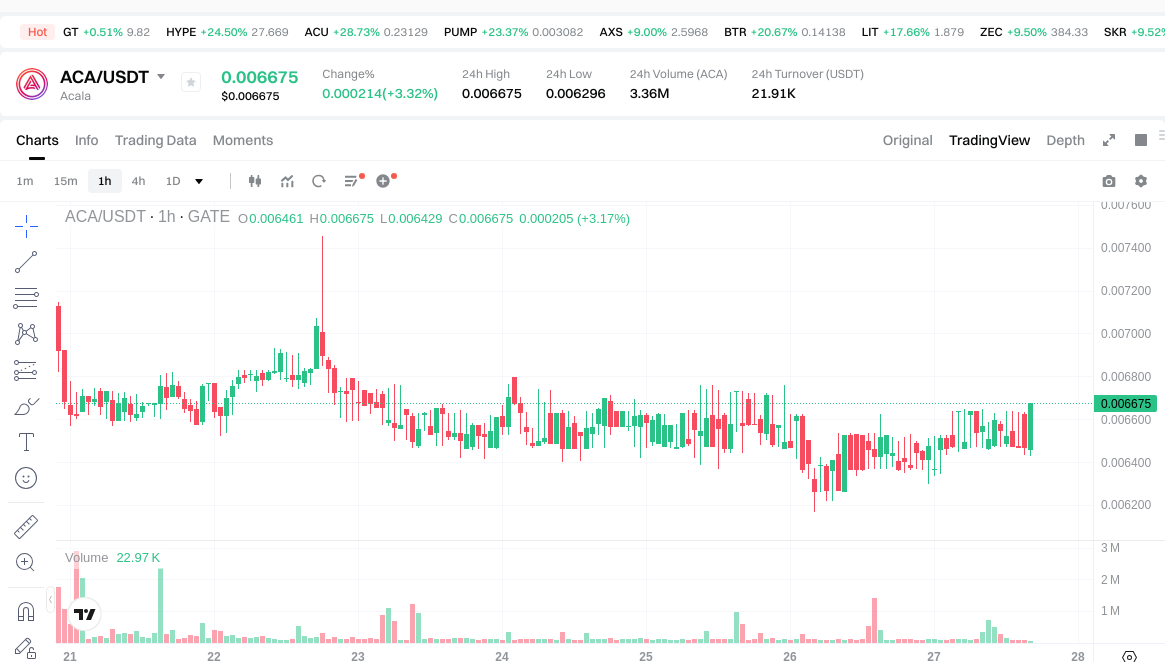
- ACA current price: $0.006594
- Market sentiment (Fear & Greed Index): Neutral market positioning observed
- 24-hour trading volume: $21,929.94
- Market capitalization: $7,692,999.96
Click to view real-time ACA market price
II. Core Factors Influencing Whether ACA is a Good Investment
Supply Mechanism and Scarcity (ACA Investment Scarcity)
-
Supply Structure Impact on Investment Value: Acala Token (ACA) has a maximum supply of 1,600,000,000 tokens, with a current circulating supply of 1,166,666,660 tokens, representing approximately 72.92% of the total supply. This relatively high circulation ratio may influence scarcity perception among investors.
-
Token Supply Dynamics: The current market capitalization to fully diluted valuation ratio stands at 72.92%, indicating that a substantial portion of the total token supply is already in circulation. The proximity between circulating supply and maximum supply suggests limited future dilution risk, which could be a consideration for investment assessment.
-
Investment Consideration: Token scarcity remains a factor in long-term investment evaluation. With the circulating supply approaching the maximum supply, future supply-side pressure may be relatively contained compared to projects with lower circulation ratios.
Institutional Investment and Mainstream Adoption (Institutional Investment in ACA)
-
Holder Base: As of the latest data, Acala Token has 183,987 holders, indicating a distributed ownership structure across the network.
-
Exchange Availability: ACA is listed on 16 exchanges, including major platforms, which provides accessibility for potential investors and contributes to liquidity in the market.
-
Ecosystem Position: Acala functions as a DeFi network and liquidity hub within the Polkadot ecosystem, offering decentralized exchange services (Acala Swap), a decentralized stablecoin (aUSD), DOT staking liquidity solutions (LDOT), and Acala EVM+ for Ethereum compatibility. These ecosystem components may influence institutional interest in the platform's utility token.
Macroeconomic Environment's Impact on ACA Investment
-
Market Performance Context: ACA has experienced significant price volatility, with a 1-year price change of -90.86% and a 30-day change of -33.15%. Such performance patterns may reflect broader market conditions affecting risk asset valuations.
-
Trading Activity: The 24-hour trading volume stands at $21,929.94, with the token price at $0.006594 as of January 27, 2026. Market liquidity and trading patterns can be influenced by macroeconomic factors affecting cryptocurrency markets.
-
Market Position: With a market dominance of 0.00033% and a ranking of 1332, ACA's position in the broader cryptocurrency market may be influenced by shifts in capital allocation driven by macroeconomic conditions.
Technology and Ecosystem Development (Technology & Ecosystem for ACA Investment)
-
Layer-1 Smart Contract Platform: Acala operates as a Layer-1 smart contract platform that is scalable, Ethereum-compatible, and optimized for DeFi applications. The platform incorporates built-in liquidity and native financial DApps, which may support long-term utility and ecosystem growth.
-
Ethereum Compatibility via Acala EVM+: The Acala EVM+ enables developers to utilize Ethereum's core functionality alongside Substrate's complete feature set, potentially expanding the developer base and application ecosystem built on Acala.
-
DeFi Infrastructure Components: The ecosystem includes multiple DeFi primitives such as Acala Swap (decentralized exchange), aUSD (decentralized stablecoin), and LDOT (liquid staking derivative for DOT). These components provide foundational infrastructure that may contribute to the platform's long-term value proposition and investment consideration.
III. ACA Future Investment Predictions and Price Outlook (Is Acala(ACA) worth investing in 2026-2031)
Short-term Investment Forecast (2026, short-term ACA investment outlook)
- Conservative forecast: $0.00647475 - $0.006675
- Neutral forecast: $0.006675 - $0.007209
- Optimistic forecast: $0.007209 - $0.007743
Mid-term Investment Outlook (2027-2029, mid-term Acala(ACA) investment forecast)
- Market stage expectation: The token may experience gradual growth as the DeFi ecosystem on Polkadot continues to develop, with potential fluctuations influenced by broader crypto market conditions and regulatory developments.
- Investment return forecast:
- 2027: $0.00684855 - $0.00886707
- 2028: $0.00538548 - $0.01004754
- 2029: $0.00660124 - $0.01293119
- Key catalysts: Expansion of Acala's DeFi infrastructure, adoption of aUSD stablecoin, growth in DOT liquid staking (LDOT), development of Acala EVM+ platform, and overall Polkadot ecosystem advancement.
Long-term Investment Outlook (Is Acala a good long-term investment?)
- Base scenario: $0.006482 - $0.012965 (assuming steady ecosystem growth and moderate DeFi adoption)
- Optimistic scenario: $0.009341 - $0.015449 (assuming accelerated DeFi integration and favorable market sentiment)
- Risk scenario: Below $0.006482 (under conditions of prolonged market downturn or significant competitive pressure)
Check ACA long-term investment and price forecast: Price Prediction
2026-01-27 - 2031 Long-term Outlook
- Base scenario: $0.006482 - $0.012965 USD (corresponding to steady progress and gradual mainstream application improvement)
- Optimistic scenario: $0.009341 - $0.015449 USD (corresponding to large-scale adoption and favorable market environment)
- Transformative scenario: Above $0.015449 USD (if the ecosystem achieves breakthrough developments and mainstream popularization)
- 2031-12-31 predicted high: $0.015449 USD (based on optimistic development assumptions)
Disclaimer: Price predictions are based on historical data and market analysis models, and do not constitute investment advice. Cryptocurrency markets are highly volatile and unpredictable. Past performance does not guarantee future results. Investors should conduct their own research and consider their risk tolerance before making any investment decisions.
| Year |
Predicted High Price |
Predicted Average Price |
Predicted Low Price |
Price Change |
| 2026 |
0.007743 |
0.006675 |
0.00647475 |
1 |
| 2027 |
0.00886707 |
0.007209 |
0.00684855 |
9 |
| 2028 |
0.01004754375 |
0.008038035 |
0.00538548345 |
21 |
| 2029 |
0.01293118880625 |
0.009042789375 |
0.00660123624375 |
37 |
| 2030 |
0.012964647126937 |
0.010986989090625 |
0.006482323563468 |
66 |
| 2031 |
0.015448805360327 |
0.011975818108781 |
0.009341138124849 |
81 |
IV. ACA Investment Strategy and Risk Management (How to invest in cryptocurrency)
Investment Strategy (ACA investment strategy)
Long-term Holding (HODL ACA)
For conservative investors, long-term holding (HODL) may be a suitable approach. This strategy involves purchasing ACA tokens and holding them over an extended period, regardless of short-term price fluctuations. Given ACA's role as the utility token powering Acala's DeFi ecosystem on Polkadot, long-term holders may benefit from the potential growth of the Polkadot ecosystem and DeFi sector adoption. However, investors should note that ACA has experienced significant price volatility, with the current price of $0.006594 representing a substantial decline from its all-time high of $2.79 recorded on January 25, 2022.
Active Trading
Active trading strategies rely on technical analysis and swing trading approaches. Traders may attempt to capitalize on ACA's price movements by analyzing chart patterns, volume trends, and market indicators. Recent data shows ACA's 24-hour trading volume at $21,929.94, with the token experiencing a 1.65% increase over 24 hours but declining 6.12% over the past week. Active traders should consider the token's high volatility and relatively low liquidity when developing their strategies.
Risk Management (Risk management for ACA investment)
Asset Allocation Ratios
- Conservative investors: May allocate a small percentage (1-3%) of their cryptocurrency portfolio to ACA, focusing primarily on established assets like Bitcoin and Ethereum
- Aggressive investors: Could consider allocating 5-10% of their portfolio to ACA, accepting higher risk for potential returns
- Professional investors: May incorporate ACA as part of a diversified DeFi sector allocation, potentially ranging from 3-8% depending on market conditions and risk tolerance
Risk Hedging Solutions
Investors should consider implementing multi-asset portfolio strategies to mitigate concentration risk. This may include:
- Diversifying across different cryptocurrency sectors (DeFi, Layer-1, stablecoins)
- Maintaining exposure to both established and emerging projects
- Utilizing stablecoins for partial profit-taking during favorable market conditions
- Considering derivatives or options strategies where available
Secure Storage
Proper storage is essential for protecting ACA holdings:
- Hot wallets: Suitable for active traders requiring frequent access, but with heightened security risks
- Cold wallets: Recommended for long-term holders, providing offline storage with enhanced security
- Hardware wallets: Devices like Ledger or Trezor offer robust security solutions for storing ACA tokens, though investors should verify compatibility with Polkadot-based assets
V. ACA Investment Risks and Challenges (Risks of investing in cryptocurrency)
Market Risks
ACA faces significant market-related risks:
- High volatility: The token has demonstrated extreme price volatility, declining 90.86% over the past year from $0.072144 to the current price of $0.006594. The 30-day decline of 33.15% further illustrates the token's susceptibility to sharp price movements
- Price manipulation concerns: With a relatively modest 24-hour trading volume of $21,929.94 and a market capitalization of approximately $7.69 million, ACA may be vulnerable to price manipulation by large holders
- Low liquidity: Trading across 16 exchanges, ACA's liquidity may be limited compared to major cryptocurrencies, potentially resulting in wider bid-ask spreads and slippage during transactions
Regulatory Risks
Cryptocurrency investments face varying regulatory environments:
- Policy uncertainty: Different jurisdictions maintain evolving regulatory frameworks for cryptocurrencies and DeFi protocols, which may impact ACA's accessibility and legal status
- Compliance requirements: Changes in regulatory compliance standards could affect Acala's operations and ACA's utility within the ecosystem
- Cross-border restrictions: Potential limitations on cryptocurrency trading and transfers across international borders may affect ACA's market accessibility
Technical Risks
- Network security vulnerabilities: As a blockchain-based project, Acala faces potential risks from smart contract exploits, protocol vulnerabilities, or security breaches that could negatively impact ACA's value
- Upgrade failures: Technical upgrades or migrations within the Acala ecosystem or the broader Polkadot network could encounter implementation challenges, potentially affecting network functionality and token value
- Dependency risks: ACA's performance is closely tied to the Polkadot ecosystem's development and adoption, creating additional technical dependencies
VI. Conclusion: Is cryptocurrency a Good Investment?
Investment Value Summary
ACA represents a utility token within Polkadot's DeFi ecosystem, offering exposure to decentralized finance applications including the Acala Swap DEX, aUSD stablecoin, and LDOT staking solutions. While the project provides technical infrastructure for DeFi development, ACA has experienced significant price volatility, with substantial declines over multiple timeframes. The token's current market capitalization of approximately $7.69 million and circulating supply of 1,166,666,660 tokens (72.92% of maximum supply) reflect its current market positioning.
Investor Recommendations
✅ Beginners: Consider dollar-cost averaging (DCA) strategies to mitigate timing risks, combined with secure wallet storage practices. Start with minimal allocations to understand market dynamics before increasing exposure.
✅ Experienced investors: May explore swing trading opportunities based on technical analysis while maintaining proper risk management through portfolio diversification and position sizing.
✅ Institutional investors: Could evaluate strategic long-term allocation as part of a broader DeFi sector exposure, contingent upon thorough due diligence and alignment with investment mandates.
⚠️ Disclaimer: Cryptocurrency investments carry high risks, including potential loss of capital. This content is provided for informational purposes only and does not constitute investment advice, financial advice, trading advice, or recommendations. Investors should conduct independent research and consult with qualified financial advisors before making investment decisions.
VII. FAQ
Q1: Is ACA a good investment in 2026?
ACA presents a high-risk, high-volatility investment opportunity that may not be suitable for all investors. As of January 27, 2026, ACA trades at $0.006594 with a market capitalization of only $7.69 million, representing a 90.86% decline over the past year. While the token serves as the utility backbone for Acala's DeFi ecosystem on Polkadot, its extremely low liquidity ($21,929.94 24-hour volume) and substantial price depreciation from its all-time high of $2.79 indicate significant market challenges. Conservative investors should limit exposure to 1-3% of their cryptocurrency portfolio, while more aggressive investors accepting higher risk might consider 5-10% allocation. The token's value proposition depends heavily on Polkadot ecosystem growth and DeFi adoption, making it more suitable for experienced investors who understand sector-specific risks.
Q2: What are the main risks of investing in Acala (ACA)?
The primary risks include extreme price volatility, low market liquidity, and ecosystem dependency. ACA has demonstrated severe price volatility with a 90.86% annual decline and 33.15% monthly drop, making it susceptible to sharp downward movements. The relatively modest trading volume of $21,929.94 across 16 exchanges creates liquidity concerns, potentially resulting in wider spreads and difficulty executing large orders. Additionally, ACA's performance is intrinsically tied to the Polkadot ecosystem's development and broader DeFi sector adoption. Technical risks such as smart contract vulnerabilities, protocol upgrade failures, and security breaches could negatively impact token value. Regulatory uncertainty across different jurisdictions poses additional challenges, as evolving compliance requirements may affect Acala's operations and ACA's accessibility in various markets.
Q3: What is ACA's price prediction for 2026-2031?
Based on historical data and market analysis models, ACA's price forecasts vary significantly across different scenarios. For 2026, conservative estimates range from $0.00647475 to $0.007743, with a neutral average around $0.006675. Mid-term projections for 2027-2029 show potential growth, with 2029 estimates ranging from $0.00660124 to $0.01293119. Long-term outlook through 2031 presents a base scenario of $0.006482-$0.012965, an optimistic scenario of $0.009341-$0.015449, and a transformative scenario above $0.015449 if breakthrough ecosystem developments occur. The 2031 predicted high stands at $0.015449 under optimistic assumptions. However, these predictions should be viewed with caution, as they are based on models that cannot account for unforeseen market events, regulatory changes, or technological disruptions. Past performance does not guarantee future results, and cryptocurrency markets remain highly unpredictable.
Q4: How should I store my ACA tokens securely?
Proper storage depends on your trading frequency and security requirements. For long-term holders, cold storage solutions such as hardware wallets (Ledger or Trezor) provide the highest security by keeping private keys offline and protected from online threats. These devices offer robust protection against hacking attempts and malware, though investors should verify compatibility with Polkadot-based assets before purchase. Active traders who require frequent access may use hot wallets, which provide convenience but come with heightened security risks due to internet connectivity. When using hot wallets, implement strong passwords, enable two-factor authentication, and avoid storing large amounts for extended periods. Regardless of storage method, maintain backup recovery phrases in secure physical locations, never share private keys, and be cautious of phishing attempts. Consider distributing holdings across multiple storage solutions to mitigate single-point-of-failure risks.
Q5: What makes Acala different from other DeFi platforms?
Acala distinguishes itself as Polkadot's dedicated DeFi hub with several unique characteristics. As a Layer-1 smart contract platform, Acala is optimized specifically for DeFi applications while maintaining Ethereum compatibility through Acala EVM+, allowing developers to leverage both Ethereum's functionality and Substrate's complete feature set. The platform offers integrated DeFi primitives including Acala Swap (decentralized exchange), aUSD (decentralized stablecoin), and LDOT (liquid staking derivative for DOT), providing comprehensive infrastructure within a single ecosystem. Unlike standalone protocols, Acala benefits from Polkadot's shared security model and cross-chain interoperability, potentially enabling seamless asset transfers across parachains. The built-in liquidity mechanisms and native financial applications differentiate Acala from general-purpose smart contract platforms that require separate DeFi protocol deployment.
Q6: How does ACA's supply mechanism affect its investment value?
ACA's supply structure significantly influences its scarcity profile and potential investment considerations. With a maximum supply of 1,600,000,000 tokens and current circulation of 1,166,666,660 tokens (72.92%), ACA has relatively limited supply-side pressure compared to projects with lower circulation ratios. The proximity between circulating supply and maximum supply suggests minimal future dilution risk, as approximately 433,333,340 tokens (27.08%) remain unvested. This high circulation ratio may reduce concerns about sudden supply increases that could negatively impact price. However, the substantial circulating supply relative to the modest market capitalization of $7.69 million indicates that scarcity alone has not been sufficient to support price levels. The distributed ownership structure across 183,987 holders suggests broad token distribution, though concentration among large holders could still influence price dynamics.
Q7: What investment strategy is most suitable for ACA?
The optimal strategy depends on investor risk tolerance, experience level, and investment timeframe. Long-term holding (HODL) may suit conservative investors who believe in Acala's ecosystem development despite current price challenges, accepting that ACA has declined 90.86% over the past year. This approach requires patience and tolerance for extended periods of negative performance. Dollar-cost averaging (DCA) can help beginners mitigate timing risks by spreading purchases across regular intervals, reducing exposure to short-term volatility. Active trading strategies based on technical analysis may appeal to experienced investors comfortable with ACA's price movements, though the low 24-hour volume of $21,929.94 presents liquidity challenges. Professional investors might incorporate ACA as part of a diversified DeFi sector allocation (3-8% range), balancing potential upside with significant downside risks. Regardless of strategy, position sizing should reflect ACA's high-risk profile and individual financial circumstances.
Q8: How does the macroeconomic environment affect ACA's investment potential?
Macroeconomic conditions significantly influence ACA's performance as a risk asset within the cryptocurrency sector. Broader market sentiment affecting capital allocation to cryptocurrencies directly impacts ACA, as evidenced by its substantial price declines during challenging market periods. With a market dominance of only 0.00033% and ranking of 1332, ACA remains highly sensitive to shifts in investor risk appetite and liquidity flows toward or away from smaller-cap altcoins. Economic factors such as interest rate changes, inflation trends, and regulatory developments affect investor willingness to allocate capital to speculative DeFi tokens. During periods of macroeconomic uncertainty or monetary tightening, capital typically flows toward established cryptocurrencies or exits the sector entirely, disproportionately affecting smaller projects like ACA. The token's correlation with broader crypto market movements means that favorable macroeconomic conditions supporting risk assets could benefit ACA, while adverse conditions may exacerbate downward pressure on its already-depressed valuation.
* The information is not intended to be and does not constitute financial advice or any other recommendation of any sort offered or endorsed by Gate.