This comprehensive analysis evaluates Across Protocol (ACX) as an investment opportunity within the cross-chain bridge infrastructure sector. ACX serves as the governance token for Across Protocol, currently trading at $0.04834 with a market cap of $32.01 million as of January 2026. The article examines ACX's price history, revealing significant volatility with an 87.97% one-year decline from its December 2024 peak of $1.69. Key investment factors include tokenomics with 662.25 million circulating tokens, limited trading volume of $72,788, and deployment across Ethereum, Arbitrum, Polygon, and Optimism. Price forecasts range from conservative to optimistic scenarios through 2031, with 2029 projections of $0.0435-$0.0922. Investment strategies, risk management approaches, and detailed risk assessments guide different investor profiles. The analysis concludes ACX represents speculative exposure to Layer 2 infrastructure, suitable for risk-tolerant investors conducting thorough due diligence, available on Gate a
Introduction: Across Protocol (ACX) Investment Position and Market Outlook
ACX is a governance token within the cryptocurrency sector, serving as the decision-making instrument for the Across Protocol cross-chain bridge infrastructure. As of January 21, 2026, ACX maintains a market capitalization of approximately $32.01 million, with a circulating supply of 662.25 million tokens and a current trading price near $0.048. The token has been deployed across multiple blockchain networks including Ethereum, Arbitrum, Polygon, and Optimism, operating as an ERC-20 token. With a market dominance of 0.0015% and trading availability on 28 exchanges, ACX represents a governance asset in the Layer 2 scaling solutions sector. The protocol optimizes capital efficiency through a unified liquidity pool and competitive relay mechanism. As market participants evaluate the question "Is Across Protocol (ACX) a good investment?", this analysis provides a comprehensive examination of ACX's investment characteristics, historical price movements, future outlook considerations, and associated risk factors to support informed decision-making processes.
I. ACX Price History Review and Current Investment Value Status
- 2023: Price reached a low point of $0.0344 in June, reflecting early-stage market positioning and limited trading activity during the bear market cycle.
- 2024: Token experienced significant appreciation, with price climbing to $1.69 in December, representing notable gains as the project gained traction in the cross-chain bridge sector.
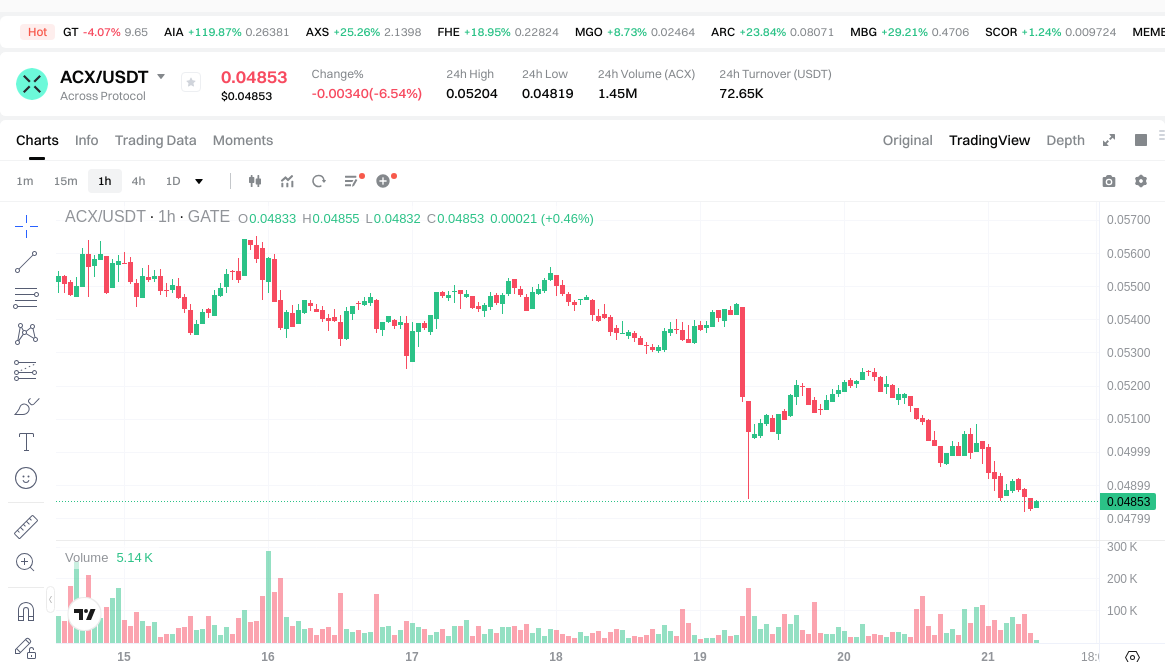
- 2025-2026: Market correction phase observed, with ACX declining from previous elevated levels to current trading range around $0.048, influenced by broader market dynamics and sector-specific developments.
Current ACX Investment Market Status (January 2026)
- ACX current price: $0.04834
- Market sentiment (Fear & Greed Index): Data not available in provided materials
- 24-hour trading volume: $72,788.38
- Institutional investor holdings: Information not available in provided materials
Click to view real-time ACX market price
II. Core Factors Affecting Whether ACX Is a Good Investment
Supply Mechanism and Scarcity (ACX Investment Scarcity)
- Total Supply and Circulation: ACX has a maximum supply of 1,000,000,000 tokens, with a current circulating supply of 662,247,302.327876 tokens, representing approximately 66.22% of the total supply. This relatively high circulation ratio indicates that a significant portion of tokens is already in the market.
- Supply Distribution Impact: The substantial circulating supply may affect short-term price volatility. As the remaining tokens enter circulation, potential dilution effects could influence investment value considerations.
- Investment Implication: The fixed maximum supply cap provides a degree of scarcity framework. However, with over two-thirds of tokens already circulating, the scarcity factor may be less pronounced compared to projects with lower circulation ratios.
Institutional Investment and Mainstream Adoption (Institutional Investment in ACX)
- Holder Base: ACX currently has 7,237 token holders, indicating a growing but relatively modest community base. This holder count reflects early-stage adoption within the cross-chain bridge sector.
- Exchange Presence: The token is listed on 28 exchanges, suggesting reasonable accessibility for investors seeking exposure to cross-chain infrastructure projects.
- Adoption Considerations: As a cross-chain bridge protocol optimized for Optimistic Rollup L2 solutions, ACX's investment value is tied to the broader adoption of Layer 2 scaling technologies and cross-chain interoperability demand.
Macroeconomic Environment's Impact on ACX Investment
- Market Positioning: As an ERC-20 governance token within the DeFi infrastructure space, ACX's investment appeal is influenced by broader cryptocurrency market sentiment and regulatory developments affecting decentralized protocols.
- Risk Factors: The token has experienced notable volatility, with a 1-year price change of -87.97%, reflecting sensitivity to market cycles and evolving competitive dynamics in the cross-chain bridge sector.
- Economic Context: Changes in global monetary policy and risk appetite for DeFi investments may affect capital flows into infrastructure tokens like ACX.
Technology and Ecosystem Development (Technology & Ecosystem for ACX Investment)
- Protocol Features: Across Protocol employs a single liquidity pool model with a competitive relayer landscape and a fee structure designed to eliminate slippage, potentially enhancing capital efficiency for users.
- Governance Function: ACX tokens manage decisions affecting protocol functionality and DAO treasury operations, providing holders with governance participation rights that may influence long-term value.
- Multi-Chain Deployment: The token is deployed across multiple blockchain networks including Ethereum, Arbitrum, Polygon, and Optimism, demonstrating cross-chain operational capability that aligns with the protocol's core value proposition.
- Ecosystem Support: The protocol's focus on Optimistic Rollup solutions positions it within the Layer 2 scaling narrative, with potential investment value tied to the growth of L2 adoption and cross-chain transaction volumes.
III. ACX Future Investment Forecast and Price Outlook (Is Across Protocol(ACX) worth investing in 2026-2031)
Short-term Investment Forecast (2026, short-term ACX investment outlook)
- Conservative forecast: $0.0291 - $0.0485
- Neutral forecast: $0.0485 - $0.0583
- Optimistic forecast: $0.0583 - $0.0675
Mid-term Investment Outlook (2027-2029, mid-term Across Protocol(ACX) investment forecast)
- Market stage expectations: The mid-term outlook reflects gradual ecosystem development and potential expansion of cross-chain bridge adoption as Layer 2 solutions continue to mature.
- Investment return forecast:
- 2027: $0.0540 - $0.0731
- 2028: $0.0492 - $0.0819
- 2029: $0.0435 - $0.0922
- Key catalysts: Expansion of Optimistic Rollup adoption, growth in cross-chain transaction volume, protocol upgrades, and broader DeFi integration.
Long-term Investment Outlook (Is ACX a good long-term investment?)
- Base scenario: $0.0435 - $0.0922 (assuming steady protocol development and moderate market conditions)
- Optimistic scenario: $0.0817 - $0.1036 (assuming accelerated cross-chain bridge adoption and favorable market environment)
- Risk scenario: Below $0.0435 (under adverse market conditions or significant competitive pressure)
View ACX long-term investment and price forecast: Price Prediction
2026-01-21 - 2031 Long-term Outlook
- Base scenario: $0.0435 - $0.0922 (corresponding to steady progress and gradual mainstream application adoption)
- Optimistic scenario: $0.0817 - $0.1036 (corresponding to large-scale adoption and favorable market environment)
- Transformative scenario: Above $0.1036 (if ecosystem achieves breakthrough progress and mainstream adoption)
- 2031-12-31 predicted high: $0.1036 (based on optimistic development assumptions)
Disclaimer: Price forecasts are based on historical data and market analysis, and do not constitute investment advice. Cryptocurrency markets are highly volatile and unpredictable. Investors should conduct their own research and assess risks carefully before making any investment decisions.
| Year |
Predicted High Price |
Predicted Average Price |
Predicted Low Price |
Price Change |
| 2026 |
0.0674845 |
0.04855 |
0.02913 |
0 |
| 2027 |
0.073101735 |
0.05801725 |
0.0539560425 |
20 |
| 2028 |
0.081949365625 |
0.0655594925 |
0.049169619375 |
35 |
| 2029 |
0.092193036328125 |
0.0737544290625 |
0.043515113146875 |
52 |
| 2030 |
0.085462944676171 |
0.082973732695312 |
0.059741087540625 |
71 |
| 2031 |
0.103588556583462 |
0.084218338685742 |
0.081691788525169 |
74 |
IV. ACX Investment Strategy and Risk Management (How to invest in Across Protocol)
Investment Methodology (ACX investment strategy)
Long-term Holding (HODL ACX)
For conservative investors seeking exposure to cross-chain infrastructure, a long-term holding strategy may be considered. This approach involves acquiring ACX tokens and holding them through market cycles, based on confidence in the protocol's fundamental value proposition as a cross-chain bridge solution. Given ACX's role as a governance token for the Across Protocol, long-term holders participate in protocol decision-making while potentially benefiting from adoption growth.
Active Trading
Active traders may employ technical analysis and swing trading strategies to capitalize on ACX's price movements. With a 24-hour trading volume of $72,788 and recent price fluctuations (24-hour range: $0.04819 - $0.05204), opportunities for short-term trading exist. However, traders should note the token's volatility, as evidenced by 1-hour, 24-hour, and 7-day price changes of -0.29%, -6.72%, and -12.88% respectively.
Risk Management (Risk management for ACX investment)
Asset Allocation Ratio
- Conservative investors: Allocate 1-3% of crypto portfolio to ACX, treating it as a speculative position within diversified holdings
- Aggressive investors: May allocate 5-10% depending on risk tolerance and conviction in cross-chain bridge infrastructure
- Professional investors: Consider strategic positioning based on thorough due diligence, potentially incorporating derivatives for hedging
Risk Hedging Solutions
Implement multi-asset portfolio construction combining ACX with established cryptocurrencies and stablecoins. Consider correlation analysis with major assets and utilize hedging instruments such as options or futures where available. Given ACX's relatively small market capitalization of approximately $32 million, position sizing should reflect liquidity constraints.
Secure Storage
ACX is an ERC-20 token with contract addresses on multiple chains including Ethereum (0x44108f0223A3C3028F5Fe7AEC7f9bb2E66beF82F), Arbitrum, Polygon, and Optimism. Storage options include:
- Cold wallets: Hardware wallets such as Ledger or Trezor for long-term holdings
- Hot wallets: MetaMask, Trust Wallet for active trading, with only necessary amounts
- Multi-signature wallets: For larger holdings requiring enhanced security
V. ACX Investment Risks and Challenges (Risks of investing in Across Protocol)
Market Risk
ACX exhibits high price volatility, with a 1-year decline of -87.97% from previous levels. The token's current price of $0.04834 represents a significant distance from its peak of $1.69 recorded on December 6, 2024. With a relatively modest market capitalization and 24-hour trading volume, the token may be susceptible to price fluctuations driven by limited liquidity and concentrated trading activity.
Regulatory Risk
As a governance token for a cross-chain bridge protocol, ACX faces evolving regulatory frameworks across different jurisdictions. Uncertainty regarding the classification of governance tokens, cross-chain bridge regulations, and DeFi oversight creates potential compliance risks. Policy changes in major markets could impact the protocol's operations and token utility.
Technical Risk
Cross-chain bridge protocols face inherent technical challenges including smart contract vulnerabilities, potential bridge exploits, and integration complexities across multiple blockchain networks. With ACX deployed on Ethereum, Arbitrum, Polygon, and Optimism, the protocol must maintain security across multiple chains. Any security incidents affecting the Across Protocol or competing bridge solutions could negatively impact ACX value and investor confidence.
Supply Dynamics
With a circulating supply of approximately 662 million ACX tokens (66.22% of total supply) and a maximum supply of 1 billion tokens, future token releases could create selling pressure. The market cap to fully diluted valuation ratio of 66.22% indicates additional tokens may enter circulation, potentially affecting price dynamics.
VI. Conclusion: Is Across Protocol a Good Investment?
Investment Value Summary
ACX represents exposure to cross-chain infrastructure through the Across Protocol, which optimizes capital efficiency via a single liquidity pool and competitive relay mechanism. While the protocol addresses real utility in the L2 ecosystem, the token has experienced significant price volatility, including a substantial decline over the past year. The relatively small market capitalization of $32 million and limited trading volume present both opportunity and risk considerations.
Investor Recommendations
✅ Beginners: Consider dollar-cost averaging with small allocations, prioritizing secure storage in hardware wallets. Thoroughly research cross-chain bridge technology and governance token mechanics before investing.
✅ Experienced Investors: May employ swing trading strategies while maintaining core positions, utilizing portfolio diversification across different crypto sectors. Monitor protocol development, governance proposals, and competitive dynamics in the cross-chain bridge space.
✅ Institutional Investors: Conduct comprehensive due diligence on protocol architecture, security audits, team background, and competitive positioning before considering strategic allocation. Evaluate liquidity constraints and implement appropriate risk management frameworks.
⚠️ Disclaimer: Cryptocurrency investments carry high risk and significant volatility. This content is for informational purposes only and does not constitute investment advice. Investors should conduct independent research and consider their risk tolerance before making investment decisions.
VII. FAQ
Q1: What is Across Protocol (ACX) and what role does it serve in the cryptocurrency ecosystem?
ACX is the governance token of Across Protocol, a cross-chain bridge infrastructure operating across multiple blockchain networks including Ethereum, Arbitrum, Polygon, and Optimism. As an ERC-20 token, ACX grants holders decision-making authority over protocol functionality and DAO treasury operations. The protocol utilizes a single liquidity pool model with competitive relayers and a fee structure designed to eliminate slippage, optimizing capital efficiency for cross-chain transactions. With 7,237 token holders and availability on 28 exchanges, ACX represents a governance asset within the Layer 2 scaling solutions sector, specifically optimized for Optimistic Rollup solutions.
Q2: What has been ACX's historical price performance and current market status?
ACX has experienced significant volatility throughout its trading history. The token reached a low of $0.0344 in June 2023 during the bear market cycle, then appreciated substantially to $1.69 in December 2024. However, as of January 21, 2026, ACX trades at approximately $0.04834, representing an 87.97% decline over one year. Current market metrics include a market capitalization of $32.01 million, circulating supply of 662.25 million tokens (66.22% of maximum supply), and 24-hour trading volume of $72,788. Recent price changes show -0.29% (1-hour), -6.72% (24-hour), and -12.88% (7-day), reflecting ongoing volatility.
Q3: What are the primary investment risks associated with ACX?
ACX carries several notable investment risks. Market risk manifests through high volatility and limited liquidity given its modest market cap and trading volume. Regulatory risk stems from uncertainty regarding governance token classification and evolving DeFi oversight across jurisdictions. Technical risk includes potential smart contract vulnerabilities and cross-chain bridge exploits, particularly given deployment across multiple blockchain networks. Supply dynamics present risk through potential token releases, as approximately 338 million tokens (33.78% of maximum supply) remain outside circulation. The competitive landscape in cross-chain bridge solutions adds business risk, as superior alternatives could diminish protocol adoption and token value.
Q4: What investment strategies are appropriate for ACX?
Investment strategies for ACX depend on investor profiles and risk tolerance. Conservative investors might allocate 1-3% of their crypto portfolio to ACX, treating it as a speculative position with long-term holding (HODL) approach focused on protocol governance participation. Active traders can employ swing trading strategies utilizing technical analysis, capitalizing on price volatility within the 24-hour range of $0.04819-$0.05204. Aggressive investors may allocate 5-10% depending on conviction in cross-chain infrastructure growth. Risk management should include multi-asset portfolio construction, correlation analysis with major cryptocurrencies, and secure storage utilizing hardware wallets (Ledger, Trezor) for long-term holdings or multi-signature wallets for larger amounts.
Q5: What factors could influence ACX's future price performance?
Several factors may affect ACX's investment outlook through 2026-2031. Positive catalysts include expanded adoption of Optimistic Rollup L2 solutions, increased cross-chain transaction volume, successful protocol upgrades, and broader DeFi integration. Macroeconomic conditions affecting risk appetite for cryptocurrency investments and regulatory clarity around governance tokens will influence capital flows. Technical developments such as security enhancements and competitive positioning against alternative cross-chain bridges remain critical. Price forecasts suggest conservative ranges of $0.0291-$0.0485 for 2026, expanding to $0.0435-$0.0922 by 2029 under base scenarios, though these projections carry significant uncertainty given market volatility.
Q6: How does ACX's tokenomics structure impact investment considerations?
ACX's tokenomics features a maximum supply cap of 1 billion tokens with 662.25 million currently circulating (66.22% of total supply). This relatively high circulation ratio means approximately two-thirds of tokens are already market-active, reducing scarcity effects compared to projects with lower circulation percentages. The remaining 337.75 million tokens represent potential future supply that could create selling pressure upon release. The fixed maximum supply provides a degree of scarcity framework, but dilution risk from remaining token releases requires consideration. As a governance token, ACX's value proposition ties directly to protocol adoption and the importance stakeholders place on governance participation rights within the Across Protocol ecosystem.
Q7: What are realistic price expectations for ACX through 2031?
Price forecasts for ACX through 2031 vary based on adoption scenarios and market conditions. Short-term (2026) projections range from conservative ($0.0291-$0.0485) to optimistic ($0.0583-$0.0675) estimates. Mid-term outlook (2027-2029) anticipates gradual price appreciation contingent on L2 ecosystem growth, with 2029 projections ranging $0.0435-$0.0922. Long-term (2031) scenarios include base case ($0.0435-$0.0922), optimistic ($0.0817-$0.1036), and transformative (above $0.1036) outcomes. The predicted 2031 high of $0.1036 assumes favorable protocol development and mainstream adoption. However, these forecasts carry substantial uncertainty given cryptocurrency market volatility, competitive dynamics, and the inherent unpredictability of technological adoption curves.
Q8: Is ACX suitable for different investor profiles, and what allocation strategies are recommended?
ACX suitability varies significantly by investor profile. Beginners should approach cautiously with dollar-cost averaging strategies, allocating only small percentages they can afford to lose, prioritizing secure storage, and thoroughly researching cross-chain bridge technology before investing. Experienced investors may employ more sophisticated strategies including swing trading while maintaining core positions, utilizing portfolio diversification across crypto sectors, and monitoring protocol governance developments. Institutional investors require comprehensive due diligence covering protocol architecture, security audits, team credentials, and competitive positioning before considering strategic allocation, with appropriate risk management frameworks addressing liquidity constraints. All investor categories should recognize ACX as a high-risk, speculative asset within the broader cryptocurrency market context.
* The information is not intended to be and does not constitute financial advice or any other recommendation of any sort offered or endorsed by Gate.