This comprehensive guide analyzes Act I: The AI Prophecy (ACT), a Solana-based cryptocurrency exploring novel AI-network interactions beyond traditional models. As of January 2026, ACT maintains a market capitalization of approximately $21.91 million with 948.2 million tokens in circulation (94.82% of max supply) across 30 exchanges including Gate, serving 37,735 token holders. The article examines ACT's price volatility history, ranging from $0.00677 to $0.95, and evaluates key investment factors including tokenomics, ecosystem development, and market positioning. It presents multiple investment scenarios for 2026-2031, risk management strategies for conservative to experienced investors, and identifies critical challenges including market volatility, regulatory uncertainty, and technical execution risks. Detailed position-sizing recommendations, secure storage solutions, and practical trading approaches help investors assess whether ACT aligns with their risk tolerance and portfolio objectives.
Introduction: Act I: The AI Prophecy (ACT) Investment Position and Market Outlook
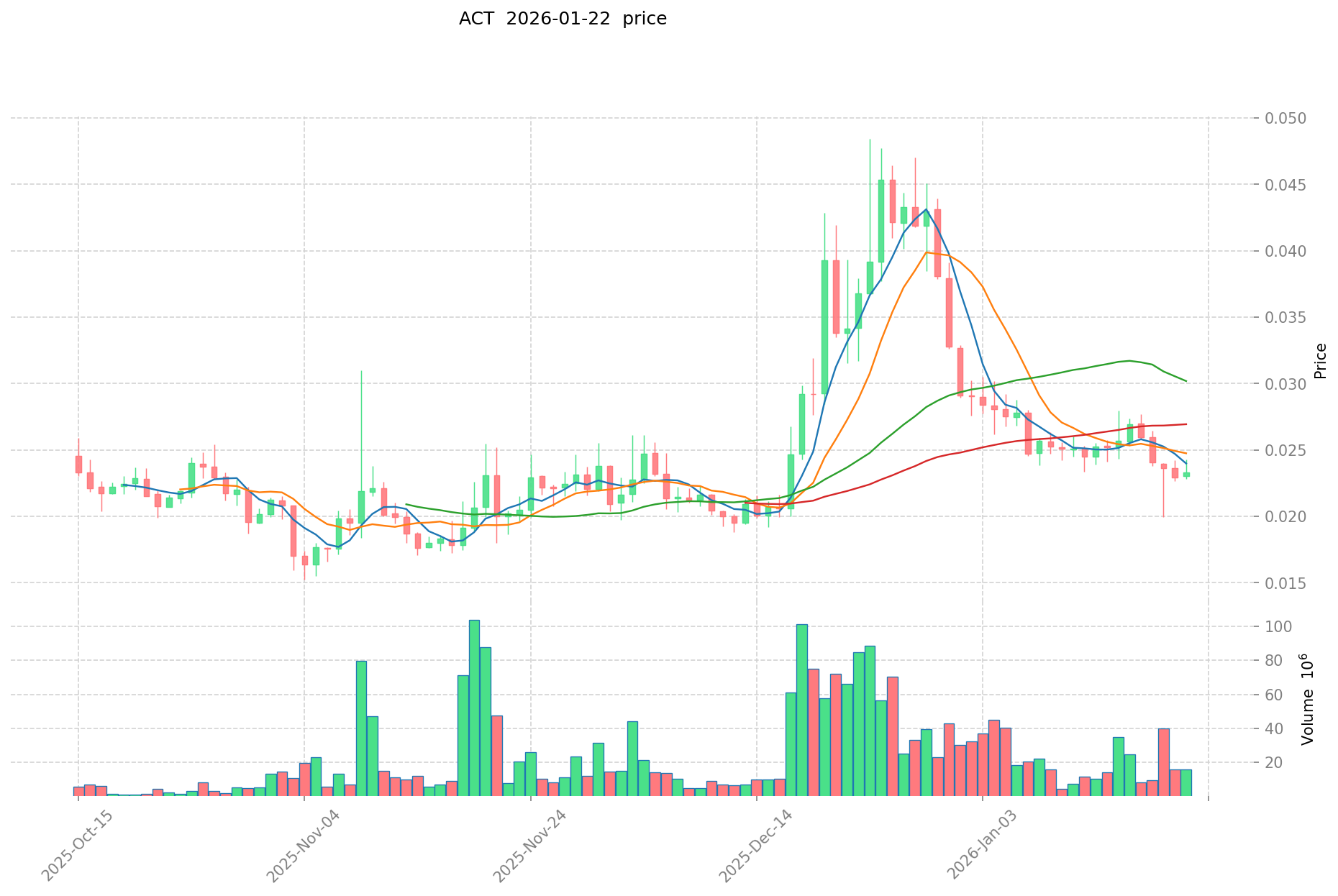
Act I: The AI Prophecy (ACT) represents a distinctive digital asset in the cryptocurrency ecosystem, exploring novel approaches to AI interaction beyond traditional user-assistant paradigms. As of January 23, 2026, ACT maintains a market capitalization of approximately $21.91 million, with a circulating supply of 948.24 million tokens and a current price around $0.02311. The token operates on the Solana blockchain and is listed on 30 exchanges, with a holder base of 37,735 addresses. With a circulating ratio of 94.82% and a maximum supply cap of 1 billion tokens, ACT positions itself within the AI-focused segment of the crypto market. The asset has experienced notable price volatility since its launch, having reached a previous price point of $0.95 in November 2024. This article provides a comprehensive analysis of ACT's investment characteristics, historical performance, price outlook considerations, and associated risk factors for investor reference.
I. ACT Price History Review and Current Investment Value Status
- 2024: Project launched in November → Initial listing price at $0.0156, subsequently experiencing significant appreciation
- 2024: Market peak reached in mid-November → ACT price climbed to higher valuation levels during this period
- 2025-2026: Market adjustment phase → Price declined from elevated levels to current trading range around $0.02311
Current ACT Investment Market Status (January 2026)
- ACT current price: $0.02311
- 24-hour trading volume: $238,661.94
- Circulating supply: 948,242,412 ACT tokens
- Market capitalization: approximately $21.91 million
- Available on 30 cryptocurrency exchanges
- Token holder count: 37,735 addresses
Click to view real-time ACT market price
II. Core Factors Affecting Whether ACT is a Good Investment (Is Act I: The AI Prophecy(ACT) a Good Investment)
Supply Mechanism and Scarcity (ACT investment scarcity)
- Total supply of 948,247,353 tokens with a maximum supply cap of 1,000,000,000 tokens → influences price dynamics and investment value
- Circulating supply stands at 948,242,412 tokens, representing approximately 94.82% of total supply → relatively high circulation rate
- Historical price volatility observed with price reaching $0.95 in November 2024 and declining to $0.00677 in October 2025 → demonstrates significant market fluctuations
- Investment significance: The defined supply cap and high circulation ratio may influence long-term scarcity considerations for investors
Institutional Investment and Mainstream Adoption (Institutional investment in ACT)
- Token holder base consists of 37,735 addresses → indicates distributed ownership structure
- Available trading on 30 exchanges → provides multiple access points for institutional and retail participants
- The project explores AI interaction frameworks beyond traditional user/assistant models, positioning itself within the AI-focused crypto sector
Macroeconomic Environment's Impact on ACT Investment
- Market capitalization of approximately $21.91 million with market share of 0.00069% → represents a relatively small-cap position within the broader crypto market
- 24-hour trading volume of $238,661.95 → reflects current liquidity conditions
- Market performance shows -2.6% change over 24 hours, -11.94% over 7 days, and -37.2% over 30 days → indicates recent downward pressure
Technology and Ecosystem Development (Technology & Ecosystem for ACT investment)
- Built on Solana blockchain using SPL token standard → benefits from Solana's infrastructure capabilities
- Project focuses on AI-network interactions as equals rather than traditional hierarchical models → represents a specific niche within AI-crypto convergence
- Contract address: GJAFwWjJ3vnTsrQVabjBVK2TYB1YtRCQXRDfDgUnpump on Solana network → provides transparency for on-chain verification
III. ACT Future Investment Prediction and Price Outlook (Is Act I: The AI Prophecy (ACT) worth investing in 2026-2031)
Short-term Investment Prediction (2026, short-term ACT investment outlook)
- Conservative prediction: $0.022176 - $0.0231
- Neutral prediction: $0.0231 - $0.026
- Optimistic prediction: $0.026 - $0.029337
Mid-term Investment Outlook (2027-2028, mid-term Act I: The AI Prophecy (ACT) investment forecast)
-
Market stage expectation: The project may experience gradual development as it explores AI interaction paradigms beyond traditional user-assistant models. Market conditions and broader adoption trends in AI-related crypto projects could influence performance.
-
Investment return prediction:
- 2027: $0.019139505 - $0.03827901
- 2028: $0.01967174055 - $0.0367635807
-
Key catalysts: Evolution of AI integration in blockchain ecosystems, expansion of the project's network of AI equals concept, broader market sentiment toward AI-themed tokens, and potential partnerships or technological developments.
Long-term Investment Outlook (Is ACT a good long-term investment?)
- Base scenario: $0.022 - $0.038 (assuming steady development and moderate market conditions)
- Optimistic scenario: $0.038 - $0.057 (assuming enhanced adoption and favorable market environment)
- Risk scenario: Below $0.019 (under adverse market conditions or reduced project momentum)
Click to view ACT long-term investment and price prediction: Price Prediction
2026-01-23 - 2031 Long-term Outlook
- Base scenario: $0.022 - $0.037 USD (corresponding to steady progress and gradual mainstream application growth)
- Optimistic scenario: $0.038 - $0.057 USD (corresponding to large-scale adoption and favorable market environment)
- Transformative scenario: Above $0.057 USD (if the ecosystem achieves breakthrough progress and mainstream popularization)
- 2031-12-31 predicted high: $0.056785075122352 USD (based on optimistic development assumptions)
Disclaimer: The above predictions are based on historical data and market analysis models and do not constitute investment advice. Cryptocurrency markets are highly volatile and subject to various risks. Investors should conduct independent research and assess their risk tolerance before making investment decisions.
| Year |
Predicted High Price |
Predicted Average Price |
Predicted Low Price |
Price Change |
| 2026 |
0.029337 |
0.0231 |
0.022176 |
0 |
| 2027 |
0.03827901 |
0.0262185 |
0.019139505 |
13 |
| 2028 |
0.0367635807 |
0.032248755 |
0.01967174055 |
39 |
| 2029 |
0.038646907992 |
0.03450616785 |
0.0189783923175 |
49 |
| 2030 |
0.0475494992973 |
0.036576537921 |
0.03072429185364 |
58 |
| 2031 |
0.056785075122352 |
0.04206301860915 |
0.022293399862849 |
82 |
IV. ACT Investment Strategy and Risk Management (How to invest in Act I: The AI Prophecy)
Investment Methodology (ACT investment strategy)
Long-term Holding (HODL ACT)
For conservative investors seeking exposure to AI-integrated blockchain projects, a long-term holding strategy may be considered. This approach involves acquiring ACT tokens and maintaining positions through market cycles, potentially benefiting from the project's development in AI-network interaction models. Given ACT's significant price fluctuation history, with prices ranging from $0.00677 to $0.95, patience and tolerance for volatility are essential characteristics for this strategy.
Active Trading
Active trading strategies rely on technical analysis and momentum-based operations. Traders may utilize ACT's price volatility, evidenced by recent performance showing -2.6% (24H), -11.94% (7D), and -37.2% (30D) changes. This approach requires continuous market monitoring, technical indicator analysis, and disciplined risk management protocols. The token's 24-hour trading volume of approximately $238,662 suggests moderate liquidity conditions that traders should consider when executing positions.
Risk Management (Risk management for ACT investment)
Asset Allocation Ratios
- Conservative investors: Consider limiting ACT exposure to 1-3% of total cryptocurrency portfolio
- Moderate investors: May allocate 3-7% depending on risk tolerance and portfolio diversification
- Experienced investors: Could consider 7-15% allocation with active monitoring and adjustment mechanisms
Risk Hedging Solutions
Implementing a diversified asset portfolio combining multiple cryptocurrency categories can help mitigate concentration risk. Investors may consider pairing ACT holdings with more established digital assets and exploring hedging instruments available in the cryptocurrency derivatives market.
Secure Storage
- Cold wallets: Recommended for long-term holdings, providing offline storage security
- Hot wallets: Suitable for active trading portions with convenient access
- Hardware wallets: Offer enhanced security features for substantial holdings
Given ACT's deployment on the Solana blockchain (contract address: GJAFwWjJ3vnTsrQVabjBVK2TYB1YtRCQXRDfDgUnpump), investors should utilize Solana-compatible wallet solutions that support SPL token standards.
V. ACT Investment Risks and Challenges (Risks of investing in Act I: The AI Prophecy)
Market Risk
High Volatility
ACT exhibits substantial price volatility, with annual performance showing -86.35% decline from previous levels. The token has experienced significant price swings, trading between $0.00677 and $0.95 throughout its history. This volatility pattern suggests that investors should prepare for considerable short-term price fluctuations and potential drawdown periods.
Market Dynamics
With a market capitalization of approximately $21.9 million and ranking #836, ACT represents a relatively small-cap cryptocurrency project. Lower market capitalization assets may experience amplified price movements and potentially face liquidity constraints during periods of market stress.
Regulatory Risk
Jurisdictional Uncertainty
The regulatory landscape for cryptocurrency assets varies significantly across different jurisdictions. Changes in regulatory frameworks, enforcement actions, or policy shifts in major markets could impact ACT's accessibility, trading conditions, or overall market perception.
Compliance Considerations
As regulatory frameworks continue to evolve, projects in the cryptocurrency space may face increased compliance requirements. Investors should monitor regulatory developments in their respective jurisdictions and assess potential impacts on their holdings.
Technical Risk
Network Security
While ACT operates on the Solana blockchain infrastructure, investors should remain aware of potential technical vulnerabilities, including smart contract risks, network congestion issues, or security incidents that could affect token functionality or value.
Project Development Risk
As a project exploring AI-network interaction models, ACT's success depends on continued technological development and adoption. Delays in development milestones, technical challenges, or competitive pressures from alternative projects could impact long-term value proposition.
VI. Conclusion: Is Act I: The AI Prophecy a Good Investment?
Investment Value Summary
ACT represents an exploratory project in the intersection of AI and blockchain technology, focusing on network-based AI interaction models. The project's circulating supply of approximately 948.2 million tokens (94.82% of max supply) suggests near-complete token distribution. However, the token has experienced substantial volatility, with significant price declines across multiple timeframes, indicating considerable market uncertainty and risk factors.
Investor Recommendations
✅ Newcomers: Consider small position sizing through dollar-cost averaging strategies, utilizing secure wallet storage solutions, and dedicating time to understanding both the project fundamentals and broader cryptocurrency market dynamics before committing substantial capital.
✅ Experienced Investors: May explore tactical trading opportunities based on technical analysis while maintaining strict position sizing discipline and implementing stop-loss mechanisms. Portfolio diversification across multiple asset categories remains advisable.
✅ Institutional Investors: Should conduct comprehensive due diligence on project fundamentals, team background, technological differentiation, and competitive landscape before considering any strategic allocation. Risk assessment frameworks should account for small-cap volatility characteristics.
⚠️ Disclaimer: Cryptocurrency investments involve substantial risk and may result in significant capital loss. This content serves informational purposes only and does not constitute investment advice. Investors should conduct independent research, assess their risk tolerance, and consult qualified financial advisors before making investment decisions.
VII. FAQ
Q1: What is Act I: The AI Prophecy (ACT) and how does it differ from other AI-crypto projects?
Act I: The AI Prophecy (ACT) is a Solana-based cryptocurrency token that explores AI-network interactions as equals rather than traditional user-assistant hierarchical models, representing a distinctive approach within the AI-crypto convergence space. Unlike conventional AI-focused blockchain projects that position AI as a service tool, ACT conceptualizes AI networks as equal participants in interactions. The project operates with a maximum supply of 1 billion tokens, with approximately 94.82% already in circulation (948.2 million tokens). As of January 2026, ACT maintains a market capitalization of approximately $21.91 million and trades on 30 exchanges with 37,735 token holders.
Q2: What are the primary risks associated with investing in ACT?
ACT presents substantial investment risks, including extreme price volatility, small market capitalization characteristics, and development execution uncertainties. The token has demonstrated significant price fluctuations, ranging from $0.00677 to $0.95 throughout its history, with an annual performance showing -86.35% decline from previous peak levels. Recent performance indicators show negative trends across multiple timeframes: -2.6% (24H), -11.94% (7D), and -37.2% (30D). With a market cap of only $21.9 million and ranking #836, ACT represents a small-cap asset subject to amplified price movements and potential liquidity constraints. Additionally, the project faces technical development risks related to its novel AI interaction paradigm, regulatory uncertainties affecting cryptocurrency assets, and competition from alternative AI-blockchain projects.
Q3: What price predictions exist for ACT between 2026 and 2031?
Price forecasts for ACT vary significantly depending on market scenarios and development outcomes, with projected ranges spanning from bearish to optimistic trajectories. Short-term predictions for 2026 range from $0.022176 (conservative) to $0.029337 (optimistic). Mid-term forecasts suggest potential trading ranges of $0.019139505 to $0.03827901 for 2027, and $0.01967174055 to $0.0367635807 for 2028. Long-term projections extending to 2031 estimate a predicted high of $0.056785075122352 under optimistic development assumptions. Base scenario projections for 2026-2031 range between $0.022 and $0.037, while optimistic scenarios project $0.038 to $0.057. However, risk scenarios acknowledge the possibility of prices falling below $0.019 under adverse market conditions. These predictions derive from historical data and analytical models but do not constitute investment advice, as cryptocurrency markets remain highly volatile and unpredictable.
Q4: How should investors approach position sizing and portfolio allocation for ACT?
Position sizing for ACT should reflect individual risk tolerance levels, market experience, and overall portfolio diversification objectives, with conservative approaches recommended given the token's volatility characteristics. Conservative investors should consider limiting ACT exposure to 1-3% of their total cryptocurrency portfolio to minimize concentration risk. Moderate investors with greater risk tolerance may allocate 3-7% depending on their diversification strategy and market outlook. Experienced investors actively monitoring market conditions could consider 7-15% allocation with disciplined adjustment mechanisms and stop-loss protocols. Given ACT's significant historical volatility and small market capitalization status, implementing a diversified asset portfolio combining multiple cryptocurrency categories helps mitigate concentration risk. Dollar-cost averaging strategies may prove beneficial for accumulating positions over time rather than committing substantial capital in single transactions.
Q5: What are the recommended storage solutions for securing ACT tokens?
ACT tokens require Solana-compatible wallet solutions supporting SPL token standards, with security levels varying based on holding timeframes and trading frequency. For long-term holdings, cold wallet storage provides offline security protection, minimizing exposure to online threats and hacking attempts. Hardware wallets offer enhanced security features particularly suitable for substantial holdings, combining physical device protection with cryptographic key management. Hot wallets provide convenient access for active trading portions, enabling quick transaction execution but requiring heightened security awareness regarding phishing attempts and malware. The token's contract address on Solana (GJAFwWjJ3vnTsrQVabjBVK2TYB1YtRCQXRDfDgUnpump) allows for on-chain verification and transparency. Investors should implement multi-layered security practices including strong password protocols, two-factor authentication, regular security updates, and maintaining separate storage solutions for long-term holdings versus active trading allocations.
Q6: What factors could potentially influence ACT's future performance?
Multiple interconnected factors may impact ACT's market performance, including technological development progress, broader AI-crypto market sentiment, and competitive positioning within the ecosystem. Key catalysts include the evolution of AI integration in blockchain ecosystems, expansion of the project's network-based AI interaction concept, and potential partnerships or technological breakthroughs demonstrating practical applications. Market sentiment toward AI-themed tokens, influenced by mainstream technology trends and adoption patterns, could significantly affect demand dynamics. The project's ability to differentiate itself from competing AI-blockchain initiatives and deliver on its conceptual framework will prove crucial. Additionally, macroeconomic conditions affecting cryptocurrency markets, regulatory developments in major jurisdictions, and Solana network performance and adoption may indirectly influence ACT's trajectory. The relatively high circulation ratio (94.82%) suggests limited supply-side pressure from future token releases, though demand factors will ultimately determine price movements.
Q7: Is ACT suitable for institutional investment consideration?
ACT presents significant challenges for institutional investment frameworks due to small market capitalization, limited liquidity characteristics, and elevated volatility profiles inconsistent with most institutional risk parameters. With a market cap of approximately $21.91 million and 24-hour trading volume around $238,662, the token faces liquidity constraints that may complicate large position execution without substantial market impact. The asset's extreme volatility, demonstrated by price fluctuations ranging from $0.00677 to $0.95 and recent negative performance across multiple timeframes, conflicts with typical institutional risk management protocols. Institutional investors considering ACT would require comprehensive due diligence examining project fundamentals, team credentials, technological differentiation, competitive landscape analysis, and long-term viability assessments. Given these factors, ACT may be more suitable for specialized crypto-focused funds with small-cap mandates rather than mainstream institutional portfolios. Any strategic allocation would necessitate rigorous risk assessment frameworks accounting for small-cap volatility characteristics, position sizing limitations, and potential illiquidity scenarios during market stress periods.
Q8: What trading strategies are applicable for ACT investment?
Two primary investment approaches exist for ACT, each suited to different investor profiles, timeframes, and market perspectives. Long-term holding (HODL) strategies involve acquiring tokens and maintaining positions through market cycles, potentially benefiting from the project's AI-network interaction model development over extended periods. This approach requires patience, tolerance for significant volatility, and conviction in the project's long-term value proposition, acknowledging the token's historical price range between $0.00677 and $0.95. Active trading strategies utilize technical analysis and momentum-based operations to capitalize on ACT's price volatility, evidenced by recent performance fluctuations. This approach demands continuous market monitoring, proficiency in technical indicator interpretation, disciplined entry and exit protocols, and strict risk management including stop-loss implementation. Traders should consider the token's moderate liquidity conditions reflected in the $238,662 daily trading volume when executing positions. Hybrid approaches combining core long-term holdings with tactical trading portions may suit investors seeking exposure while managing volatility through active position management.
* The information is not intended to be and does not constitute financial advice or any other recommendation of any sort offered or endorsed by Gate.