Acurast (ACU) represents the first decentralized verifiable compute network powered by smartphones, with a current market cap of $25.9 million and price of $0.12046. This comprehensive analysis examines ACU's investment potential across tokenomics, ecosystem development, and market outlook through 2031. The article evaluates historical price volatility (ranging $0.011-$0.17717), explores tokenomics factors including the 1 billion token maximum supply with 21.5% circulation, and assesses core catalysts like mainnet progression and enterprise adoption. Short-term price forecasts (2026) range from $0.0912-$0.1596, while long-term scenarios project $0.17-$0.35 by 2031 depending on adoption levels. The guide provides risk management strategies, investment methodologies for different investor profiles, and security recommendations for ACU token storage across Ethereum and BSC networks. Suitable for investors seeking exposure to DePIN infrastructure innovation while understanding the associated market volatility and
Introduction: Acurast (ACU) Investment Position and Market Outlook
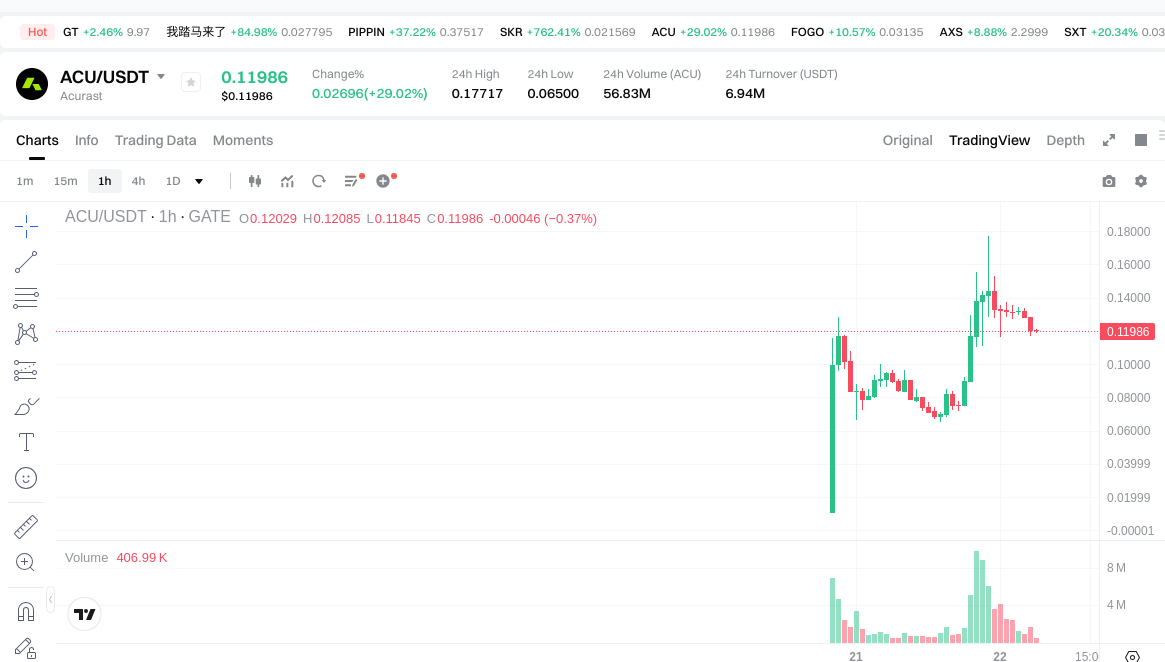
ACU is an emerging asset in the cryptocurrency sector, representing the first decentralized verifiable compute network powered by smartphones. As of January 22, 2026, Acurast holds a market position ranked at 768 with a market capitalization of approximately $25.90 million and a circulating supply of 215 million tokens. The current price stands at around $0.12046, with a 24-hour trading volume of approximately $6.93 million. The token is accessible across 11 exchanges and operates with multi-chain compatibility through BEP-20 and ERC-20 standards.
Acurast's approach to decentralized computing utilizes global smartphone resources rather than traditional data centers, with its incentivized testnet already connecting over 168,500 devices worldwide. This verifiable, scalable, and confidential compute infrastructure supports secure applications on decentralized infrastructure while maintaining operational speed and privacy features. The network currently serves mission-critical workloads with requirements for security and AI processing capabilities.
With a circulating supply representing 21.5% of its maximum supply of 1 billion tokens, ACU presents characteristics typical of projects in development phases. The token's price history shows notable volatility, with recorded levels ranging from $0.011 to $0.17717 within recent trading periods. Recent performance data indicates a 24-hour change of 26.14%, alongside a 7-day decline of -32.95%. The market dominance of ACU currently represents 0.0037% of the total cryptocurrency market.
For participants evaluating whether Acurast (ACU) represents a suitable investment opportunity, this analysis examines the token's fundamental characteristics, historical price movements, future price scenarios, and associated risk factors to provide informational context for decision-making processes.
I. Historical Price Review and Current Investment Value of ACU
- 2026: Recent market volatility → ACU experienced significant price fluctuations
- January 2026: Token listing and initial trading → Price reached $0.17717 on January 21, 2026, followed by a decline to $0.065
Current ACU Investment Market Status (January 2026)
- ACU current price: $0.12046
- 24-hour trading volume: $6,928,501.97
- Market capitalization: $25,898,900
- Circulating supply: 215,000,000 ACU (21.5% of total supply)
- Number of holders: 579
- Listed on 11 exchanges
Click to view real-time ACU market price
II. Core Factors Affecting Whether ACU is a Good Investment (Is Acurast(ACU) a Good Investment)
Supply Mechanism and Scarcity (ACU investment scarcity)
- Maximum supply capped at 1,000,000,000 ACU with current circulating supply of 215,000,000 tokens (21.5% of total) → influences price dynamics and investment value assessment
- Historical pattern: ACU price experienced notable volatility with a recorded high of $0.17717 and low of $0.011 during its trading period
- Investment significance: the fixed maximum supply and gradual token release mechanism establish a foundation for evaluating long-term scarcity dynamics
Institutional Investment and Mainstream Adoption (Institutional investment in ACU)
- Current holder base stands at 579 addresses across multiple blockchain networks
- Token deployment across Ethereum (ERC-20) and BNB Smart Chain (BEP-20) standards enables multi-chain accessibility for institutional participants
- Exchange availability: ACU is listed on 11 cryptocurrency exchanges, facilitating institutional and retail access
Macroeconomic Environment's Impact on ACU Investment
- Monetary policy and interest rate fluctuations → alter the attractiveness of alternative digital asset investments including decentralized infrastructure projects
- Economic uncertainty environments may influence capital allocation toward innovative computing infrastructure solutions
- Geopolitical factors affecting technology infrastructure development → potential influence on decentralized compute network adoption trends
Technology and Ecosystem Development (Technology & Ecosystem for ACU investment)
- Decentralized verifiable compute network powered by smartphones: leverages global mobile device infrastructure without requiring traditional data centers → represents distinctive technological positioning
- Incentivized testnet deployment: onboarded 168,500+ devices globally, establishing operational scale for verifiable compute services
- Application focus areas: network supports mission-critical workloads with high-security requirements and AI computational demands → potential for ecosystem expansion in enterprise and decentralized application sectors
- Infrastructure model positions ACU within the decentralized physical infrastructure (DePIN) category, addressing compute scalability while maintaining verification and confidentiality features
III. ACU Future Investment Forecast and Price Outlook (Is Acurast(ACU) worth investing in 2026-2031)
Short-term Investment Forecast (2026, short-term ACU investment outlook)
- Conservative Forecast: $0.0912 - $0.12
- Neutral Forecast: $0.12 - $0.14
- Optimistic Forecast: $0.14 - $0.1596
Mid-term Investment Outlook (2027-2028, mid-term Acurast(ACU) investment forecast)
-
Market Stage Expectations: ACU may enter a growth phase as the decentralized verifiable compute network expands its testnet participants and onboards more mission-critical workloads. The network's unique positioning in utilizing smartphones for computation could attract attention from developers and enterprises seeking scalable, confidential compute solutions.
-
Investment Return Forecast:
- 2027: $0.109044 - $0.170556
- 2028: $0.08845146 - $0.20638674
-
Key Catalysts: Mainnet launch progress, expansion of the phone network beyond current testnet levels, partnerships with enterprises requiring high-security compute resources, adoption of AI workloads on the network, and broader DePIN sector development.
Long-term Investment Outlook (Is ACU a good long-term investment?)
- Baseline Scenario: $0.15 - $0.25 (assuming steady network growth and moderate adoption of decentralized compute solutions)
- Optimistic Scenario: $0.25 - $0.35 (assuming significant expansion of the phone network, mainstream enterprise adoption, and favorable DePIN market conditions)
- Risk Scenario: $0.08 - $0.12 (under scenarios of limited adoption, technical challenges, or adverse market conditions affecting the broader crypto sector)
Click to view ACU long-term investment and price forecast: Price Prediction
2026-01-22 - 2031 Long-term Outlook
- Baseline Scenario: $0.17 - $0.25 USD (corresponding to steady progress and gradual mainstream application adoption)
- Optimistic Scenario: $0.25 - $0.28 USD (corresponding to large-scale adoption and favorable market environment)
- Transformative Scenario: Above $0.30 USD (if the ecosystem achieves breakthrough developments and mainstream adoption)
- 2031-12-31 Predicted High: $0.282779783154 USD (based on optimistic development assumptions)
Disclaimer: Price predictions are speculative and based on historical data patterns and market analysis. Cryptocurrency investments carry substantial risk, and actual prices may differ significantly from forecasts due to market volatility, regulatory changes, technological developments, and other unforeseen factors. This information does not constitute financial advice, and investors should conduct their own research before making investment decisions.
| Year |
Predicted High Price |
Predicted Average Price |
Predicted Low Price |
Price Change |
| 2026 |
0.1596 |
0.12 |
0.0912 |
0 |
| 2027 |
0.170556 |
0.1398 |
0.109044 |
16 |
| 2028 |
0.20638674 |
0.155178 |
0.08845146 |
28 |
| 2029 |
0.2476718469 |
0.18078237 |
0.1211241879 |
50 |
| 2030 |
0.282779783154 |
0.21422710845 |
0.1863775843515 |
77 |
| 2031 |
0.25595854917606 |
0.248503445802 |
0.16649730868734 |
106 |
IV. ACU Investment Strategy and Risk Management (How to invest in Acurast)
Investment Methodology (ACU investment strategy)
Long-term Holding (HODL ACU): Suitable for Conservative Investors
For investors who believe in the long-term vision of decentralized verifiable compute networks, holding ACU may align with a patient approach to infrastructure-layer projects. Long-term holders typically focus on the protocol's development milestones, ecosystem growth, and adoption of its smartphone-powered compute network rather than short-term price movements.
Active Trading: Relying on Technical Analysis and Swing Operations
Traders focusing on ACU may utilize technical indicators, market sentiment analysis, and price action patterns. Given the asset's observed volatility—with 24-hour changes exceeding 26% and weekly fluctuations around 33%—active traders may seek opportunities in price swings. However, lower liquidity and relatively modest trading volumes (approximately $6.93 million in 24-hour volume as of January 22, 2026) may impact execution and spread costs.
Risk Management (Risk management for ACU investment)
Asset Allocation Ratios: Conservative / Aggressive / Professional Investors
- Conservative Investors: May consider limiting exposure to ACU to a small percentage (e.g., 1-3%) of total portfolio, treating it as a speculative allocation within a broader crypto basket.
- Aggressive Investors: Could allocate a higher proportion (e.g., 5-10%), accepting increased volatility in exchange for potential upside tied to DePIN (Decentralized Physical Infrastructure Network) narrative expansion.
- Professional Investors: May adopt strategic positions based on quantitative models, ecosystem metrics (e.g., device count, compute utilization), and correlation analysis with other infrastructure tokens.
Risk Hedging Solutions: Multi-asset Portfolio + Hedging Tools
Diversification across different crypto categories (Layer 1s, DeFi, AI-related tokens) can reduce concentration risk. Investors may also consider stablecoin reserves or derivatives strategies (if available) to hedge against sharp downturns, though ACU's relatively early stage and limited exchange listings (11 exchanges) may constrain hedging options.
Secure Storage: Hot and Cold Wallets + Hardware Wallet Recommendations
ACU tokens are issued on both Ethereum (ERC-20) and BNB Smart Chain (BEP-20). Investors should:
- Use hardware wallets (e.g., Ledger, Trezor) for long-term holdings to minimize exposure to online threats.
- Reserve hot wallets (e.g., MetaMask, Trust Wallet) for active trading amounts only.
- Verify contract addresses carefully:
- Ethereum: 0x216b3643ff8b7bb30d8a48e9f1bd550126202add
- BSC: 0x6ef2ffb38d64afe18ce782da280b300e358cfeaf
- Enable multi-signature or additional security layers where possible.
V. ACU Investment Risks and Challenges (Risks of investing in Acurast)
Market Risk: High Volatility and Price Manipulation
ACU exhibits significant short-term price volatility. Within a 24-hour period, the token fluctuated between $0.065 and $0.17717. Such price swings may be influenced by low circulating supply (215 million out of 1 billion total supply, representing 21.5% circulation), limited market depth, and speculative trading behavior. Investors should be prepared for rapid price changes and potential liquidity challenges during volatile periods.
Regulatory Risk: Policy Uncertainty Across Different Countries
As a decentralized compute network utilizing smartphones as infrastructure, Acurast operates in a relatively novel regulatory space. Potential concerns include:
- Classification of ACU tokens under securities or utility token frameworks.
- Regulatory treatment of decentralized physical infrastructure networks (DePIN) in major markets.
- Compliance requirements for participants contributing smartphone compute resources.
- Evolving global stances on crypto assets and decentralized networks, which may impact adoption, liquidity, and token utility.
Technical Risk: Network Security Vulnerabilities and Upgrade Failures
Key technical risks associated with Acurast include:
- Smart Contract Vulnerabilities: ACU is deployed on both Ethereum and BSC. Any bugs or exploits in token contracts or related infrastructure could lead to fund loss or protocol disruption.
- Network Integrity: As the protocol relies on a decentralized network of smartphones, ensuring verifiable compute and maintaining network security across a diverse, globally distributed device pool presents unique challenges.
- Protocol Upgrades: Future upgrades or changes to the Acurast network may introduce risks if not executed smoothly, potentially affecting token functionality or ecosystem confidence.
- Adoption Risks: The protocol's success depends on continued onboarding of devices and real-world compute demand. Any slowdown in growth or technical issues affecting the testnet transition to mainnet could impact long-term value.
VI. Conclusion: Is Acurast a Good Investment?
Investment Value Summary
ACU represents exposure to an emerging narrative within decentralized infrastructure—specifically, verifiable compute powered by smartphones. The protocol's testnet has reportedly onboarded over 168,500 devices, suggesting early traction in building a decentralized compute network. However, the token exhibits considerable short-term price volatility, with limited circulation and modest trading volumes. Long-term investment potential may depend on the protocol's ability to scale, attract mission-critical workloads, and sustain ecosystem growth, while short-term price movements remain influenced by speculative dynamics and market sentiment.
Investor Recommendations
✅ Beginners: Consider dollar-cost averaging (DCA) strategies to manage entry timing and reduce exposure to volatility. Prioritize secure storage using hardware wallets and thoroughly research the protocol before committing capital.
✅ Experienced Investors: May explore swing trading strategies based on technical analysis, while maintaining diversified portfolio exposure. Monitor ecosystem developments, device onboarding metrics, and partnership announcements as potential catalysts.
✅ Institutional Investors: Could evaluate strategic long-term allocation within DePIN or infrastructure-focused portfolios, contingent on due diligence regarding protocol fundamentals, team execution, and competitive positioning.
⚠️ Disclaimer: Cryptocurrency investment carries substantial risk, including the potential for total loss of capital. This content is for informational purposes only and does not constitute investment advice. Investors should conduct independent research and consult with qualified financial advisors before making investment decisions.
VII. FAQ
Q1: What is Acurast (ACU) and what makes it different from other blockchain projects?
Acurast (ACU) is the native token of the first decentralized verifiable compute network powered by smartphones, distinguishing itself by utilizing global mobile device infrastructure instead of traditional data centers. The protocol has onboarded over 168,500 devices in its incentivized testnet, creating a scalable, verifiable, and confidential compute infrastructure. Unlike conventional cloud computing or blockchain infrastructure projects, Acurast leverages the combined processing power of smartphones worldwide to provide mission-critical workloads with high-security requirements and AI computational demands, positioning itself uniquely within the DePIN (Decentralized Physical Infrastructure Network) category.
Q2: How volatile is ACU's price, and what factors contribute to its price fluctuations?
ACU exhibits high price volatility, with recent data showing a 26.14% change in 24 hours and a -32.95% decline over 7 days. The token's price has fluctuated between $0.065 and $0.17717 within short periods. This volatility stems from several factors: limited circulating supply (215 million tokens representing only 21.5% of maximum supply), relatively modest 24-hour trading volume of approximately $6.93 million, availability on only 11 exchanges, and a small holder base of 579 addresses. These characteristics create lower liquidity and market depth, making the token susceptible to rapid price movements driven by speculative trading behavior and market sentiment shifts.
Q3: What are the price predictions for ACU from 2026 to 2031?
Price forecasts for ACU vary significantly across different scenarios. For 2026, conservative estimates range from $0.0912 to $0.12, neutral forecasts suggest $0.12 to $0.14, and optimistic projections indicate $0.14 to $0.1596. By 2031, baseline scenarios estimate $0.17 to $0.25, optimistic scenarios suggest $0.25 to $0.28, and transformative scenarios project above $0.30, with a predicted high of $0.282779783154. However, these projections are speculative and based on assumptions of steady network growth, ecosystem development, mainnet launch progress, and favorable DePIN market conditions. Actual prices may differ substantially due to market volatility, regulatory changes, technological developments, and unforeseen factors.
Q4: What are the main risks associated with investing in ACU?
Investing in ACU carries multiple significant risks. Market risk includes extreme volatility with potential for rapid price swings and liquidity challenges due to limited trading volumes and exchange listings. Regulatory risk arises from policy uncertainty surrounding decentralized infrastructure networks and varying global approaches to crypto asset classification. Technical risks encompass potential smart contract vulnerabilities on both Ethereum and BSC deployments, network security challenges across a distributed smartphone infrastructure, protocol upgrade complications, and adoption risks if device onboarding slows or compute demand fails to materialize. Additionally, the token's early development stage (21.5% circulating supply) introduces uncertainty regarding future token releases and dilution effects.
Q5: What investment strategies are suitable for different types of ACU investors?
Investment strategies for ACU vary by risk tolerance and experience level. Conservative investors may adopt a long-term holding (HODL) approach with limited allocation (1-3% of total portfolio), focusing on protocol development milestones rather than short-term price movements. Aggressive investors might allocate 5-10% of their portfolio while accepting higher volatility for potential DePIN narrative upside. Active traders can employ technical analysis and swing trading strategies, though they should account for liquidity constraints and wider spreads. Beginners should consider dollar-cost averaging (DCA) to manage entry timing and prioritize secure storage using hardware wallets. All investors should diversify across multiple crypto categories and maintain risk management practices appropriate to their individual circumstances.
Q6: How can investors securely store their ACU tokens?
ACU tokens exist on both Ethereum (ERC-20) and BNB Smart Chain (BEP-20), requiring appropriate storage solutions for each network. For long-term holdings, hardware wallets such as Ledger or Trezor provide the highest security by keeping private keys offline. Hot wallets like MetaMask or Trust Wallet are suitable for amounts needed for active trading but carry higher online security risks. Investors must verify contract addresses carefully—Ethereum: 0x216b3643ff8b7bb30d8a48e9f1bd550126202add, BSC: 0x6ef2ffb38d64afe18ce782da280b300e358cfeaf—to avoid interacting with fraudulent tokens. Additional security measures include enabling multi-signature features where available and never sharing private keys or seed phrases.
Q7: What factors should investors monitor to evaluate ACU's long-term investment potential?
Evaluating ACU's long-term potential requires monitoring several key factors. Protocol development indicators include mainnet launch progress, expansion of the device network beyond current testnet levels (currently 168,500+ devices), and onboarding of mission-critical workloads. Ecosystem growth metrics encompass partnerships with enterprises requiring high-security compute resources, adoption of AI workloads on the network, and overall DePIN sector development trends. Market factors include circulating supply changes as tokens are released from the maximum supply of 1 billion, trading volume trends, exchange listing expansions, and holder base growth beyond the current 579 addresses. Additionally, investors should track competitive positioning within the decentralized compute landscape and technological advancements in verifiable computation and confidential computing.
Q8: Is ACU suitable as a long-term investment compared to short-term trading?
The suitability of ACU for long-term versus short-term approaches depends on individual circumstances and risk tolerance. Long-term investment may appeal to those who believe in the fundamental vision of decentralized verifiable compute networks and can withstand significant volatility while awaiting ecosystem maturation. This approach requires patience through development milestones, including mainnet launch and adoption scaling. Short-term trading opportunities exist due to high volatility (26% daily swings observed), but face challenges from limited liquidity, modest trading volumes ($6.93 million daily), and wider spreads on available exchanges. The token's early stage (21.5% circulation) introduces uncertainty for both approaches. Conservative investors might view ACU as a small speculative allocation (1-3%), while those with higher risk tolerance could justify larger positions (5-10%) based on DePIN narrative potential and protocol execution confidence.
* The information is not intended to be and does not constitute financial advice or any other recommendation of any sort offered or endorsed by Gate.