This comprehensive analysis examines whether Acurast (ACU) represents a viable investment opportunity for 2024-2031. ACU, a decentralized verifiable compute network powered by smartphones, currently trades at $0.1283 with a market cap of $27.58 million and ranks #748 globally. The article evaluates ACU's investment potential through multiple lenses: historical price trends showing volatility from $0.011 to $0.17717, fundamental factors including fixed supply mechanics and ecosystem development with 168,500+ testnet devices, and future price scenarios ranging from conservative ($0.0904-$0.1273 in 2026) to optimistic outcomes (up to $0.2469 by 2031). Key investment considerations include market risks from low liquidity, regulatory uncertainties surrounding DePIN projects, and technical execution challenges. The analysis provides actionable investment strategies, risk management protocols, secure storage guidance for ERC-20 and BEP-20 tokens on Gate exchange, and recommendations tailored for beginners through in
Introduction: Acurast (ACU) Investment Position and Market Outlook
ACU is a notable asset in the cryptocurrency sector, representing Acurast, the first decentralized verifiable compute network powered by smartphones. As of January 2026, ACU holds a market capitalization of approximately $27.58 million with a circulating supply of 215 million tokens, while the current price stands at around $0.1283. The token operates on both Ethereum and Binance Smart Chain, supporting BEP-20 and ERC-20 standards. With a market ranking of 748 and a market share of 0.0040%, ACU has established its position in the decentralized infrastructure sector. Positioned as a project redefining computation through smartphone-based decentralized networks, Acurast has onboarded over 168,500 devices on its incentivized testnet, demonstrating operational scale. This introduction examines ACU's investment characteristics, historical price movements, future price considerations, and associated risks to provide informational context for market participants interested in understanding "Is Acurast (ACU) a good investment?"
I. ACU Price History Review and Investment Value Status
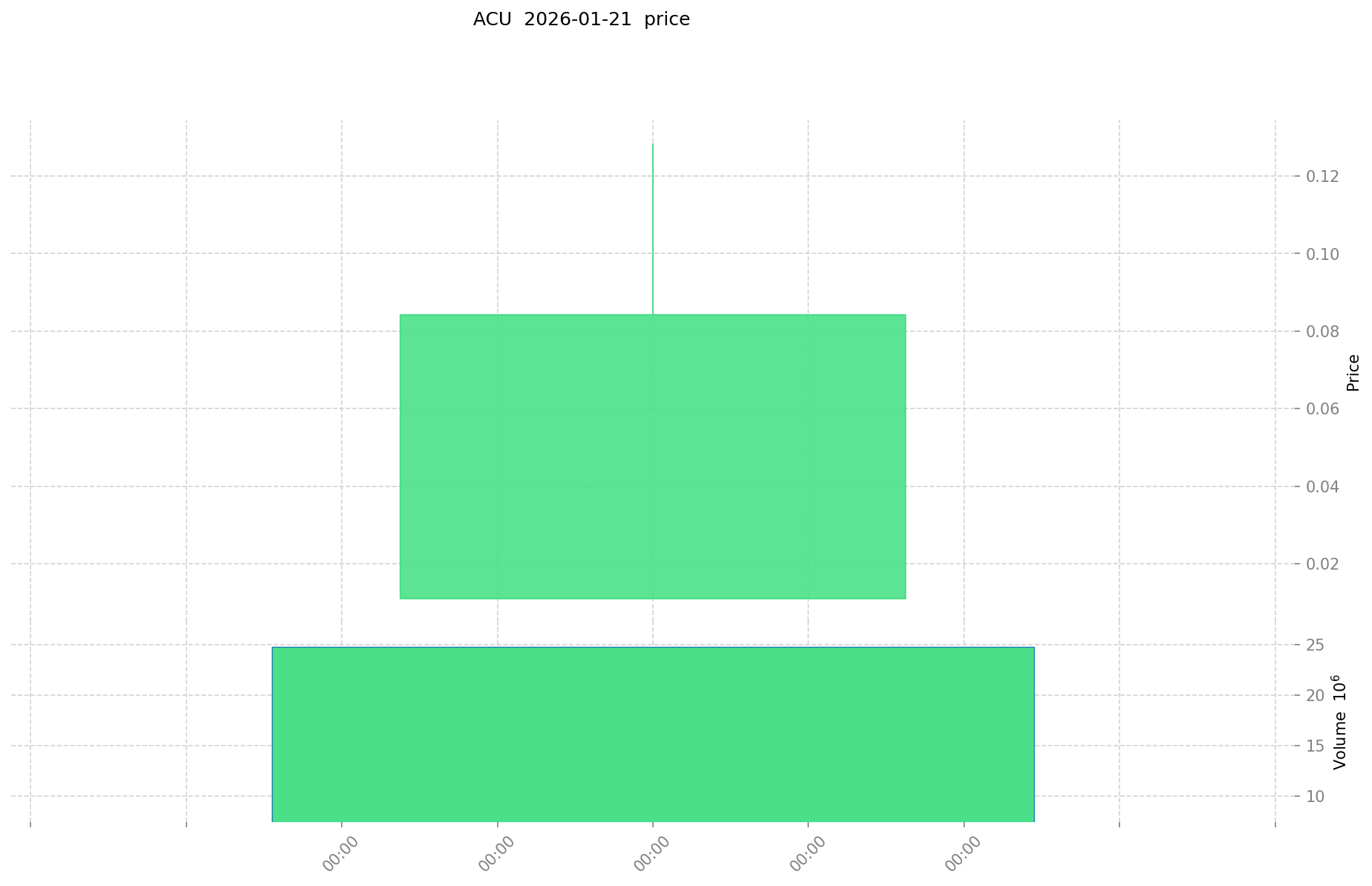
As of January 22, 2026, ACU has experienced notable price fluctuations within a relatively short timeframe since its market debut:
- January 20, 2026: ACU recorded a price level of $0.011, representing a lower reference point in its early trading period.
- January 21, 2026: The token reached a price of $0.17717, demonstrating significant upward movement within the initial trading days.
- January 22, 2026: Market dynamics led to price adjustments, with ACU trading around $0.1283, reflecting ongoing price discovery as the asset establishes market presence.
Current ACU Investment Market Status (January 2026)
- ACU Current Price: $0.1283
- 24-hour Trading Volume: $5,963,180.01
- Market Capitalization: $27,584,500.00
- Circulating Supply: 215,000,000 ACU (21.5% of total supply)
- Total Supply: 1,000,000,000 ACU
- Trading Pairs Available: Listed on 11 exchanges
- Holder Count: 579 addresses
Click to view real-time ACU market price
II. Core Factors Affecting Whether ACU is a Good Investment (Is Acurast(ACU) a Good Investment)
Supply Mechanism and Scarcity (ACU investment scarcity)
- Fixed maximum supply of 1,000,000,000 ACU with current circulating supply of 215,000,000 (21.5% of total) → Influences price dynamics and investment value assessment
- Token distribution strategy: Controlled release mechanism with significant portion yet to enter circulation may impact supply-demand balance over time
- Investment significance: The predetermined supply cap and gradual token release schedule represent fundamental factors for evaluating long-term scarcity-driven value potential
Institutional Investment and Mainstream Adoption (Institutional investment in ACU)
- Current holder base: 579 addresses holding ACU tokens across multiple blockchain networks
- Multi-chain deployment: ACU operates on both Ethereum (ERC-20) and BSC (BEP-20) standards, enabling broader accessibility across different blockchain ecosystems
- Exchange presence: Listed on 11 cryptocurrency exchanges, providing liquidity channels for institutional and retail participation
Macroeconomic Environment's Impact on ACU Investment
- Monetary policy and interest rate changes → Alter investment attractiveness across risk asset categories including crypto assets
- Inflation environment considerations → Projects offering decentralized infrastructure may present alternative value propositions during economic uncertainty
- Geopolitical uncertainty → May drive interest toward decentralized computing solutions independent of centralized data center infrastructure
Technology and Ecosystem Development (Technology & Ecosystem for ACU investment)
- Decentralized verifiable compute network: Leverages smartphone devices as computational resources, eliminating traditional data center dependencies → Creates differentiated infrastructure approach
- Network scale: Incentivized testnet has onboarded over 168,500 mobile devices globally, establishing distributed compute capacity for mission-critical workloads
- Application focus: Supports high-security requirements and AI workloads on decentralized infrastructure while maintaining privacy and performance standards → Positions project within growing decentralized physical infrastructure (DePIN) sector
III. ACU Future Investment Forecast and Price Outlook (Is Acurast(ACU) worth investing in 2026-2031)
Short-term Investment Forecast (2026, short-term ACU investment outlook)
- Conservative forecast: $0.0904 - $0.1273
- Neutral forecast: $0.1273 - $0.1350
- Optimistic forecast: $0.1350 - $0.1658
Mid-term Investment Outlook (2027-2028, mid-term Acurast(ACU) investment forecast)
-
Market stage expectation: The project may enter a phase of network expansion and ecosystem development as its incentivized testnet continues to attract computing nodes. Market positioning could evolve as the decentralized compute network establishes use cases in high-security and AI workloads.
-
Investment return forecast:
- 2027: $0.1128 - $0.1377
- 2028: $0.0793 - $0.1667
-
Key catalysts: Network adoption metrics, mainnet development milestones, partnership announcements in the DePIN sector, and broader market sentiment toward decentralized infrastructure projects.
Long-term Investment Outlook (Is Acurast a good long-term investment?)
- Base scenario: $0.0919 - $0.1885 (assuming steady network growth and sustained interest in decentralized computing solutions)
- Optimistic scenario: $0.1511 - $0.2469 (assuming accelerated adoption, successful mainnet launch, and favorable market conditions for DePIN protocols)
- Risk scenario: Below $0.0793 (in cases of prolonged market downturns, technical setbacks, or significant competitive pressure)
Check ACU long-term investment and price forecast: Price Prediction
2026-01-22 - 2031 Long-term Outlook
- Base scenario: $0.0919 - $0.1885 (corresponding to steady progress and gradual mainstream application expansion)
- Optimistic scenario: $0.1511 - $0.2469 (corresponding to large-scale adoption and favorable market environment)
- Transformational scenario: Above $0.2469 (if ecosystem achieves breakthrough developments and mainstream penetration)
- 2031-12-31 forecasted high: $0.2469 (based on optimistic development assumptions)
Disclaimer: Price forecasts are based on historical data analysis and market modeling. Cryptocurrency markets are highly volatile and subject to numerous external factors. These predictions should not be construed as financial advice. Investors should conduct their own research and consider their risk tolerance before making investment decisions.
| Year |
Predicted High Price |
Predicted Average Price |
Predicted Low Price |
Price Change |
| 2026 |
0.134991 |
0.12735 |
0.0904185 |
0 |
| 2027 |
0.137729025 |
0.1311705 |
0.11280663 |
2 |
| 2028 |
0.1667177055 |
0.1344497625 |
0.079325359875 |
4 |
| 2029 |
0.19274717952 |
0.150583734 |
0.10992612582 |
17 |
| 2030 |
0.188832002436 |
0.17166545676 |
0.1510656019488 |
33 |
| 2031 |
0.24694075954926 |
0.180248729598 |
0.09192685209498 |
40 |
IV. ACU Investment Strategy and Risk Management (How to invest in Acurast)
Investment Methodology (ACU investment strategy)
-
Long-term Holding (HODL ACU): Suitable for conservative investors who believe in the long-term vision of decentralized verifiable compute networks. This approach involves accumulating ACU tokens and holding through market cycles, focusing on the fundamental value proposition of utilizing smartphones as compute resources.
-
Active Trading: Relies on technical analysis and swing trading strategies. Given ACU's price volatility, with 24-hour fluctuations reaching significant levels, active traders may capitalize on price movements by monitoring key support and resistance levels, volume patterns, and market sentiment indicators.
Risk Management (Risk management for ACU investment)
V. ACU Investment Risks and Challenges (Risks of investing in Acurast)
-
Market Risk: ACU demonstrates considerable price volatility, with recent data showing substantial intraday fluctuations. The relatively low market capitalization of approximately $27.58 million increases susceptibility to price swings. Limited exchange availability across 11 platforms may impact liquidity during volatile periods.
-
Regulatory Risk: Decentralized compute networks face evolving regulatory frameworks across jurisdictions. Different countries maintain varying stances on decentralized physical infrastructure networks (DePIN), creating uncertainty for token holders. Changes in data privacy regulations or telecommunications policies could impact the smartphone-based compute model.
-
Technical Risk: Network security considerations include potential vulnerabilities in the smartphone-based infrastructure. The testnet currently operates with 168,500+ connected devices, and transitioning to mainnet operations carries execution risks. Smart contract vulnerabilities on Ethereum and BSC chains require ongoing auditing and security monitoring.
VI. Conclusion: Is Acurast a Good Investment?
-
Investment Value Summary: ACU represents an innovative approach to decentralized computing infrastructure, leveraging smartphones as compute resources. The project addresses growing demands for verifiable, scalable computation with applications in AI and high-security workloads. However, the token experiences notable price fluctuations and operates in a competitive DePIN landscape.
-
Investor Recommendations:
✅ Beginners: Implement dollar-cost averaging (DCA) strategy with small, regular purchases. Prioritize secure wallet storage using hardware wallets compatible with ERC-20 and BEP-20 tokens. Start with minimal allocation while learning about the project fundamentals.
✅ Experienced Investors: Consider swing trading opportunities based on technical indicators while maintaining a core long-term position. Diversify across multiple DePIN projects and established cryptocurrencies. Monitor testnet developments and mainnet launch progress.
✅ Institutional Investors: Evaluate strategic long-term allocation as part of broader DePIN sector exposure. Conduct thorough due diligence on technology infrastructure, team capabilities, and competitive positioning. Consider phased entry strategies aligned with project milestones.
⚠️ Disclaimer: Cryptocurrency investments carry substantial risk including potential loss of principal. This content is for informational purposes only and does not constitute investment advice. Conduct independent research and consult financial professionals before making investment decisions.
VII. FAQ
Q1: Is ACU a good investment for beginners in 2026?
ACU presents both opportunities and challenges for beginners. With a current market cap of $27.58 million and significant price volatility, ACU requires careful consideration before investment. For beginners, ACU may be suitable as a small portion (1-3%) of a diversified crypto portfolio using dollar-cost averaging (DCA) strategy. The project's innovative smartphone-based decentralized compute network shows promise, but the early-stage nature means higher risk. Beginners should prioritize secure storage using hardware wallets compatible with ERC-20 and BEP-20 standards, start with minimal allocation, and thoroughly understand the project fundamentals before committing significant capital.
Q2: What makes ACU different from other cryptocurrency investments?
ACU distinguishes itself through its unique decentralized verifiable compute network powered by smartphones rather than traditional data centers. Unlike conventional cryptocurrencies that focus on payments or DeFi, ACU provides infrastructure for high-security computations and AI workloads using over 168,500 connected mobile devices on its incentivized testnet. This positions ACU within the growing DePIN (Decentralized Physical Infrastructure Network) sector. The dual-chain deployment on both Ethereum (ERC-20) and Binance Smart Chain (BEP-20) enhances accessibility and interoperability, while the fixed maximum supply of 1 billion tokens with only 21.5% currently circulating creates a controlled supply mechanism that may influence long-term price dynamics.
Q3: What are the biggest risks of investing in ACU?
The primary risks include substantial market volatility, with ACU showing significant intraday price fluctuations due to its relatively low $27.58 million market capitalization. Limited exchange availability across only 11 platforms may reduce liquidity during volatile periods. Regulatory uncertainty poses challenges, as different jurisdictions maintain varying positions on DePIN projects, and changes in data privacy or telecommunications policies could impact the smartphone-based compute model. Technical risks involve potential vulnerabilities in the distributed smartphone infrastructure, smart contract security concerns on Ethereum and BSC chains, and execution challenges in transitioning from the current incentivized testnet to mainnet operations. The competitive DePIN landscape also presents market share challenges from established and emerging projects.
Q4: How should I store ACU tokens securely?
ACU token storage requires compatible wallets supporting both ERC-20 (Ethereum) and BEP-20 (Binance Smart Chain) standards. For optimal security, use a tiered approach: store only active trading amounts in hot wallets (mobile or web-based wallets) for quick access, while maintaining the majority of holdings in cold storage solutions. Hardware wallets such as Ledger or Trezor devices offer enhanced security for long-term holdings and are recommended for substantial investments. Always verify wallet compatibility with both blockchain standards before transferring tokens, maintain backup phrases in secure physical locations, and never share private keys or seed phrases. For institutional-scale holdings, consider multi-signature wallet solutions and custodial services with insurance coverage.
Q5: What is the realistic price outlook for ACU by 2030?
Based on analytical modeling, ACU's price outlook for 2030 ranges across multiple scenarios. The base scenario projects a range of $0.1511 - $0.1888, assuming steady network growth and sustained interest in decentralized computing solutions. The optimistic scenario forecasts $0.1717 - $0.1888, contingent on accelerated adoption, successful mainnet launch, and favorable market conditions for DePIN protocols. Conservative estimates suggest potential lows near $0.1511 if the project experiences prolonged market downturns or technical setbacks. These projections factor in the current circulating supply of 215 million tokens (21.5% of total supply) and anticipated network expansion. However, cryptocurrency markets are highly volatile and influenced by numerous external factors including technological developments, regulatory changes, macroeconomic conditions, and competitive dynamics within the DePIN sector.
Q6: Can ACU generate passive income for investors?
Currently, ACU's primary value proposition centers on capital appreciation rather than direct passive income generation through staking or yield farming mechanisms. Investors participate in potential value growth as the decentralized compute network expands and captures market share within the DePIN sector. The 168,500+ connected devices on the incentivized testnet demonstrate operational scale, and device operators may earn rewards for providing computational resources, though token holders do not automatically receive these benefits. Future protocol developments might introduce staking mechanisms or governance rewards, but these remain speculative at present. Investors seeking passive income should monitor official announcements regarding tokenomics updates. Meanwhile, the primary investment thesis relies on network adoption, mainnet launch success, and growing demand for decentralized verifiable computation services translating into token value appreciation over time.
Q7: How does ACU compare to other DePIN projects as an investment?
ACU occupies a distinctive position within the DePIN sector by utilizing smartphones as compute resources rather than specialized hardware, creating a lower barrier to network participation compared to projects requiring dedicated mining equipment or data center infrastructure. With a market cap of $27.58 million and ranking at #748, ACU represents an earlier-stage investment compared to established DePIN leaders with billion-dollar valuations. This positioning offers higher growth potential but correspondingly elevated risk. The project's focus on verifiable computation for AI workloads and high-security applications addresses specific market needs within the broader decentralized infrastructure landscape. The dual-chain deployment (Ethereum and BSC) provides flexibility, though network effects and ecosystem maturity lag behind more established competitors. Investment comparison should consider ACU's technological differentiation, current network scale of 168,500+ testnet devices, development roadmap progress, and competitive advantages in smartphone-based decentralized computing versus alternative DePIN investment options.
* The information is not intended to be and does not constitute financial advice or any other recommendation of any sort offered or endorsed by Gate.