ADAPad (ADAPAD) is a Cardano-based token issuance platform featuring deflationary tokenomics through 10% sales fees and up to 25% early unlock penalties. As of February 2026, the token trades at $0.001211 with a market cap of approximately $449,621 and limited liquidity on a single exchange. This comprehensive analysis examines ADAPad's investment characteristics, revealing significant volatility with 63.05% 1-year decline and price projections ranging from $0.00070 to $0.002699 through 2031 under various scenarios. Core factors influencing investment potential include deflationary supply mechanics, Cardano ecosystem integration, and platform utilization rates, though limited market presence and institutional adoption remain concerns. The article provides differentiated investment strategies for beginners, experienced traders, and institutions, alongside detailed risk management guidance addressing market volatility, regulatory uncertainty, and liquidity constraints. Suitable for investors seeking specialized
Introduction: ADAPad (ADAPAD)'s Investment Position and Market Outlook
ADAPad (ADAPAD) is a token issuance platform operating on the Cardano blockchain, distinguished by its deflationary mechanism. As of February 6, 2026, ADAPAD maintains a market capitalization of approximately $449,621, with a circulating supply of around 371,280,438 tokens and a current trading price near $0.001211. The platform's deflationary model is triggered through token sales, unlock events, and IDO participation, incorporating mechanisms such as a 10% fee on all token sales and early unlock penalties of up to 25%. With a 24-hour trading volume of $12,756.82 and a market dominance of 0.000019%, ADAPAD presents itself as a subject of analysis when investors consider "Is ADAPad (ADAPAD) a good investment?" This article provides a comprehensive examination of ADAPAD's investment characteristics, historical price movements, future price projections, and associated investment risks to serve as a reference for potential investors.
I. ADAPad (ADAPAD) Price History Review and Current Investment Value Status
- 2021: ADAPAD reached a notable price level of $1.28 in October → subsequent market cycles resulted in significant price adjustments
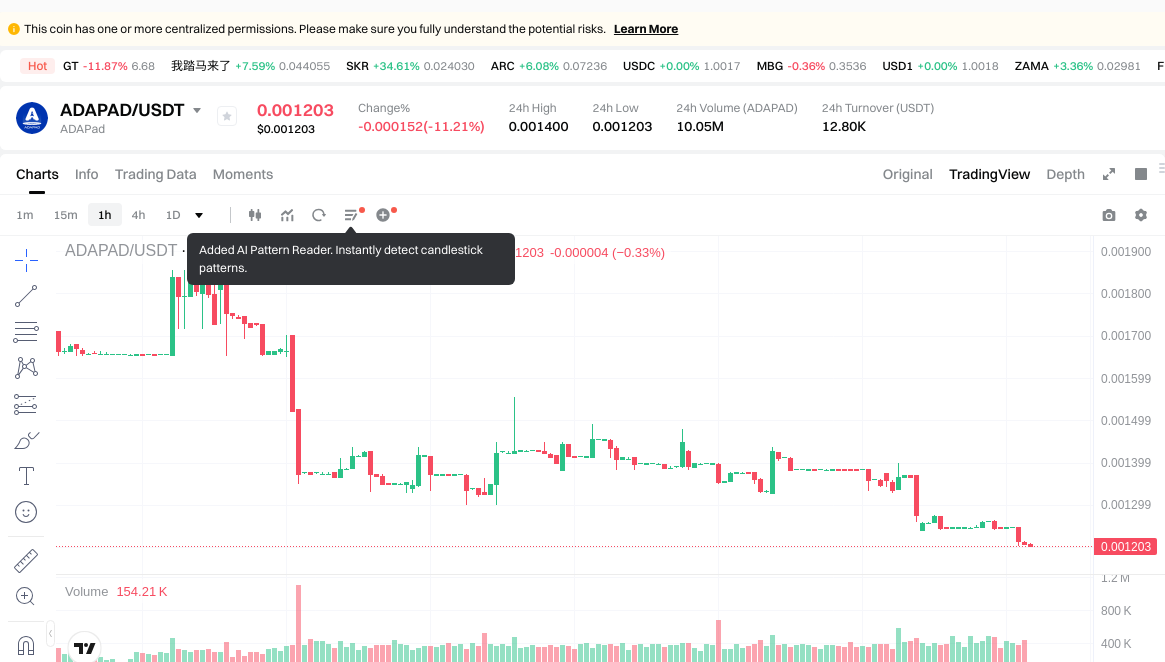
- 2025-2026: The token experienced considerable volatility → price declined from $0.001859 (December 28, 2025) to $0.001211 (February 6, 2026)
- Recent performance: ADAPAD showed mixed short-term movements → 24-hour decline of 11.18%, 7-day decline of 30.99%, while 1-year performance reflected a 63.05% decrease
Current ADAPAD Investment Market Status (February 2026)
- ADAPAD current price: $0.001211
- Market sentiment (Fear & Greed Index): Data not available in provided materials
- 24-hour trading volume: $12,756.82
- Institutional investor positions: Data not available in provided materials
Click to view real-time ADAPAD market price
II. Core Factors Influencing Whether ADAPAD is a Good Investment
Supply Mechanism and Scarcity (ADAPAD investment scarcity)
- Deflationary tokenomics → Direct impact on price and investment value
- ADAPad employs a deflationary mechanism with triggers linked to sales, unlocking schedules, and IDO participation. The primary deflationary mechanisms include a 10% fee on all token sales and up to 25% on early unlock fees. With a circulating supply of 371,280,438 ADAPAD and a maximum supply of 1,000,000,000 tokens, the current circulation ratio stands at approximately 37.13%
- Historical pattern: The token reached a notable price level of $1.28 on October 7, 2021, while the recent price point of $0.00120049 was recorded on February 6, 2026
- Investment significance: The deflationary design and token burn mechanisms may contribute to long-term scarcity considerations, though market dynamics remain subject to multiple variables
Institutional Investment and Mainstream Adoption (Institutional investment in ADAPAD)
- Holder distribution: Current data shows 14,927 holders as of February 6, 2026
- The token is listed on 1 exchange, with limited information available regarding institutional holdings or major enterprise adoption
- As a token launch platform operating on Cardano, ADAPad's investment outlook may be influenced by broader regulatory frameworks affecting decentralized finance platforms and token issuance mechanisms
Macroeconomic Environment's Impact on ADAPAD Investment
- Monetary policy shifts and interest rate fluctuations → May alter the attractiveness of risk assets in the crypto sector
- In inflationary environments, digital assets have been explored for potential hedging characteristics, though ADAPAD's correlation with macro trends requires individual assessment
- Geopolitical uncertainty and market volatility → Could influence demand patterns for alternative investment vehicles, including tokens with deflationary features
Technology and Ecosystem Development (Technology & Ecosystem for ADAPAD investment)
- Platform functionality: ADAPad operates as a token issuance platform on Cardano, facilitating IDO participation and implementing deflationary mechanisms through fee structures
- The platform's deflationary triggers are designed to activate through sales activity, unlock schedules, and IDO engagement, potentially influencing token velocity and supply dynamics
- Smart contract addresses are deployed on both Ethereum (0xDB0170e2d0c1CC1b2E7a90313d9B9afA4f250289) and Binance Smart Chain (0xDB0170e2d0c1CC1b2E7a90313d9B9afA4f250289), indicating multi-chain presence
- Ecosystem considerations: The token's utility within the ADAPad platform and its integration with Cardano's infrastructure may affect long-term value propositions, though specific DeFi applications, NFT integrations, or payment adoption data were not detailed in available materials
III. ADAPAD Future Investment Forecast and Price Outlook (Is ADAPad(ADAPAD) worth investing in 2026-2031)
Short-term Investment Forecast (2026, short-term ADAPAD investment outlook)
Based on current market positioning at $0.001211, short-term forecasts for 2026 suggest:
- Conservative forecast: $0.00070006 - $0.001009
- Neutral forecast: $0.001009 - $0.001207
- Optimistic forecast: $0.001207 - $0.001316
The token has experienced notable volatility, with 24-hour fluctuations of -11.18% and 7-day movements of -30.99%. Short-term price action may continue to reflect broader market sentiment and liquidity conditions.
Mid-term Investment Outlook (2027-2029, mid-term ADAPad(ADAPAD) investment forecast)
- Market phase expectation: Gradual recovery phase with potential accumulation opportunities, contingent on broader market stabilization and platform development progress
- Investment return forecast:
- 2027: $0.001009 - $0.001451
- 2028: $0.000908 - $0.001559
- 2029: $0.001166 - $0.001866
- Key catalysts: Platform utilization growth on Cardano, deflationary mechanism effectiveness through token burns, IDO participation rates, and broader DeFi adoption trends
Long-term Investment Outlook (Is ADAPAD a good long-term investment?)
- Base scenario: $0.001065 - $0.002010 (assuming sustained ecosystem activity and moderate market conditions through 2030-2031)
- Optimistic scenario: $0.001836 - $0.002699 (contingent on increased adoption of Cardano-based launchpad services and favorable regulatory environment)
- Risk scenario: Below $0.00070 (in cases of prolonged bear market conditions or fundamental platform challenges)
For detailed ADAPAD long-term investment and price forecasts, visit: Price Prediction
2026-2031 Long-term Outlook
- Base scenario: $0.00070 - $0.002010 (corresponding to steady progress and incremental mainstream application growth)
- Optimistic scenario: $0.001836 - $0.002699 (corresponding to large-scale adoption and favorable market environment)
- Transformative scenario: Above $0.0030 (contingent on breakthrough ecosystem developments and mainstream integration)
- 2031-12-31 projected high: $0.002699 (based on optimistic development assumptions)
Disclaimer: The forecasts presented are derived from historical data patterns, market analysis, and algorithmic projections. Cryptocurrency markets exhibit high volatility and uncertainty. These projections should not be construed as investment advice, and actual outcomes may differ substantially. Investors should conduct independent research and consider their risk tolerance before making investment decisions.
| Year |
Predicted High Price |
Predicted Average Price |
Predicted Low Price |
Price Change |
| 2026 |
0.00131563 |
0.001207 |
0.00070006 |
0 |
| 2027 |
0.00145051225 |
0.001261315 |
0.001009052 |
4 |
| 2028 |
0.00155930066875 |
0.001355913625 |
0.00090846212875 |
11 |
| 2029 |
0.001865737148 |
0.001457607146875 |
0.0011660857175 |
20 |
| 2030 |
0.002010623298399 |
0.001661672147437 |
0.001578588540065 |
37 |
| 2031 |
0.00269913715269 |
0.001836147722918 |
0.001064965679292 |
51 |
IV. ADAPad Investment Strategy and Risk Management (How to invest in Launchpad tokens)
Investment Methodology (ADAPad investment strategy)
-
Long-term holding (HODL ADAPad): This approach may suit investors who believe in the long-term potential of the Cardano ecosystem and launchpad platforms. Given ADAPad's deflationary mechanism, which includes a 10% fee on all token sales and up to 25% early unlock fees, long-term holders might benefit from reduced token supply over time.
-
Active trading: Traders who rely on technical analysis and swing trading strategies should note ADAPad's high volatility. Recent data shows significant price fluctuations, with a 24-hour change of -11.18% and a 7-day decline of -30.99%. Active traders should monitor price levels, with the 24-hour range between 0.001203 and 0.0014.
Risk Management (Risk management for ADAPad investment)
V. ADAPad Investment Risks and Challenges (Risks of investing in Launchpad tokens)
-
Market risks: ADAPad exhibits high volatility characteristics, with a 1-year decline of -63.05% and 30-day decrease of -29.90%. The token's 24-hour trading volume of approximately 12,756.82 indicates relatively limited liquidity, which may contribute to price instability. The current price of 0.001211 represents a significant decrease from its all-time high of 1.28 recorded on October 7, 2021.
-
Regulatory risks: As a token launchpad platform, ADAPad operates in a regulatory environment that varies by jurisdiction. Different countries maintain distinct policies regarding token offerings and launchpad operations, creating uncertainty for platform operations and token value.
-
Technical risks: Network security vulnerabilities represent potential concerns for blockchain-based platforms. The project operates on both Ethereum and BSC networks, which introduces cross-chain complexity. Platform upgrade failures or smart contract vulnerabilities could impact token functionality and investor holdings.
-
Liquidity concerns: With a circulating supply of 371,280,438.46 tokens (approximately 37.13% of max supply) and a total market capitalization of 449,620.61, ADAPad maintains limited market presence. The token is listed on only 1 exchange, which may restrict trading flexibility and price discovery.
-
Competition risks: The launchpad sector includes numerous competing platforms across various blockchain ecosystems, which may affect ADAPad's market position and adoption rates.
VI. Conclusion: Is Launchpad Token a Good Investment?
-
Investment value summary: ADAPad presents characteristics of a specialized blockchain launchpad platform with deflationary tokenomics. The platform's connection to the Cardano ecosystem and its token burn mechanisms through sales fees and early unlock penalties create unique economic dynamics. However, the token has experienced substantial price decline over the past year, and current market metrics indicate limited liquidity and trading activity.
-
Investor recommendations:
✅ Beginners: Consider dollar-cost averaging with small positions and prioritize secure wallet storage. Start with amounts you can afford to lose completely given the high volatility.
✅ Experienced investors: May explore swing trading opportunities during volatile periods while maintaining strict position sizing. Consider the deflationary mechanics and Cardano ecosystem developments in timing decisions.
✅ Institutional investors: Conduct thorough due diligence on platform usage, IDO success rates, and competitive positioning before any strategic allocation.
⚠️ Disclaimer: Cryptocurrency investments carry substantial risks including potential total loss of capital. This content is for informational purposes only and does not constitute investment advice. Always conduct independent research and consult qualified financial advisors before making investment decisions.
VII. FAQ
Q1: What is ADAPad's deflationary mechanism and how does it affect token supply?
ADAPad implements a deflationary tokenomics model through multiple mechanisms: a 10% fee on all token sales and up to 25% penalty on early unlock transactions. These fees trigger token burns during sales activity, unlock schedules, and IDO participation. With a current circulating supply of 371,280,438 tokens (37.13% of the 1 billion max supply), these burn mechanisms are designed to reduce supply over time. The effectiveness of this deflationary pressure depends on platform activity levels, trading volumes, and participation rates in token offerings, which directly influence the rate of token removal from circulation.
Q2: Why has ADAPad's price declined significantly from its all-time high?
ADAPad recorded an all-time high of $1.28 on October 7, 2021, but currently trades at approximately $0.001211 as of February 6, 2026—representing a decline of over 99%. This substantial decrease reflects broader cryptocurrency market corrections following the 2021 bull cycle, limited trading liquidity with only one exchange listing, and a 24-hour trading volume of just $12,756.82. Additionally, the 1-year performance shows a 63.05% decline, indicating ongoing bearish pressure. Market factors including reduced DeFi enthusiasm, competition from other launchpad platforms, and the token's limited mainstream adoption have contributed to this sustained downward trend.
Q3: How does ADAPad's liquidity impact investment risk?
ADAPad demonstrates limited liquidity characteristics that significantly affect investment risk profiles. The token maintains a market capitalization of approximately $449,621 with a 24-hour trading volume of only $12,756.82, indicating a volume-to-market-cap ratio below 3%. Being listed on just one exchange further restricts trading flexibility and price discovery mechanisms. This limited liquidity can result in higher price slippage during trades, difficulty executing large orders without significant price impact, and increased vulnerability to price manipulation. Investors should be aware that exiting positions quickly during market stress may prove challenging, making position sizing and risk management particularly critical.
Q4: What factors should investors consider when evaluating ADAPad's long-term potential?
Long-term ADAPad investment evaluation requires assessment of multiple factors: (I) Cardano ecosystem development and adoption rates, as ADAPad operates as a launchpad on this blockchain; (II) Platform utilization metrics including IDO participation, successful project launches, and token holder growth beyond the current 14,927 holders; (III) Effectiveness of deflationary mechanisms in achieving meaningful supply reduction; (IV) Competitive positioning against other launchpad platforms across various blockchain networks; (V) Regulatory developments affecting token offering platforms and DeFi operations. Price projections suggest potential ranges from $0.00070 to $0.002699 through 2031 under various scenarios, though these remain speculative and dependent on sustained ecosystem activity and favorable market conditions.
Q5: Is ADAPad suitable for different types of investors?
ADAPad's suitability varies significantly by investor profile. For beginners: High volatility (24-hour decline of 11.18%, 7-day drop of 30.99%) and limited liquidity make this a high-risk option; if considering exposure, use dollar-cost averaging with minimal position sizes (1-3% of portfolio) and secure storage solutions. For experienced traders: The token's price volatility may present swing trading opportunities, though strict position management is essential given liquidity constraints; allocations of 3-7% within crypto holdings may be appropriate based on risk tolerance. For institutional investors: Thorough due diligence on platform metrics, IDO success rates, and competitive analysis is necessary before any strategic allocation; the limited market presence and single exchange listing represent significant structural concerns. All investor categories should recognize the potential for total capital loss and avoid investment amounts exceeding their risk capacity.
Q6: How does ADAPad compare to other launchpad tokens in the market?
ADAPad operates in a competitive launchpad sector with numerous platforms across multiple blockchain ecosystems. Compared to established launchpads, ADAPad shows several distinguishing characteristics: (I) Exclusive focus on the Cardano blockchain, which limits cross-chain opportunities but provides specialization within that ecosystem; (II) Specific deflationary mechanisms tied to sales fees and unlock penalties, differentiating its tokenomics from inflationary or fixed-supply competitors; (III) Significantly smaller market presence with a market cap of approximately $449,621 and dominance of just 0.000019%, placing it well below major launchpad platforms; (IV) Limited exchange availability with only one listing, restricting accessibility compared to widely-distributed competitors. Investors should evaluate whether Cardano-specific opportunities justify the reduced liquidity and market presence relative to multi-chain or more established launchpad alternatives.
Q7: What are the primary risks associated with investing in ADAPad?
ADAPad investment carries multiple risk categories requiring careful consideration: Market risk—extreme volatility with 1-year decline of 63.05% and potential for continued price deterioration; Liquidity risk—limited trading volume and single exchange listing create challenges for position entry/exit; Regulatory risk—evolving frameworks for token offerings and launchpad operations across jurisdictions may impact platform viability; Technical risk—smart contract vulnerabilities, cross-chain complexity (operating on both Ethereum and BSC), and potential platform upgrade failures; Competition risk—numerous alternative launchpad platforms may capture market share and reduce ADAPad's relevance; Concentration risk—dependence on Cardano ecosystem growth and adoption for fundamental value. The circulating supply of only 37.13% of max supply also presents uncertainty regarding future unlock schedules and potential dilution effects. Investors should only allocate capital they can afford to lose completely given these compounding risk factors.
Q8: What storage solutions are recommended for ADAPad tokens?
ADAPad token storage should be approached with security as the primary consideration, with solutions varying based on investment timeframe and trading frequency. For long-term holders: Hardware wallets (Ledger or Trezor) provide optimal security through offline private key storage; this method is recommended for the majority of holdings intended for extended periods. For active traders: Hot wallets such as MetaMask or Trust Wallet offer convenient access for frequent transactions, suitable for trading portions while maintaining compatibility with both Ethereum (contract address: 0xDB0170e2d0c1CC1b2E7a90313d9B9afA4f250289) and BSC networks where ADAPad operates. Best practice approach: Implement a hybrid strategy with 70-90% in cold storage (hardware wallets) and 10-30% in hot wallets for trading flexibility. Regardless of storage method, maintain backup recovery phrases in secure, offline locations, enable all available security features (2FA, biometrics), and never share private keys or seed phrases with any third parties.
* The information is not intended to be and does not constitute financial advice or any other recommendation of any sort offered or endorsed by Gate.