This comprehensive analysis evaluates whether AdEx (ADX) represents a viable investment opportunity in 2026 and beyond. The article examines ADX's current market position at $0.09177 with a $13.57 million market capitalization, tracing its 97.4% decline from its 2018 all-time high of $3.49. By analyzing the token's role in blockchain-based advertising infrastructure, supply mechanics, and ecosystem development, the guide assesses key investment factors including market volatility, liquidity constraints, and regulatory considerations. The content provides price predictions ranging from $0.095 to $0.1948 through 2031 across conservative to optimistic scenarios, alongside detailed investment strategies for various investor profiles. Finally, the article outlines risk management approaches, including appropriate asset allocation ratios (1-3% for conservative investors, 5-10% for aggressive investors) and emphasizes that ADX investment carries substantial risks requiring thorough due diligence before capital commi
Introduction: AdEx (ADX) Investment Position and Market Prospects
ADX is a notable asset in the cryptocurrency sector, having been launched in 2017 as the native token of the AdEx web3 marketing platform. As of January 25, 2026, ADX maintains a market capitalization of approximately $13.57 million, with a circulating supply of 147.9 million tokens, and a current price around $0.09177. Positioned as an innovative web3 advertising solution leveraging blockchain technology and programmatic advertising, ADX has established itself as a platform focused on transparency and fraud protection in digital advertising. With its ranking at 1054 in the cryptocurrency market and a presence on 16 exchanges, ADX has drawn attention from investors exploring opportunities in the blockchain-based advertising sector. When investors consider "Is AdEx (ADX) a good investment?", they typically examine factors including the project's technological approach to solving digital advertising challenges, its market performance trajectory, and its position within the evolving web3 ecosystem. This article provides a comprehensive analysis of ADX's investment characteristics, historical price movements, future price considerations, and associated investment risks to offer informational reference for market participants.
I. Cryptocurrency (ADX) Price History Review and Current Investment Value Status
- 2018: All-time high recorded on January 9 → ADX reached $3.49 during this period
- 2020: Market downturn phase on March 13 → ADX price declined to $0.03511504
- 2025-2026: Market adjustment cycle → Price decreased from approximately $0.1766 to current levels
Current ADX Investment Market Status (January 2026)
- ADX current price: $0.09177
- 24-hour trading volume: $36,206.99
- Number of token holders: 4,626
- Circulating supply: 147,900,000 ADX (representing 72.78% of total supply)
- Market capitalization: $13,572,783
Click to view real-time ADX market price
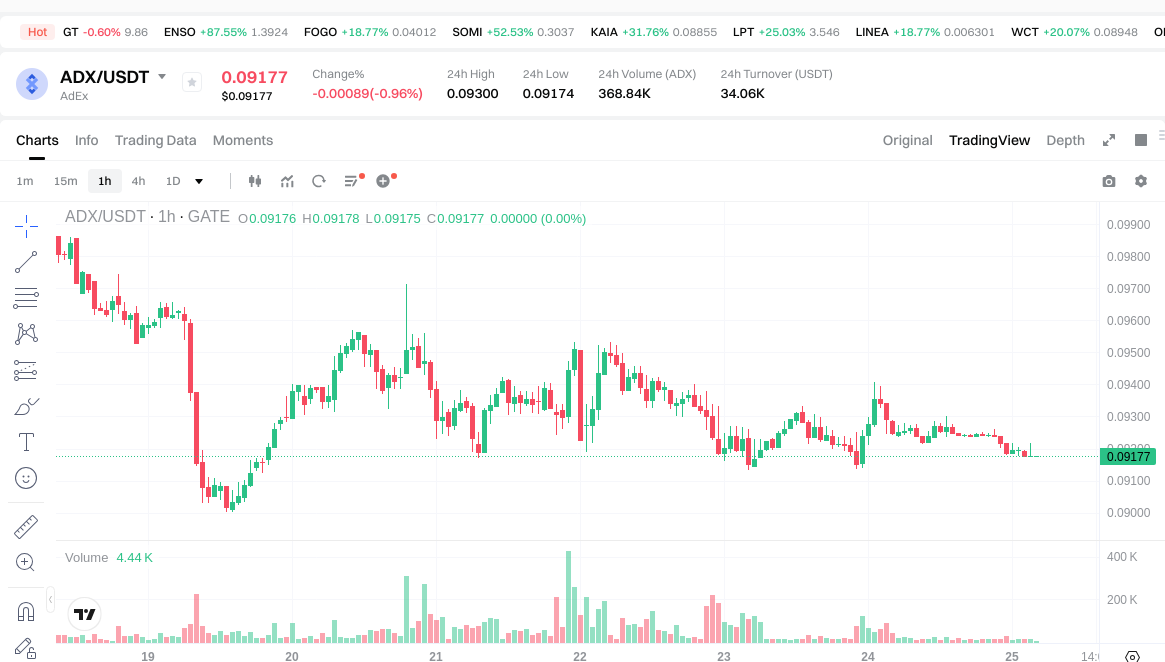
II. Core Factors Affecting Whether ADX Is a Good Investment (Is AdEx(ADX) a Good Investment)
Supply Mechanism and Scarcity (ADX investment scarcity)
- ADX has a maximum supply of 203,211,602 tokens, with a circulating supply of 147,900,000 tokens (approximately 72.78% of max supply) → supply parameters influence price dynamics and investment considerations
- The token's market capitalization to fully diluted valuation ratio stands at 72.78%, indicating a significant portion of tokens are already in circulation
- Investment consideration: the relationship between circulating supply and maximum supply represents a factor in evaluating potential price dynamics
Institutional Investment and Mainstream Adoption (Institutional investment in ADX)
- ADX is listed on 16 exchanges, providing accessibility for various market participants
- The token has approximately 4,626 holders, representing the current level of adoption and distribution
- AdEx operates as a web3 marketing platform utilizing blockchain technology for programmatic advertising, positioning itself within the emerging web3 advertising sector
Macroeconomic Environment's Impact on ADX Investment
- As a digital asset within the broader cryptocurrency market, ADX holds a market share of 0.00043%, reflecting its positioning within the overall crypto ecosystem
- The token's performance shows volatility across different timeframes: -0.03% (1H), -0.86% (24H), -6.61% (7D), -14.79% (30D), and -48.13% (1Y)
- Market dynamics and broader economic conditions may influence investor sentiment toward smaller-cap digital assets like ADX
Technology and Ecosystem Development (Technology & Ecosystem for ADX investment)
- AdEx leverages blockchain technology to create a transparent, fraud-protected advertising experience for web3 advertisers
- The platform enables web3 advertisers to reach crypto audiences while maintaining control over advertising expenditure
- The project's infrastructure is supported by multiple GitHub repositories covering protocol, validator, market, and platform components, indicating ongoing technical development
III. ADX Future Investment Prediction and Price Outlook (Is AdEx(ADX) worth investing in 2026-2031)
Short-term ADX Investment Outlook (2026)
- Conservative Prediction: $0.0486 - $0.0918
- Neutral Prediction: $0.0918
- Optimistic Prediction: $0.0918 - $0.1083
Mid-term AdEx(ADX) Investment Forecast (2027-2028)
- Market Stage Expectation: The ADX token may experience gradual recovery and stabilization phases during 2027-2028, with predicted average prices showing modest growth from $0.1000 to $0.1110.
- Investment Return Prediction:
- 2027: $0.0570 - $0.1220
- 2028: $0.0933 - $0.1255
- Key Catalysts: Platform adoption rates, web3 advertising market expansion, blockchain technology integration improvements, and overall cryptocurrency market sentiment.
Long-term Investment Outlook (Is AdEx a good long-term investment?)
- Base Scenario: $0.0950 - $0.1585 (assuming steady platform development and moderate market growth through 2031)
- Optimistic Scenario: $0.1036 - $0.1947 (assuming accelerated web3 advertising adoption and favorable market conditions)
- Risk Scenario: $0.0486 - $0.0570 (under challenging market conditions or platform adoption setbacks)
View ADX long-term investment and price prediction: Price Prediction
2026-01-25 - 2031 Long-term Outlook
- Base Scenario: $0.0950 - $0.1585 (corresponding to steady progress and mainstream application gradual improvement)
- Optimistic Scenario: $0.1036 - $0.1947 (corresponding to large-scale adoption and favorable market environment)
- Transformative Scenario: Above $0.1947 (such as breakthrough ecosystem progress and mainstream popularization)
- 2031-12-31 Predicted High: $0.1948 (based on optimistic development assumptions)
Disclaimer: These predictions are based on historical data and market analysis models. Cryptocurrency investments carry significant risks. Past performance does not guarantee future results. Investors should conduct independent research and consider their risk tolerance before making investment decisions.
| Year |
Predicted High Price |
Predicted Average Price |
Predicted Low Price |
Price Change |
| 2026 |
0.1082886 |
0.09177 |
0.0486381 |
0 |
| 2027 |
0.122035746 |
0.1000293 |
0.057016701 |
9 |
| 2028 |
0.12546675099 |
0.111032523 |
0.09326731932 |
20 |
| 2029 |
0.16200200268315 |
0.118249636995 |
0.1087896660354 |
28 |
| 2030 |
0.176558532997234 |
0.140125819839075 |
0.103693106680915 |
52 |
| 2031 |
0.19476087699433 |
0.158342176418154 |
0.095005305850892 |
72 |
IV. ADX Investment Strategy and Risk Management (How to invest in AdEx)
Investment Methodology (ADX investment strategy)
Long-term Holding (HODL ADX)
Long-term holding may suit investors who believe in the fundamental value proposition of blockchain-based advertising infrastructure. This approach involves acquiring ADX tokens and maintaining positions through market cycles, potentially benefiting from broader adoption of web3 marketing solutions.
Active Trading
Active trading strategies rely on technical analysis and market timing. Given ADX's price fluctuations, traders may attempt to capitalize on short-term price movements. However, this approach requires continuous market monitoring and understanding of technical indicators.
Risk Management (Risk management for ADX investment)
Asset Allocation Ratios
- Conservative investors: May consider limiting ADX exposure to 1-3% of their crypto portfolio, given the token's volatility and market capitalization rank (1054)
- Aggressive investors: Could allocate 5-10% while maintaining diversification across multiple assets
- Professional investors: May employ dynamic allocation based on market conditions and risk assessment models
Risk Hedging Solutions
- Multi-asset portfolio construction combining different crypto categories
- Consideration of stablecoins or traditional assets as hedging instruments
- Regular rebalancing based on predetermined thresholds
Secure Storage
- Cold wallet solutions: Hardware wallets for long-term holdings
- Hot wallet options: For active trading purposes with limited amounts
- Security practices: Multi-signature wallets and regular security audits for larger holdings
V. ADX Investment Risks and Challenges (Risks of investing in AdEx)
Market Risk
- High volatility: ADX has experienced price changes of -0.86% (24H), -6.61% (7D), -14.79% (30D), and -48.13% (1Y), demonstrating substantial price fluctuations
- Liquidity considerations: With 24-hour trading volume of approximately $36,206.99, liquidity may be limited during certain market conditions
- Market manipulation potential: Lower market capitalization tokens may be more susceptible to price manipulation
Regulatory Risk
- Advertising and blockchain intersection faces evolving regulatory frameworks across jurisdictions
- Compliance requirements for digital advertising platforms vary significantly by country
- Changes in data privacy regulations could impact platform operations
Technical Risk
- Smart contract vulnerabilities in the AdEx protocol could potentially affect token holders
- Network security considerations related to the Ethereum blockchain infrastructure
- Platform upgrade risks and potential technical implementation challenges
Project-Specific Risks
- Competition from established web2 advertising platforms and emerging web3 alternatives
- Adoption challenges in convincing advertisers to transition to blockchain-based solutions
- Revenue sustainability dependent on platform usage and ecosystem growth
VI. Conclusion: Is AdEx a Good Investment?
Investment Value Summary
ADX presents characteristics of a specialized utility token within the web3 advertising sector. With a current price of $0.09177 and market capitalization of approximately $13.57 million, the token remains far below its historical high of $3.49 (January 2018). The circulating supply represents 72.78% of the maximum supply, indicating relatively high token circulation.
Investor Recommendations
✅ Beginners: Consider dollar-cost averaging (DCA) strategies combined with secure wallet storage. Start with small allocations to understand market dynamics before increasing exposure.
✅ Experienced Investors: May explore swing trading opportunities based on technical analysis while maintaining portfolio diversification. Monitor platform adoption metrics and ecosystem development.
✅ Institutional Investors: Could evaluate strategic positioning based on comprehensive due diligence, including technology assessment, team evaluation, and competitive landscape analysis.
⚠️ Disclaimer: Cryptocurrency investments carry substantial risks due to market volatility, regulatory uncertainty, and technological challenges. This content is for informational purposes only and does not constitute investment advice. Investors should conduct their own research and consult with financial advisors before making investment decisions. Past performance does not guarantee future results.
VII. FAQ
Q1: Is AdEx (ADX) a good investment for beginners in 2026?
ADX may be considered a higher-risk investment option for beginners due to its significant price volatility and lower market capitalization ranking (1054). For those new to cryptocurrency investing, ADX could serve as a learning opportunity with small allocations (1-3% of crypto portfolio), preferably through dollar-cost averaging (DCA) strategies. Beginners should focus on understanding the web3 advertising sector fundamentals, secure wallet storage practices, and market dynamics before committing substantial capital. The token's 48.13% decline over the past year demonstrates the importance of risk management and portfolio diversification. Starting with educational research and minimal exposure allows beginners to gain market experience while limiting potential losses.
Q2: What is the realistic price prediction for ADX by 2031?
Based on historical data and market analysis models, ADX price predictions for 2031 range from $0.095 (conservative scenario) to $0.1948 (optimistic scenario), with a predicted average price of approximately $0.1584. The base scenario assumes steady platform development and moderate market growth, projecting prices between $0.0950-$0.1585. However, these predictions carry significant uncertainty due to multiple variables including web3 advertising adoption rates, broader cryptocurrency market conditions, regulatory developments, and platform execution. The transformative scenario exceeding $0.1947 would require breakthrough ecosystem progress and mainstream adoption of blockchain-based advertising solutions. Investors should note that cryptocurrency price predictions are inherently speculative and past performance does not guarantee future results.
Q3: How does ADX's current market performance compare to its historical peak?
ADX is currently trading at approximately $0.09177 as of January 25, 2026, representing a 97.4% decline from its all-time high of $3.49 reached on January 9, 2018. This substantial decrease reflects broader market corrections, shifts in investor sentiment toward blockchain advertising projects, and evolving competitive dynamics within the web3 marketing sector. The token has experienced consistent downward pressure across multiple timeframes: -0.86% (24H), -6.61% (7D), -14.79% (30D), and -48.13% (1Y). With a current market capitalization of $13.57 million and 72.78% of maximum supply in circulation, ADX maintains a modest position in the cryptocurrency market with a 0.00043% market share. Understanding this historical context is crucial for investors evaluating recovery potential and long-term investment viability.
Q4: What are the main risks associated with investing in AdEx?
ADX investment carries multiple risk categories that investors must carefully evaluate. Market risk remains significant, evidenced by high volatility and limited liquidity with 24-hour trading volume of approximately $36,207. Regulatory risk stems from evolving frameworks governing blockchain advertising and data privacy across jurisdictions. Technical risks include potential smart contract vulnerabilities in the AdEx protocol and Ethereum network dependencies. Project-specific challenges encompass competition from established web2 advertising platforms and emerging web3 alternatives, adoption barriers in convincing advertisers to transition to blockchain solutions, and revenue sustainability dependent on platform usage growth. Additionally, the token's lower market capitalization (ranked 1054) may increase susceptibility to price manipulation. Investors should implement comprehensive risk management strategies including appropriate asset allocation, portfolio diversification, and secure storage solutions.
Q5: How should investors approach asset allocation for ADX in their portfolio?
Asset allocation for ADX should align with individual risk tolerance and investment objectives. Conservative investors may limit ADX exposure to 1-3% of their cryptocurrency portfolio, recognizing the token's volatility and market positioning. Aggressive investors comfortable with higher risk could allocate 5-10% while maintaining diversification across multiple crypto assets and traditional hedging instruments. Professional investors might employ dynamic allocation strategies based on market conditions, technical indicators, and fundamental analysis of platform adoption metrics. Regardless of allocation percentage, investors should implement risk management practices including regular portfolio rebalancing based on predetermined thresholds, combining ADX with different crypto categories and stablecoins for hedging, and utilizing secure storage solutions (cold wallets for long-term holdings, limited hot wallet amounts for trading). Dollar-cost averaging (DCA) strategies can help mitigate timing risk for new positions.
Q6: What factors could drive ADX price appreciation in the future?
Several catalysts could potentially drive ADX price appreciation through 2031. Primary growth drivers include increased adoption of the AdEx web3 marketing platform by advertisers seeking blockchain-based transparency and fraud protection, expansion of the overall web3 advertising market as more brands enter the crypto ecosystem, and successful technology integration improvements that enhance platform functionality. Broader cryptocurrency market momentum and favorable regulatory developments for blockchain advertising could create positive sentiment. Platform-specific catalysts include growing user base beyond the current 4,626 token holders, increased trading volume and exchange listings beyond the current 16 platforms, and ecosystem partnerships that expand AdEx's reach within the digital advertising industry. However, these potential catalysts face significant uncertainties and competition from both traditional advertising platforms and emerging web3 alternatives, requiring careful evaluation of execution risk and market conditions.
Q7: What investment strategies work best for ADX tokens?
Two primary investment strategies apply to ADX tokens: long-term holding (HODL) and active trading, each suited to different investor profiles. Long-term holding may benefit investors who believe in blockchain-based advertising infrastructure fundamentals and are willing to maintain positions through market cycles, potentially capitalizing on broader web3 marketing adoption over years. This approach requires strong conviction, secure storage solutions, and tolerance for volatility. Active trading strategies involve technical analysis and market timing to capitalize on short-term price movements, which can be substantial given ADX's volatility patterns. However, active trading demands continuous market monitoring, understanding of technical indicators, and acceptance of higher transaction costs and tax implications. Many investors employ a hybrid approach, maintaining a core long-term position while allocating a smaller portion for tactical trading opportunities. Regardless of strategy, risk management through appropriate position sizing, stop-loss orders (for traders), and portfolio diversification remains essential for ADX investment success.
Q8: Is AdEx suitable for institutional investment consideration?
ADX presents both opportunities and challenges for institutional investors evaluating web3 advertising exposure. The token's market capitalization of $13.57 million and ranking at 1054 positions it as a smaller-cap asset requiring specialized evaluation frameworks. Institutional consideration would necessitate comprehensive due diligence including technology assessment of the AdEx protocol and validator infrastructure, team evaluation and project governance analysis, competitive landscape positioning against both web2 and web3 advertising alternatives, and regulatory compliance review across operating jurisdictions. The limited liquidity evidenced by $36,207 in 24-hour trading volume may constrain institutional position sizing and exit strategies. However, institutions seeking strategic exposure to blockchain advertising infrastructure with higher risk tolerance might evaluate ADX as part of a diversified web3 portfolio allocation. Any institutional investment would require robust risk management frameworks, including position limits, regular rebalancing protocols, secure custody solutions, and ongoing monitoring of platform adoption metrics and ecosystem development progress.
* The information is not intended to be and does not constitute financial advice or any other recommendation of any sort offered or endorsed by Gate.