This comprehensive guide evaluates whether aelf (ELF), an AI-enhanced Layer 1 blockchain platform launched in 2017, represents a viable investment opportunity. As of January 2026, ELF trades at $0.10089 with a $82.37 million market cap, backed by institutions like Arrington Capital and Galaxy Digital. The article analyzes critical investment factors including the project's C# programming language infrastructure, modular Layer 2 ZK Rollup technology, supply dynamics (81.65% circulating), and market performance showing 77.8% year-over-year decline. Price forecasts range from conservative scenarios ($0.0576-$0.1173 by 2026) to optimistic projections ($0.2418 by 2030) depending on ecosystem adoption and AI integration success. The guide addresses investment strategies for different investor profiles, risk management techniques using portfolio diversification and secure storage, and significant challenges including market volatility, regulatory uncertainty, and intense Layer 1 blockchain competition, equipping rea
Introduction: aelf (ELF) Investment Position and Market Outlook
ELF is a notable asset in the cryptocurrency space, launched in December 2017 as an AI-enhanced Layer 1 blockchain network. The project positions itself as a platform leveraging the C# programming language for efficiency and scalability across its multi-layered architecture. As of January 18, 2026, aelf holds a market capitalization of approximately $82.37 million, with a circulating supply of around 816.47 million tokens, and the current price stands at approximately $0.10089. Founded with its global hub in Singapore, aelf has secured investments from institutions such as Arrington Capital, Draper Dragon, and Galaxy Digital. The project successfully launched its Testnet in 2018 and Mainnet in 2020, managed by a team led by founder and CEO Auric. With its focus on AI integration and modular Layer 2 ZK Rollup technology, aelf has become a subject of interest for investors evaluating "Is aelf (ELF) a good investment?" This article provides a comprehensive analysis of ELF's investment characteristics, historical performance, future price outlook, and associated risks to serve as a reference for potential investors.
I. ELF Price History Review and Current Investment Value
- 2018: Following mainnet launch and early exchange listings, ELF experienced notable price activity in the market
- 2020: Mainnet successfully launched, representing a technical milestone in the project's development roadmap
- Market cycles: ELF has experienced significant price fluctuations since its initial trading period, reflecting broader cryptocurrency market dynamics
Current ELF Investment Market Status (January 2026)
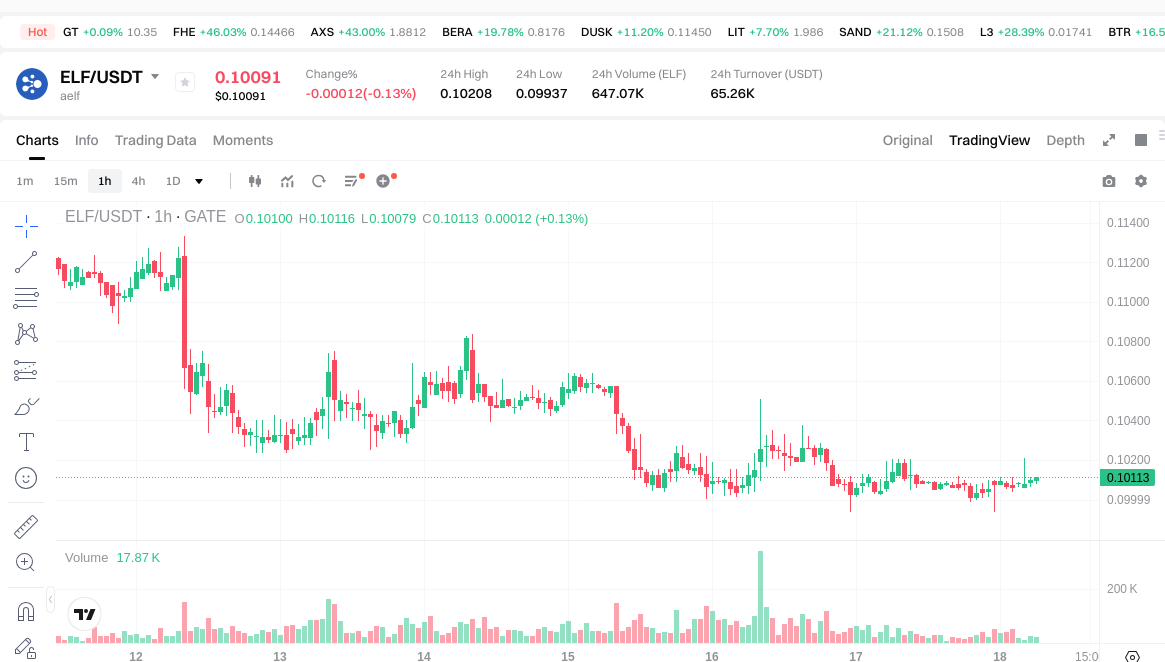
- ELF current price: $0.10089
- 24-hour trading volume: $65,261.47
- Market capitalization: $82.37 million
- Circulating supply: 816.47 million ELF (81.65% of max supply)
- Price changes: +0.03% (24H), -12.52% (7D), +14.74% (30D), -77.8% (1Y)
- Exchange listings: Available on 11 exchanges
- Token holders: 49,887 addresses
Click to view real-time ELF market price
II. Core Factors Influencing Whether ELF is a Good Investment
Supply Mechanism and Scarcity (ELF Investment Scarcity)
- Supply structure → influences price and investment value
- ELF has a maximum supply of 1,000,000,000 tokens, with current circulating supply at 816,472,610.59 tokens (approximately 81.65% of max supply)
- The relatively high circulation ratio indicates limited additional supply pressure, which may support price stability
- Investment significance: understanding supply dynamics is essential for assessing long-term investment potential
Institutional Investment and Mainstream Adoption (Institutional Investment in ELF)
- Institutional backing trends: aelf secured investments from notable institutions including Arrington Capital, Draper Dragon, and Galaxy Digital during its initial fundraising phase
- Early institutional support helped establish credibility and provided initial momentum for the project
- The project's Singapore-based global hub positioning may facilitate regulatory compliance and regional adoption
Macroeconomic Environment Impact on ELF Investment
- Cryptocurrency market conditions → affect altcoin investment attractiveness
- Current market performance shows ELF experienced a 0.03% increase over 24 hours, while facing a 12.52% decline over 7 days and a 77.8% decrease over 1 year
- Broader market volatility and risk sentiment influence investor appetite for Layer 1 blockchain tokens
- Market capitalization of approximately $82.37 million ranks ELF at position 409, indicating mid-tier market presence
Technology and Ecosystem Development (Technology & Ecosystem for ELF Investment)
- AI-enhanced Layer 1 blockchain architecture: leverages C# programming language for efficiency and scalability across multi-layered infrastructure
- Modular Layer 2 ZK Rollup technology integration: designed to provide efficient, low-cost, and secure platform environment
- AI integration initiatives: aelf focuses on advancing Web3 and AI technology adoption within its ecosystem
- Developer and end-user accessibility: platform architecture aims to balance technical sophistication with usability
- Ecosystem expansion potential: commitment to fostering innovation may support long-term value development
- Technical milestones: testnet launched in 2018, mainnet successfully deployed in 2020, demonstrating operational track record
III. ELF Future Investment Forecast and Price Outlook (Is aelf(ELF) worth investing in 2026-2030)
Short-term Investment Outlook (2026, short-term ELF investment outlook)
- Conservative Forecast: $0.0576 - $0.0677
- Neutral Forecast: $0.1011 - $0.1092
- Optimistic Forecast: $0.1168 - $0.1173
Mid-term Investment Outlook (2027-2029, mid-term aelf(ELF) investment forecast)
-
Market Phase Expectation: ELF may experience gradual growth as its AI-enhanced Layer 1 blockchain architecture continues development, with potential expansion in Asia-Pacific markets and integration of modular Layer 2 ZK Rollup technology.
-
Investment Return Forecast:
- 2027: $0.0677 - $0.1168
- 2028: $0.0927 - $0.1549
- 2029: $0.1246 - $0.1996
-
Key Catalysts: Ecosystem innovation advancement, AI integration development, expansion of developer adoption in the C# programming environment, and growth of international partnerships particularly in Asian blockchain markets.
Long-term Investment Outlook (Is ELF a good long-term investment?)
- Base Scenario: $0.1100 - $0.1995 (assuming steady ecosystem development and moderate adoption of AI-enhanced blockchain solutions)
- Optimistic Scenario: $0.1667 - $0.2418 (assuming accelerated Web3 and AI technology adoption, successful Layer 2 implementation, and expanded global market presence)
- Risk Scenario: $0.0576 - $0.0927 (under conditions of intensified competition in Layer 1 blockchain space or slower-than-expected technology adoption)
For detailed ELF long-term investment and price forecasts: Price Prediction
2026-2030 Long-term Outlook
- Base Scenario: $0.1100 - $0.1995 (corresponding to steady progress and stable advancement in mainstream application)
- Optimistic Scenario: $0.1667 - $0.2418 (corresponding to large-scale adoption and favorable market conditions)
- Transformative Scenario: Above $0.2418 (if breakthrough developments occur in the ecosystem and mainstream popularization is achieved)
- 2030-12-31 Forecast High: $0.2318 (based on optimistic development assumptions)
Disclaimer: Price predictions are based on technical analysis and historical data trends. Cryptocurrency markets are highly volatile and influenced by numerous unpredictable factors. These forecasts should not be considered as financial advice or guarantees of future performance. Investors should conduct thorough research and assess their risk tolerance before making investment decisions.
| Year |
Predicted High Price |
Predicted Average Price |
Predicted Low Price |
Price Change |
| 2026 |
0.1173108 |
0.10113 |
0.0576441 |
0 |
| 2027 |
0.116865828 |
0.1092204 |
0.067716648 |
8 |
| 2028 |
0.15486906618 |
0.113043114 |
0.09269535348 |
12 |
| 2029 |
0.1995945742341 |
0.13395609009 |
0.1245791637837 |
32 |
| 2030 |
0.231817711705249 |
0.16677533216205 |
0.110071719226953 |
65 |
| 2031 |
0.241148791539716 |
0.199296521933649 |
0.109613087063507 |
97 |
IV. aelf Investment Strategy and Risk Management (How to invest in aelf)
Investment Methodology (aelf investment strategy)
Long-term Holding (HODL aelf)
This approach may suit investors with a longer time horizon who are willing to tolerate short-term price fluctuations. Given aelf's focus on AI-enhanced Layer 1 blockchain technology and its ongoing ecosystem development, some participants view long-term holding as a way to potentially benefit from the project's technological progress and adoption over time. However, market conditions and project execution remain uncertain.
Active Trading
Active trading involves utilizing technical analysis and short-term price movements to make buy and sell decisions. Traders may monitor aelf's price trends, trading volume, and market sentiment indicators. The 24-hour trading volume of approximately $65,261 and recent price volatility (with 7-day changes of -12.52% and 30-day changes of +14.74%) suggest that active trading opportunities may exist, though this approach requires constant market monitoring and carries significant risk.
Risk Management (Risk management for aelf investment)
Asset Allocation Ratio
- Conservative investors: May consider allocating a small percentage (typically 1-5%) of their portfolio to aelf or similar digital assets, maintaining the majority in traditional investment vehicles
- Aggressive investors: Might allocate a moderate portion (5-15%) to aelf while diversifying across multiple digital assets
- Professional investors: Could take larger positions (15-30%) based on thorough research and risk assessment, often with hedging strategies in place
Risk Hedging Solutions
Diversification across multiple asset classes and digital currencies can help manage concentration risk. Some investors consider combining aelf holdings with established cryptocurrencies, stablecoins, or traditional assets to balance portfolio volatility. Position sizing and stop-loss strategies may also be employed to limit potential downside exposure.
Secure Storage
- Cold Wallets: Hardware wallets (such as Ledger or Trezor devices) provide offline storage and are generally recommended for long-term holdings
- Hot Wallets: Exchange wallets or software wallets offer convenience for active trading but carry additional security considerations
- Multi-signature solutions: May provide an extra layer of security for larger holdings
V. aelf Investment Risks and Challenges (Risks of investing in aelf)
Market Risk
High price volatility is a characteristic of digital asset markets. aelf has experienced significant price fluctuations, with a 1-year price change of -77.8% and varied shorter-term movements. The current price of $0.10089 remains substantially below its historical high of $2.60 recorded in January 2018. Trading volume and market depth can also vary considerably, potentially affecting execution prices during periods of heightened volatility.
Regulatory Risk
Different jurisdictions maintain varying approaches to digital asset regulation, which continues to evolve. Changes in regulatory frameworks, taxation policies, or enforcement actions in key markets could affect aelf's adoption, trading accessibility, or operational capabilities. The regulatory landscape for blockchain projects remains uncertain in many regions.
Technical Risk
- Network Security: Smart contract vulnerabilities, consensus mechanism issues, or protocol exploits could pose risks to the network and user funds
- Upgrade Implementation: Technical upgrades or protocol changes may encounter unforeseen complications or delays
- Competition: The Layer 1 blockchain space is highly competitive, with numerous projects offering similar or alternative technological approaches
- Adoption Uncertainty: The success of aelf's AI-enhanced blockchain platform depends on developer adoption, ecosystem growth, and real-world use case development, all of which remain uncertain
VI. Conclusion: Is aelf a Good Investment?
Investment Value Summary
aelf represents an AI-enhanced Layer 1 blockchain project with technical features including C# programming language support and a multi-layered architecture. The project has been operational since its mainnet launch in 2020, with backing from institutions such as Arrington Capital, Draper Dragon, and Galaxy Digital. However, the project's long-term potential must be weighed against considerable short-term price volatility and the competitive landscape of blockchain platforms.
Investor Recommendations
✅ New Investors: Consider starting with small allocations through dollar-cost averaging strategies, and prioritize secure storage solutions using hardware wallets or reputable custody services. Focus on understanding the technology and market dynamics before making substantial commitments.
✅ Experienced Investors: May explore tactical trading opportunities based on technical analysis while maintaining diversified portfolio positions. Consider tracking project developments, ecosystem metrics, and market trends to inform trading decisions.
✅ Institutional Investors: Could evaluate aelf as part of a broader digital asset allocation strategy, considering factors such as technological differentiation, team execution capability, ecosystem development, and competitive positioning within the Layer 1 blockchain sector.
⚠️ Disclaimer: Cryptocurrency investment involves substantial risk due to price volatility, regulatory uncertainty, and technological challenges. This content is provided for informational purposes only and does not constitute investment advice. Individuals should conduct thorough research and consider their risk tolerance before making investment decisions.
VII. FAQ
Q1: Is aelf (ELF) a good investment in 2026?
The answer depends on your investment goals and risk tolerance. aelf presents both opportunities and challenges as an AI-enhanced Layer 1 blockchain project. With a current market cap of approximately $82.37 million and institutional backing from firms like Arrington Capital and Galaxy Digital, the project has established credibility. However, the token has experienced significant volatility, with a 77.8% decline over the past year. Conservative forecasts suggest potential prices between $0.0576-$0.1173 in 2026, while optimistic scenarios project up to $0.2418 by 2030. The investment case hinges on aelf's ability to execute its technology roadmap, expand ecosystem adoption, and compete effectively in the crowded Layer 1 blockchain space.
Q2: What are the main risks of investing in aelf?
The primary risks include market volatility, regulatory uncertainty, and technological challenges. ELF has shown substantial price fluctuations, currently trading at $0.10089 compared to its all-time high of $2.60 in January 2018. The project faces intense competition in the Layer 1 blockchain sector, with numerous alternatives offering similar solutions. Additionally, evolving regulatory frameworks across different jurisdictions could impact aelf's operational capabilities and market accessibility. Technical risks such as smart contract vulnerabilities, network security issues, and adoption uncertainty further contribute to the investment risk profile. These factors make aelf suitable primarily for investors with high risk tolerance who understand the cryptocurrency market dynamics.
Q3: How does aelf's technology differentiate it from other blockchain platforms?
aelf distinguishes itself through several technical features. The platform utilizes C# programming language, making it accessible to a broad developer community familiar with Microsoft's development ecosystem. Its multi-layered architecture incorporates AI-enhanced capabilities and modular Layer 2 ZK Rollup technology designed to provide efficient, low-cost, and secure transaction processing. The project has maintained operational continuity since its mainnet launch in 2020, demonstrating technical stability. However, these features must compete against established Layer 1 platforms with larger ecosystems and network effects, making technological differentiation alone insufficient to guarantee success without corresponding ecosystem growth and developer adoption.
Q4: What investment strategy is best for aelf?
The optimal strategy depends on your investment profile. Conservative investors should consider allocating only 1-5% of their portfolio to aelf, focusing on long-term holding (HODL) if they believe in the project's technological vision. Aggressive investors might allocate 5-15% while actively trading based on technical analysis, taking advantage of price volatility (recent data shows +14.74% over 30 days but -12.52% over 7 days). Professional investors with comprehensive market knowledge could consider 15-30% allocations with appropriate hedging strategies. Regardless of approach, dollar-cost averaging can help mitigate timing risk, and secure storage using cold wallets is essential for protecting holdings. Always prioritize diversification across multiple assets to manage concentration risk.
Q5: What institutional support does aelf have?
aelf secured investments from notable institutional backers including Arrington Capital, Draper Dragon, and Galaxy Digital during its initial fundraising phases. These institutions provided early-stage credibility and financial support for the project's development. The project maintains its global hub in Singapore, which may facilitate regulatory compliance and regional market access in Asia-Pacific. However, investors should note that early institutional backing does not guarantee future success or price appreciation. The current market performance (77.8% decline over one year) suggests that institutional support alone is insufficient without corresponding ecosystem growth, user adoption, and competitive differentiation in the blockchain space.
Q6: How liquid is the aelf market?
aelf maintains moderate liquidity with availability on 11 cryptocurrency exchanges and a 24-hour trading volume of approximately $65,261 as of January 2026. The circulating supply of 816.47 million tokens represents 81.65% of the maximum supply, indicating relatively high token availability. However, compared to major cryptocurrencies, this trading volume is relatively low, which could result in price slippage during larger trades. The token holder count of 49,887 addresses suggests a distributed but not extensively broad ownership base. For investors planning significant position sizes, execution strategies such as limit orders and gradual accumulation may be necessary to avoid adverse market impact. Market depth should be carefully evaluated before executing large trades.
Q7: What are aelf's price predictions for 2027-2030?
Based on technical analysis and historical trend projections, aelf's mid to long-term forecasts vary significantly by scenario. For 2027, predictions range from $0.0677 (conservative) to $0.1168 (optimistic). By 2029, estimates extend from $0.1246 to $0.1996 depending on ecosystem development progress. Long-term projections for 2030 suggest a base scenario of $0.1100-$0.1995, an optimistic scenario of $0.1667-$0.2418, and a risk scenario of $0.0576-$0.0927. The forecast high for December 2030 stands at $0.2318 under favorable conditions. These predictions assume varying degrees of AI integration success, Layer 2 technology adoption, and ecosystem expansion. However, cryptocurrency price forecasts carry significant uncertainty and should not be considered investment guarantees.
Q8: Should I invest in aelf for passive income?
aelf is not primarily designed as a passive income investment vehicle. Unlike some blockchain projects that offer staking rewards or regular yield mechanisms, aelf's value proposition centers on its AI-enhanced Layer 1 blockchain technology and ecosystem development potential. Returns would primarily come from price appreciation rather than regular income generation. Investors seeking passive income from cryptocurrency holdings should explore alternative projects that explicitly offer staking rewards, liquidity provision incentives, or other yield-generating mechanisms. If you're considering aelf, the investment thesis should focus on long-term capital appreciation potential based on technology adoption and ecosystem growth, rather than consistent passive income streams.
* The information is not intended to be and does not constitute financial advice or any other recommendation of any sort offered or endorsed by Gate.