Aethir (ATH) is a decentralized GPU cloud computing infrastructure platform targeting AI, machine learning, and cloud gaming sectors. With a market cap of $167.01 million and current price of $0.010057, ATH operates within the $3.5 trillion DePIN market opportunity. The article provides comprehensive investment analysis covering historical price performance (85% decline from $0.14724 peak), core value factors including $91 million annual revenue and institutional positioning, long-term price predictions ranging from $0.009514 to $0.024813 through 2031, and strategic recommendations for different investor profiles. Risk assessment covers market volatility, regulatory uncertainty, technical vulnerabilities, and platform-specific challenges. Investment strategies range from conservative dollar-cost averaging to active trading approaches, with guidance on asset allocation, hedging mechanisms, and secure storage solutions via Gate exchange.
Introduction: Aethir (ATH) Investment Position and Market Prospects
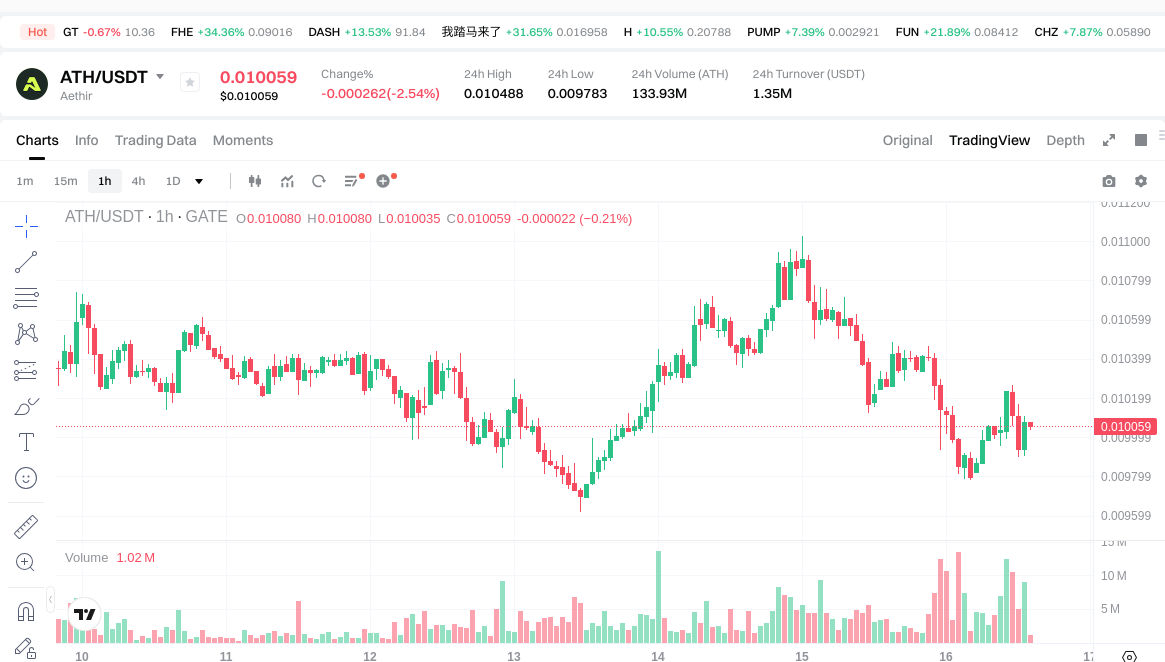
Aethir (ATH) is a significant asset in the cryptocurrency field. As a cloud computing infrastructure platform, it has deployed a scalable and competitive framework for sharing distributed computational resources, serving enterprise applications across various industries and regions. As of January 16, 2026, ATH has a market capitalization of approximately $167.01 million, with a circulating supply of around 16.61 billion tokens, and the current price is maintained at approximately $0.010057. The platform focuses on optimizing GPU utilization for compute-intensive domains including Artificial Intelligence (AI), Machine Learning (ML), and Cloud Gaming. With a market ranking of 270 and holding 52,653 addresses, ATH has gradually become a focal point for investors discussing "Is Aethir (ATH) a good investment?" The token has experienced notable price fluctuations, with short-term changes showing a 0.79% increase over 1 hour, a 2.48% decrease over 24 hours, and a 5.21% gain over the past 30 days. This article will comprehensively analyze ATH's investment value, historical trends, future price predictions, and investment risks to provide reference for investors.
I. Aethir (ATH) Price History Review and Current Investment Value
- June 2024: ATH token launched with initial trading activity, establishing its presence in the decentralized cloud computing infrastructure sector.
- June 12, 2024: Price reached $0.14724, marking a significant early peak as institutional interest in GPU-sharing platforms gained momentum.
- 2024-2025: Market experienced considerable volatility as the broader crypto ecosystem faced headwinds, with ATH declining alongside many infrastructure tokens during sector rotation.
- December 31, 2025: Price touched $0.00843, reflecting broader market consolidation and reduced speculative activity in cloud computing tokens.
- January 2026: Trading stabilized around $0.010057, representing an 85.02% decline from peak levels over the trailing twelve-month period.
Current Market Status for ATH (January 2026)
- Current Price: $0.010057 USD
- Market Sentiment: Data indicates a neutral-to-cautious market environment (sentiment score: 2), reflecting ongoing uncertainty in the infrastructure token segment.
- 24-Hour Trading Volume: $1,349,805.23 USD
- Circulating Supply: 16.61 billion ATH (39.54% of total supply)
- Market Capitalization: $167.01 million USD
- Fully Diluted Valuation: $422.39 million USD
- Holder Base: 52,653 addresses, indicating sustained community engagement despite price volatility.
View real-time ATH market price
II. Core Factors Influencing Whether ATH is a Good Investment
Supply Mechanism and Scarcity (ATH Investment Scarcity)
- Fixed supply structure with a maximum supply of 42 billion ATH tokens, of which approximately 39.54% is currently in circulation (16.61 billion tokens), establishing a clear supply ceiling that may influence long-term value dynamics.
- The circulating supply represents less than 40% of the total supply, suggesting significant token unlock events may occur in the future, which could affect price dynamics and investment considerations.
- Investment significance: The defined supply cap of 42 billion tokens provides a framework for understanding potential scarcity dynamics, though actual scarcity effects depend on demand growth and token distribution schedules.
Institutional Investment and Mainstream Adoption (Institutional Investment in ATH)
- Aethir reported $91 million in annual revenue with a market capitalization of approximately $400 million, demonstrating revenue generation capabilities within the decentralized GPU cloud infrastructure sector.
- Strategic developments include the Aethir Digital Asset Treasury (DAT), described as the world's first Strategic Compute Reserve, which utilizes ATH tokens to fund GPU onboarding and compute bookings, creating a mechanism that may generate demand for the token.
- The project has positioned itself within the DePIN (Decentralized Physical Infrastructure Networks) sector, which has been noted for its focus on real-world applications rather than speculative token incentives.
- As of Q4 2025, Aethir has been expanding its compute network and GPU monetization by onboarding new Cloud Hosts across multiple locations, with plans to more than double its global compute footprint by Q1 2026.
Macroeconomic Environment's Impact on ATH Investment
- The DePIN sector, in which Aethir operates, has been characterized as a transformative force in enterprise computing during 2025, potentially benefiting from broader trends toward decentralized infrastructure solutions.
- The project's positioning within the AI and machine learning infrastructure space may correlate with macroeconomic trends favoring AI development and enterprise computing demand.
Technology and Ecosystem Development (Technology & Ecosystem for ATH Investment)
- Aethir operates a decentralized GPU cloud infrastructure platform designed to optimize GPU utilization for compute-intensive applications including AI, machine learning, and cloud gaming.
- The v2 Mainnet upgrade has been implemented, with expansion plans positioning the project within what has been described as a $3.5 trillion DePIN market opportunity.
- The platform generates revenue by providing distributed computational resources to enterprise applications across various industries and regions, differentiating itself from traditional centralized cloud computing models.
- The ecosystem includes Cloud Hosts who stake ATH tokens to join the decentralized GPU cloud network, expanding compute availability through a distributed infrastructure model.
- Integration with AI and machine learning workloads provides potential application areas, though the competitive landscape includes established centralized cloud providers and other decentralized computing projects.
III. ATH Future Investment Predictions and Price Outlook (Is Aethir(ATH) worth investing in 2026-2031)
Short-term Investment Predictions (2026, short-term ATH investment outlook)
Based on available market data and technical analysis perspectives, ATH's short-term outlook for 2026 presents varied scenarios:
- Conservative Prediction: $0.0062341 - $0.008711
- Neutral Prediction: $0.010055 - $0.01232
- Optimistic Prediction: $0.01442 - $0.01457975
The short-term trajectory may be influenced by multiple factors including broader cryptocurrency market sentiment, GPU computing demand trends, and the platform's ability to expand its enterprise client base in AI, ML, and cloud gaming sectors.
Mid-term Investment Outlook (2027-2029, mid-term Aethir(ATH) investment forecast)
-
Market Stage Expectation: Consolidation and potential expansion phase as decentralized GPU infrastructure matures and addresses growing computational demands across AI and gaming industries.
-
Investment Return Predictions:
- 2027: $0.007009 - $0.0155198925 (approximately 22% potential change from 2026 baseline)
- 2028: $0.009111 - $0.02059957795 (approximately 38% potential change)
- 2029: $0.009612 - $0.01725910585 (approximately 71% potential change)
-
Key Catalysts: Expansion of enterprise GPU adoption, technological developments in decentralized computing infrastructure, competitive positioning within the DePIN sector, and evolving market demand for scalable GPU resources.
Long-term Investment Outlook (Is Aethir a good long-term investment?)
- Baseline Scenario: $0.009514897592563 - $0.018656661946203 (assuming steady development and moderate market adoption through 2031)
- Optimistic Scenario: $0.018656661946203 - $0.024813360388451 (assuming accelerated enterprise adoption and favorable market conditions)
- Risk Scenario: Below $0.009514897592563 (under adverse market conditions or significant competitive pressures)
Check ATH long-term investment and price predictions: Price Prediction
2026-01-16 to 2031 Long-term Outlook
- Base Scenario: $0.0062341 - $0.018656661946203 (corresponding to steady progress and gradual mainstream application enhancement)
- Optimistic Scenario: $0.018656661946203 - $0.024813360388451 (corresponding to large-scale adoption and favorable market environment)
- Transformational Scenario: Above $0.024813360388451 (contingent on breakthrough ecosystem developments and mainstream proliferation)
- 2031-12-31 Predicted High: $0.024813360388451 (based on optimistic development assumptions)
Disclaimer: The predictions presented are derived from various analytical models and third-party forecasts. Cryptocurrency markets exhibit inherent volatility, and actual outcomes may differ substantially from projections. Multiple factors including technological advancement, regulatory developments, competitive dynamics, supply-demand equilibrium, and broader market sentiment can influence ATH's price trajectory. This analysis does not constitute financial advice, and investors should conduct thorough independent research (DYOR) and consider their risk tolerance before making investment decisions. Past performance and predictive models are not reliable indicators of future results.
| Year |
Predicted High Price |
Predicted Average Price |
Predicted Low Price |
Price Change |
| 2026 |
0.01457975 |
0.010055 |
0.0062341 |
0 |
| 2027 |
0.0155198925 |
0.012317375 |
0.0081294675 |
22 |
| 2028 |
0.02059957795 |
0.01391863375 |
0.00723768955 |
38 |
| 2029 |
0.0177768790255 |
0.01725910585 |
0.009665099276 |
71 |
| 2030 |
0.019795331454657 |
0.01751799243775 |
0.012437774630802 |
74 |
| 2031 |
0.024813360388451 |
0.018656661946203 |
0.009514897592563 |
85 |
IV. ATH Investment Strategy and Risk Management (How to invest in Aethir)
Investment Methodology (ATH investment strategy)
Long-term Holding (HODL ATH)
For conservative investors seeking exposure to the decentralized GPU computing infrastructure sector, a long-term holding strategy may be appropriate. This approach involves:
- Dollar-Cost Averaging (DCA): Implementing systematic purchases at regular intervals to mitigate the impact of short-term price volatility
- Position Sizing: Allocating a predetermined percentage of portfolio capital based on individual risk tolerance
- Rebalancing Schedule: Periodic portfolio reviews to maintain target allocation percentages
Given ATH's position in the cloud computing infrastructure space, long-term holders should monitor:
- Platform adoption metrics and enterprise GPU utilization rates
- Competition from alternative decentralized computing networks
- Technological developments in AI, ML, and cloud gaming sectors
Active Trading Approach
For experienced traders comfortable with technical analysis, active trading strategies may include:
- Technical Analysis Framework: Utilizing support and resistance levels, moving averages, and volume indicators
- Swing Trading: Capitalizing on medium-term price movements based on chart patterns and market momentum
- Range Trading: Executing trades within established price channels when market conditions are consolidating
Note: ATH has demonstrated significant price volatility, with a 24-hour change of -2.48% and 7-day change of -4.27% as of January 16, 2026.
Risk Management (Risk management for ATH investment)
Asset Allocation Guidelines
Conservative Investors
- Recommended allocation: 1-3% of total cryptocurrency portfolio
- Focus on established assets with ATH as a satellite position
- Emphasis on capital preservation over aggressive growth
Moderate Investors
- Recommended allocation: 3-7% of total cryptocurrency portfolio
- Balanced approach combining established assets with emerging infrastructure projects
- Regular monitoring of fundamental developments
Aggressive/Professional Investors
- Recommended allocation: Up to 10-15% of total cryptocurrency portfolio
- Higher risk tolerance for emerging blockchain infrastructure projects
- Active portfolio management with defined exit strategies
Risk Hedging Strategies
Diversification Approach
- Cross-sector allocation: Combining ATH with tokens from different categories (DeFi, Layer 1/2, gaming)
- Market cap diversification: Balancing large-cap, mid-cap, and small-cap positions
- Temporal diversification: Staggered entry and exit points to reduce timing risk
Hedging Instruments
- Stablecoin reserves: Maintaining liquid positions for opportunistic purchases during drawdowns
- Correlation analysis: Monitoring price relationships with Bitcoin and Ethereum for portfolio hedging
- Stop-loss implementation: Setting predetermined exit points to limit downside exposure
Secure Storage Solutions
Hot Wallet Options (for active trading)
- MetaMask: Popular Ethereum-compatible wallet for ERC-20 tokens
- Trust Wallet: Multi-chain support with user-friendly interface
- Exchange wallets: Convenient for frequent trading but with higher security risks
Cold Storage Recommendations (for long-term holding)
- Hardware wallets: Ledger Nano X, Trezor Model T for offline private key storage
- Multi-signature wallets: Enhanced security through distributed key management
- Paper wallets: Offline generation and storage of private keys
Security Best Practice: Store the majority of holdings (70-80%) in cold storage, maintaining only active trading positions in hot wallets.
V. ATH Investment Risks and Challenges (Risks of investing in Aethir)
Market Risks
High Volatility Characteristics
ATH has exhibited substantial price fluctuations:
- 1-hour price change: +0.79%
- 24-hour price range: $0.009783 - $0.010488
- 30-day performance: +5.21%
- 1-year performance: -85.02%
The token's current price of $0.010057 represents significant distance from its previous level of $0.14724 recorded on June 12, 2024.
Liquidity Considerations
- 24-hour trading volume: $1,349,805.23
- Market capitalization: $167,012,701.85
- Circulating supply: 16,606,612,494 ATH (39.54% of maximum supply)
Relatively lower trading volumes compared to major cryptocurrencies may result in:
- Wider bid-ask spreads during execution
- Increased slippage for larger orders
- Potential difficulty exiting positions during market stress
Price Manipulation Susceptibility
Tokens with smaller market capitalizations and lower liquidity profiles may face:
- Pump-and-dump schemes coordinated through social media
- Whale accumulation or distribution affecting price discovery
- Wash trading or artificial volume inflation on certain exchanges
Regulatory Risks
Jurisdictional Uncertainty
The regulatory landscape for cryptocurrency assets varies significantly across jurisdictions:
United States
- Ongoing regulatory framework development by SEC and CFTC
- Uncertainty regarding classification as security or commodity
- Potential impacts from proposed legislation
European Union
- Markets in Crypto-Assets (MiCA) regulation implementation timeline
- Compliance requirements for service providers and token issuers
- Cross-border trading and taxation considerations
Asia-Pacific Region
- Diverse regulatory approaches across different markets
- Potential restrictions on cryptocurrency activities
- Licensing requirements for exchanges and service providers
Compliance Evolution
- Know Your Customer (KYC) and Anti-Money Laundering (AML) requirements may expand
- Reporting obligations for cryptocurrency holdings could increase
- Tax treatment may change as regulatory frameworks mature
Technical Risks
Smart Contract Vulnerabilities
As an ERC-20 token deployed on Ethereum (contract address: 0xbe0Ed4138121EcFC5c0E56B40517da27E6c5226B), ATH faces inherent smart contract risks:
- Code vulnerabilities potentially exploitable by malicious actors
- Dependency on Ethereum network security and performance
- Upgrade or migration risks during protocol changes
Network Security Concerns
- Potential distributed denial-of-service (DDoS) attacks on Aethir infrastructure
- Security of GPU provider nodes within the distributed network
- Data integrity and privacy considerations for enterprise clients
Technology Obsolescence Risk
The rapidly evolving blockchain and cloud computing sectors present:
- Competition from alternative decentralized GPU computing solutions
- Advancement in centralized cloud infrastructure reducing cost advantages
- Technological breakthroughs potentially disrupting current business models
- Scalability limitations affecting enterprise adoption
- Integration complexity with existing enterprise systems
- GPU provider churn affecting network reliability and performance
VI. Conclusion: Is Aethir a Good Investment?
Investment Value Assessment
ATH represents exposure to the emerging decentralized GPU computing infrastructure sector, targeting applications in AI, machine learning, and cloud gaming. The token's market position reflects both opportunities and challenges:
Potential Strengths:
- Positioning within growing AI and cloud computing markets
- Decentralized infrastructure model addressing enterprise GPU resource needs
- Established presence with 52,653 token holders
Notable Considerations:
- Significant price volatility with substantial drawdown from previous levels
- Relatively lower market capitalization ($167 million) compared to established cryptocurrencies
- Only 39.54% of maximum supply currently in circulation
- Limited exchange availability (1 exchange listed)
The long-term investment potential depends on factors including platform adoption, competitive positioning, technological execution, and overall cryptocurrency market conditions. Short-term price movements remain subject to high volatility and market sentiment fluctuations.
Investor Recommendations
✅ Beginner Investors
- Strategy: Dollar-cost averaging approach with small position sizes
- Allocation: Limit exposure to 1-2% of total cryptocurrency portfolio
- Storage: Prioritize secure storage using reputable hardware wallets
- Education: Develop understanding of decentralized computing infrastructure before investing
- Timeframe: Maintain long-term perspective (3+ years) to ride out volatility
✅ Experienced Investors
- Strategy: Combine swing trading opportunities with core long-term position
- Allocation: Consider 3-7% allocation within diversified cryptocurrency portfolio
- Risk Management: Implement stop-loss orders and regular portfolio rebalancing
- Analysis: Monitor on-chain metrics, platform developments, and sector trends
- Flexibility: Adjust positions based on fundamental changes and market conditions
✅ Institutional Investors
- Strategy: Strategic allocation as part of blockchain infrastructure thesis
- Due Diligence: Comprehensive evaluation of platform technology, team, and competitive landscape
- Position Sizing: Determined by overall cryptocurrency allocation and risk parameters
- Monitoring: Establish protocols for ongoing performance assessment and risk review
- Diversification: Include within broader portfolio of blockchain infrastructure investments
⚠️ Important Disclaimer
Cryptocurrency investments carry substantial risk. Token prices may experience extreme volatility, and investors may lose their entire investment. This analysis is provided for informational purposes only and does not constitute financial advice, investment recommendation, or solicitation to buy or sell any asset. Prospective investors should:
- Conduct independent research and due diligence
- Consult qualified financial advisors regarding individual circumstances
- Only invest capital they can afford to lose completely
- Understand that past performance does not indicate future results
- Recognize that regulatory changes may impact token value and accessibility
The cryptocurrency market operates 24/7 with minimal regulatory oversight in many jurisdictions. Market conditions, project developments, and external factors can change rapidly, materially affecting investment outcomes.
VII. FAQ
Q1: What is Aethir (ATH) and what makes it different from other cryptocurrency investments?
Aethir (ATH) is a decentralized GPU cloud infrastructure platform that provides distributed computational resources for AI, machine learning, and cloud gaming applications. Unlike traditional cryptocurrencies that primarily serve as digital currencies or store of value, ATH operates within the DePIN (Decentralized Physical Infrastructure Networks) sector, generating revenue through enterprise GPU resource sharing. The platform reported $91 million in annual revenue with a market capitalization of approximately $400 million, distinguishing itself by focusing on real-world utility rather than speculative token incentives. Its business model involves Cloud Hosts who stake ATH tokens to join the network, creating a mechanism where token demand correlates with platform expansion and GPU resource utilization.
Q2: Is ATH a good investment for beginners in cryptocurrency?
For beginners, ATH should be approached with caution and limited allocation (1-2% of total cryptocurrency portfolio). The token has demonstrated extreme volatility, declining 85.02% from its peak price of $0.14724 in June 2024 to the current level of approximately $0.010057 as of January 2026. Beginners should utilize dollar-cost averaging strategies to mitigate short-term price fluctuations and maintain a long-term perspective (3+ years minimum). Priority should be given to understanding the decentralized computing infrastructure sector, secure storage using hardware wallets, and fundamental education before investing. The relatively lower liquidity ($1.35 million 24-hour volume) and limited exchange availability (1 exchange) present additional challenges for inexperienced investors who may face execution difficulties during market stress.
Q3: What are the major risks associated with investing in ATH?
ATH investment carries multiple risk categories: (1) Market risks include high volatility evidenced by 85% drawdown from peak, relatively low liquidity creating potential slippage issues, and susceptibility to price manipulation given its smaller market capitalization of $167 million; (2) Regulatory risks involve uncertainty around cryptocurrency classification across jurisdictions, evolving compliance requirements under frameworks like MiCA in Europe, and potential restrictions affecting token accessibility; (3) Technical risks encompass smart contract vulnerabilities as an ERC-20 token, network security concerns for distributed GPU infrastructure, competition from alternative decentralized computing solutions, and technology obsolescence in rapidly evolving cloud computing sectors. Only 39.54% of the maximum supply currently circulates, suggesting significant future token unlock events could affect price dynamics.
Q4: What is the long-term price prediction for ATH through 2031?
Long-term predictions for ATH through 2031 present three scenarios: (1) Base scenario projects prices ranging from $0.009514 to $0.018656 assuming steady development and moderate enterprise adoption; (2) Optimistic scenario forecasts $0.018656 to $0.024813 contingent on accelerated GPU infrastructure adoption and favorable market conditions; (3) Risk scenario anticipates prices below $0.009514 under adverse competitive pressures or market downturns. By 2031, the predicted high reaches $0.024813 representing potential 147% appreciation from current levels. These projections depend on multiple variables including technological advancement in decentralized computing, competitive positioning against centralized cloud providers, regulatory developments, enterprise adoption rates, and overall cryptocurrency market sentiment. Past performance and predictive models should not be considered reliable indicators of future results.
Q5: How should I store my ATH tokens securely?
ATH token storage strategy should balance security with accessibility based on investment timeframe: For long-term holding (70-80% of holdings), utilize cold storage solutions including hardware wallets like Ledger Nano X or Trezor Model T that store private keys offline, multi-signature wallets for enhanced security through distributed key management, or properly generated paper wallets. For active trading positions (20-30% of holdings), hot wallet options include MetaMask for ERC-20 token compatibility, Trust Wallet for multi-chain support, or exchange wallets for frequent trading convenience despite higher security risks. Never store significant holdings on exchanges long-term, enable two-factor authentication on all accounts, backup recovery phrases securely offline, and regularly review wallet security practices as technology evolves.
Q6: What factors will most significantly impact ATH's investment value in 2026?
Five critical factors will influence ATH's 2026 performance: (1) Platform adoption metrics—specifically enterprise GPU utilization rates and the expansion of Cloud Host network across global locations, with plans to more than double compute footprint by Q1 2026; (2) Competitive dynamics within the $3.5 trillion DePIN market opportunity, particularly against centralized cloud providers and other decentralized computing projects; (3) Broader cryptocurrency market sentiment and Bitcoin/Ethereum price movements which historically correlate with infrastructure token performance; (4) Token unlock schedule affecting supply dynamics, as only 39.54% of maximum supply currently circulates; (5) Developments in AI and machine learning sectors creating demand for scalable GPU resources. The v2 Mainnet upgrade implementation and Strategic Compute Reserve (DAT) mechanism may also influence token demand through GPU onboarding incentives.
Q7: What is the recommended investment strategy for ATH in current market conditions?
Current investment strategy for ATH should match risk tolerance and experience level: Conservative investors should implement dollar-cost averaging with 1-3% portfolio allocation, focusing on capital preservation through diversified holdings and long-term timeframes (3+ years). Moderate investors may allocate 3-7% with balanced approach combining core position and tactical rebalancing, monitoring fundamental developments including platform adoption and competitive positioning. Aggressive investors with higher risk tolerance could allocate up to 10-15%, employing active trading strategies utilizing technical analysis of support/resistance levels given recent price movements showing -4.27% seven-day change. All strategies should incorporate risk management through stop-loss orders, stablecoin reserves for opportunistic purchases during drawdowns, and secure storage protocols. Given current neutral-to-cautious market sentiment (score: 2) and recent volatility, gradual position building rather than concentrated purchases is advisable.
Q8: How does Aethir's business model generate value for ATH token holders?
Aethir's value generation mechanism operates through several channels: The platform generates $91 million annual revenue by providing distributed GPU computational resources to enterprise clients across AI, machine learning, and cloud gaming industries. The Aethir Digital Asset Treasury (DAT)—described as the world's first Strategic Compute Reserve—utilizes ATH tokens to fund GPU onboarding and compute bookings, creating direct demand correlation between platform growth and token utility. Cloud Hosts must stake ATH tokens to participate in the network, reducing circulating supply while expanding infrastructure capacity. As the platform scales its GPU monetization and doubles global compute footprint by Q1 2026, increased enterprise adoption theoretically drives token demand through staking requirements and treasury operations. However, actual value accrual depends on revenue distribution mechanisms, token economics implementation, and competitive positioning against centralized alternatives that may offer lower costs or superior performance.
* The information is not intended to be and does not constitute financial advice or any other recommendation of any sort offered or endorsed by Gate.