This comprehensive analysis examines whether Aevo (AEVO), a decentralized derivatives exchange token, represents a viable investment opportunity. Trading at $0.03697 with a market cap of $33.87 million, AEVO has experienced significant volatility since its March 2023 launch, declining 87.11% annually from peak levels. The article evaluates AEVO's fundamentals including its fixed 1 billion token supply (91.61% circulating), Layer 2 infrastructure on OP Stack, and presence across 34 exchanges via Gate and other platforms. Price forecasts range from $0.0266-$0.0402 in 2026 to $0.0513-$0.0727 by 2031 under various scenarios. While the specialized derivatives trading focus offers growth potential, substantial risks include high volatility, regulatory uncertainty, and technical vulnerabilities. The analysis provides tailored investment strategies for beginners, experienced traders, and institutions, emphasizing robust risk management and portfolio diversification for this volatile mid-cap cryptocurrency investment.
Introduction: Aevo (AEVO)'s Investment Position and Market Prospects
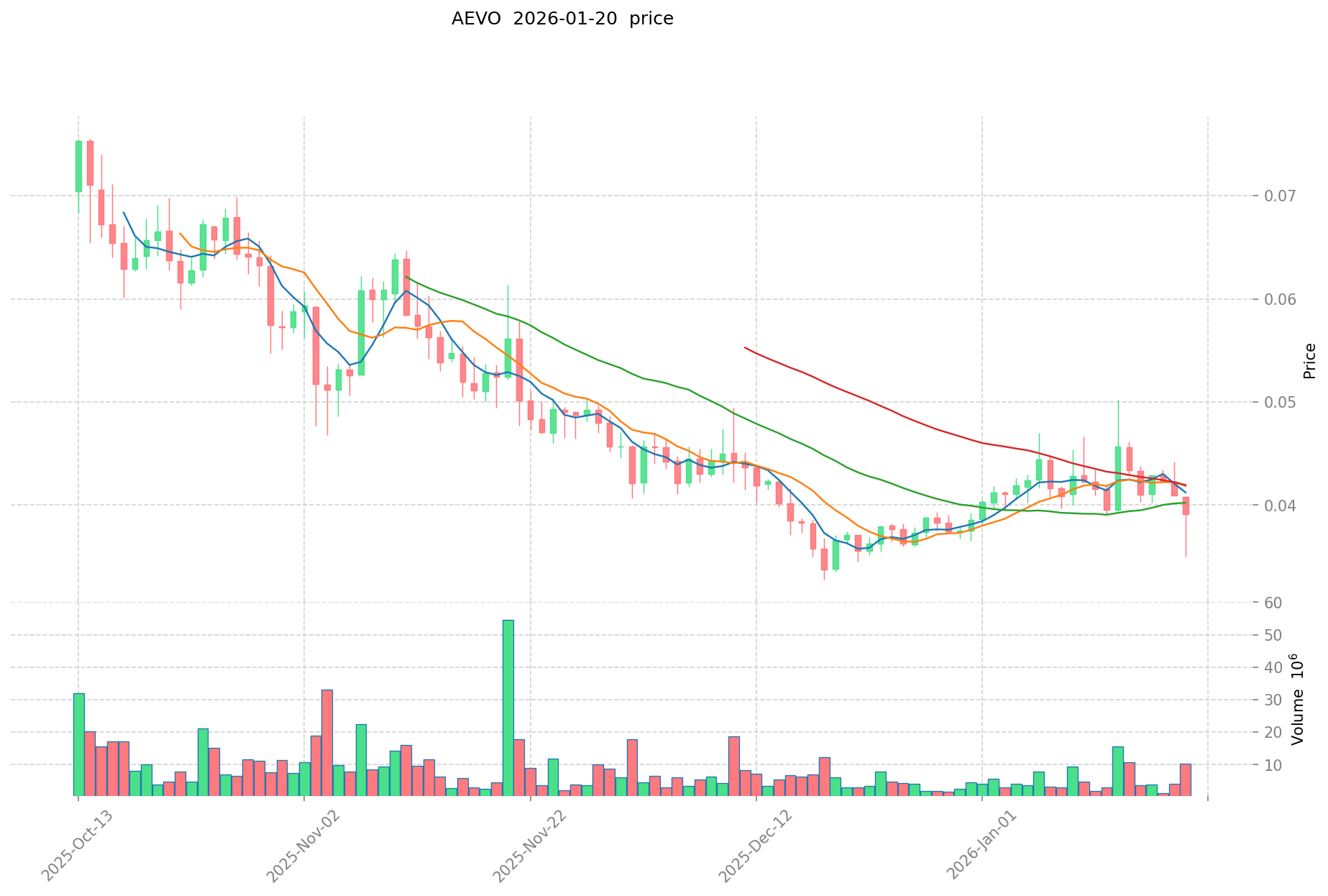
Aevo (AEVO) is a decentralized derivatives exchange focused on options and perpetual trading, operating on Aevo L2, an Ethereum roll-up based on the OP Stack. Since its launch in March 2023, Aevo has established itself in the decentralized finance (DeFi) derivatives sector. As of January 21, 2026, AEVO holds a market capitalization of approximately $33.87 million, with a circulating supply of around 916.12 million tokens, representing 91.61% of its maximum supply of 1 billion tokens. The current price stands at approximately $0.03697, with a 24-hour trading volume of $90,127. Ranked 656th in the cryptocurrency market, AEVO accounts for 0.0011% of the total crypto market share. The token is available on 34 exchanges and has approximately 45,018 holders. With its positioning as a specialized derivatives trading platform, AEVO has become a subject of discussion among investors evaluating "Is Aevo (AEVO) a good investment?" This article provides a comprehensive analysis of AEVO's investment value, historical performance, future price projections, and associated investment risks to serve as a reference for investors.
I. Aevo (AEVO) Price History Review and Current Investment Value
- 2024-03-13: AEVO reached a notable price level of $4, representing a significant milestone in its early market performance
- 2025-10-10: The token experienced considerable downward movement, declining to $0.01711
- 2025: Market conditions led to substantial price adjustments, with AEVO moving from elevated levels to lower price ranges
Current AEVO Investment Market Status (January 2026)
- AEVO current price: $0.03697
- 24-hour trading volume: $90,127.09
- Circulating supply: 916,115,609.83 AEVO (91.61% of maximum supply)
- Market capitalization: $33,868,794.10
- Fully diluted valuation: $36,970,000.00
- Market cap to FDV ratio: 91.61%
Click to view real-time AEVO market price
II. Core Factors Affecting Whether AEVO is a Good Investment
Supply Mechanism and Scarcity (AEVO investment scarcity)
- Fixed Supply Structure → Impacts price and investment value
- AEVO has a maximum supply of 1,000,000,000 tokens, with a current circulating supply of 916,115,609.83 tokens (approximately 91.61% of total supply).
- The relatively high circulation ratio suggests that most tokens are already in the market, which may limit significant supply-side pressure in the near term.
- Price Volatility → Historical performance reflects market dynamics
- AEVO has experienced substantial price fluctuations since its launch in March 2023. The token reached a notable price level of $4.00 on March 13, 2024, while recording a lower price point of $0.01711 on October 10, 2025.
- As of January 21, 2026, AEVO is trading at $0.03697, reflecting various market cycles and investor sentiment shifts.
- Investment Significance → Scarcity considerations for long-term positioning
- With over 91% of tokens already circulating, the supply dynamics are relatively transparent. The fixed maximum supply framework may contribute to potential scarcity effects, though market demand and utility remain critical factors for investment value.
Institutional Investment and Mainstream Adoption (Institutional investment in AEVO)
- Holder Distribution → Decentralization indicator
- AEVO currently has 45,018 token holders, suggesting a distributed ownership structure across the ecosystem.
- The presence of thousands of holders indicates a degree of community participation, though specific institutional holding data is not detailed in available materials.
- Market Presence → Exchange availability and liquidity
- AEVO is listed on 34 exchanges, providing multiple access points for investors and contributing to market liquidity.
- Trading volume of $90,127.09 over the recent period reflects ongoing market activity, though investors should consider liquidity conditions relative to their investment size.
Macroeconomic Environment's Impact on AEVO Investment
- Cryptocurrency Market Context → Broader market influences
- As a decentralized derivatives exchange token, AEVO's investment appeal is influenced by overall cryptocurrency market sentiment and the adoption of decentralized finance (DeFi) platforms.
- Market capitalization stands at approximately $33.87 million, representing 0.0011% of the broader crypto market, positioning AEVO as a mid-to-lower tier project by market cap.
- Risk-Return Profile → Volatility considerations
- AEVO has demonstrated significant price volatility, with a one-year decline of 87.11% from previous levels, indicating elevated risk factors that potential investors should carefully assess.
- Recent shorter-term trends show mixed signals: a 30-day increase of 5.63% contrasts with a 7-day decline of 13.55%, reflecting ongoing market uncertainty.
Technology & Ecosystem Development (Technology & Ecosystem for AEVO investment)
- Layer 2 Infrastructure → Technical foundation
- Aevo operates as a decentralized derivatives exchange (DEX) focused on options and perpetual trading. The platform runs on Aevo L2, an Ethereum rollup built on the OP Stack framework.
- The Layer 2 architecture aims to provide enhanced scalability and efficiency for derivatives trading, which could support long-term utility and user adoption.
- Token Standard and Integration → Technical compatibility
- AEVO is deployed as an ERC20 token on Ethereum (contract address: 0xB528edBef013aff855ac3c50b381f253aF13b997), ensuring compatibility with Ethereum's extensive DeFi ecosystem and wallet infrastructure.
- DeFi Application Focus → Ecosystem positioning
- As a derivatives-focused platform, Aevo targets a specific segment within the DeFi landscape. The platform's emphasis on options and perpetual contracts addresses advanced trading needs, which may appeal to sophisticated traders but could face adoption challenges in attracting broader retail participation.
- The success of the investment thesis depends significantly on the platform's ability to gain traction in the competitive decentralized derivatives market and build sustainable trading volume.
III. AEVO Future Investment Forecast and Price Outlook (Is Aevo(AEVO) worth investing in 2026-2031)
Short-term Investment Forecast (2026, short-term AEVO investment outlook)
- Conservative Forecast: $0.0266 - $0.0337
- Neutral Forecast: $0.0337 - $0.0369
- Optimistic Forecast: $0.0369 - $0.0402
Mid-term Investment Outlook (2027-2028, mid-term Aevo(AEVO) investment forecast)
-
Market Stage Expectation: The mid-term period may witness gradual ecosystem development as the platform continues to refine its decentralized derivatives offerings on the Aevo L2 infrastructure. Market sentiment could remain cautious given the broader crypto market dynamics and the ongoing evolution of Layer 2 solutions.
-
Investment Return Forecast:
- 2027: $0.0343 - $0.0440
- 2028: $0.0293 - $0.0446
-
Key Catalysts: Platform adoption rates, enhancements to derivatives trading features, partnerships within the DeFi ecosystem, regulatory developments affecting derivatives trading, and overall Layer 2 network performance.
Long-term Investment Outlook (Is Aevo a good long-term investment?)
- Base Scenario: $0.0262 - $0.0446 (assuming steady platform development and moderate adoption of decentralized derivatives trading)
- Optimistic Scenario: $0.0446 - $0.0631 (assuming accelerated ecosystem growth, increased trading volumes, and favorable regulatory environment for DeFi derivatives)
- Risk Scenario: $0.0262 - $0.0293 (in case of significant market downturns, regulatory headwinds, or competitive pressures affecting platform growth)
For detailed AEVO long-term investment and price forecast: Price Prediction
2026-01-21 to 2031 Long-term Outlook
- Base Scenario: $0.0262 - $0.0513 USD (corresponding to steady progress and gradual mainstream application enhancement)
- Optimistic Scenario: $0.0513 - $0.0727 USD (corresponding to large-scale adoption and favorable market environment)
- Transformative Scenario: Above $0.0727 USD (in case of breakthrough ecosystem developments and mainstream adoption)
- 2031-12-31 Predicted High: $0.0727 USD (based on optimistic development assumptions)
Disclaimer: Cryptocurrency investments carry significant risks. Price predictions are based on historical data and market analysis models, and actual results may vary substantially. Past performance does not guarantee future returns. Investors should conduct thorough research and consider their risk tolerance before making investment decisions.
| Year |
Predicted High Price |
Predicted Average Price |
Predicted Low Price |
Price Change |
| 2026 |
0.0402428 |
0.03692 |
0.0265824 |
0 |
| 2027 |
0.043982796 |
0.0385814 |
0.034337446 |
4 |
| 2028 |
0.04458466584 |
0.041282098 |
0.02931028958 |
11 |
| 2029 |
0.0596774008688 |
0.04293338192 |
0.0352053731744 |
16 |
| 2030 |
0.063105631415112 |
0.0513053913944 |
0.026165749611144 |
38 |
| 2031 |
0.07265099948404 |
0.057205511404756 |
0.045192354009757 |
54 |
IV. Aevo Investment Strategy and Risk Management (How to invest in Aevo)
Investment Methodology (Aevo investment strategy)
Long-term Holding (HODL Aevo)
Long-term holding represents a strategy suitable for conservative investors who believe in the fundamental value proposition of decentralized derivatives exchanges. This approach involves acquiring AEVO tokens and maintaining positions through market cycles, focusing on the project's technological development and ecosystem growth rather than short-term price movements. Investors adopting this strategy typically allocate a predetermined portion of their portfolio to AEVO and hold through volatility periods.
Active Trading
Active trading strategies for AEVO rely on technical analysis and swing trading techniques. Given the token's observed price volatility, with 24-hour changes reaching -5.27% and 7-day fluctuations of -13.55%, traders may identify opportunities in price swings between support and resistance levels. This approach requires monitoring trading volumes, which currently stand at approximately $90,127, and analyzing price patterns within the established range between $0.03668 and $0.03995 in recent 24-hour periods.
Risk Management (Risk management for Aevo investment)
Asset Allocation Ratio
Conservative Investors: May consider allocating 1-3% of their crypto portfolio to AEVO, prioritizing capital preservation while gaining exposure to the decentralized derivatives sector.
Aggressive Investors: Could allocate 5-10% of their portfolio, accepting higher volatility for potentially greater returns aligned with the derivatives exchange market growth.
Professional Investors: Might implement dynamic allocation strategies ranging from 3-15%, adjusted based on market conditions, technical indicators, and fundamental developments in the Aevo ecosystem.
Risk Hedging Solutions
Implementing a multi-asset portfolio approach can help mitigate concentration risk. Investors might combine AEVO holdings with established cryptocurrencies, stablecoins, and other DeFi protocol tokens to create balanced exposure. Additionally, considering AEVO's position as a derivatives platform token, investors could potentially use the platform's own trading products for hedging strategies, though this requires advanced understanding of derivatives instruments.
Secure Storage
Cold Wallet Solutions: For long-term holders, storing AEVO tokens in cold storage wallets provides maximum security against online threats. Hardware wallets such as Ledger or Trezor support ERC-20 tokens and offer offline private key management.
Hot Wallet Considerations: For active traders requiring frequent access, reputable software wallets with multi-signature support and two-factor authentication provide a balance between accessibility and security. The contract address 0xB528edBef013aff855ac3c50b381f253aF13b997 on Ethereum should be verified before any transaction.
Custodial Options: Exchanges offering AEVO trading (currently available on 34 platforms) provide custodial services, though this involves trusting third parties with asset custody.
V. Aevo Investment Risks and Challenges (Risks of investing in Aevo)
Market Risk
High Volatility: AEVO demonstrates significant price volatility, with annual performance showing -87.11% change. The token has experienced substantial price movements from its highest recorded price of $4 to a low of $0.01711, reflecting the inherent volatility in cryptocurrency markets, particularly for mid-cap tokens with a market capitalization of approximately $33.87 million.
Price Manipulation Concerns: With a 24-hour trading volume of $90,127 relative to its market cap, lower liquidity periods could potentially expose the token to price manipulation risks through large trades or coordinated market activities.
Regulatory Risk
As a derivatives-focused platform, Aevo operates in a regulatory landscape where different jurisdictions maintain varying approaches to cryptocurrency derivatives trading. Changes in regulatory frameworks across major markets could impact platform operations, user access, and token utility. The decentralized nature of the exchange may provide some operational resilience, but token holders should remain aware of evolving compliance requirements that could affect platform adoption and token value.
Technical Risk
Network Security Vulnerabilities: Built on OP Stack as an Ethereum Layer 2 solution, Aevo inherits both the security properties and potential vulnerabilities of this technology stack. Smart contract risks, bridge vulnerabilities, or consensus mechanism issues could potentially impact platform operations and token value.
Upgrade Implementation: As Layer 2 technology continues evolving, required protocol upgrades or migrations could introduce technical challenges. Implementation difficulties or compatibility issues during upgrades might temporarily affect platform functionality or user confidence.
VI. Conclusion: Is Aevo a Good Investment?
Investment Value Summary
Aevo presents a specialized investment opportunity within the decentralized derivatives exchange sector. The project's focus on options and perpetual trading addresses a specific niche in DeFi infrastructure, operating on OP Stack-based Layer 2 technology. With a circulating supply of approximately 916 million tokens (91.61% of maximum supply) and presence across 34 exchanges, AEVO maintains reasonable market accessibility. However, the token has experienced considerable price volatility, reflected in the -87.11% annual performance and significant drawdown from peak levels.
Investor Recommendations
✅ Beginners
Consider dollar-cost averaging (DCA) strategies to build positions gradually, reducing exposure to short-term volatility. Prioritize secure storage using hardware wallets and thoroughly research the platform's functionality before investing. Start with minimal allocation within overall portfolio risk tolerance.
✅ Experienced Investors
Evaluate swing trading opportunities based on technical analysis while maintaining core long-term positions. Implement portfolio diversification across multiple DeFi sectors and protocols. Monitor platform developments, trading volume trends, and derivatives market growth indicators for informed position adjustments.
✅ Institutional Investors
Assess strategic allocation potential within broader DeFi infrastructure investments. Consider the derivatives exchange market opportunity size, competitive positioning, and technology stack maturity. Implement comprehensive due diligence on protocol security, team execution capability, and regulatory risk management.
⚠️ Notice
Cryptocurrency investments carry high risk, and past performance does not guarantee future results. This content is provided for informational purposes only and does not constitute investment advice. Investors should conduct independent research and consider their financial situation, risk tolerance, and investment objectives before making any investment decisions. The volatile nature of cryptocurrency markets, including AEVO, means capital loss is possible.
VII. FAQ
Q1: What is Aevo (AEVO) and what makes it different from other cryptocurrency investments?
Aevo (AEVO) is a decentralized derivatives exchange token that specializes in options and perpetual trading, operating on Aevo L2, an Ethereum rollup built on the OP Stack. Unlike general-purpose cryptocurrencies, AEVO represents a specialized investment in DeFi infrastructure focused specifically on derivatives trading. The platform's Layer 2 architecture provides enhanced scalability for complex financial instruments, differentiating it from spot-trading-focused exchanges. As of January 2026, AEVO has a market capitalization of approximately $33.87 million with 45,018 token holders and availability on 34 exchanges. The token's value is tied directly to the adoption and success of its derivatives trading platform rather than serving as a general medium of exchange or store of value.
Q2: How has AEVO performed historically, and what does this indicate about investment risk?
AEVO has demonstrated significant price volatility since its launch in March 2023. The token reached a notable high of $4 on March 13, 2024, but subsequently declined to $0.01711 by October 10, 2025, representing substantial downward movement. As of January 2026, AEVO trades at approximately $0.03697, reflecting an annual performance decline of 87.11%. This historical trajectory indicates high investment risk characteristic of mid-cap cryptocurrency projects. Short-term performance shows mixed signals, with a 30-day increase of 5.63% contrasted by a 7-day decline of 13.55%. The significant price swings reflect both the speculative nature of cryptocurrency markets and the challenges facing decentralized derivatives platforms in gaining mainstream adoption.
Q3: What is the supply structure of AEVO, and how does it affect investment value?
AEVO has a maximum supply of 1 billion tokens, with approximately 916.12 million tokens currently in circulation, representing 91.61% of the total supply. This high circulation ratio indicates that most tokens are already distributed in the market, potentially limiting future supply-side pressure. The market cap to fully diluted valuation (FDV) ratio of 91.61% suggests relatively transparent supply dynamics compared to projects with large locked or unvested token allocations. While the fixed maximum supply framework could theoretically support scarcity-driven value appreciation, the investment thesis depends more critically on demand factors, including platform adoption, trading volume growth, and utility expansion within the DeFi derivatives ecosystem.
Q4: What are the price predictions for AEVO from 2026 to 2031?
Price forecasts for AEVO vary significantly based on adoption scenarios. For 2026, conservative estimates range from $0.0266 to $0.0337, neutral forecasts suggest $0.0337 to $0.0369, and optimistic projections indicate $0.0369 to $0.0402. Mid-term forecasts for 2027-2028 range from $0.0293 to $0.0446, depending on ecosystem development and market conditions. Long-term projections through 2031 present three scenarios: a base scenario of $0.0262 to $0.0513, an optimistic scenario of $0.0513 to $0.0727, and a transformative scenario exceeding $0.0727. The predicted high for 2031 stands at $0.0727, representing approximately a 97% increase from current levels. However, these predictions carry substantial uncertainty and depend on multiple factors including platform adoption, regulatory developments, and overall cryptocurrency market conditions.
Q5: What are the main risks associated with investing in AEVO?
AEVO investment carries several significant risks. Market risk is substantial, evidenced by high volatility and an 87.11% annual decline, with price movements ranging from $4 to $0.01711 historically. The relatively low 24-hour trading volume of $90,127 compared to market cap suggests liquidity concerns and potential price manipulation vulnerability. Regulatory risk affects the platform as a derivatives-focused exchange, with evolving compliance requirements across jurisdictions potentially impacting operations and token utility. Technical risks include smart contract vulnerabilities, Layer 2 bridge security concerns, and potential complications during protocol upgrades. Additionally, the competitive landscape in decentralized derivatives trading presents adoption challenges, as the platform must differentiate itself and attract sufficient trading volume to sustain long-term value.
Q6: What investment strategy should different types of investors consider for AEVO?
Conservative investors should consider allocating 1-3% of their crypto portfolio to AEVO, focusing on long-term holding (HODL) strategies while prioritizing capital preservation. Dollar-cost averaging (DCA) can help mitigate volatility exposure during position building. Aggressive investors might allocate 5-10% of their portfolio and employ active trading strategies, capitalizing on AEVO's price volatility by identifying swing trading opportunities between support and resistance levels. Professional investors could implement dynamic allocation ranging from 3-15%, adjusted based on technical indicators, fundamental developments, and market conditions. Regardless of strategy, all investors should implement proper risk management through portfolio diversification, secure storage using cold wallets for long-term holdings, and regular monitoring of platform developments and trading volume trends.
Q7: How does the technology behind Aevo affect its investment potential?
Aevo operates on Aevo L2, an Ethereum rollup built on the OP Stack framework, which provides the technical foundation for its derivatives trading platform. This Layer 2 architecture aims to deliver enhanced scalability and efficiency compared to Ethereum mainnet operations, potentially reducing transaction costs and improving user experience. The AEVO token is deployed as an ERC-20 token (contract address: 0xB528edBef013aff855ac3c50b381f253aF13b997), ensuring compatibility with Ethereum's extensive DeFi ecosystem and wallet infrastructure. The platform's focus on options and perpetual contracts addresses sophisticated trading needs within the derivatives market. Investment potential depends significantly on the platform's ability to leverage this technology stack to gain competitive advantages, attract trading volume, and demonstrate technical reliability. The success of Layer 2 adoption more broadly and the security track record of OP Stack implementations will influence AEVO's long-term investment viability.
Q8: Is AEVO suitable for long-term investment, and what factors should be monitored?
AEVO's suitability for long-term investment depends on individual risk tolerance and conviction in the decentralized derivatives market's growth potential. With 91.61% of tokens already circulating and a fixed maximum supply of 1 billion tokens, the supply-side dynamics are relatively transparent. Long-term investors should monitor several critical factors: platform trading volume trends indicating user adoption, ecosystem partnerships and integrations expanding utility, regulatory developments affecting derivatives trading in key markets, technological upgrades to the Layer 2 infrastructure, competitive positioning against both centralized and decentralized derivatives platforms, and overall DeFi market growth. Given the -87.11% annual performance and significant historical volatility, long-term investment requires strong conviction and willingness to withstand substantial price fluctuations. Investors should only allocate capital they can afford to lose and maintain diversification across multiple assets and sectors within their overall portfolio strategy.
* The information is not intended to be and does not constitute financial advice or any other recommendation of any sort offered or endorsed by Gate.