This comprehensive analysis examines whether Akash Network (AKT) represents a viable investment opportunity within the decentralized cloud computing sector. As of January 2026, AKT trades at approximately $0.4729 with a market capitalization of $134.68 million (ranked 304th), demonstrating recovery momentum with 10.93% 7-day and 18.84% 30-day gains despite an 85.22% annual decline. The article evaluates AKT's investment value through price history analysis, supply dynamics, institutional adoption, and ecosystem development across Cosmos infrastructure. It provides price forecasts ranging from conservative ($0.26-$0.47 in 2026) to optimistic scenarios ($0.93-$1.27 by 2031), alongside tailored investment strategies for beginners, experienced traders, and institutional participants. Critical risk assessments address market volatility, regulatory uncertainty, and technical vulnerabilities, offering comprehensive risk management frameworks including asset allocation guidelines, portfolio diversification strategies
Introduction: Akash Network (AKT) Investment Position and Market Outlook
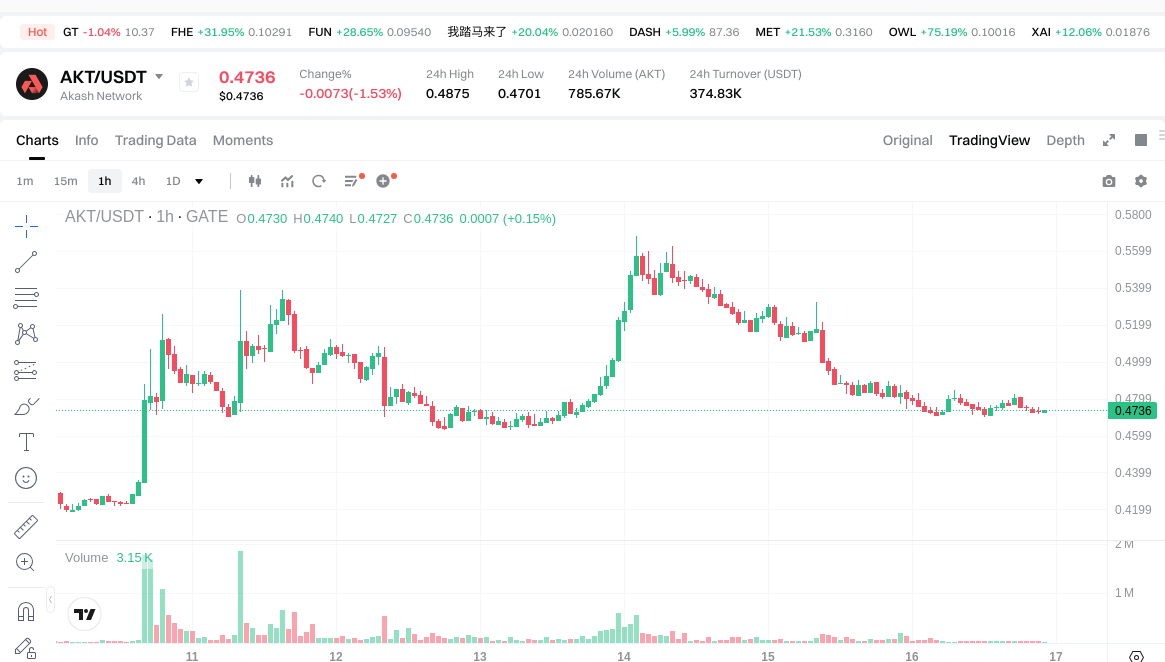
AKT is a significant asset in the cryptocurrency field. As of January 2026, Akash Network holds a market position ranked 304th with a market capitalization of approximately $134.68 million and a circulating supply of around 284.80 million tokens. The current price stands at approximately $0.4729. With its positioning as a decentralized cloud computing marketplace designed for DeFi, AKT has gradually become a focal point for investors considering "Is Akash Network (AKT) a good investment?" The project enables the monetization of underutilized cloud computing capacity across data centers, serving as both a governance token and reserve currency within the Cosmos-based ecosystem. This article provides a comprehensive analysis of AKT's investment value, historical performance, future price projections, and investment risks to offer reference for investors.
I. Akash Network (AKT) Price History Review and Current Investment Value
-
2021: AKT experienced notable price appreciation during a period of broader crypto market growth, with the token reaching significant valuation levels in early April. Investors who entered positions during earlier stages of the project saw substantial returns during this period.
-
2022: The broader cryptocurrency market downturn impacted AKT's valuation, with the token experiencing considerable price compression. By late November, AKT traded near lower price levels as market sentiment weakened across the digital asset sector.
-
2024-2025: AKT demonstrated recovery characteristics, with price movement showing positive momentum. Over a 30-day period leading into January 2026, the token reflected an increase of approximately 18.84%, while the 7-day trend indicated growth of around 10.93%.
Current AKT Investment Market Status (January 2026)
- Current AKT Price: Approximately $0.4729
- 24-Hour Trading Volume: Approximately $383,119.34
- Circulating Supply: Approximately 284.80 million AKT tokens
- Market Capitalization: Approximately $134.68 million
- Market Cap to Fully Diluted Valuation Ratio: 73.3%
- Recent Price Movement: -1.86% (24-hour period), +10.93% (7-day period), +18.84% (30-day period)
Click to view real-time AKT market price
II. Core Factors Influencing Whether AKT is a Good Investment (Is Akash Network(AKT) a Good Investment)
Supply Mechanism and Scarcity (AKT investment scarcity)
- Supply dynamics play a role in shaping price and investment considerations
- Current circulating supply stands at approximately 284.8 million AKT tokens, representing 73.3% of the maximum supply of 388.5 million tokens
- The defined maximum supply cap establishes a framework for understanding token availability over time
- Investment consideration: the relationship between circulating supply and maximum supply may influence discussions around long-term token economics
Institutional Investment and Mainstream Adoption (Institutional investment in AKT)
- AKT is currently listed on 16 cryptocurrency exchanges, providing various access points for market participants
- The project has established presence across multiple platforms including social media channels and development repositories
- Broader adoption patterns in decentralized cloud computing infrastructure may influence the token's positioning within the cryptocurrency landscape
Macroeconomic Environment's Impact on AKT Investment
- Cryptocurrency markets, including AKT, may be influenced by broader monetary policy trends and interest rate environments
- Market sentiment and risk appetite in the digital asset space can shift based on macroeconomic conditions
- Global economic uncertainty may affect investor allocation decisions across various digital asset categories, including infrastructure-focused tokens
Technology and Ecosystem Development (Technology & Ecosystem for AKT investment)
- Akash Network operates as a decentralized cloud computing marketplace built on Cosmos Hub using a proof-of-stake consensus mechanism
- The platform aims to provide access to underutilized computing capacity across data centers
- The AKT token serves multiple functions including governance, network security through staking, and value exchange within the ecosystem
- The network's economic model is designed to incentivize both supply-side providers and demand-side users within the decentralized cloud infrastructure marketplace
- Ecosystem development focuses on establishing competitive pricing mechanisms and encouraging long-term network participation through staking incentives
III. AKT Future Investment Forecast and Price Outlook (Is Akash Network(AKT) worth investing in 2026-2031)
Short-term Investment Forecast (2026, short-term AKT investment outlook)
- Conservative forecast: $0.26 - $0.47
- Neutral forecast: $0.47 - $0.59
- Optimistic forecast: $0.59 - $0.70
Mid-term Investment Outlook (2027-2029, mid-term Akash Network(AKT) investment forecast)
- Market stage expectation: The mid-term outlook suggests potential growth driven by increased adoption of decentralized cloud computing solutions and expanding ecosystem development.
- Investment return forecast:
- 2027: $0.38 - $0.86
- 2028: $0.46 - $0.95
- 2029: $0.44 - $0.90
- Key catalysts: Network expansion, increased platform utilization, technological upgrades, and broader market acceptance of decentralized infrastructure solutions.
Long-term Investment Outlook (Is AKT a good long-term investment?)
- Base scenario: $0.67 - $0.93 (assuming steady ecosystem growth and maintained market position)
- Optimistic scenario: $0.93 - $1.27 (assuming accelerated adoption and favorable market conditions)
- Risk scenario: Below $0.26 (under adverse market conditions or significant competitive pressures)
Click to view AKT long-term investment and price forecast: Price Prediction
2026-2031 Long-term Outlook
- Base scenario: $0.67 - $0.93 (corresponding to steady progress and gradual mainstream application improvement)
- Optimistic scenario: $0.93 - $1.27 (corresponding to large-scale adoption and favorable market environment)
- Transformative scenario: Above $1.27 (if the ecosystem achieves breakthrough progress and mainstream adoption)
- 2031-12-31 predicted high: $1.27 (based on optimistic development assumptions)
Disclaimer: Price predictions are inherently uncertain and should not be considered as investment advice. Cryptocurrency markets are highly volatile and subject to various risks. Historical performance does not guarantee future results. Investors should conduct their own research and consider their risk tolerance before making investment decisions.
| Year |
Predicted High Price |
Predicted Average Price |
Predicted Low Price |
Price Change |
| 2026 |
0.704621 |
0.4729 |
0.264824 |
0 |
| 2027 |
0.85959033 |
0.5887605 |
0.382694325 |
24 |
| 2028 |
0.94866979365 |
0.724175415 |
0.4634722656 |
53 |
| 2029 |
0.903336412671 |
0.836422604325 |
0.44330398029225 |
76 |
| 2030 |
0.99166263968772 |
0.869879508498 |
0.66980722154346 |
83 |
| 2031 |
1.265848660766289 |
0.93077107409286 |
0.707386016310573 |
96 |
IV. AKT Investment Strategy and Risk Management (How to invest in Akash Network)
Investment Methodology (AKT investment strategy)
Long-term Holding (HODL AKT): Suitable for Conservative Investors
For investors seeking exposure to decentralized cloud computing infrastructure, a long-term holding strategy may align with the gradual adoption of Akash Network's marketplace. This approach focuses on the protocol's potential to capture value from underutilized computing resources across data centers. Investors following this strategy typically monitor network utilization metrics, provider onboarding rates, and ecosystem development milestones rather than short-term price movements.
Staking AKT tokens represents a core component of long-term strategies, as it contributes to network security while potentially generating returns. The token's role as a reserve currency within Akash's multi-chain ecosystem positions staking as both a governance participation mechanism and a value accrual method.
Active Trading: Technical Analysis and Swing Trading
Active traders may capitalize on AKT's price volatility by employing technical analysis frameworks. Given the token's 24-hour fluctuation range of $0.4701 to $0.4875 as of January 16, 2026, swing traders often utilize support and resistance levels, moving averages, and volume indicators to identify entry and exit points.
The 7-day performance showing a 10.93% increase and 30-day gain of 18.84% suggests potential momentum-based trading opportunities. However, the 1-year decline of 85.22% from previous levels indicates the importance of risk management in active trading strategies.
Risk Management (Risk management for AKT investment)
Asset Allocation Ratios: Conservative / Aggressive / Professional Investors
-
Conservative Investors: May allocate 1-3% of their digital asset portfolio to AKT, treating it as a speculative position within infrastructure-focused holdings. This approach limits exposure while maintaining participation in decentralized cloud computing narratives.
-
Aggressive Investors: Could consider 5-10% allocation, particularly those with conviction in DeCloud adoption trends. This higher allocation reflects willingness to accept increased volatility in exchange for potential upside from network growth.
-
Professional Investors: Institutional participants may structure positions ranging from 3-7% within thematic infrastructure portfolios, often combining spot holdings with derivatives for hedging purposes. Professional allocations typically incorporate detailed due diligence on network economics and competitive positioning.
Diversification across multiple blockchain infrastructure tokens can reduce concentration risk associated with single-protocol exposure. Investors may combine AKT holdings with:
- Layer 1 blockchain tokens to balance infrastructure exposure
- Stablecoins to maintain liquidity for rebalancing opportunities
- Traditional cloud computing equities as correlation hedges
For sophisticated participants, options strategies and perpetual contracts on platforms listing AKT may provide downside protection or yield enhancement mechanisms.
Secure Storage: Hot/Cold Wallets + Hardware Wallet Recommendations
Given AKT's role within the Cosmos ecosystem, secure storage practices include:
- Hardware Wallets: Ledger and Trezor devices supporting Cosmos-based tokens offer offline storage with staking capabilities through compatible interfaces
- Cold Storage: Multi-signature wallets for larger holdings, with keys distributed across secure locations
- Hot Wallets: Keplr and Cosmostation for active staking and governance participation, maintaining only operational amounts in these interfaces
Investors should verify official wallet integrations through Akash Network's documentation to avoid counterfeit applications.
V. AKT Investment Risks and Challenges (Risks of investing in Akash Network)
Market Risk: High Volatility and Price Manipulation Concerns
AKT demonstrates significant price volatility, with historical movements ranging from an all-time high of $8.07 in April 2021 to an all-time low of $0.164994 in November 2022. The current price of $0.4729 represents an 85.22% decline over the past year, illustrating the substantial downside potential inherent in the asset.
With a 24-hour trading volume of approximately $383,119 and a market capitalization of $134.68 million, AKT operates with relatively modest liquidity compared to major digital assets. Lower liquidity environments may experience increased price sensitivity to large orders, potentially creating challenges for position entry and exit.
The token's circulation ratio of approximately 73.3% (284.8 million tokens circulating of 388.5 million maximum supply) indicates ongoing token release dynamics that could influence supply-demand equilibrium over time.
Regulatory Risk: Policy Uncertainty Across Jurisdictions
Decentralized cloud computing marketplaces operate within evolving regulatory frameworks that vary significantly across jurisdictions:
- Data sovereignty regulations: Requirements regarding data storage locations and cross-border data transfers may impact Akash's operational model in certain regions
- Securities classification: Regulatory determinations regarding AKT's classification could affect trading availability and compliance requirements
- Decentralized infrastructure oversight: Emerging frameworks for decentralized service providers may introduce compliance obligations for network participants
Investors should monitor regulatory developments in their jurisdictions and assess how policy changes might affect network operations and token utility.
Technical Risk: Network Security Vulnerabilities and Upgrade Failures
As a blockchain-based infrastructure protocol, Akash faces several technical risk categories:
- Smart contract vulnerabilities: Bugs or exploits in protocol smart contracts could result in loss of funds or network disruption
- Consensus mechanism risks: As a Proof-of-Stake network built on Cosmos Hub, AKT's security depends on validator integrity and sufficient stake distribution
- Upgrade execution: Protocol upgrades requiring validator coordination carry implementation risks that could temporarily affect network functionality
- Provider reliability: The marketplace's value proposition depends on cloud providers delivering consistent service quality
While the Cosmos ecosystem provides established infrastructure, investors should recognize that technical risks remain inherent to blockchain protocols.
VI. Conclusion: Is Akash Network a Good Investment?
Investment Value Summary
AKT presents a specialized investment thesis centered on decentralized cloud computing infrastructure. The protocol's positioning within the Cosmos ecosystem and its focus on underutilized computing capacity represent differentiated approaches to blockchain-based service delivery.
Long-term potential correlates with adoption rates of decentralized cloud services and the network's ability to attract both providers and tenants. However, the significant price decline over the past year and relatively modest market capitalization highlight the speculative nature of the investment.
Short-term price movements reflect broader digital asset market dynamics and sector-specific sentiment around infrastructure protocols, contributing to substantial volatility.
Investor Recommendations
✅ Beginners: Consider dollar-cost averaging (DCA) strategies to build positions gradually while mitigating timing risk. Prioritize secure storage through hardware wallets and allocate only capital designated for high-risk speculative positions. Focus on understanding Akash's value proposition and network metrics before committing significant capital.
✅ Experienced Investors: May employ swing trading strategies based on technical analysis while maintaining core long-term positions for staking rewards. Diversify across multiple infrastructure protocols to reduce single-asset concentration. Monitor network utilization data, provider growth, and ecosystem developments as fundamental indicators.
✅ Institutional Investors: Strategic long-term allocation within thematic infrastructure portfolios may be appropriate for participants with dedicated digital asset research capabilities. Conduct comprehensive due diligence on competitive positioning, tokenomics, and governance structures. Consider structured products for risk management and tax optimization.
⚠️ Disclaimer: Cryptocurrency investments carry substantial risk, including the potential for total capital loss. This analysis is provided for informational purposes only and does not constitute investment advice. Investors should conduct independent research and consult qualified financial advisors before making investment decisions.
VII. FAQ
Q1: What is Akash Network (AKT) and why should investors consider it?
Akash Network is a decentralized cloud computing marketplace built on Cosmos Hub that enables monetization of underutilized computing capacity across data centers. Investors consider AKT because it serves triple functions as a governance token, reserve currency, and staking mechanism within a growing decentralized infrastructure ecosystem. The protocol addresses the cloud computing market through a peer-to-peer marketplace model, positioning itself as an alternative to centralized providers while offering potential value capture from network utilization growth.
Q2: Is AKT a good investment for beginners or should only experienced traders consider it?
AKT suits different investor profiles with adjusted strategies. Beginners should approach AKT as a high-risk speculative position, allocating only 1-3% of their digital asset portfolio and employing dollar-cost averaging (DCA) to mitigate timing risk. The token's 85.22% decline over the past year and significant volatility ($0.164994 all-time low to $8.07 all-time high) demonstrate substantial downside potential. Experienced investors may employ active trading strategies while maintaining core positions for staking rewards, whereas institutional participants can integrate AKT into thematic infrastructure portfolios with comprehensive due diligence frameworks.
Q3: What are the price predictions for AKT from 2026 to 2031?
Price forecasts suggest varied scenarios based on adoption trajectories. For 2026, conservative estimates range $0.26-$0.47, neutral forecasts $0.47-$0.59, and optimistic projections $0.59-$0.70. Mid-term outlooks for 2027-2029 anticipate potential ranges of $0.38-$0.86 (2027), $0.46-$0.95 (2028), and $0.44-$0.90 (2029) driven by ecosystem expansion. Long-term scenarios for 2031 project a base case of $0.67-$0.93, optimistic scenario of $0.93-$1.27, and transformative potential above $1.27 contingent on breakthrough adoption. These predictions assume continued network development and favorable market conditions but carry inherent uncertainty given cryptocurrency market volatility.
Q4: What are the main risks of investing in Akash Network?
AKT faces multiple risk categories including market volatility (demonstrated by 85.22% annual decline and modest $383,119 24-hour trading volume), regulatory uncertainty across jurisdictions regarding decentralized infrastructure and data sovereignty requirements, and technical vulnerabilities inherent to blockchain protocols. The relatively low market capitalization of $134.68 million (ranked 304th) creates liquidity constraints that may amplify price movements. Additional considerations include smart contract security risks, validator integrity within the Proof-of-Stake consensus mechanism, and dependency on cloud provider reliability for marketplace functionality. The ongoing token release schedule (73.3% circulation ratio) presents supply-demand dynamics that could influence valuations over time.
Q5: How can investors implement effective risk management strategies for AKT holdings?
Effective risk management requires multi-layered approaches tailored to investor profiles. Asset allocation should range from 1-3% for conservative investors to 5-10% for aggressive participants, with institutional allocators structuring 3-7% positions within infrastructure-focused portfolios. Diversification across complementary blockchain infrastructure tokens, stablecoins for rebalancing liquidity, and traditional cloud computing equities provides correlation hedging. Secure storage practices include hardware wallets (Ledger, Trezor) for cold storage with staking capabilities, multi-signature arrangements for larger holdings, and hot wallets (Keplr, Cosmostation) maintaining only operational amounts for active governance participation.
Q6: What factors should investors monitor to assess AKT's investment potential?
Key indicators include network utilization metrics measuring actual computing resource deployment versus available capacity, provider onboarding rates reflecting supply-side growth, and tenant acquisition demonstrating demand-side adoption. Fundamental analysis should track staking participation rates (indicating long-term holder conviction), governance proposal activity, and protocol upgrade implementations. Market dynamics require monitoring circulating supply expansion toward the 388.5 million maximum cap, competitive positioning against alternative decentralized cloud providers, and broader cryptocurrency infrastructure sector sentiment. Technical analysis may incorporate support/resistance levels, with recent 7-day gains of 10.93% and 30-day increases of 18.84% suggesting potential momentum patterns.
Q7: What are the advantages of staking AKT tokens for long-term investors?
Staking AKT provides multiple value propositions for long-term holders. The mechanism contributes to network security through the Proof-of-Stake consensus system while generating potential returns beyond price appreciation. Stakers participate in governance decisions affecting protocol development, fee structures, and resource allocation policies. The staking model aligns with Akash's economic design by incentivizing long-term network participation and reducing circulating supply available for trading. For conservative investors pursuing HODL strategies, staking represents a method to accrue value during periods of price consolidation while maintaining exposure to the decentralized cloud computing thesis. However, staking periods may include unbonding timeframes that limit immediate liquidity access.
Q8: How does Akash Network's position within the Cosmos ecosystem affect its investment proposition?
Akash's integration within the Cosmos Hub ecosystem provides both strategic advantages and dependencies. The interoperable multi-chain architecture enables AKT to function as a reserve currency across connected blockchains, potentially expanding utility beyond the core marketplace. Cosmos's established infrastructure (IBC protocol, Tendermint consensus) reduces technical development requirements while providing security benefits from validator network effects. However, this positioning also creates correlations with broader Cosmos ecosystem performance and competitive dynamics with other Cosmos-based service protocols. Investors should assess how developments in the wider Cosmos network—including upgrades, security incidents, or regulatory attention—may impact AKT's value proposition and operational capabilities.
* The information is not intended to be and does not constitute financial advice or any other recommendation of any sort offered or endorsed by Gate.