This comprehensive guide examines whether AladdinDAO (ALD) represents a viable investment opportunity in 2026. Currently trading at $0.02405 with a market capitalization of $3.60 million, ALD functions as a decentralized asset management platform addressing DeFi information asymmetry through DAO governance. The analysis covers ALD's price history from its $1.37 peak to current levels, tokenomics featuring near-complete 99.89% circulation, and institutional backing. Key investment considerations include market volatility (39.73% annual decline), limited liquidity ($10,688 daily volume), and technical infrastructure on Ethereum. Short-term forecasts range $0.02064-$0.03336, while long-term scenarios project $0.023-$0.050 through 2031 depending on adoption rates. The guide provides differentiated strategies for beginners (dollar-cost averaging, 1-3% allocation), experienced traders (swing trading), and institutional investors (comprehensive due diligence). Essential risk factors include market volatility, regula
Introduction: AladdinDAO (ALD) Investment Position and Market Outlook
ALD is a notable asset in the cryptocurrency sector. Since its launch in 2021, it has been positioned within the decentralized finance (DeFi) and decentralized autonomous organization (DAO) space. As of January 30, 2026, ALD maintains a market capitalization of approximately $3.60 million, with a circulating supply of around 149.83 million tokens, and a current trading price near $0.02405. With its positioning as a decentralized asset management platform, ALD has gradually become a focal point for investors discussing "Is AladdinDAO (ALD) a good investment?" This article provides a comprehensive analysis of ALD's investment characteristics, historical price movements, future price outlook considerations, and associated investment risks, offering reference points for potential investors.
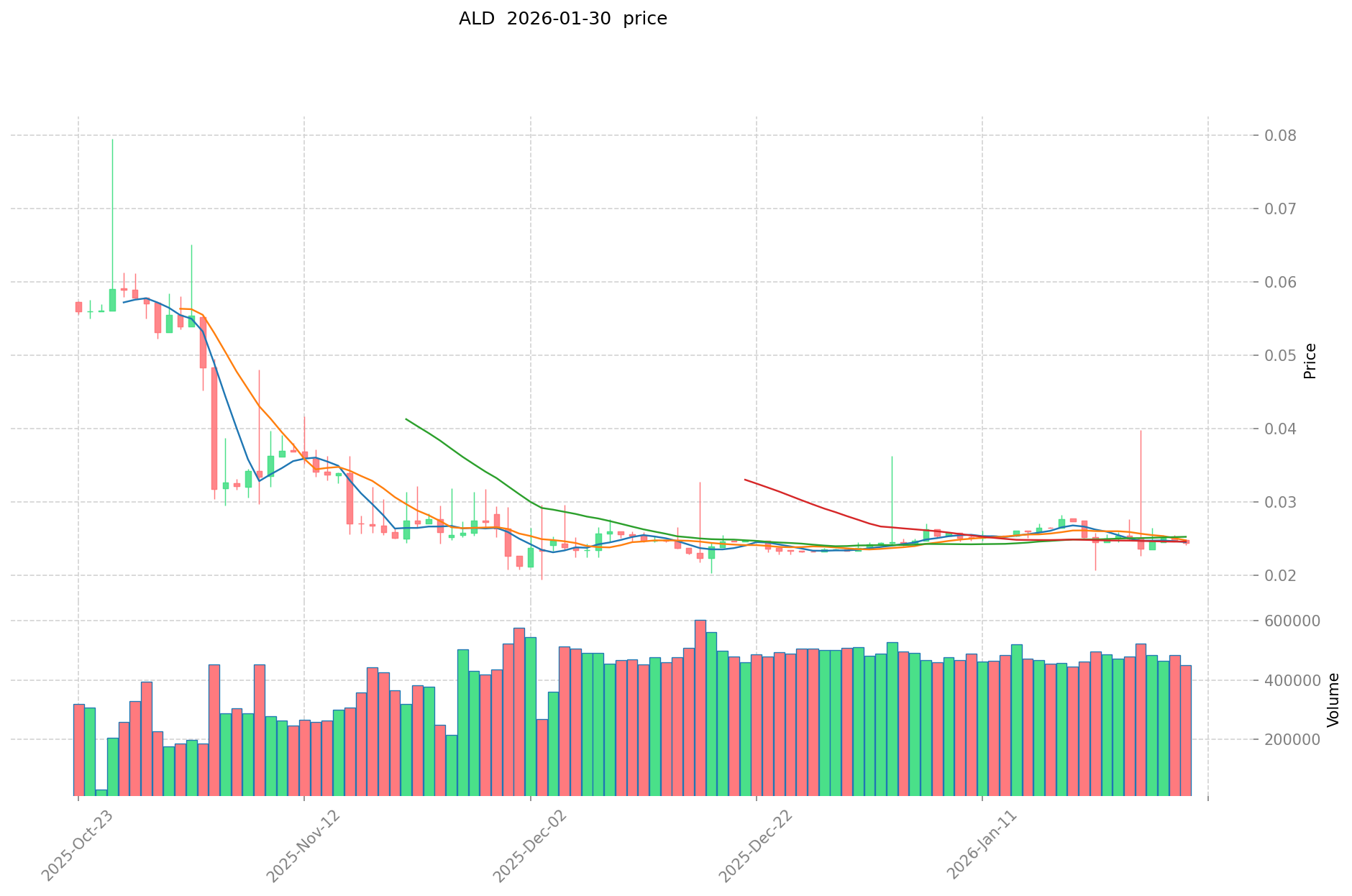
I. ALD Price History Review and Current Investment Value Status
- September 2021: Token launch with an initial offering price of $0.2 → Early investors experienced price appreciation as ALD reached a peak value during the initial market enthusiasm period
- September 2021: Price peaked at $1.37 → ALD demonstrated significant volatility characteristic of early-stage DeFi governance tokens
- April 2025: Market correction period → Price declined to $0.01759207, reflecting broader market adjustments and shifts in DeFi sector sentiment
- January 2026: Gradual recovery phase → Current trading demonstrates a modest rebound from previous lows, with ALD priced at $0.02405
Current ALD Investment Market Status (January 2026)
- ALD current price: $0.02405
- Market sentiment: Circulating supply represents 99.89% of total supply (149.83 million ALD out of 150 million maximum supply)
- 24-hour trading volume: $10,688.41
- Market capitalization: $3.60 million
- 24-hour price range: $0.02364 - $0.02492
- Recent price movements: -3.45% (24H), -6.94% (7D), +2.08% (30D), -39.73% (1Y)
Click to view real-time ALD market price
II. Core Factors Influencing Whether ALD is a Good Investment
Supply Mechanism and Scarcity (ALD Investment Scarcity)
- Maximum supply capped at 150,000,000 ALD tokens with current circulating supply at 149,831,946.77 tokens (99.89% circulation ratio), indicating near-complete token distribution
- The token experienced significant price volatility, trading at $0.02405 as of January 30, 2026, compared to its historical range between $0.01759207 and $1.37
- Investment consideration: The high circulation ratio suggests limited artificial scarcity effects, with price movements potentially driven more by market demand than supply constraints
Institutional Investment and Mainstream Adoption (Institutional Investment in ALD)
- AladdinDAO was jointly launched by multiple cryptocurrency investment institutions as a decentralized asset management platform
- Current holder count stands at 2,870 addresses, with trading activity across 2 exchanges and 24-hour trading volume of $10,688.41
- The project aims to address information asymmetry in DeFi investment through DAO governance mechanisms, though mainstream enterprise adoption data remains limited in available materials
Macroeconomic Environment's Impact on ALD Investment
- As a DeFi-focused governance token with relatively small market capitalization ($3.60 million), ALD may exhibit higher sensitivity to broader crypto market conditions and risk appetite changes
- The token's price performance shows -39.73% decline over one year and -6.94% over seven days, reflecting market volatility patterns
- Cryptocurrency market cycles and regulatory developments could significantly impact investment outcomes for smaller-cap tokens like ALD
Technology and Ecosystem Development (Technology & Ecosystem for ALD Investment)
- ALD operates as an ERC-20 token on the Ethereum network (contract address: 0xb26c4b3ca601136daf98593feaeff9e0ca702a8d)
- The platform functions as a decentralized asset management marketplace designed to help DeFi participants select liquidity mining projects through cryptoeconomic mechanisms
- Ecosystem participation includes staking opportunities, though the project's long-term technical roadmap and competitive positioning within the broader DeFi landscape require ongoing evaluation
III. ALD Future Investment Forecasts and Price Outlook (Is AladdinDAO(ALD) worth investing in 2026-2031)
Short-term Investment Forecast (2026, short-term ALD investment outlook)
- Conservative Forecast: $0.02064 - $0.024
- Neutral Forecast: $0.024 - $0.028
- Optimistic Forecast: $0.028 - $0.03336
Mid-term Investment Outlook (2027-2028, mid-term AladdinDAO(ALD) investment forecast)
- Market Stage Expectation: Based on available data, ALD may experience gradual price development during this period, with potential fluctuations influenced by broader market conditions and platform developments.
- Investment Return Forecast:
- 2027: $0.0177816 - $0.0335556
- 2028: $0.023960706 - $0.037963716
- Key Catalysts: Market adoption trends, DeFi sector dynamics, and community engagement levels may influence price movements during this period.
Long-term Investment Outlook (Is AladdinDAO a good long-term investment?)
- Base Scenario: $0.023 - $0.037 (assuming steady platform development and stable market conditions)
- Optimistic Scenario: $0.035 - $0.050 (assuming increased adoption of decentralized asset management and favorable DeFi market conditions)
- Risk Scenario: $0.018 - $0.025 (under challenging market conditions or reduced platform activity)
For detailed ALD long-term investment and price forecasts, visit: Price Prediction
2026-01-30 to 2031 Long-term Outlook
- Base Scenario: $0.0235 - $0.0375 USD (corresponding to steady progress and gradual mainstream application growth)
- Optimistic Scenario: $0.035 - $0.050 USD (corresponding to large-scale adoption and favorable market environment)
- Transformative Scenario: Above $0.050 USD (such as breakthrough ecosystem developments and mainstream adoption)
- 2031-12-31 Forecast High: $0.049958975204145 USD (based on optimistic development assumptions)
Disclaimer: The forecasts presented are for informational purposes only and should not be considered investment advice. Cryptocurrency markets are highly volatile, and actual prices may differ significantly from predictions. Investors should conduct their own research and consider their risk tolerance before making investment decisions.
| Year |
Predicted High Price |
Predicted Average Price |
Predicted Low Price |
Price Change |
| 2026 |
0.03336 |
0.024 |
0.02064 |
0 |
| 2027 |
0.0335556 |
0.02868 |
0.0177816 |
19 |
| 2028 |
0.037963716 |
0.0311178 |
0.023960706 |
29 |
| 2029 |
0.0362677959 |
0.034540758 |
0.02625097608 |
43 |
| 2030 |
0.037528533567 |
0.03540427695 |
0.023366822787 |
47 |
| 2031 |
0.049958975204145 |
0.0364664052585 |
0.032455100680065 |
51 |
IV. ALD Investment Strategy and Risk Management (How to invest in AladdinDAO)
Investment Methodology (ALD investment strategy)
-
Long-term Holding (HODL ALD): This approach may be suitable for conservative investors who prefer minimal trading activity. Given ALD's 1-year price decline of 39.73%, long-term holders would need to carefully assess the project's fundamental development trajectory and market positioning.
-
Active Trading: This strategy relies on technical analysis and swing trading operations. With ALD showing 24-hour volatility ranging between $0.02364 and $0.02492, active traders may identify short-term trading opportunities, though execution requires solid technical analysis capabilities and risk management discipline.
Risk Management (Risk management for ALD investment)
-
Asset Allocation Ratio: Conservative investors might consider limiting ALD exposure to 1-3% of their portfolio; aggressive investors could allocate 5-10%; professional investors with higher risk tolerance might consider 10-15%, depending on their overall strategy and risk assessment.
-
Risk Hedging Solutions: Diversification across multiple assets and risk management tools can help mitigate exposure. Consider combining ALD with other DeFi assets, stablecoins, or traditional crypto assets to balance portfolio risk.
-
Secure Storage: For ALD (ERC-20 token on Ethereum), cold wallets and hardware wallets are recommended for long-term storage. Hot wallets may be used for active trading purposes, but only with amounts you're prepared to actively manage.
V. ALD Investment Risks and Challenges (Risks of investing in AladdinDAO)
-
Market Risk: ALD demonstrates significant volatility, with a 24-hour change of -3.45% and 7-day decline of -6.94%. The token's relatively low market capitalization of approximately $3.6 million and 24-hour trading volume of around $10,688 may indicate lower liquidity, which could amplify price movements.
-
Regulatory Risk: As a decentralized asset management platform involving multiple cryptocurrency investment institutions, AladdinDAO may face varying regulatory frameworks across different jurisdictions. Policy uncertainty regarding DeFi protocols and DAO structures could impact the project's operations.
-
Technical Risk: The project's infrastructure relies on smart contracts and decentralized mechanisms. Potential vulnerabilities in smart contract code, network security issues, or challenges in protocol upgrades could pose technical risks to token holders.
VI. Conclusion: Is AladdinDAO a Good Investment?
-
Investment Value Summary: ALD presents itself as a specialized DeFi asset management solution, but faces considerable market challenges, as evidenced by its 39.73% decline over the past year. The project's relatively small market cap and limited exchange listings (2 exchanges) suggest it remains in an early or niche stage. Short-term price volatility remains substantial.
-
Investor Recommendations:
✅ Beginners: If considering ALD, employ dollar-cost averaging (DCA) strategies and prioritize secure wallet storage. However, beginners should be aware of the higher risks associated with smaller market cap tokens.
✅ Experienced Investors: May consider swing trading strategies while maintaining diversified portfolio allocation. Monitor the project's development progress and community activity closely.
✅ Institutional Investors: Should conduct comprehensive due diligence on the project's fundamentals, team background, and market positioning before considering any strategic allocation.
⚠️ Disclaimer: Cryptocurrency investment carries high risk. This content is for informational purposes only and does not constitute investment advice. Conduct thorough research and consult with financial professionals before making investment decisions.
VII. FAQ
Q1: Is AladdinDAO (ALD) a good investment for beginners in 2026?
ALD carries significant risks for beginners due to its high volatility and limited liquidity. As of January 30, 2026, ALD demonstrates substantial price fluctuations with a 24-hour trading volume of only $10,688.41 and a market capitalization of approximately $3.60 million. The token has declined 39.73% over the past year and shows recent negative momentum with -3.45% (24H) and -6.94% (7D) changes. Beginners considering ALD should start with small allocations (1-3% of portfolio), employ dollar-cost averaging strategies, and prioritize secure wallet storage. Given the project's early-stage characteristics and limited exchange availability (only 2 exchanges), novice investors should thoroughly research the DeFi sector and understand the higher risks associated with smaller market cap tokens before investing.
Q2: What is the price prediction for AladdinDAO (ALD) in 2027-2028?
Mid-term forecasts suggest ALD may range between $0.0177816-$0.0335556 in 2027 and $0.023960706-$0.037963716 in 2028. These projections are based on assumptions of steady platform development and stable market conditions. The predicted average price for 2027 stands at approximately $0.02868, representing a potential 19% increase from the 2026 baseline, while 2028's average forecast of $0.0311178 suggests a 29% cumulative growth. However, actual performance will depend heavily on several key catalysts including broader DeFi sector dynamics, community engagement levels, and market adoption trends. Investors should note that cryptocurrency markets are highly volatile, and these forecasts should not be considered guaranteed outcomes but rather potential scenarios based on current data and market analysis.
Q3: How does ALD's supply mechanism affect its investment potential?
ALD has a maximum supply cap of 150,000,000 tokens with near-complete distribution at 99.89% circulation ratio (149,831,946.77 tokens currently circulating). This high circulation ratio indicates limited artificial scarcity effects, meaning price movements are likely driven more by genuine market demand rather than supply constraints. Unlike cryptocurrencies with low circulation ratios where future token releases might create selling pressure, ALD's nearly complete distribution reduces this concern. However, this also means there is minimal supply-side pressure to drive price appreciation. The token operates as an ERC-20 on Ethereum (contract address: 0xb26c4b3ca601136daf98593feaeff9e0ca702a8d), and with only 2,870 holder addresses, the relatively concentrated ownership structure may contribute to price volatility. Investors should recognize that investment returns will depend primarily on increased adoption and utility rather than scarcity-driven appreciation.
Q4: What are the main risks associated with investing in AladdinDAO?
Three primary risk categories affect ALD investment: market risk, regulatory risk, and technical risk. Market risk is evidenced by significant volatility and low liquidity—the token's market capitalization of only $3.6 million and 24-hour trading volume of approximately $10,688 make it susceptible to amplified price movements and potential difficulty executing large trades. Regulatory risk stems from AladdinDAO's positioning as a decentralized asset management platform involving multiple cryptocurrency investment institutions, which may face varying regulatory frameworks across jurisdictions, particularly as DeFi protocols and DAO structures encounter evolving policy landscapes. Technical risk relates to the project's reliance on smart contracts and decentralized mechanisms—potential vulnerabilities in smart contract code, network security issues, or challenges in protocol upgrades could directly impact token holders. Additionally, the limited exchange availability (only 2 exchanges) creates concentration risk and may restrict liquidity options for investors.
Q5: What investment strategies are recommended for ALD holders?
Two primary strategies exist for ALD investors, each suited to different risk profiles and time horizons. The long-term holding (HODL) approach may suit conservative investors preferring minimal trading activity, though given ALD's 39.73% annual decline, holders must carefully assess the project's fundamental development trajectory and market positioning before committing to this strategy. This approach typically involves allocating 1-3% of portfolio for conservative investors, 5-10% for aggressive investors, and potentially 10-15% for professional investors with higher risk tolerance. The active trading strategy relies on technical analysis and swing trading operations, potentially capitalizing on ALD's intraday volatility range between $0.02364 and $0.02492. However, this requires solid technical analysis capabilities and disciplined risk management. Regardless of strategy, investors should implement proper risk hedging through portfolio diversification across multiple DeFi assets, stablecoins, or traditional cryptocurrencies, and utilize cold wallets or hardware wallets for long-term storage of ALD tokens.
Q6: How does AladdinDAO compare to other DeFi governance tokens?
AladdinDAO positions itself as a decentralized asset management marketplace designed to address information asymmetry in DeFi investment through cryptoeconomic mechanisms and DAO governance. However, its current market metrics reveal a relatively modest scale compared to established DeFi protocols—with a market cap of only $3.60 million and holder count of 2,870 addresses, ALD operates in a more niche segment. The platform's core value proposition focuses on helping DeFi participants select liquidity mining projects through decentralized decision-making, which differentiates it from broader DeFi governance tokens that manage entire protocol ecosystems. While jointly launched by multiple cryptocurrency investment institutions, mainstream enterprise adoption data remains limited. The token's historical price trajectory from a peak of $1.37 to current levels around $0.02405 reflects both the challenges of early-stage DeFi projects and the broader market correction experienced across the sector. Investors evaluating ALD should consider how its specialized asset management focus and current development stage compare to their specific investment thesis within the DeFi landscape.
Q7: What factors could drive ALD price appreciation in 2026-2031?
Long-term price appreciation for ALD depends on several interconnected catalysts spanning technological development, market adoption, and ecosystem growth. The base scenario projecting $0.0235-$0.0375 by 2031 assumes steady platform progress and gradual mainstream application expansion within the decentralized asset management niche. Key positive drivers could include increased adoption of AladdinDAO's asset management tools by DeFi participants, successful expansion of the platform's marketplace functionality, and growing recognition of its value proposition in addressing information asymmetry. The optimistic scenario ($0.035-$0.050) would require favorable DeFi market conditions, potential integration with major DeFi protocols, and significant growth in community engagement and governance participation. The transformative scenario (above $0.050) could materialize through breakthrough ecosystem developments such as institutional partnerships, innovative product offerings that significantly expand the addressable market, or mainstream adoption of decentralized asset management solutions. However, investors should note that achieving these scenarios requires sustained development momentum, competitive differentiation, and navigating regulatory landscapes while maintaining technical security and operational efficiency.
Q8: Should investors buy ALD at current price levels in January 2026?
The investment decision depends critically on individual risk tolerance, investment horizon, and portfolio strategy. At the current price of $0.02405 (as of January 30, 2026), ALD trades significantly below its historical peak of $1.37 but shows a modest 2.08% gain over the past 30 days, potentially indicating stabilization after the April 2025 correction to $0.01759207. Short-term forecasts suggest a conservative range of $0.02064-$0.024, neutral range of $0.024-$0.028, and optimistic range of $0.028-$0.03336 for 2026, indicating limited immediate upside with continued volatility risk. For risk-tolerant investors with strong conviction in decentralized asset management and the DeFi sector's long-term prospects, current levels might represent an entry opportunity, particularly using dollar-cost averaging to mitigate timing risk. However, several cautions apply: the 24-hour trading volume of only $10,688.41 indicates very limited liquidity, the token's availability on just 2 exchanges restricts trading options, and the broader market uncertainty affecting small-cap DeFi tokens persists. Conservative investors should wait for clearer signs of platform development progress, increased trading volume, and improved market sentiment before initiating positions. Regardless of decision, any ALD investment should represent only a small percentage of overall portfolio allocation given the high-risk profile.
* The information is not intended to be and does not constitute financial advice or any other recommendation of any sort offered or endorsed by Gate.