Alchemist AI (ALCH) is a Solana-based no-code development platform token with a market cap of $132.34 million and current price of $0.15569. This comprehensive analysis examines ALCH's investment potential through tokenomics, with 1 billion tokens fixed supply and 850 million in circulation, and advanced technology utilizing natural language processing for application development. The article evaluates multiple investment scenarios, projecting price ranges from $0.050547 to $0.21091 in 2026 and up to $0.29578 by 2029, considering factors like ecosystem adoption and market conditions. Investment strategies are tailored for conservative (1-2% allocation), moderate (3-5%), and aggressive (5-10%) investors, emphasizing diversification and risk management. Significant risks include market volatility, regulatory uncertainty, and technical dependencies on Solana infrastructure. Currently listed on 22 exchanges including Gate with 26,995 holders, ALCH presents opportunities for investors willing to tolerate emerging
Introduction: Alchemist AI (ALCH) Investment Position and Market Prospects
ALCH is a notable asset in the cryptocurrency field. As of January 2026, Alchemist AI holds a market capitalization of approximately $132.34 million, with a circulating supply of around 850 million tokens, and the current price is maintained at approximately $0.15569. With its positioning as a no-code development platform that enables users to create software applications through simple descriptions, ALCH has gradually become a focal point for investors discussing "Is Alchemist AI (ALCH) a good investment?" The token serves primarily for in-app payments, consumption, and market transactions within its ecosystem. This article will comprehensively analyze ALCH's investment value, historical trends, future price predictions, and investment risks to provide reference for investors.
I. Cryptocurrency (ALCH) Price Historical Review and Current Investment Value Status
- 2025: Token Launch and Initial Trading → ALCH was published at $0.18 on November 30, 2024, and experienced price fluctuations during its early trading phase
- 2025: Price Volatility Period → ALCH price moved from approximately $0.24492 to around $0.01405 during market adjustment cycles
- 2026: Market Recovery Phase → As of January 17, 2026, ALCH showed signs of stabilization with a 7-day increase of 28.38%
Current ALCH Investment Market Status (January 2026)
- ALCH current price: $0.15569
- Market sentiment (Fear & Greed Index): Data not available in provided materials
- 24-hour trading volume: $1,792,584.92
- Institutional investor holdings: Data shows 26,995 holders with a circulating supply of 850,000,000 tokens
Click to view real-time ALCH market price
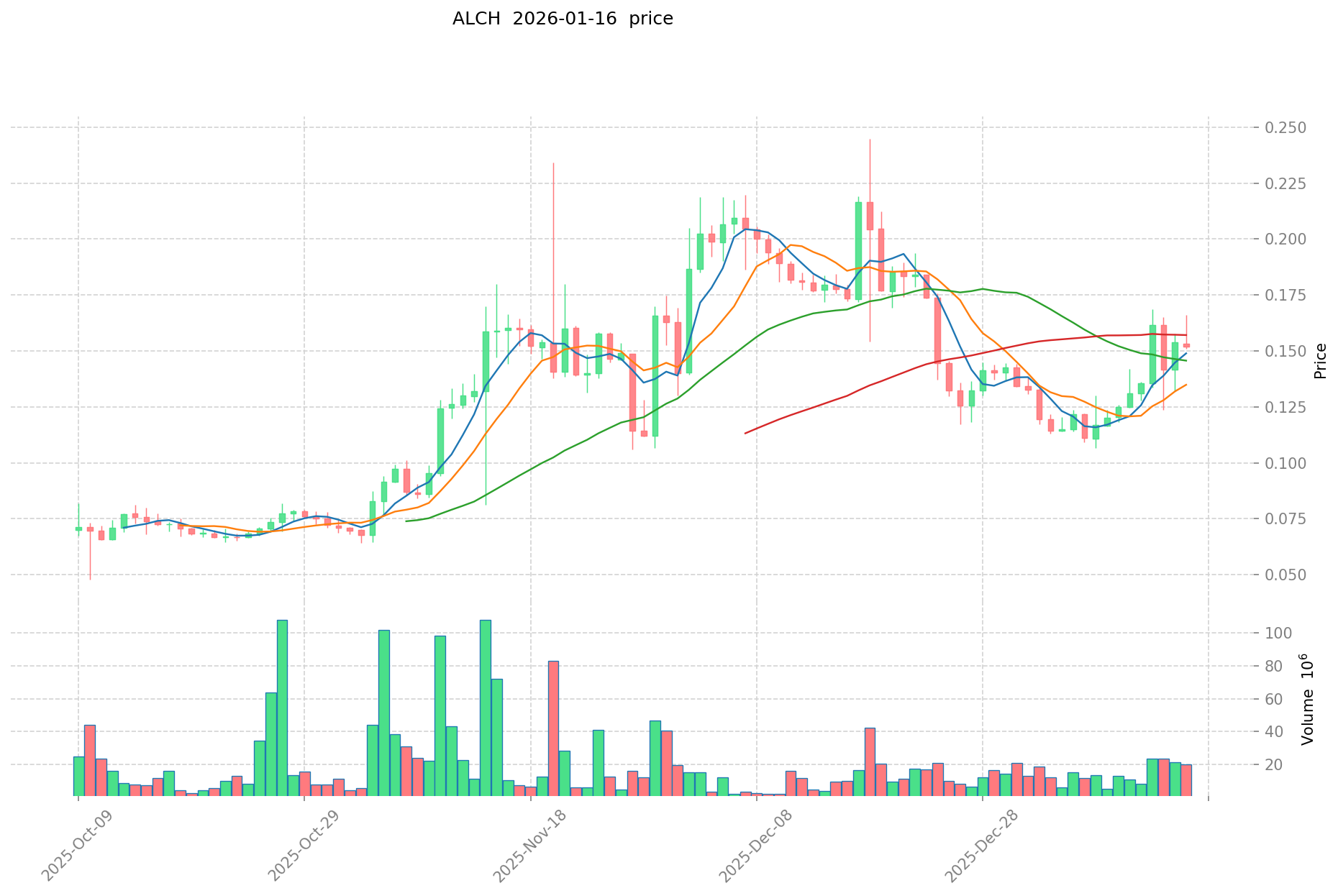
II. Core Factors Affecting Whether ALCH is a Good Investment (Is Alchemist AI(ALCH) a Good Investment)
Supply Mechanism and Scarcity (ALCH investment scarcity)
- Fixed maximum supply of 1,000,000,000 ALCH tokens → influences price dynamics and investment value
- Current circulation: 850,000,000 tokens (85% of total supply) with fully diluted market cap at $155,690,000
- Investment significance: the limited supply structure provides a foundation for potential scarcity-driven value appreciation
Institutional Investment and Mainstream Adoption (Institutional investment in ALCH)
- Holder base: 26,995 addresses demonstrate growing community participation
- Listed on 22 exchanges, including major platforms, indicating market accessibility and liquidity
- The $ALCH token functions as the primary medium for in-app payments, consumption, and marketplace transactions within the Alchemist AI ecosystem, supporting utility-driven adoption
Macroeconomic Environment's Impact on ALCH Investment
- As a Solana-based token, ALCH's investment appeal may be influenced by broader cryptocurrency market sentiment and monetary policy shifts
- During periods of technological innovation focus, no-code development platforms may attract increased investor interest
- Market volatility and regulatory developments in the crypto space continue to shape investment considerations for AI-focused tokens
Technology and Ecosystem Development (Technology & Ecosystem for ALCH investment)
- Core platform functionality: Alchemist AI utilizes natural language processing, code generation, web framework integration, and limited operating system APIs to transform user descriptions into functional applications
- No-code development paradigm: lowers barriers to software creation, potentially expanding the addressable market and user base
- Ecosystem applications: the token's integration into the platform's payment and marketplace infrastructure provides utility-based demand drivers for long-term value consideration
III. ALCH Future Investment Prediction and Price Outlook (Is Alchemist AI (ALCH) worth investing in 2026-2031)
Short-term Investment Prediction (2026, short-term ALCH investment outlook)
Based on current market data and analytical models, short-term price projections for ALCH in 2026 present the following scenarios:
- Conservative prediction: $0.050547 - $0.12655
- Neutral prediction: $0.14758 - $0.15623
- Optimistic prediction: $0.18358 - $0.21091
These projections reflect varying market conditions, including potential volatility in trading volume (currently at $1.79 million over 24 hours) and the token's recent 7-day performance showing a 28.38% increase. The circulating supply stands at 850 million tokens (85% of total supply), which may influence price stability within this timeframe.
Mid-term Investment Outlook (2027-2029, mid-term Alchemist AI (ALCH) investment forecast)
-
Market stage expectation: The mid-term period may witness consolidation phases as the no-code development platform expands its user base and ecosystem applications. Market sentiment indicators suggest growing interest in AI-powered development tools, which could support sustained momentum.
-
Investment return prediction:
- 2027: $0.11014 - $0.19275 (reflecting a potential 17% growth trajectory)
- 2028: $0.17499 - $0.20886 (projecting a 20% increase scenario)
- 2029: $0.10521 - $0.29578 (indicating wider price variance with 26% growth potential)
-
Key catalysts: Expansion of ecosystem applications, increased adoption of the no-code platform, developments in natural language processing capabilities, and integration with web frameworks. The token's utility in in-app payments and marketplace transactions within the ecosystem may drive demand.
Long-term Investment Outlook (Is ALCH a good long-term investment?)
- Baseline scenario: $0.14324 - $0.28137 (assuming steady ecosystem development and moderate market conditions)
- Optimistic scenario: $0.24714 - $0.29578 (contingent upon successful platform adoption and favorable market environment)
- Risk scenario: $0.10521 - $0.17794 (under challenging market conditions or slower-than-expected adoption rates)
For detailed ALCH long-term investment and price predictions, visit: Price Prediction
2026-2031 Long-term Outlook
- Base scenario: $0.15569 - $0.25579 (corresponding to steady progress and gradual mainstream application uptake)
- Optimistic scenario: $0.24714 - $0.29578 (corresponding to large-scale adoption and favorable market environment)
- Transformative scenario: Above $0.30 (contingent upon breakthrough ecosystem developments and mainstream adoption)
- December 31, 2031 projected high: $0.28137 (based on optimistic development assumptions)
Disclaimer: These predictions are analytical projections based on available data and market models. Cryptocurrency markets are highly volatile and influenced by numerous unpredictable factors. Historical performance does not guarantee future results. Investors should conduct thorough research and consider their risk tolerance before making investment decisions. This analysis does not constitute financial advice.
| Year |
Predicted High Price |
Predicted Average Price |
Predicted Low Price |
Price Change |
| 2026 |
0.2109105 |
0.15623 |
0.1265463 |
0 |
| 2027 |
0.1927487625 |
0.18357025 |
0.11014215 |
17 |
| 2028 |
0.2088570519375 |
0.18815950625 |
0.1749883408125 |
20 |
| 2029 |
0.295777335849687 |
0.19850827909375 |
0.105209387919687 |
26 |
| 2030 |
0.264442803994739 |
0.247142807471718 |
0.177942821379637 |
58 |
| 2031 |
0.281372086306551 |
0.255792805733229 |
0.143243971210608 |
63 |
IV. ALCH Investment Strategy and Risk Management (How to invest in Alchemist AI)
Investment Methodology (ALCH investment strategy)
Long-term Holding (HODL ALCH)
Long-term holding may suit investors who believe in the fundamental value of Alchemist AI's no-code development platform. This approach typically involves:
- Acquiring ALCH tokens during price consolidation periods
- Storing tokens securely for extended periods
- Focusing on the platform's adoption metrics and ecosystem growth rather than short-term price movements
This strategy is generally more appropriate for investors with:
- Higher risk tolerance for emerging technology projects
- Ability to withstand significant price volatility
- Long-term conviction in AI-driven development tools
Active Trading
Active trading strategies involve:
- Technical analysis using price charts and indicators
- Monitoring the 24-hour trading volume (approximately $1.79 million as of recent data)
- Identifying support and resistance levels based on historical price ranges
- Utilizing swing trading during periods of high volatility
Traders should note ALCH's price volatility, with 7-day changes reaching 28.38% and 30-day fluctuations of -9.95%.
Risk Management (Risk management for ALCH investment)
Asset Allocation Ratios
Conservative Investors:
- Allocate no more than 1-2% of total crypto portfolio to ALCH
- Maintain majority holdings in established cryptocurrencies
- Prioritize capital preservation over aggressive growth
Moderate Investors:
- Consider 3-5% allocation to emerging AI-focused tokens like ALCH
- Balance between established assets and growth opportunities
- Regular portfolio rebalancing based on market conditions
Aggressive Investors:
- May allocate 5-10% to speculative positions in projects like ALCH
- Accept higher volatility for potential growth opportunities
- Implement strict stop-loss mechanisms
Risk Hedging Approaches
Multi-Asset Portfolio Construction:
- Diversify across different cryptocurrency categories
- Include both utility tokens and platform tokens
- Consider correlation patterns between different assets
Risk Mitigation Tools:
- Set predetermined exit points for both profit-taking and loss limitation
- Monitor circulating supply (850 million ALCH, representing 85% of total supply)
- Track market capitalization changes and trading volume trends
Secure Storage Solutions
Cold Wallet Storage:
For long-term holdings:
- Hardware wallets supporting Solana-based tokens
- Paper wallets with proper backup procedures
- Multi-signature wallet configurations for larger amounts
Hot Wallet Considerations:
For active trading:
- Reputable exchange wallets with strong security track records
- Two-factor authentication and withdrawal whitelisting
- Limited fund allocation for immediate trading needs
Hardware Wallet Recommendations:
- Devices compatible with Solana ecosystem tokens
- Regular firmware updates and security patches
- Proper backup and recovery phrase management
V. ALCH Investment Risks and Challenges (Risks of investing in Alchemist AI)
Market Risks
High Volatility:
- ALCH has demonstrated significant price movements, with a 7-day change of 28.38%
- Historical price range spans from $0.01405 to $0.24492
- Current market capitalization of approximately $132.34 million indicates relatively small market size
- Daily trading volume of $1.79 million suggests potential liquidity constraints
Price Manipulation Concerns:
- Relatively concentrated holder base (26,995 holders)
- Market depth may be insufficient for large transactions
- Susceptibility to whale movements due to smaller trading volumes
Regulatory Risks
Jurisdictional Uncertainty:
- Different countries maintain varying regulatory frameworks for utility tokens
- Potential classification changes could impact token trading and usage
- Compliance requirements may evolve as cryptocurrency regulations develop
Platform Service Risks:
- No-code development platforms may face regulatory scrutiny regarding software licensing
- Cross-border service provision could encounter legal complexities
- Token utility within the ecosystem may be subject to securities regulations in certain jurisdictions
Technical Risks
Network Security:
- Smart contract vulnerabilities on the Solana blockchain
- Potential exploits in the platform's code generation mechanisms
- Dependency on Solana network stability and performance
Upgrade and Development Risks:
- Platform functionality updates may introduce unforeseen bugs
- Integration challenges with evolving web frameworks
- Competition from established development platforms and emerging AI tools
Ecosystem Dependencies:
- Reliance on Solana blockchain infrastructure
- Third-party API integration risks
- Natural language processing accuracy and reliability
VI. Conclusion: Is Alchemist AI a Good Investment?
Investment Value Summary
Alchemist AI presents a distinctive value proposition in the no-code development space, combining artificial intelligence with blockchain technology. The platform's approach to transforming natural language descriptions into functional applications addresses a growing market need. However, several factors warrant careful consideration:
- The token has experienced considerable price volatility, ranging from $0.01405 to $0.24492
- Current market positioning with 22 exchange listings and approximately 27,000 holders indicates developing adoption
- The circulating supply represents 85% of total supply, suggesting limited future dilution concerns
- 30-day price decline of -9.95% reflects short-term market pressures
Investor Recommendations
✅ Beginner Investors:
- Consider small allocation through dollar-cost averaging approach
- Utilize secure wallet solutions compatible with Solana tokens
- Focus on understanding the platform's utility before investment
- Start with minimal exposure to learn market dynamics
✅ Experienced Investors:
- Implement technical analysis for entry and exit timing
- Monitor platform adoption metrics and ecosystem development
- Diversify across multiple AI and utility token projects
- Consider both short-term trading and strategic holding positions
✅ Institutional Investors:
- Evaluate as part of emerging technology portfolio allocation
- Conduct thorough due diligence on platform technology and team
- Consider longer-term holding periods aligned with platform development roadmap
- Implement professional risk management frameworks
⚠️ Important Notice: Cryptocurrency investments carry substantial risk, including the potential loss of principal. This analysis is provided for informational purposes only and does not constitute financial, investment, or trading advice. Market conditions can change rapidly, and past performance does not indicate future results. Investors should conduct independent research and consider their individual financial situation and risk tolerance before making investment decisions.
VII. FAQ
Q1: What is the primary function of the ALCH token within the Alchemist AI ecosystem?
The ALCH token serves as the primary medium for in-app payments, consumption, and marketplace transactions within the Alchemist AI ecosystem. The token enables users to access the no-code development platform's services, facilitating the creation of software applications through natural language descriptions. Beyond payment functionality, ALCH operates as a utility token that supports the platform's economic model, connecting developers with the tools and resources needed for application development. The token's integration into the platform's infrastructure provides utility-based demand, as users require ALCH to participate in the ecosystem's various activities, including accessing advanced features, participating in marketplace transactions, and consuming platform resources.
Q2: What are the key technical risks associated with investing in ALCH?
The primary technical risks include smart contract vulnerabilities on the Solana blockchain, potential exploits in the platform's code generation mechanisms, and dependency on Solana network stability. Since Alchemist AI operates on Solana infrastructure, any network disruptions or security breaches affecting the underlying blockchain could impact ALCH's functionality and value. Additionally, the platform's reliance on natural language processing and code generation technologies introduces risks related to accuracy and reliability. Platform updates may introduce unforeseen bugs, and integration challenges with evolving web frameworks could affect user experience. Competition from established development platforms and emerging AI tools also presents technical competitive risks. Investors should consider these technical dependencies when evaluating their risk exposure to ALCH tokens.
Q3: How does ALCH's supply mechanism affect its investment potential?
ALCH has a fixed maximum supply of 1,000,000,000 tokens, with 850,000,000 tokens currently in circulation (85% of total supply). This limited supply structure provides a foundation for potential scarcity-driven value appreciation, as only 15% of tokens remain undistributed. The relatively high circulating percentage suggests minimal future dilution concerns compared to projects with lower initial circulation rates. The fully diluted market capitalization stands at approximately $155.69 million, indicating the potential maximum market value at current prices if all tokens enter circulation. This supply mechanism creates a predictable tokenomics model where increasing demand must compete for a relatively fixed token supply, potentially supporting price appreciation as adoption grows. However, investors should note that supply constraints alone do not guarantee value appreciation, as market sentiment, platform adoption, and broader cryptocurrency market conditions remain critical factors.
Q4: What are the recommended portfolio allocation strategies for ALCH based on different investor risk profiles?
Conservative investors should allocate no more than 1-2% of their total cryptocurrency portfolio to ALCH, maintaining majority holdings in established cryptocurrencies and prioritizing capital preservation. Moderate investors may consider a 3-5% allocation to emerging AI-focused tokens like ALCH, balancing between established assets and growth opportunities while implementing regular portfolio rebalancing. Aggressive investors might allocate 5-10% to speculative positions in projects like ALCH, accepting higher volatility for potential growth opportunities while implementing strict stop-loss mechanisms. These recommendations reflect ALCH's position as an emerging technology project with significant volatility, as evidenced by price movements ranging from $0.01405 to $0.24492. Regardless of risk profile, investors should ensure they maintain diversification across different cryptocurrency categories and implement appropriate risk management tools, including predetermined exit points and secure storage solutions.
Q5: What factors could drive ALCH's price performance in the mid-term (2027-2029)?
Mid-term price performance for ALCH depends primarily on platform adoption metrics, ecosystem expansion, and developments in natural language processing capabilities. Projections suggest potential price ranges from $0.11014 to $0.29578 during 2027-2029, with varying scenarios reflecting different adoption trajectories. Key catalysts include the expansion of ecosystem applications, increased adoption of the no-code development platform, and successful integration with web frameworks. The token's utility in facilitating in-app payments and marketplace transactions provides fundamental demand drivers that could support sustained momentum. Additionally, broader market sentiment toward AI-powered development tools and the overall cryptocurrency market environment will significantly influence price direction. The platform's ability to attract and retain users, expand its holder base beyond the current 26,995 addresses, and maintain or increase trading volumes from current levels will be critical indicators of mid-term success and corresponding price appreciation potential.
Q6: How does ALCH's current market liquidity compare to established cryptocurrencies?
ALCH demonstrates relatively limited market liquidity compared to established cryptocurrencies, with a 24-hour trading volume of approximately $1.79 million and a market capitalization of $132.34 million. The token is listed on 22 exchanges, providing reasonable accessibility but still representing a developing market presence. The daily trading volume relative to market capitalization suggests moderate liquidity constraints, potentially making the token susceptible to larger price movements from significant buy or sell orders. The holder base of 26,995 addresses indicates growing community participation but remains substantially smaller than major cryptocurrency projects. This liquidity profile means investors should be prepared for potentially wider bid-ask spreads and possible difficulty executing large transactions without price impact. For comparison, major cryptocurrencies typically exhibit daily trading volumes representing a higher percentage of their market capitalization and maintain significantly deeper order books across multiple exchanges.
Q7: What regulatory considerations should investors be aware of when investing in ALCH?
Investors should be aware of several regulatory considerations affecting ALCH. Different jurisdictions maintain varying regulatory frameworks for utility tokens, and potential classification changes could impact token trading and usage rights. The platform's no-code development services may face regulatory scrutiny regarding software licensing requirements, and cross-border service provision could encounter legal complexities depending on operational jurisdictions. Token utility within the ecosystem may be subject to securities regulations in certain countries, particularly if regulatory bodies determine that ALCH exhibits characteristics of an investment contract. Compliance requirements continue to evolve as cryptocurrency regulations develop globally, and changes in regulatory stance could affect the token's legal status, exchange listings, or platform operations. Investors should monitor regulatory developments in their specific jurisdictions and consider consulting legal professionals familiar with cryptocurrency regulations. The decentralized nature of blockchain technology provides certain protections, but investors remain subject to local laws governing cryptocurrency ownership and trading activities.
Q8: What distinguishes Alchemist AI's no-code development approach from competing platforms?
Alchemist AI distinguishes itself through its integration of natural language processing with blockchain-based tokenomics, enabling users to create software applications through simple descriptions without traditional coding knowledge. The platform utilizes code generation capabilities, web framework integration, and limited operating system APIs to transform user descriptions into functional applications. Unlike traditional no-code platforms, ALCH incorporates a token-based economic model where the $ALCH token facilitates in-app payments, consumption, and marketplace transactions, creating a self-sustaining ecosystem. This approach lowers barriers to software creation while providing economic incentives for platform participation. However, investors should note that the competitive landscape includes established development platforms and emerging AI tools that may offer similar or enhanced functionality. The platform's success depends on its ability to deliver superior user experience, maintain technological advantages in natural language processing accuracy, and build a robust ecosystem of applications and services that drive sustained token utility and demand.
* The information is not intended to be and does not constitute financial advice or any other recommendation of any sort offered or endorsed by Gate.