This comprehensive analysis examines whether Alchemix (ALCX) presents a viable investment opportunity within the DeFi sector. As of January 2026, ALCX trades at approximately $7.00 with a market capitalization of $17.58 million, representing a niche position among cryptocurrency assets. The article evaluates ALCX's unique self-repaying loan mechanism, unlimited supply model, and governance structure through a detailed framework covering historical price performance, fundamental factors, and future price projections ranging from $5.53 to $14.66 through 2031. Key investment considerations include the token's 99.66% decline from its all-time high, modest trading volume constraints, and exposure to DeFi sector risks. The analysis provides tailored recommendations for conservative, experienced, and institutional investors, while highlighting critical technical vulnerabilities, regulatory uncertainties, and market liquidity challenges that require careful risk management before establishing ALCX positions.
Introduction: Alchemix (ALCX)'s Investment Position and Market Outlook
ALCX is a significant asset in the cryptocurrency space, launched in 2021 as the native governance and utility token of the Alchemix protocol. Since its inception, it has established a presence in the decentralized finance (DeFi) sector, particularly in yield-generating lending mechanisms. As of January 24, 2026, Alchemix holds a market capitalization of approximately 17.58 million USD, with a circulating supply of around 2.51 million tokens, and the current price stands at approximately 7.00 USD. With its positioning as a DeFi protocol that enables self-repaying loans through future yield tokenization, ALCX has become a focal point for investors considering "Is Alchemix (ALCX) a good investment?" The protocol operates through key components including Vaults, Staking Pools, and Transmuter mechanisms, managed by the Alchemix DAO. The token serves multiple functions including liquidity mining incentives, synthetic token minting collateral, and on-chain governance participation. This article provides a comprehensive analysis of ALCX's investment value, historical performance, future price projections, and associated risks to offer reference for potential investors.
I. Historical Price Review and Current Investment Value Status of ALCX
- 2021: Token launch and early market adoption → ALCX experienced significant price appreciation during the DeFi summer period
- 2025: Market consolidation phase → ALCX price fluctuated between support and resistance levels established throughout the year
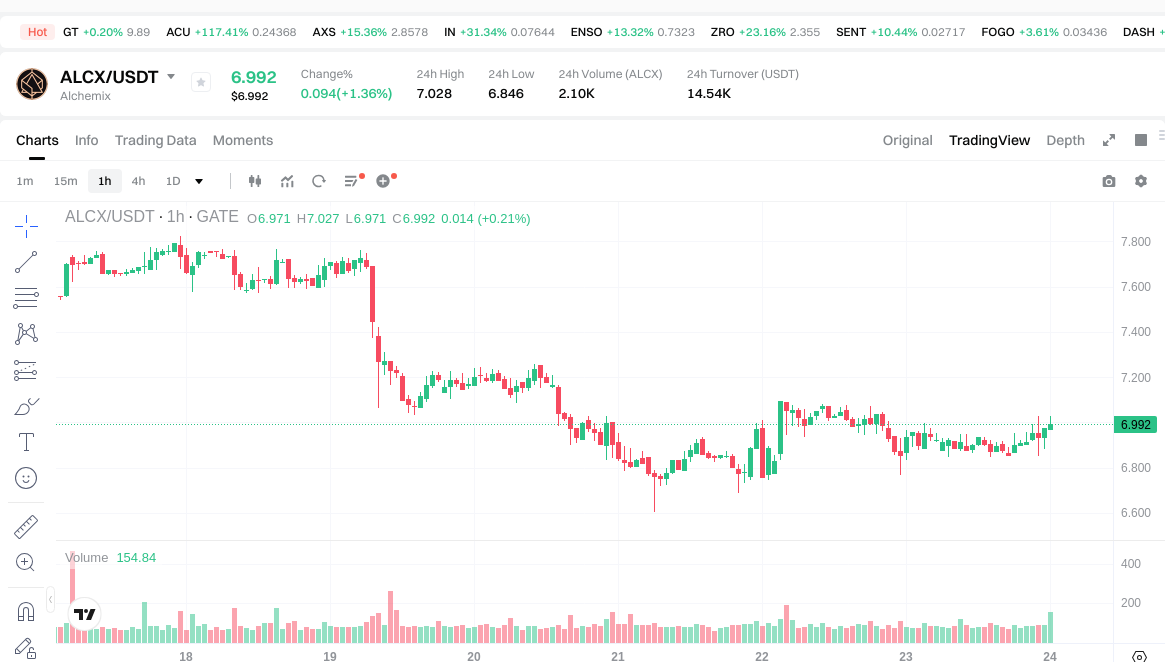
- Recent trend: The token declined from $7.50 range to approximately $5.17 within the observed period
Current ALCX Investment Market Status (January 2026)
- Current ALCX price: $7.001
- Market sentiment (Fear & Greed Index): Data not available in provided materials
- 24-hour trading volume: $13,620.16
- Institutional investor holdings: Data not available in provided materials
Click to view real-time ALCX market price
II. Core Factors Influencing Whether ALCX is a Good Investment (Is Alchemix(ALCX) a Good Investment)
Supply Mechanism and Scarcity (ALCX investment scarcity)
- Maximum supply is unlimited (∞), with current total supply of 3,099,764.75 ALCX and circulating supply of 2,510,917.26 ALCX
- The circulating supply represents approximately 83.55% of total supply, indicating a relatively high circulation ratio in the market
- Investment significance: The unlimited maximum supply model may present challenges for long-term scarcity-driven value appreciation compared to fixed-supply assets
Institutional Investment and Mainstream Adoption (Institutional investment in ALCX)
- ALCX has a holder base of 14,268 addresses, reflecting current market participation levels
- The token is listed on 17 exchanges, providing liquidity channels across different platforms
- Market capitalization stands at approximately $17.58 million with a market share of 0.00068%, positioning it within the mid-to-lower tier of digital assets
Macroeconomic Environment's Impact on ALCX Investment
- As a DeFi protocol token, ALCX's investment appeal may be influenced by broader monetary policy shifts and interest rate environments affecting yield-generating opportunities
- During periods of economic uncertainty, investor preference may shift between traditional DeFi protocols and emerging alternatives, potentially affecting ALCX's market positioning
- Regulatory developments in decentralized finance could impact the operational framework and investment considerations for protocols like Alchemix
Technology and Ecosystem Development (Technology & Ecosystem for ALCX investment)
- Vault mechanism: Enables users to deposit collateral and mint synthetic tokens representing future yield, providing a unique value proposition in the DeFi lending space
- Transmuter functionality: Allows users to convert synthetic assets back to underlying assets over time, enhancing protocol utility
- Integration with established DeFi platforms: The protocol's compatibility with yield-generating strategies across Ethereum ecosystem may support long-term ecosystem development
- DAO governance structure: ALCX token holders participate in protocol governance through on-chain voting, providing community-driven decision-making capabilities
III. ALCX Future Investment Forecast and Price Outlook (Is Alchemix(ALCX) worth investing in 2026-2031)
Short-term Investment Forecast (2026, short-term ALCX investment outlook)
- Conservative forecast: $5.53 - $7.00
- Neutral forecast: $7.00 - $7.67
- Optimistic forecast: $7.67 - $8.33
Mid-term Investment Outlook (2027-2029, mid-term Alchemix(ALCX) investment forecast)
-
Market phase expectations: The DeFi protocol segment may experience moderate growth as the ecosystem continues to develop its self-repaying loan mechanism and synthetic token offerings. Market conditions could remain volatile with potential for gradual recovery.
-
Investment return forecast:
- 2027: $7.28 - $10.81
- 2028: $5.54 - $9.61
- 2029: $5.94 - $11.22
-
Key catalysts: Potential expansion of vault offerings, increased adoption of self-repaying loan mechanisms, development of liquidity mining incentives, and broader DeFi market trends.
Long-term Investment Outlook (Is ALCX a good long-term investment?)
- Base scenario: $9.70 - $14.66 (assuming steady protocol development and moderate DeFi sector growth)
- Optimistic scenario: $12.49 - $14.66 (assuming increased adoption of synthetic assets and favorable regulatory environment)
- Risk scenario: $5.53 - $7.28 (under conditions of extended market downturn or reduced DeFi activity)
View ALCX long-term investment and price forecast: Price Prediction
2026-01-24 - 2031 Long-term Outlook
- Base scenario: $9.70 - $12.49 (corresponding to steady progress and gradual mainstream application growth)
- Optimistic scenario: $12.49 - $14.66 (corresponding to large-scale adoption and favorable market environment)
- Transformative scenario: Above $14.66 (if ecosystem achieves breakthrough progress and mainstream adoption)
- 2031-12-31 forecast high: $14.66 (based on optimistic development assumptions)
Disclaimer: Price forecasts are based on historical data and market analysis. Cryptocurrency investments involve substantial risk, and actual prices may differ significantly from predictions due to market volatility, regulatory changes, and unforeseen events. This information does not constitute investment advice.
| Year |
Predicted High Price |
Predicted Average Price |
Predicted Low Price |
Price Change |
| 2026 |
8.33357 |
7.003 |
5.53237 |
0 |
| 2027 |
10.81228185 |
7.668285 |
7.28487075 |
9 |
| 2028 |
9.609894762 |
9.240283425 |
5.544170055 |
31 |
| 2029 |
11.215856021265 |
9.4250890935 |
5.937806128905 |
34 |
| 2030 |
14.65507103148315 |
10.3204725573825 |
9.70124420393955 |
47 |
| 2031 |
14.23605984565342 |
12.487771794432825 |
10.739483743212229 |
78 |
IV. ALCX Investment Strategy and Risk Management (How to invest in Alchemix)
Investment Methodology (ALCX investment strategy)
Long-term Holding (HODL ALCX): Suitable for Conservative Investors
Long-term holding represents a passive investment approach that may be suitable for investors who believe in the fundamental value proposition of Alchemix's self-repaying loan mechanism. This strategy typically involves acquiring ALCX tokens and maintaining positions through market cycles, potentially benefiting from the protocol's development and adoption over time.
Given ALCX's historical price performance, with the token trading at $7.001 as of January 24, 2026, compared to its all-time high of $2,066.2 in March 2021, long-term investors should carefully consider the significant price decline of approximately 99.66% from peak levels. The current circulating supply of 2,510,917 tokens represents approximately 83.55% of the total supply of 3,099,764 tokens.
Active Trading: Technical Analysis and Swing Operations
Active trading strategies for ALCX may involve technical analysis and short-term position management. Recent price movements show:
- 1-hour change: +0.5%
- 24-hour change: +1.71%
- 7-day change: -6.64%
- 30-day change: -5.86%
- 1-year change: -57.63%
The 24-hour trading range between $6.834 and $7.028 indicates relatively modest intraday volatility. With a 24-hour trading volume of approximately $13,620, liquidity conditions should be considered when executing active trading strategies.
Risk Management (Risk management for ALCX investment)
Asset Allocation Ratio: Conservative / Aggressive / Professional Investors
Conservative Investors: May consider allocating a small percentage (potentially 1-3%) of their overall crypto portfolio to ALCX, given its niche position in the DeFi sector and relatively lower market capitalization of approximately $17.58 million.
Aggressive Investors: Could consider higher allocation percentages (potentially 5-10%) while maintaining awareness of concentration risk, particularly given ALCX's ranking at position 926 and market share of 0.00068%.
Professional Investors: May implement more sophisticated allocation strategies, potentially incorporating ALCX as part of a broader DeFi protocol exposure strategy, with allocation decisions based on comprehensive fundamental and technical analysis.
Investors may consider diversification strategies that include:
- Combining ALCX holdings with established cryptocurrencies to balance portfolio risk
- Monitoring correlation with broader DeFi protocol tokens
- Considering the protocol's exposure to Ethereum network performance, as ALCX operates as an ERC-20 token (contract address: 0xdbdb4d16eda451d0503b854cf79d55697f90c8df)
Secure Storage: Hot and Cold Wallets + Hardware Wallet Recommendations
Given ALCX's implementation on the Ethereum network, investors should consider:
- Hardware wallet solutions compatible with ERC-20 tokens for long-term storage
- Software wallet options with robust security features for more frequent trading activities
- Implementing multi-signature solutions for larger holdings
- Regular security audits of wallet configurations and backup procedures
V. ALCX Investment Risks and Challenges (Risks of investing in Alchemix)
Market Risk: High Volatility and Price Manipulation
ALCX has demonstrated substantial price volatility throughout its history. The token reached an all-time high of $2,066.2 on March 21, 2021, but subsequently declined to an all-time low of $5.17 on October 11, 2025. This represents significant price fluctuation that investors should carefully evaluate.
The relatively modest 24-hour trading volume of approximately $13,620 and market capitalization of approximately $17.58 million may present liquidity concerns during periods of market stress. Lower liquidity environments can potentially result in increased price volatility and wider bid-ask spreads.
With ALCX listed on 17 exchanges and held by approximately 14,268 addresses, the distribution and trading depth should be considered when assessing market risk exposure.
Regulatory Risk: Policy Uncertainty Across Different Jurisdictions
As a DeFi protocol offering synthetic asset creation and self-repaying loan mechanisms, Alchemix operates in a regulatory environment that continues to evolve across various jurisdictions. The protocol's features, including:
- Creation of synthetic tokens representing future yield
- Collateralized debt positions without liquidation risk
- Decentralized governance through ALCX token holders
These features may face varying degrees of regulatory scrutiny depending on local securities laws, lending regulations, and derivatives frameworks. Investors should monitor regulatory developments that may impact DeFi protocols and synthetic asset platforms.
Technical Risk: Network Security Vulnerabilities and Upgrade Failures
Alchemix's technical architecture involves several components that present potential risk vectors:
Vaults: The vault system, which accepts collateral and mints synthetic tokens, relies on smart contract security. Any vulnerabilities in vault contracts could potentially impact user funds.
Yield Generation Integration: The protocol's core functionality depends on integrating with external yield-generating platforms. Changes or issues with these underlying protocols could affect Alchemix's ability to auto-repay user loans.
Transmuter System: The mechanism allowing users to convert synthetic assets back to underlying assets over time involves complex smart contract logic that requires ongoing security maintenance.
Governance Risks: As ALCX token holders participate in on-chain governance, decisions regarding protocol upgrades, parameter changes, or treasury management could impact the protocol's security and functionality.
Investors should monitor the project's GitHub repository and security audit reports for information regarding technical development and potential vulnerabilities.
VI. Conclusion: Is Alchemix a Good Investment?
Investment Value Summary
ALCX presents a specialized investment opportunity within the DeFi sector, focusing on self-repaying loans and synthetic asset creation. The protocol's innovative approach to collateralized debt positions eliminates liquidation risk, which differentiates it from traditional lending protocols.
However, the token's price performance has shown substantial decline from its historical peak, with the current price of $7.001 representing approximately 99.66% below the all-time high. The market capitalization of approximately $17.58 million and trading volume suggest ALCX occupies a niche position within the broader cryptocurrency market.
The circulating supply ratio of approximately 83.55% indicates relatively high token distribution, with the total supply of 3,099,764 tokens and unlimited maximum supply presenting considerations for long-term supply dynamics.
Investor Recommendations
✅ Beginners: Consider small position sizing through dollar-cost averaging strategies, utilizing secure wallet storage solutions compatible with ERC-20 tokens. Focus on understanding the protocol's fundamental mechanics before establishing positions.
✅ Experienced Investors: May implement swing trading strategies based on technical analysis, while maintaining awareness of liquidity constraints given the modest trading volumes. Consider ALCX as part of a diversified DeFi protocol exposure strategy.
✅ Institutional Investors: Could evaluate ALCX for strategic positioning within specialized DeFi allocations, conducting comprehensive due diligence on protocol security, governance mechanisms, and competitive positioning within the synthetic asset sector.
⚠️ Disclaimer: Cryptocurrency investments involve substantial risk and price volatility. This analysis is provided for informational purposes only and does not constitute investment advice. Investors should conduct independent research and consider their own financial circumstances, risk tolerance, and investment objectives before making any investment decisions.
VII. FAQ
Q1: What is the core mechanism that makes Alchemix unique in the DeFi lending space?
Alchemix eliminates liquidation risk through its self-repaying loan mechanism. The protocol allows users to deposit yield-generating collateral into Vaults, which then mint synthetic tokens representing future yield. The deposited assets automatically generate returns through integrated yield strategies, and these yields are used to gradually repay the user's loan over time. This means borrowers can access liquidity from their deposits without the risk of forced liquidation during market downturns, unlike traditional DeFi lending protocols that liquidate positions when collateral values drop below specified thresholds.
Q2: How does ALCX's unlimited supply model affect its long-term investment value?
ALCX's unlimited maximum supply presents different dynamics compared to fixed-supply assets like Bitcoin. Currently, the circulating supply of 2,510,917 tokens represents approximately 83.55% of the total supply of 3,099,764 tokens. The unlimited supply model means there is no hard cap on token issuance, which may impact scarcity-driven value appreciation over time. However, token distribution is governed by the Alchemix DAO, which controls emission rates through liquidity mining incentives and staking rewards. Investors should monitor governance proposals related to token issuance and carefully consider how supply dynamics may influence long-term price performance relative to their investment horizon.
Q3: What role does ALCX token play in the Alchemix ecosystem beyond price speculation?
ALCX serves multiple functional roles within the Alchemix protocol: (1) Governance rights - token holders participate in on-chain voting through the Alchemix DAO to make decisions about protocol parameters, upgrades, and treasury management; (2) Liquidity mining incentives - ALCX rewards are distributed to users who provide liquidity to protocol-related pools; (3) Staking mechanisms - users can stake ALCX in designated pools to earn additional rewards. These utility functions create intrinsic demand beyond speculative trading, though investors should evaluate whether current protocol usage and governance participation justify their investment thesis.
Q4: Why has ALCX declined approximately 99.66% from its all-time high, and what does this indicate?
ALCX reached its all-time high of $2,066.2 in March 2021 during the DeFi summer period, when yield farming protocols experienced extraordinary speculative demand. The subsequent decline to the current price of $7.001 reflects several factors: (1) normalization following the initial speculative surge; (2) broader crypto market corrections throughout 2022-2025; (3) increased competition from other DeFi lending protocols; (4) shift in investor sentiment toward more established protocols. This dramatic price decline illustrates the high-risk nature of protocol tokens launched during market euphoria. While historical price performance doesn't determine future outcomes, investors should carefully consider why earlier valuations were unsustainable and whether current pricing reflects more realistic fundamental value.
Q5: What are the primary technical risks investors should monitor with Alchemix?
Technical risks for ALCX investment include: (1) Smart contract vulnerabilities in the Vault system that manages user collateral and synthetic token minting; (2) Integration risks with underlying yield-generating protocols - if external platforms experience security issues or yield disruptions, it directly impacts Alchemix's ability to auto-repay loans; (3) Transmuter mechanism complexity, which involves intricate smart contract logic for converting synthetic assets back to underlying assets; (4) Governance risks, where token holder decisions regarding protocol upgrades or parameter changes could introduce unexpected consequences. Investors should regularly review security audit reports, monitor the project's GitHub repository for development activity, and stay informed about any incidents affecting integrated yield platforms.
Q6: How should investors approach position sizing for ALCX given its market characteristics?
Position sizing for ALCX should reflect its risk profile: the token has a relatively modest market capitalization of approximately $17.58 million, ranks at position 926 with a market share of 0.00068%, and demonstrates low trading volume of approximately $13,620 in 24 hours. Conservative investors might allocate 1-3% of their crypto portfolio to ALCX, treating it as a specialized DeFi exposure with higher risk. Aggressive investors could consider 5-10% allocation while maintaining awareness of concentration risk and liquidity constraints. Professional investors may implement more sophisticated strategies, potentially using ALCX as part of a diversified DeFi protocol basket. All investors should consider the token's liquidity limitations when planning entry and exit strategies, as lower trading volumes can result in wider bid-ask spreads and potential slippage during larger transactions.
Q7: What catalysts could drive ALCX price performance in 2026-2027?
Potential positive catalysts include: (1) Expansion of vault offerings to support additional collateral types and yield strategies; (2) Increased adoption of self-repaying loan mechanisms as more users recognize the value of liquidation-free borrowing; (3) Development and enhancement of liquidity mining incentives that attract protocol users; (4) Broader DeFi market recovery that increases overall sector participation; (5) Strategic partnerships with other protocols or platforms that expand Alchemix's reach. However, investors should note that forecasts project relatively modest appreciation, with the 2027 neutral scenario estimating $7.28-$10.81 price range. External factors such as regulatory developments, competitive dynamics with other lending protocols, and general crypto market conditions will significantly influence whether these catalysts translate into sustained price appreciation.
Q8: How does ALCX's governance model affect investment risk and potential returns?
ALCX operates under a DAO governance structure where token holders vote on protocol decisions including upgrades, parameter changes, and treasury management. This decentralized governance provides community-driven decision-making but also introduces governance risk: (1) Token holder decisions may not always optimize for long-term value creation; (2) Low participation rates could allow concentrated holders to exert disproportionate influence; (3) Complex technical proposals may be difficult for typical token holders to evaluate; (4) Governance processes may slow protocol adaptation to competitive threats or market changes. Conversely, effective governance can be a positive factor if the community successfully guides protocol development, manages treasury resources prudently, and adapts to evolving market conditions. Investors should review governance proposals and participation metrics available through the protocol's governance platform to assess decision-making quality and community engagement levels.
* The information is not intended to be and does not constitute financial advice or any other recommendation of any sort offered or endorsed by Gate.