Alchemy Pay (ACH) is a cryptocurrency payment infrastructure provider connecting fiat and crypto economies across 70+ countries through 300 payment channels and 2 million+ merchants via partnerships with Binance, Shopify, and other platforms. As of January 2026, ACH trades at $0.012476 with a market capitalization of $61.68 million and circulating supply of 4.94 billion tokens (49.44% of 10 billion maximum). This comprehensive analysis examines ACH's investment viability by evaluating its price history, core investment factors including fixed token supply and institutional adoption, and price forecasts ranging from conservative ($0.00741-$0.00818) to optimistic scenarios ($0.01368-$0.01804) for 2026. The article addresses investment strategies across different investor profiles—beginners using dollar-cost averaging, experienced traders leveraging technical analysis, and institutional investors—alongside detailed risk management frameworks and regulatory considerations. Critical risk factors include market vol
Introduction: Alchemy Pay (ACH) Investment Position and Market Prospects
ACH is a notable asset in the cryptocurrency space, having been launched in 2020 and achieving significant progress in the digital payment solutions sector. As of January 2026, Alchemy Pay maintains a market capitalization of approximately $61.68 million, with a circulating supply of around 4.94 billion tokens and a current price near $0.012476. Positioned as a payment infrastructure provider connecting fiat and cryptocurrency economies, ACH has gradually become a focal point for investors discussing "Is Alchemy Pay (ACH) a good investment?" Founded in Singapore in 2018, Alchemy Pay serves as a payment solution provider that seamlessly connects fiat and cryptocurrency economies for global consumers, merchants, developers, and institutions. Through partnerships with industry leaders such as Binance, Shopify, NIUM, and QF Pay, the platform has established touchpoints with over 2 million merchants and operates 300 payment channels across more than 70 countries. With a total supply capped at 10 billion tokens and a circulating ratio of approximately 49.44%, ACH demonstrates specific tokenomics characteristics within the digital asset market. This article will comprehensively analyze Alchemy Pay's investment value, historical trends, future price projections, and associated investment risks to provide reference for investors.
I. ACH Price History Review and Current Investment Value Status
Alchemy Pay (ACH) has experienced notable price fluctuations since its launch in September 2020. The token reached a significant peak of $0.198666 on August 7, 2021, driven by growing interest in cryptocurrency payment solutions and strategic partnerships with industry leaders such as Binance, Shopify, and QF Pay. During this period, early investors who acquired ACH near its low point of $0.00135537 on July 21, 2021, witnessed substantial returns as the project gained traction in facilitating fiat-to-crypto payment infrastructure.
In subsequent years, ACH experienced market volatility aligned with broader cryptocurrency market cycles. The token's price movements reflected shifts in investor sentiment toward payment-focused blockchain projects and evolving regulatory landscapes across multiple jurisdictions where Alchemy Pay operates.
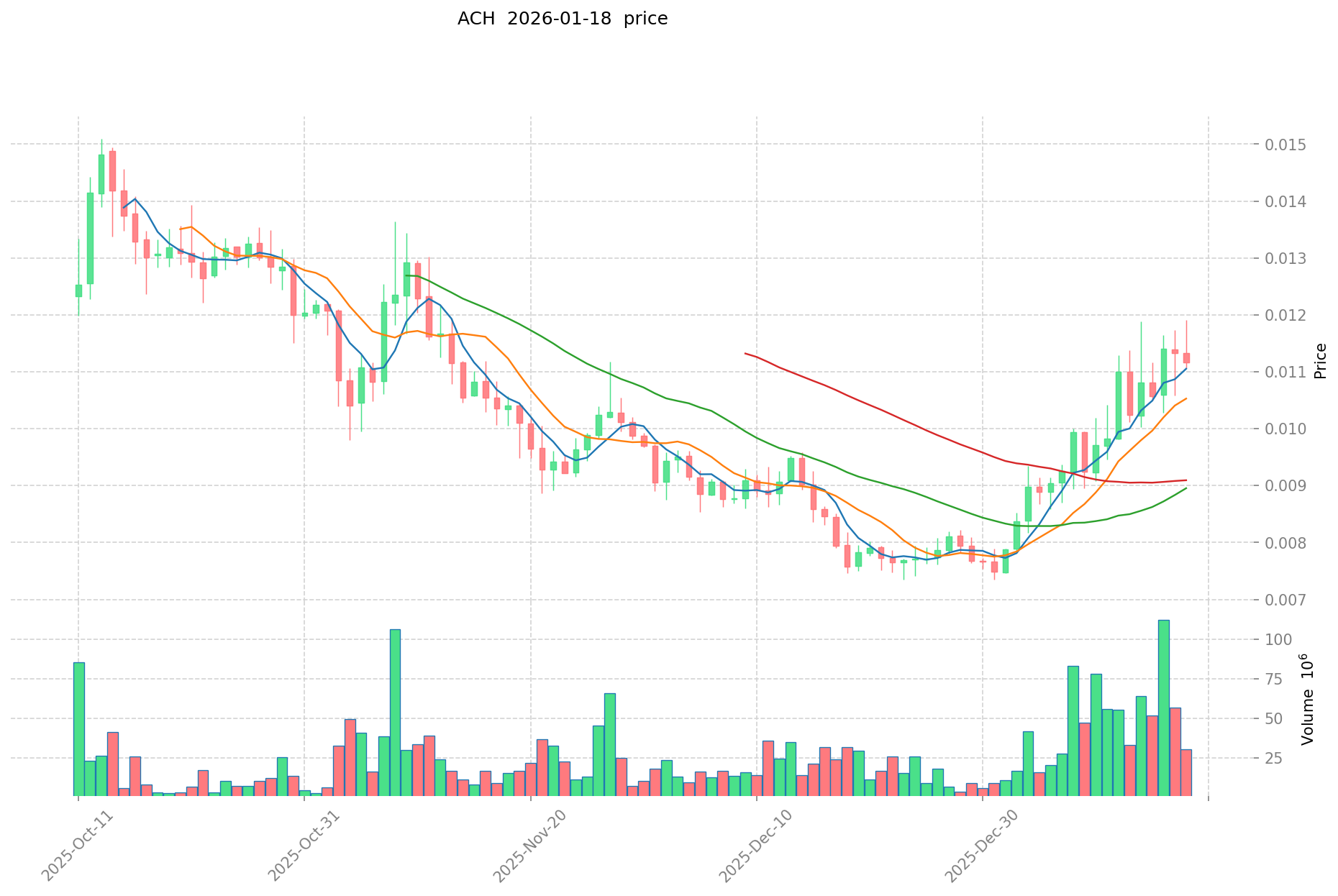
As of January 2026, ACH has demonstrated resilience with price performance showing a 30-day increase of 64.059%, suggesting renewed market interest in crypto payment infrastructure. The one-year performance indicates a decrease of 51.19%, reflecting the challenging market conditions that affected many altcoins during 2025.
Current ACH Investment Market Status (January 2026)
- ACH current price: $0.012476
- 24-hour trading volume: $918,065.09
- Circulating supply: 4,943,691,067 ACH (49.44% of total supply)
- Market capitalization: $61,677,489.75
- Listed on 33 exchanges with active trading
- Holder count: 37,396 addresses
Click to view real-time ACH market price
Alchemy Pay's infrastructure spans over 70 countries with 300+ payment channels, connecting with more than 2 million merchants globally. This operational footprint positions ACH within the growing segment of blockchain-based payment solutions bridging traditional finance and cryptocurrency ecosystems. The project's focus on both online and offline merchant payment facilitation, combined with partnerships across the Asia-Pacific region and beyond, contributes to its positioning in the crypto payment infrastructure landscape.
II. Core Factors Influencing Whether ACH Is a Good Investment
Supply Mechanism and Scarcity (ACH Investment Scarcity)
- Fixed Maximum Supply: ACH has a maximum supply of 10 billion tokens, with approximately 49.44% currently in circulation (4.94 billion tokens). This predetermined supply cap creates a theoretical scarcity framework that may influence long-term valuation dynamics.
- Supply-Price Relationship: Historical data shows ACH reached a notable price level of $0.198666 on August 7, 2021, during periods of market expansion. The fixed supply mechanism may contribute to price volatility based on demand fluctuations.
- Investment Implication: The limited total supply provides a structural element for potential long-term value consideration, though actual market performance depends on multiple external factors including adoption rates and competitive positioning.
Institutional Investment and Mainstream Adoption (Institutional Investment in ACH)
- Strategic Partnerships: Alchemy Pay has established collaborations with industry participants including Binance, Shopify, NIUM, and QF Pay, creating touchpoints with over 2 million merchants across 70+ countries through 300 payment channels.
- Enterprise Integration: The platform's partnerships with established payment and e-commerce infrastructure providers suggest growing institutional interest in bridging fiat and cryptocurrency payment systems.
- Adoption Metrics: With 37,396 token holders and availability on 33 exchanges, ACH demonstrates measurable ecosystem participation, though concentrated institutional holding data is not specified in available materials.
Macroeconomic Environment's Impact on ACH Investment
- Payment Infrastructure Positioning: As a payment solutions provider connecting fiat and cryptocurrency economies, ACH's utility may be influenced by broader regulatory developments affecting cross-border payment systems and digital asset adoption.
- Market Volatility Context: ACH has experienced significant price fluctuations, with a 1-year performance showing -51.19% change, while demonstrating shorter-term volatility with a 30-day increase of 64.059%. Such patterns reflect sensitivity to broader cryptocurrency market conditions and macroeconomic factors.
- Geopolitical Considerations: The platform's global payment network spanning 173 countries and regions may be affected by evolving international regulatory frameworks for digital payments and cross-border transactions.
Technology and Ecosystem Development (Technology & Ecosystem for ACH Investment)
- Platform Evolution: Alchemy Pay operates as a hybrid payment solution provider, with development focused on its second-generation decentralized payment system (ADPS 2.0), which aims to integrate DeFi aggregation capabilities.
- Alchemy Chain Infrastructure: The ecosystem includes Alchemy Chain, designed to support stablecoin payment integration across its established fiat-to-crypto payment network, potentially expanding use cases for the broader platform.
- Tokenized Asset Integration: According to available information, Alchemy Pay plans to launch a real-world asset (RWA) platform in August 2025, enabling fiat investments in tokenized financial instruments through partnerships, which may expand the platform's utility beyond traditional payment processing.
- Ecosystem Scope: The platform provides access to multiple digital asset categories including established cryptocurrencies and emerging tokens, positioning itself within the evolving digital financial infrastructure rather than solely as a payment processor.
III. ACH Future Investment Forecast and Price Outlook (Is Alchemy Pay(ACH) worth investing in 2026-2031)
Short-term Investment Forecast (2026, short-term ACH investment outlook)
Based on available market analysis, ACH price projections for 2026 show varied expectations across different scenarios:
- Conservative forecast: $0.00741 - $0.00818
- Neutral forecast: $0.00948 - $0.01256
- Optimistic forecast: $0.01368 - $0.01804
Market sentiment for ACH in 2026 remains mixed, with technical indicators suggesting potential volatility. The token's performance may be influenced by broader cryptocurrency market conditions and the platform's ability to expand its payment network partnerships.
Mid-term Investment Outlook (2027-2029, mid-term Alchemy Pay(ACH) investment forecast)
The mid-term outlook for ACH presents a potential growth trajectory, though opinions among market analysts differ:
- Market phase expectation: Price consolidation with gradual upward momentum, potentially driven by ecosystem expansion and increased merchant adoption
- Investment return forecast:
- 2027: $0.01034 - $0.01696
- 2028: $0.00969 - $0.01543
- 2029: $0.01114 - $0.01988
- Key catalysts: Partnership announcements, payment channel expansion, integration with major e-commerce platforms, and regulatory developments in cryptocurrency payment solutions
The projected price range reflects uncertainty regarding adoption rates and competitive positioning within the crypto payment sector.
Long-term Investment Outlook (Is ACH a good long-term investment?)
Long-term projections for ACH through 2031 suggest potential value appreciation, contingent upon multiple factors:
- Baseline scenario: $0.01061 - $0.01895 (assuming steady ecosystem development and maintained market presence)
- Optimistic scenario: $0.02044 - $0.02161 (assuming accelerated merchant adoption and favorable regulatory environment)
- Risk scenario: Below $0.00926 (under conditions of increased competition or adverse market dynamics)
View ACH long-term investment and price forecast: Price Prediction
2026-2031 Long-term Outlook
- Base scenario: $0.01061 - $0.01895 (corresponding to steady progress and gradual mainstream application growth)
- Optimistic scenario: $0.02044 - $0.02161 (corresponding to large-scale adoption and favorable market conditions)
- Transformative scenario: Above $0.02161 (contingent upon breakthrough ecosystem developments and mainstream proliferation)
- 2031-12-31 projected high: $0.02161 (based on optimistic development assumptions)
Disclaimer: Cryptocurrency markets exhibit high volatility, and price predictions involve substantial uncertainty. Historical performance does not guarantee future results. These projections are derived from third-party analyses and should not be construed as investment advice. Investors should conduct independent research and assess their risk tolerance before making investment decisions.
| Year |
Predicted High Price |
Predicted Average Price |
Predicted Low Price |
Price Change |
| 2026 |
0.01368277 |
0.012553 |
0.00740627 |
0 |
| 2027 |
0.0162661774 |
0.013117885 |
0.01062548685 |
5 |
| 2028 |
0.01542663276 |
0.0146920312 |
0.009843660904 |
17 |
| 2029 |
0.0198783182136 |
0.01505933198 |
0.0111439056652 |
20 |
| 2030 |
0.020438525363256 |
0.0174688250968 |
0.011005359810984 |
40 |
| 2031 |
0.021607189762231 |
0.018953675230028 |
0.010614058128815 |
51 |
IV. ACH Investment Strategy and Risk Management (How to invest in Alchemy Pay)
Investment Methodology (ACH investment strategy)
Long-term Holding (HODL ACH): This approach suits investors with a conservative risk profile who believe in the long-term value proposition of payment infrastructure projects. Given Alchemy Pay's ongoing expansion across 70+ countries and integration with over 2 million merchants, long-term holders may benefit from potential network effects as adoption increases. This strategy requires patience through market cycles and a focus on fundamental developments rather than short-term price movements.
Active Trading: For traders employing technical analysis and swing trading strategies, ACH's price volatility presents opportunities. Recent data shows 24-hour price fluctuations ranging from $0.01102 to $0.01272, with 7-day gains of 12.57% and 30-day increases of 64.059%. Active traders should monitor volume patterns, key support and resistance levels, and broader market sentiment while implementing strict entry and exit criteria.
Risk Management (Risk management for ACH investment)
Asset Allocation Ratios: Investment allocation should align with individual risk tolerance:
- Conservative investors: Consider limiting ACH exposure to 1-3% of crypto portfolio, as part of a broader diversified investment strategy
- Moderate investors: May allocate 3-7% to payment infrastructure tokens like ACH, balancing growth potential with established assets
- Aggressive investors: Could consider 7-15% allocation, understanding the higher volatility associated with mid-cap altcoins
Risk Hedging Solutions: Implement a multi-asset portfolio approach by combining ACH with established cryptocurrencies and stablecoins. Consider diversifying across different crypto sectors (DeFi, infrastructure, payment solutions) to reduce concentration risk. Position sizing should account for ACH's historical volatility, with the token having experienced significant drawdowns from its all-time high of $0.198666 in August 2021 to current levels around $0.012476.
Secure Storage: For cold storage, hardware wallets such as Ledger or Trezor provide robust security for long-term holdings. Hot wallets may be suitable for active trading amounts, but should contain only funds needed for immediate transactions. Given ACH's availability on Ethereum (ERC-20) and Binance Smart Chain networks, ensure wallet compatibility with the specific contract address being used (0xed04915c23f00a313a544955524eb7dbd823143d for Ethereum, 0xBc7d6B50616989655AfD682fb42743507003056D for BSC).
V. ACH Investment Risks and Challenges (Risks of investing in Alchemy Pay)
Market Risk: ACH exhibits considerable price volatility characteristic of mid-cap cryptocurrencies. The token's market capitalization of approximately $61.68 million and relatively modest daily trading volume of around $918,065 can contribute to increased price sensitivity. Historical data reveals substantial fluctuations, with year-over-year decline of 51.19% as of the current period, despite recent positive momentum. Limited liquidity compared to larger-cap assets may result in higher slippage during large transactions.
Regulatory Risk: As a payment solution provider operating across 70+ countries, Alchemy Pay faces varied regulatory landscapes. Changes in cryptocurrency payment regulations, money transmission laws, or cross-border payment policies in key markets could impact operational capabilities. Different jurisdictions maintain evolving stances on crypto-fiat payment infrastructure, creating uncertainty around compliance requirements and potential restrictions on payment processing activities.
Technical Risk: Payment infrastructure projects face specific technical considerations including network security vulnerabilities, smart contract risks associated with token contracts on Ethereum and BSC networks, and integration challenges with evolving blockchain ecosystems. System upgrades, protocol changes, or technical issues affecting payment channels could impact service reliability. Additionally, the project's dependency on partnerships with payment processors and merchant networks introduces counterparty and integration risks.
VI. Conclusion: Is Alchemy Pay a Good Investment?
Investment Value Summary: ACH presents a value proposition centered on bridging traditional and cryptocurrency payment systems, with established presence across multiple markets and partnerships with recognized platforms. The project's operational network spanning 70+ countries and connection to over 2 million merchants through partnerships provides foundational infrastructure. However, the token has experienced substantial price volatility, with current trading levels considerably below historical peaks. Short-term price movements remain influenced by broader market sentiment, partnership announcements, and adoption metrics.
Investor Recommendations:
✅ Beginners: Consider dollar-cost averaging (DCA) to build positions gradually, reducing timing risk. Prioritize security by utilizing hardware wallets for storage and thoroughly understanding the differences between Ethereum and BSC token versions. Start with small allocations while developing understanding of payment infrastructure projects and broader cryptocurrency market dynamics.
✅ Experienced Investors: May implement swing trading strategies based on technical analysis, taking advantage of volatility patterns. Consider portfolio allocation as part of a diversified cryptocurrency investment approach, balancing ACH with assets across different sectors and risk profiles. Monitor partnership developments, merchant adoption metrics, and competitive landscape within the crypto payment sector.
✅ Institutional Investors: Could evaluate ACH within strategic allocations to payment infrastructure and Web3 adoption themes. Conduct thorough due diligence on regulatory compliance, partnership sustainability, and competitive positioning. Consider longer investment horizons aligned with crypto payment adoption trajectories while maintaining appropriate risk management frameworks.
⚠️ Disclaimer: Cryptocurrency investments carry substantial risk, including potential loss of principal. This content serves informational and educational purposes only and does not constitute financial, investment, or trading advice. Conduct independent research and consult qualified financial advisors before making investment decisions. Past performance does not indicate future results.
VII. FAQ
Q1: What is the current investment outlook for Alchemy Pay (ACH) in 2026?
ACH presents a mixed short-term investment outlook for 2026, with price projections ranging from conservative estimates of $0.00741-$0.00818 to optimistic scenarios of $0.01368-$0.01804. The token has demonstrated recent positive momentum with a 30-day increase of 64.059% as of January 2026, though year-over-year performance shows a decline of 51.19%. Investment potential depends significantly on broader cryptocurrency market conditions, expansion of the platform's payment network across its current 70+ country footprint, and successful integration with its 2 million+ merchant partners. Investors should consider ACH's relatively modest market capitalization of approximately $61.68 million and daily trading volume of around $918,065, which contribute to higher volatility compared to larger-cap assets.
Q2: How does Alchemy Pay's fixed token supply affect its investment value?
ACH has a maximum supply capped at 10 billion tokens, with approximately 49.44% (4.94 billion tokens) currently in circulation. This predetermined supply mechanism creates a scarcity framework that may influence long-term valuation dynamics as demand fluctuates. The fixed supply provides structural elements for potential value appreciation, though actual market performance depends heavily on adoption rates, competitive positioning within the crypto payment sector, and overall market sentiment. Historical data shows ACH reached $0.198666 in August 2021, demonstrating that supply constraints can contribute to price appreciation during periods of increased demand, though sustained value requires continued ecosystem development and merchant adoption rather than supply mechanics alone.
Q3: What are the primary risks associated with investing in ACH?
ACH investment carries three primary risk categories. Market risk includes substantial price volatility characteristic of mid-cap cryptocurrencies, with limited liquidity potentially causing higher slippage during large transactions. Regulatory risk stems from Alchemy Pay's operations across 70+ countries with varying cryptocurrency payment regulations, where changes in money transmission laws or cross-border payment policies could impact operational capabilities. Technical risk encompasses smart contract vulnerabilities across Ethereum and BSC networks, integration challenges with evolving blockchain ecosystems, and dependency on partnerships with payment processors and merchant networks. These risks are amplified by ACH's relatively modest trading volume and market capitalization compared to established cryptocurrencies.
Q4: How should investors allocate ACH within their cryptocurrency portfolio?
Portfolio allocation for ACH should align with individual risk tolerance levels. Conservative investors may consider limiting ACH exposure to 1-3% of their crypto portfolio as part of a broader diversified strategy, given the token's volatility and mid-cap status. Moderate investors could allocate 3-7% to payment infrastructure tokens like ACH, balancing growth potential with more established assets. Aggressive investors might consider 7-15% allocation while understanding the higher volatility associated with mid-cap altcoins. All allocation strategies should incorporate multi-asset diversification across different crypto sectors (DeFi, infrastructure, payment solutions) to reduce concentration risk, and position sizing should account for ACH's historical price fluctuations from its all-time high of $0.198666 to current levels around $0.012476.
Q5: What factors distinguish ACH from other cryptocurrency payment solutions?
Alchemy Pay distinguishes itself through established operational infrastructure spanning 300+ payment channels across 70+ countries, connecting over 2 million merchants globally through partnerships with industry participants including Binance, Shopify, NIUM, and QF Pay. The platform functions as a hybrid payment solution provider bridging fiat and cryptocurrency economies, rather than focusing solely on crypto-to-crypto transactions. Key differentiators include availability on multiple blockchain networks (Ethereum and Binance Smart Chain), development of ADPS 2.0 (second-generation decentralized payment system) with DeFi aggregation capabilities, and planned integration of real-world asset (RWA) tokenization. However, competitive positioning depends on continued partnership expansion, technological advancement, and ability to navigate evolving regulatory landscapes across its international footprint.
Q6: What is the recommended investment strategy for ACH beginners versus experienced traders?
For beginners, the recommended approach involves dollar-cost averaging (DCA) to build positions gradually, reducing timing risk associated with ACH's price volatility. Priority should be given to security fundamentals, including hardware wallet usage and understanding differences between Ethereum (0xed04915c23f00a313a544955524eb7dbd823143d) and BSC (0xBc7d6B50616989655AfD682fb42743507003056D) token versions. Starting with small allocations while developing understanding of payment infrastructure projects provides educational value with limited risk exposure. Experienced traders may implement active swing trading strategies leveraging technical analysis, capitalizing on volatility patterns demonstrated by ACH's recent 24-hour fluctuations between $0.01102-$0.01272 and 7-day gains of 12.57%. Both approaches should incorporate strict risk management, with experienced traders maintaining diversified positions across different sectors and implementing clear entry/exit criteria based on technical indicators and market sentiment analysis.
Q7: How do Alchemy Pay's partnerships influence its long-term investment potential?
Alchemy Pay's strategic partnerships with established platforms including Binance, Shopify, NIUM, and QF Pay create institutional validation and operational infrastructure that may support long-term value appreciation. These collaborations provide access to existing merchant networks and payment processing capabilities, establishing touchpoints with over 2 million merchants across 70+ countries. The partnerships suggest growing institutional interest in bridging fiat and cryptocurrency payment systems, which could drive adoption rates critical for ACH's utility and demand. However, long-term investment potential depends on the sustainability of these partnerships, ability to convert merchant connections into active platform usage, and competitive positioning as traditional financial institutions and other crypto payment solutions expand their offerings. Partnership announcements may create short-term price catalysts, but sustained value requires demonstrated transaction volume growth and merchant retention across the established network.
Q8: What are the key metrics investors should monitor when evaluating ACH investment performance?
Investors should track multiple metrics across different timeframes. Price performance indicators include 24-hour trading volume (currently ~$918,065), which reflects immediate market interest and liquidity; 30-day price changes (currently +64.059%), indicating short-term momentum; and longer-term performance metrics such as year-over-year changes (currently -51.19%). Fundamental metrics include circulating supply percentage (49.44% of 10 billion maximum supply), holder count (37,396 addresses), and exchange listing count (33 exchanges). Ecosystem development indicators encompass partnership announcements, merchant adoption figures beyond the current 2 million+ touchpoints, payment channel expansion beyond 300 existing channels, and transaction volume data when available. Technical indicators should include support/resistance levels, trading volume patterns relative to price movements, and correlation with broader cryptocurrency market trends, particularly given ACH's sensitivity to overall market sentiment as demonstrated by its substantial deviation from 2021 all-time highs.
* The information is not intended to be and does not constitute financial advice or any other recommendation of any sort offered or endorsed by Gate.