This comprehensive analysis evaluates whether Aleo (ALEO) represents a sound investment opportunity within the privacy-focused blockchain sector. ALEO, currently trading at $0.12186 with a market cap of $98.93 million, leverages zero-knowledge cryptography to enable private, scalable applications through off-chain smart contract execution. The article examines ALEO's price trajectory from $8.0002 (September 2024) to current levels, analyzes key factors including supply mechanisms (54.12% circulating ratio) and ecosystem development, and presents 2026-2031 price forecasts ranging from conservative ($0.0634) to optimistic ($0.4168) scenarios. Investment strategies span long-term holding, active trading, and risk management tailored for conservative, aggressive, and institutional investors. Critical risks include high volatility, regulatory uncertainty affecting privacy technologies, technical implementation challenges, and supply dilution effects. The analysis concludes that ALEO suits diversified portfolio all
Introduction: Aleo (ALEO)'s Investment Position and Market Outlook
Aleo (ALEO) represents a notable cryptocurrency asset in the digital asset space, having launched in September 2024. As a developer platform focused on privacy-preserving applications, Aleo has positioned itself within the zero-knowledge cryptography and scalable blockchain infrastructure sector. As of January 17, 2026, ALEO maintains a market capitalization of approximately $98.93 million, with a circulating supply of around 811.85 million tokens and a current trading price of $0.12186. With its positioning as a platform for "fully private, scalable, and cost-effective applications," Aleo has become a subject of discussion among investors evaluating "Is Aleo (ALEO) a good investment?" This article provides a comprehensive analysis of ALEO's investment characteristics, historical price movements, future price outlook, and associated risks to serve as a reference for potential investors.
I. Aleo (ALEO) Price History Review and Investment Value Status
- 2024: ALEO launched on mainnet in September 2024 → Token price experienced significant volatility following launch
- 2024: Token reached a price level of $8.0002 in September 2024 → Price subsequently declined over the following months
- 2025: Market adjustment period → Price moved from higher levels to $0.1023 in December 2025
Current ALEO Investment Market Status (January 2026)
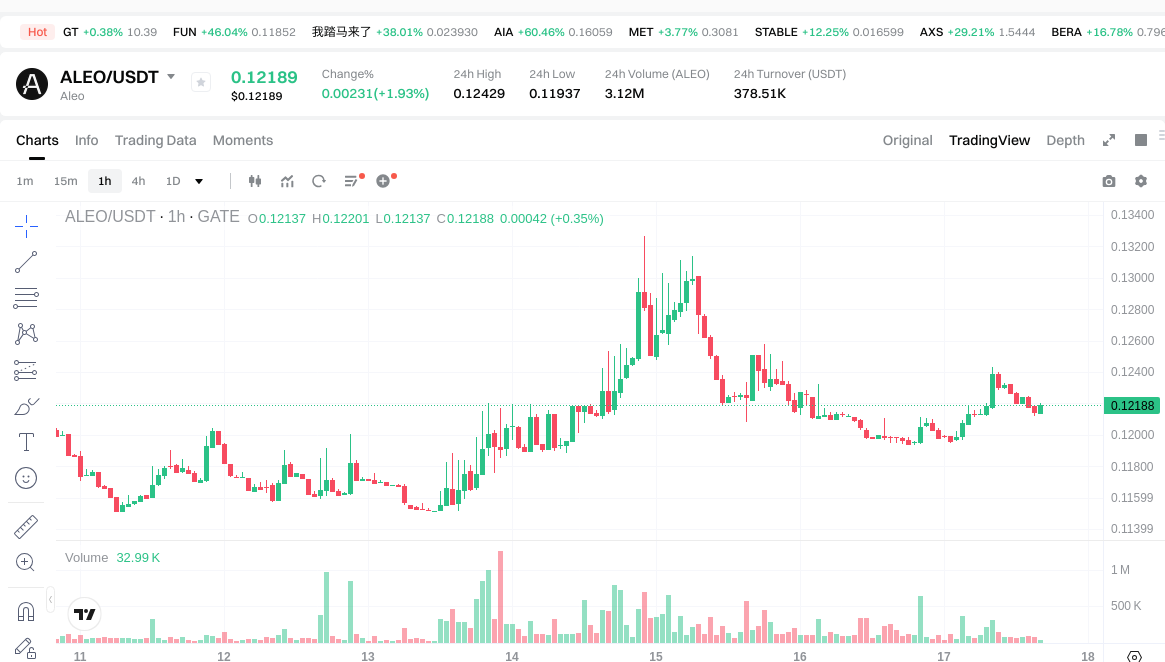
- ALEO current price: $0.12186
- Market sentiment (Fear & Greed Index): Data not available in provided materials
- 24-hour trading volume: $379,752.47
- Institutional investor holdings: Data not available in provided materials
Click to view real-time ALEO market price
II. Core Factors Affecting Whether ALEO is a Good Investment
Supply Mechanism and Scarcity (ALEO Investment Scarcity)
- Supply Structure: Aleo has a maximum supply of 1.5 billion tokens, with approximately 811.85 million ALEO currently in circulation as of January 17, 2026, representing a circulating ratio of 54.12%. The defined supply cap introduces a scarcity element that may influence long-term price dynamics as circulating supply approaches the maximum limit.
- Market Cap to Fully Diluted Valuation: The current market cap to FDV ratio stands at 54.12%, indicating that nearly half of the total token supply remains to be released. Future token emissions and distribution schedules may impact price performance as additional supply enters the market.
- Investment Implications: The predetermined supply ceiling of 1.5 billion tokens provides a framework for evaluating scarcity-based investment considerations. However, the substantial unreleased supply suggests that token distribution dynamics and emission schedules warrant attention when assessing investment value.
Institutional Investment and Mainstream Adoption (Institutional Investment in ALEO)
- Exchange Listings: As of January 2026, ALEO is listed on 14 cryptocurrency exchanges, providing accessibility for various investor categories. The token maintains trading availability on established platforms, which may facilitate institutional participation.
- Holder Distribution: Current data indicates approximately 8,224 ALEO holders, reflecting the early stage of token distribution across market participants.
- Ecosystem Growth: According to Q2 2025 data, Aleo's ecosystem expanded through strategic partnerships, infrastructure upgrades, and the launch of new applications. These developments suggest ongoing efforts to build adoption, though the scale and impact of institutional involvement remain evolving factors in the investment landscape.
Macroeconomic Environment's Impact on ALEO Investment
- Market Performance Context: ALEO has experienced significant price volatility, with a one-year price change of -78.5% as of January 17, 2026. The token's price movements reflect broader cryptocurrency market dynamics and investor sentiment toward privacy-focused blockchain solutions.
- Privacy Technology Positioning: Aleo's focus on zero-knowledge cryptography positions it within the privacy-centric segment of the blockchain market. Macroeconomic factors affecting demand for privacy solutions, including regulatory developments and data protection concerns, may influence ALEO's investment appeal.
- Market Correlation: Like other crypto assets, ALEO's performance may be influenced by macroeconomic conditions such as monetary policy shifts, risk asset sentiment, and technological sector trends. Investors should consider these broader market factors when evaluating ALEO's investment potential.
Technology and Ecosystem Development (Technology & Ecosystem for ALEO Investment)
- Zero-Knowledge Proof Technology: Aleo leverages zero-knowledge cryptography to enable fully private smart contract execution. This core technology moves computation off-chain, addressing privacy and scalability challenges in decentralized applications. The platform's technical foundation supports applications requiring transaction confidentiality while maintaining verifiability.
- Network Activity and Private Transactions: One distinguishing feature of Aleo is its ability to submit private transactions using network provers that generate Zero-Knowledge Proofs (ZKPs) to verify validity. As noted in Q2 2025 ecosystem reports, the maturation of the prover ecosystem and expansion of privacy-native applications may become differentiating factors in the Layer 1 blockchain space.
- Staking and Validator Participation: Despite price fluctuations, staking activity showed growth in native token terms during Q2 2025, indicating validator confidence and network security resilience. As the ecosystem matures and application demand increases, reward distribution dynamics may evolve with future protocol upgrades and new participation incentives.
- Real-World Applications: The project has expanded its focus to include real-world privacy applications and payment solutions, broadening its use case beyond theoretical privacy technology to practical implementation scenarios.
- Ecosystem Expansion: The broader Aleo ecosystem experienced growth in Q2 2025 through partnerships and infrastructure development. The expansion of privacy-focused decentralized applications built on Aleo's platform may contribute to long-term value proposition, though the pace and success of ecosystem adoption remain key variables for investment consideration.
III. ALEO Future Investment Forecast and Price Outlook (Is Aleo(ALEO) worth investing in 2026-2030)
Short-term Investment Forecast (2026, short-term ALEO investment outlook)
Based on various analytical models, ALEO presents divergent short-term scenarios for 2026:
- Conservative forecast: $0.0634 - $0.0886
- Neutral forecast: $0.1012 - $0.1220
- Optimistic forecast: $0.1495 - $0.1647
Multiple forecasting sources indicate a potential trading range between $0.0634 and $0.1647 by the end of 2026, with an average price estimate around $0.1220. These projections reflect the platform's early-stage development as a privacy-focused Layer 1 blockchain utilizing zero-knowledge cryptography.
Mid-term Investment Outlook (2027-2028, mid-term Aleo(ALEO) investment forecast)
-
Market stage expectation: The 2027-2028 period may witness ALEO's transition from initial deployment to broader ecosystem expansion, with potential fluctuations driven by technical milestone achievements and market adoption rates.
-
Investment return forecast:
- 2027: $0.0531 - $0.2253 (analysts present mixed views, with average estimates around $0.1434)
- 2028: $0.0969 - $0.2121 (continued volatility expected, with average projections near $0.1670)
-
Key catalysts: Platform scalability improvements, developer ecosystem growth, strategic partnerships with privacy-focused Web3 entities, and competitive positioning within the zero-knowledge proof space.
Long-term Investment Outlook (Is ALEO a good long-term investment?)
- Baseline scenario: $0.1308 - $0.2836 (2030) - Assumes steady protocol development and moderate market acceptance of privacy solutions
- Optimistic scenario: $0.3783 - $0.4168 (2029-2030) - Reflects accelerated adoption driven by regulatory tailwinds favoring privacy technologies and successful execution of technical roadmap
- Risk scenario: Below $0.0863 - Corresponds to intensified competition, technical setbacks, or unfavorable shifts in regulatory landscape affecting privacy-centric blockchains
Explore comprehensive ALEO long-term investment analysis and price predictions: Price Prediction
2026-2031 Long-term Outlook
- Base scenario: $0.1308 - $0.2552 (reflecting steady advancement and gradual mainstream application growth)
- Optimistic scenario: $0.2678 - $0.3735 (corresponding to large-scale adoption and favorable market conditions)
- Transformative scenario: Above $0.4168 (contingent upon breakthrough ecosystem developments and mainstream proliferation)
- 2031-12-31 projected high: $0.3735 (based on optimistic development assumptions)
Disclaimer: These price forecasts are derived from third-party analytical sources and historical pattern analysis. Cryptocurrency markets exhibit high volatility, and actual prices may deviate substantially from projections. Multiple factors influence ALEO's price trajectory, including technological execution, competitive dynamics, regulatory developments, and broader market sentiment. These projections should not constitute investment advice, and individuals should conduct independent research before making investment decisions.
| Year |
Predicted High Price |
Predicted Average Price |
Predicted Low Price |
Price Change |
| 2026 |
0.1647135 |
0.12201 |
0.0634452 |
0 |
| 2027 |
0.1906711275 |
0.14336175 |
0.0903179025 |
17 |
| 2028 |
0.2121108772125 |
0.16701643875 |
0.096869534475 |
37 |
| 2029 |
0.267284757753562 |
0.18956365798125 |
0.14406838006575 |
55 |
| 2030 |
0.283246017755583 |
0.228424207867406 |
0.207866029159339 |
87 |
| 2031 |
0.373519264704782 |
0.255835112811495 |
0.130475907533862 |
110 |
IV. Aleo Investment Strategy and Risk Management (How to invest in Aleo)
Investment Methodology (Aleo investment strategy)
Long-term Holding (HODL Aleo): Suitable for Conservative Investors
Long-term holding represents a fundamental approach for investors who believe in Aleo's underlying technology and future development. This strategy involves purchasing ALEO tokens and holding them through market fluctuations, focusing on the platform's long-term value proposition as a privacy-focused developer platform utilizing zero-knowledge cryptography.
Key considerations for long-term holders include:
- Monitoring the platform's adoption rate and developer ecosystem growth
- Tracking technological developments in zero-knowledge cryptography implementation
- Evaluating the expansion of decentralized applications built on Aleo
- Assessing the circulating supply ratio, which currently stands at approximately 54.12%
Active Trading: Technical Analysis and Swing Trading
Active trading strategies involve capitalizing on price movements through technical analysis and market timing. ALEO has demonstrated notable price volatility, with 24-hour price changes showing movements between $0.11937 and $0.12429.
Traders may consider:
- Utilizing technical indicators to identify entry and exit points
- Monitoring trading volume, which reached approximately $379,752.47 in 24-hour volume
- Analyzing price trends across different timeframes (1H: +0.44%, 24H: +1.96%, 7D: +2.7%, 30D: +8.92%)
- Setting appropriate stop-loss levels to manage downside risk
Risk Management (Risk management for Aleo investment)
Asset Allocation Ratios: Conservative / Aggressive / Professional Investors
Conservative Investors:
- Allocate 1-3% of total crypto portfolio to ALEO
- Focus on established cryptocurrencies with ALEO as a smaller speculative position
- Prioritize capital preservation over high returns
Aggressive Investors:
- May allocate 5-10% of crypto portfolio to ALEO
- Willing to accept higher volatility for potential returns
- Actively monitor market conditions and adjust positions accordingly
Professional Investors:
- Implement dynamic allocation based on market conditions and fundamental analysis
- Utilize advanced risk metrics and portfolio optimization techniques
- Consider derivatives and hedging instruments where available
Risk Hedging Solutions: Multi-asset Portfolio + Hedging Tools
Diversification remains essential for managing cryptocurrency investment risk:
- Maintain exposure to multiple blockchain platforms and use cases
- Balance privacy-focused assets with other crypto categories
- Consider correlation patterns between ALEO and major cryptocurrencies
- Utilize stablecoins for liquidity management and risk reduction
Secure Storage: Hot and Cold Wallets + Hardware Wallet Recommendations
Proper security measures are critical for protecting ALEO holdings:
Cold Storage Solutions:
- Hardware wallets provide offline security for long-term holdings
- Multi-signature wallets offer additional security layers
- Paper wallets for completely offline storage (advanced users)
Hot Wallet Considerations:
- Use reputable exchange wallets for active trading positions
- Enable two-factor authentication and withdrawal whitelisting
- Maintain only necessary amounts for trading purposes
Best Practices:
- Distribute holdings across multiple storage solutions
- Regularly update wallet software and security protocols
- Maintain secure backups of private keys and recovery phrases
- Verify contract addresses when interacting with ALEO (BSC contract: 0x6cfffa5bfd4277a04d83307feedfe2d18d944dd2)
V. Aleo Investment Risks and Challenges (Risks of investing in Aleo)
Market Risk: High Volatility and Price Manipulation
ALEO demonstrates significant price volatility characteristics common to cryptocurrency markets. The token has experienced substantial price fluctuations, with historical data showing movement from a recorded low of $0.1023 to a high of $8.0002. The current market capitalization of approximately $98.93 million and relatively limited exchange availability (14 exchanges) may contribute to liquidity constraints and increased volatility potential.
Investors should consider:
- The relatively small holder base of approximately 8,224 addresses
- Lower liquidity compared to major cryptocurrencies, which may amplify price swings
- Potential for increased volatility during market-wide cryptocurrency movements
- The token's market dominance of 0.0057%, indicating limited market depth
Regulatory Risk: Policy Uncertainty Across Different Countries
As a privacy-focused blockchain platform utilizing zero-knowledge cryptography, Aleo may face heightened regulatory scrutiny:
- Privacy-enhancing technologies continue to attract regulatory attention globally
- Evolving compliance requirements for privacy coins and tokens across jurisdictions
- Potential classification challenges under varying regulatory frameworks
- Uncertainty regarding future regulations governing zero-knowledge proof technologies
- Possible restrictions on trading or usage in certain jurisdictions prioritizing transaction transparency
Investors should:
- Monitor regulatory developments in their jurisdiction
- Understand local compliance requirements for cryptocurrency holdings
- Consider geographic diversification of exchange usage
- Stay informed about policy changes affecting privacy-focused blockchain projects
Technical Risk: Network Security Vulnerabilities and Upgrade Failures
As a blockchain platform emphasizing privacy through off-chain smart contract execution, Aleo faces specific technical considerations:
- Implementation complexity of zero-knowledge cryptography systems
- Potential vulnerabilities in smart contract execution mechanisms
- Risks associated with platform upgrades and protocol changes
- Dependency on continued technological development and maintenance
- Security considerations related to the interaction between on-chain and off-chain components
Additional technical considerations include:
- Smart contract risks for applications built on the platform
- Network stability and throughput performance
- Interoperability challenges with other blockchain ecosystems
- The need for ongoing security audits and vulnerability assessments
VI. Conclusion: Is Aleo a Good Investment?
Investment Value Summary
Aleo represents a blockchain platform focused on privacy-preserving application development through zero-knowledge cryptography. The project's value proposition centers on enabling scalable, private decentralized applications with off-chain smart contract execution. With a circulating supply ratio of approximately 54.12% and presence on 14 exchanges, ALEO demonstrates characteristics of an emerging cryptocurrency project in the privacy and scalability sector.
The token has shown mixed performance across different timeframes, with short-term gains (1H: +0.44%, 24H: +1.96%, 7D: +2.7%, 30D: +8.92%) contrasting with longer-term challenges. Market conditions, technological development progress, and adoption rates will likely influence future performance.
Investor Recommendations
✅ Beginners:
- Consider dollar-cost averaging (DCA) to mitigate timing risk
- Prioritize secure storage through hardware wallets or reputable custody solutions
- Start with small position sizes to gain familiarity with the asset
- Focus on understanding the fundamental technology and use cases
- Avoid over-concentration in a single asset
✅ Experienced Investors:
- Implement swing trading strategies based on technical analysis
- Maintain diversified portfolio allocation with privacy-focused and mainstream cryptocurrencies
- Monitor on-chain metrics and holder distribution patterns
- Consider position sizing based on personal risk tolerance and market conditions
- Stay informed about platform developments and ecosystem growth
✅ Institutional Investors:
- Evaluate strategic long-term allocation as part of broader blockchain exposure
- Conduct thorough due diligence on technological fundamentals and team capabilities
- Consider privacy technology trends and regulatory landscape evolution
- Implement comprehensive risk management frameworks
- Monitor competitive positioning within the privacy-focused blockchain sector
⚠️ Disclaimer: Cryptocurrency investments carry substantial risk, including potential loss of principal. This analysis is provided for informational purposes only and does not constitute investment advice. Investors should conduct independent research and consult with qualified financial advisors before making investment decisions. Past performance does not guarantee future results.
VII. FAQ
Q1: Is Aleo (ALEO) a good investment for 2026?
Aleo presents a mixed investment profile for 2026, with potential returns dependent on individual risk tolerance and investment strategy. The token currently trades at $0.12186 with a market cap of $98.93 million, positioned within the privacy-focused blockchain sector utilizing zero-knowledge cryptography. Short-term forecasts for 2026 range from conservative estimates of $0.0634-$0.0886 to optimistic projections of $0.1495-$0.1647, reflecting uncertainty in early-stage technology adoption. Investors should consider that ALEO has experienced significant volatility, with a one-year decline of -78.5%, while recent short-term momentum shows positive trends (+8.92% over 30 days). The investment value depends on multiple factors including the platform's ability to expand its developer ecosystem, increase adoption of privacy-preserving applications, and compete effectively within the Layer 1 blockchain space.
Q2: What are the main risks of investing in Aleo (ALEO)?
ALEO investment carries three primary risk categories that investors must carefully evaluate. Market risk manifests through high volatility, demonstrated by historical price fluctuations from $0.1023 to $8.0002, combined with limited liquidity across 14 exchanges and a relatively small holder base of 8,224 addresses, which may amplify price swings. Regulatory risk poses significant uncertainty as privacy-focused blockchain platforms face evolving compliance requirements globally, with potential restrictions in jurisdictions prioritizing transaction transparency. Technical risk includes implementation complexity of zero-knowledge cryptography systems, potential smart contract vulnerabilities, and dependency on continuous protocol development. The current circulating supply ratio of 54.12% indicates that substantial token emissions remain scheduled, which could impact price performance through dilution effects. Investors should implement appropriate risk management strategies, including diversified portfolio allocation and secure storage solutions.
Q3: How does Aleo's technology differentiate it from other blockchain platforms?
Aleo distinguishes itself through zero-knowledge cryptography implementation that enables fully private smart contract execution with off-chain computation. The platform addresses both privacy and scalability challenges by utilizing Zero-Knowledge Proofs (ZKPs) to verify transaction validity without revealing transaction details, allowing users to submit private transactions through network provers. This technological approach contrasts with traditional blockchain architectures where smart contracts execute on-chain with public visibility. The ecosystem developments in Q2 2025 demonstrated expanding privacy-native applications and maturing prover infrastructure, potentially differentiating Aleo within the competitive Layer 1 blockchain landscape. The platform's focus extends to real-world privacy applications and payment solutions, broadening use cases beyond theoretical privacy technology. However, the success of this technological differentiation depends on developer adoption rates, application ecosystem growth, and competitive positioning against other privacy-focused protocols.
Q4: What is the long-term price outlook for Aleo (ALEO) through 2030?
Long-term price projections for ALEO through 2030 present multiple scenarios reflecting varying adoption trajectories and market conditions. Base case projections suggest a trading range of $0.1308-$0.2836 by 2030, assuming steady protocol development and moderate market acceptance of privacy solutions. Optimistic scenarios project potential prices between $0.3783-$0.4168 by 2029-2030, contingent upon accelerated adoption driven by regulatory tailwinds favoring privacy technologies and successful technical roadmap execution. Analytical forecasts indicate a progression from current levels to an average price around $0.2284 in 2030, representing potential growth of 87% from 2026 levels. By 2031, projections extend to approximately $0.3735 under optimistic development assumptions. These forecasts depend on multiple variables including technological execution success, competitive dynamics within the privacy blockchain sector, regulatory developments affecting privacy-centric platforms, and broader cryptocurrency market sentiment. Investors should recognize that cryptocurrency price predictions carry inherent uncertainty and actual outcomes may differ substantially from projections.
Q5: How should investors allocate capital when investing in Aleo (ALEO)?
Capital allocation for ALEO investment should correspond to individual risk profiles and investment objectives. Conservative investors should limit ALEO allocation to 1-3% of their total cryptocurrency portfolio, prioritizing capital preservation while gaining exposure to privacy blockchain technology. This approach treats ALEO as a smaller speculative position within a diversified portfolio of established cryptocurrencies. Aggressive investors with higher risk tolerance may allocate 5-10% of their crypto portfolio to ALEO, accepting increased volatility for potential returns and actively monitoring market conditions for position adjustments. Professional investors should implement dynamic allocation strategies based on market conditions, fundamental analysis, and risk metrics, potentially utilizing derivatives and hedging instruments where available. Regardless of risk profile, investors should maintain diversification across multiple blockchain platforms and use cases, balance privacy-focused assets with other cryptocurrency categories, and utilize stablecoins for liquidity management. Position sizing should consider ALEO's current market characteristics, including its $98.93 million market cap, 54.12% circulating supply ratio, and demonstrated price volatility.
Q6: What are the best practices for securely storing Aleo (ALEO) tokens?
Secure ALEO token storage requires implementing multi-layered security practices tailored to investment timeframes and trading frequency. For long-term holdings, cold storage solutions provide optimal security through hardware wallets that maintain private keys offline, multi-signature wallets offering additional security layers, or paper wallets for completely offline storage (recommended for advanced users). Active traders may utilize hot wallets on reputable exchanges for trading positions, but should enable two-factor authentication, implement withdrawal whitelisting, and maintain only necessary amounts for immediate trading purposes. Best practices include distributing holdings across multiple storage solutions to reduce single-point-of-failure risk, regularly updating wallet software and security protocols, maintaining secure backups of private keys and recovery phrases in geographically separate locations, and verifying contract addresses when interacting with ALEO (BSC contract: 0x6cfffa5bfd4277a04d83307feedfe2d18d944dd2). Investors should never share private keys or seed phrases, remain vigilant against phishing attempts, and consider professional custody solutions for substantial holdings. The relatively small holder base of 8,224 addresses and limited exchange availability emphasize the importance of robust security measures for ALEO token protection.
Q7: What factors could drive Aleo's price performance in 2026-2028?
ALEO's mid-term price performance depends on multiple interconnected catalysts spanning technological, ecosystem, and market dynamics. Platform scalability improvements and successful execution of technical milestones will prove critical for maintaining competitive positioning within the Layer 1 blockchain space. Developer ecosystem growth, measured through application deployments and active developer participation, directly influences network utility and token demand. Strategic partnerships with privacy-focused Web3 entities, decentralized application platforms, and enterprise blockchain implementations could accelerate adoption and validate the technology's commercial viability. Regulatory developments affecting privacy technologies present both opportunities and risks—favorable privacy protection regulations could drive adoption while restrictive compliance requirements might constrain growth. The maturation of the prover ecosystem and expansion of privacy-native applications, as evidenced during Q2 2025 developments, may serve as differentiating factors attracting users seeking transaction confidentiality. Market sentiment toward zero-knowledge proof technologies, competition from alternative privacy solutions, and broader cryptocurrency market conditions will influence investor interest. The release schedule for the remaining 45.88% of total token supply (approximately 688.15 million tokens) will impact supply-demand dynamics and requires monitoring for potential price pressure during emission periods.
Q8: Is Aleo suitable for institutional investors?
Aleo presents characteristics that may appeal to institutional investors seeking exposure to privacy-focused blockchain infrastructure, though with considerations specific to early-stage technology investments. The platform's focus on zero-knowledge cryptography addresses growing demand for privacy-preserving solutions in decentralized applications, potentially aligning with institutional interest in next-generation blockchain capabilities. The defined maximum supply of 1.5 billion tokens and presence on 14 exchanges provides basic infrastructure for institutional participation. However, institutional investors must conduct comprehensive due diligence on several factors: the project's technological fundamentals and team capabilities, competitive positioning within the privacy blockchain sector, regulatory landscape evolution affecting privacy technologies, and liquidity constraints associated with the relatively small market cap of $98.93 million and limited exchange availability. Institutional allocation should be approached strategically as part of broader blockchain exposure rather than a core holding, implementing robust risk management frameworks appropriate for emerging technology investments. The growing validator participation, as evidenced by staking activity in Q2 2025, suggests some institutional confidence in network security and long-term viability. Institutions should monitor ecosystem development metrics, developer adoption rates, and strategic partnership announcements to inform ongoing investment decisions regarding ALEO position sizing and duration.
* The information is not intended to be and does not constitute financial advice or any other recommendation of any sort offered or endorsed by Gate.