This comprehensive analysis evaluates whether Aleph.im (ALEPH) represents a viable investment opportunity in the decentralized cloud infrastructure sector. As of January 2026, ALEPH trades at approximately $0.03021 with a market capitalization of $5.63 million, functioning as a cross-blockchain layer-2 network offering decentralized cloud computing and messaging infrastructure. The article examines ALEPH's price history—ranging from $0.0062 (2020) to $0.88 (2022)—alongside current market metrics including 13,561 token holders and availability on Gate and other exchanges. Price predictions through 2031 range from $0.0204-$0.0587 depending on adoption scenarios. The analysis addresses investment strategies for conservative, aggressive, and professional investors while detailing critical risks including high volatility (-71.61% annually), regulatory uncertainty, technical vulnerabilities, and supply dynamics with only 37.29% of tokens circulating. This resource provides investors with essential frameworks for ev
Introduction: Aleph.im (ALEPH) Investment Position and Market Outlook
ALEPH is a notable asset in the cryptocurrency field. As of January 28, 2026, Aleph.im holds a market capitalization of approximately $5.63 million, with a circulating supply of about 186.43 million tokens, and the current price is maintained around $0.03021. The project positions itself as a decentralized network for the future of decentralization, functioning as a cross-blockchain layer-2 network, a decentralized secure cloud computing network, and a platform for decentralized messaging and analytics. With a market ranking of 1467 and a market share of 0.00047%, Aleph.im has gradually become a focal point for investors discussing "Is Aleph.im (ALEPH) a good investment?" This article will comprehensively analyze ALEPH's investment value, historical trends, future price predictions, and investment risks to provide reference for investors.
I. Aleph.im (ALEPH) Price History Review and Current Investment Value
- 2020: ALEPH recorded its lowest price level at approximately $0.0062 on September 27, 2020 → Early investors who entered at this period could observe significant value appreciation in subsequent periods
- 2022: ALEPH reached a notable price peak of approximately $0.88 on January 21, 2022 → Price levels demonstrated considerable expansion from earlier trading ranges
- 2020-2022: Market cycle showed substantial volatility → Price movement ranged from approximately $0.0062 to $0.88, reflecting typical cryptocurrency market dynamics
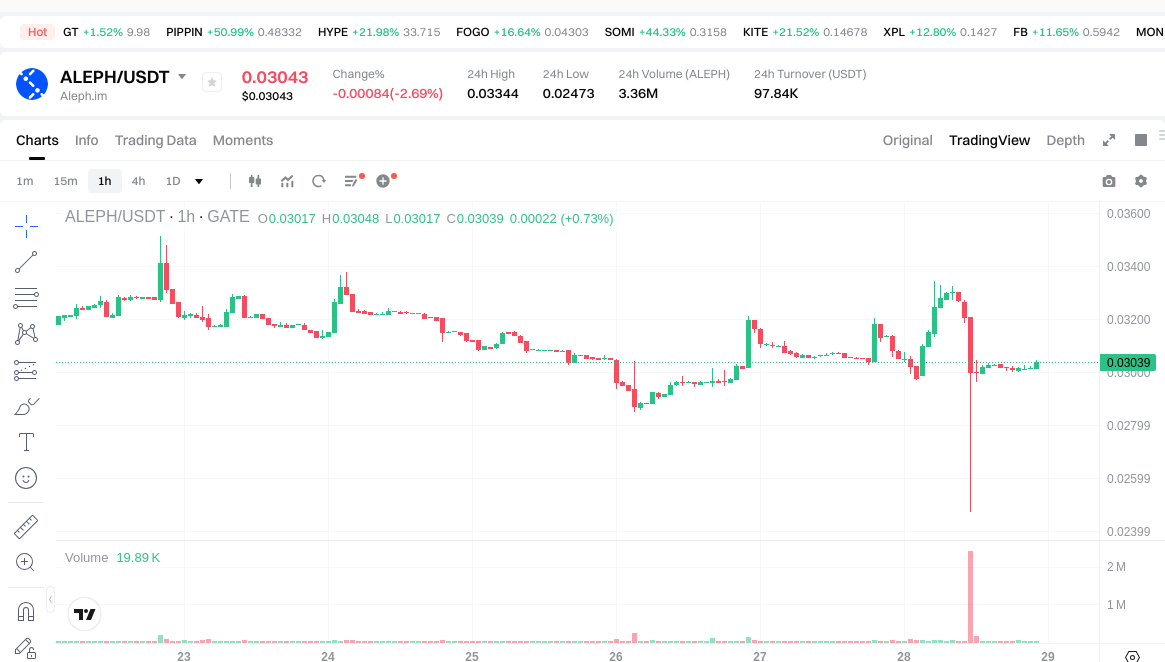
- 2025-2026: Recent performance indicates price fluctuation → From approximately $0.033 (24-hour high on January 28, 2026) to $0.025 (24-hour low), showing ongoing market adjustment patterns
Current ALEPH Investment Market Status (January 2026)
- ALEPH current price: Approximately $0.0302 (as of January 28, 2026, 22:18:54)
- 24-hour price change: -3.63%
- 24-hour trading volume: $97,518.69
- Circulating supply: Approximately 186.43 million ALEPH tokens
- Market capitalization: Approximately $5.63 million
- Market cap to fully diluted valuation ratio: 37.29%
- Number of holders: 13,561
- Exchange availability: Listed on 4 exchanges, including Gate.com
Price performance across different timeframes:
- 1-hour change: +0.069%
- 7-day change: -3.45%
- 30-day change: +1.099%
- 1-year change: -71.61%
Click to view real-time ALEPH market price
Current market characteristics:
ALEPH demonstrates characteristics of a mid-to-small cap cryptocurrency project with moderate liquidity levels. The token shows price consolidation patterns after experiencing substantial volatility in previous years. Trading activity remains relatively modest with daily volume around $97,000, suggesting selective market participation. The project maintains presence across multiple exchanges and has established a holder base of over 13,500 addresses, indicating some level of community adoption. Price performance shows mixed signals across different timeframes, with short-term stability contrasted against longer-term adjustment patterns.
II. Core Factors Influencing Whether ALEPH is a Good Investment
Supply Mechanism and Scarcity (ALEPH Investment Scarcity)
- Total Supply Cap: ALEPH has a maximum supply of 500,000,000 tokens, with approximately 186,431,941 tokens currently in circulation (37.29% of total supply). This controlled supply structure may provide a degree of scarcity that could influence long-term value dynamics.
- Circulating Supply Impact: With over 62% of tokens yet to enter circulation, future release schedules could affect price dynamics and investment considerations.
- Investment Consideration: The limited maximum supply framework may serve as one factor among many in evaluating long-term investment potential, though market conditions and adoption rates remain significant variables.
Institutional Investment and Mainstream Adoption (Institutional Investment in ALEPH)
- Holder Distribution: As of current data, ALEPH has approximately 13,561 token holders, indicating a moderately distributed ownership structure.
- Exchange Presence: ALEPH is currently listed on 4 exchanges, with Gate.com being among the trading platforms. Limited exchange availability may affect liquidity and accessibility for institutional participants.
- Market Position: With a market capitalization of approximately $5.63 million and ranking #1467, ALEPH represents a smaller-cap digital asset, which may present different risk-return characteristics compared to larger market cap projects.
Macroeconomic Environment's Impact on ALEPH Investment
- Market Volatility: Recent price data shows a 24-hour range between $0.02473 and $0.03344, indicating notable short-term volatility. The 30-day price volatility stands at approximately 6.85%, reflecting sensitivity to broader market conditions.
- Performance Context: ALEPH has experienced a -71.61% change over the past year, suggesting susceptibility to broader crypto market trends and macroeconomic factors.
- Market Share: With a market dominance of 0.00047%, ALEPH's performance may be influenced by general cryptocurrency market sentiment and macroeconomic policy shifts.
Technology and Ecosystem Development (Technology & Ecosystem for ALEPH Investment)
- Core Infrastructure: Aleph.im positions itself as a decentralized network offering cross-blockchain layer-2 solutions, decentralized cloud computing, and messaging infrastructure.
- Technical Foundation: The project maintains active development presence with GitHub repositories including myaleph and aleph-client, indicating ongoing technical work.
- Use Case Focus: The platform targets decentralized storage, computing, and messaging applications, areas that may see evolving demand as Web3 infrastructure develops.
- Ecosystem Considerations: The project's value proposition centers on providing infrastructure services for decentralized applications, though widespread adoption metrics were not available in the provided materials.
III. ALEPH Future Investment Predictions and Price Outlook (Is Aleph.im(ALEPH) worth investing in 2026-2031)
Short-term Investment Prediction (2026, short-term ALEPH investment outlook)
- Conservative Forecast: $0.0267 - $0.0304
- Neutral Forecast: $0.0304 - $0.0343
- Optimistic Forecast: $0.0343 - $0.0383
Mid-term Investment Outlook (2027-2029, mid-term Aleph.im(ALEPH) investment forecast)
-
Market Stage Expectation: The token may experience moderate growth as the decentralized cloud computing sector continues to develop, with potential price appreciation driven by increased adoption of cross-blockchain infrastructure solutions.
-
Investment Return Prediction:
- 2027: $0.0316 - $0.0388
- 2028: $0.0296 - $0.0384
- 2029: $0.0322 - $0.0424
-
Key Catalysts: Expansion of decentralized messaging and analytics platform capabilities, potential partnerships within the blockchain ecosystem, and broader adoption of layer-2 network solutions.
Long-term Investment Outlook (Is ALEPH a good long-term investment?)
- Baseline Scenario: $0.0204 - $0.0427 (assuming steady development of the decentralized cloud computing network and sustained platform utility)
- Optimistic Scenario: $0.0367 - $0.0587 (assuming accelerated adoption of cross-blockchain infrastructure and expanded ecosystem integration)
- Risk Scenario: Below $0.0204 (in cases of significant market downturns or diminished demand for decentralized infrastructure services)
Click to view ALEPH long-term investment and price prediction: Price Prediction
2026-01-28 - 2031 Long-term Outlook
- Base Scenario: $0.0204 - $0.0427 USD (corresponding to steady progress and gradual mainstream application growth)
- Optimistic Scenario: $0.0367 - $0.0587 USD (corresponding to large-scale adoption and favorable market conditions)
- Transformative Scenario: Above $0.0587 USD (if the ecosystem achieves breakthrough developments and mainstream popularization)
- 2031-12-31 Predicted High: $0.0587 USD (based on optimistic development assumptions)
Disclaimer: Price predictions are subject to market volatility and various external factors. Historical performance does not guarantee future results. Investors should conduct their own research and consider their risk tolerance before making investment decisions.
| Year |
Predicted High Price |
Predicted Average Price |
Predicted Low Price |
Price Change |
| 2026 |
0.0382914 |
0.03039 |
0.0267432 |
0 |
| 2027 |
0.038804991 |
0.0343407 |
0.031593444 |
13 |
| 2028 |
0.038401487775 |
0.0365728455 |
0.029624004855 |
21 |
| 2029 |
0.042360498300375 |
0.0374871666375 |
0.03223896330825 |
24 |
| 2030 |
0.042718500741763 |
0.039923832468937 |
0.020361154559158 |
32 |
| 2031 |
0.058676056579597 |
0.04132116660535 |
0.036362626612708 |
36 |
IV. ALEPH Investment Strategy and Risk Management (How to invest in ALEPH)
Investment Methodology (ALEPH investment strategy)
Long-term Holding (HODL ALEPH)
For conservative investors seeking steady exposure to decentralized cloud infrastructure, a long-term holding strategy may be considered. This approach involves acquiring ALEPH tokens and maintaining positions through market cycles, with the expectation that the underlying technology and network adoption will drive value over extended periods. Given ALEPH's focus on cross-blockchain Layer 2 solutions and decentralized cloud computing, investors following this strategy typically monitor network development milestones, partnership announcements, and ecosystem growth metrics.
Active Trading
Active traders may approach ALEPH through technical analysis and swing trading strategies. With a 24-hour trading volume of approximately $97,518.69 and recent price fluctuations between $0.02473 and $0.03344, the token exhibits volatility characteristics that some traders seek to capitalize on. Technical indicators, chart patterns, and volume analysis form the foundation of this approach, requiring continuous market monitoring and risk assessment.
Risk Management (Risk management for ALEPH investment)
Asset Allocation Ratio
Conservative Investors: May consider limiting ALEPH exposure to 1-3% of total portfolio value, prioritizing established assets while maintaining minimal exposure to smaller-cap tokens.
Aggressive Investors: Could allocate 5-10% of portfolio to ALEPH, accepting higher volatility in exchange for potential upside from network growth and technology adoption.
Professional Investors: May incorporate ALEPH as part of a diversified blockchain infrastructure thesis, with allocation determined by comprehensive due diligence, network metrics analysis, and correlation studies with other portfolio holdings.
Risk Hedging Solutions
Multi-asset portfolio construction remains a primary risk mitigation approach. Combining ALEPH with established cryptocurrencies, stablecoins, and traditional hedging instruments may help reduce overall portfolio volatility. Position sizing based on individual risk tolerance and stop-loss strategies can provide additional downside protection in volatile market conditions.
Secure Storage
Cold Wallets: For long-term holdings, cold storage solutions provide enhanced security by keeping private keys offline and away from potential network threats.
Hot Wallets: Active traders may utilize hot wallets for operational convenience, though this approach carries increased exposure to online security risks.
Hardware Wallet Recommendations: Dedicated hardware wallets offer a balance between security and accessibility, with devices specifically designed to safeguard private keys while enabling transaction signing when needed.
V. ALEPH Investment Risks and Challenges (Risks of investing in ALEPH)
Market Risk
High Volatility: ALEPH has demonstrated significant price fluctuations, with 24-hour movements of -3.63% and annual changes of -71.61%. The token's price has ranged from a historical low of $0.00623944 to a historical high of $0.875793, illustrating substantial volatility that characterizes smaller-cap cryptocurrency assets.
Price Manipulation Concerns: With a market capitalization of approximately $5.63 million and relatively limited exchange availability (4 exchanges), the token may be susceptible to price manipulation activities. Lower liquidity environments can amplify the impact of large transactions on market prices.
Regulatory Risk
Cryptocurrency regulatory frameworks vary significantly across jurisdictions and continue to evolve. Decentralized cloud computing networks and cross-blockchain protocols face uncertain regulatory treatment in various countries. Changes in regulatory approaches toward decentralized infrastructure, data storage requirements, or token classification could impact ALEPH's operational environment and market accessibility.
Technical Risk
Network Security Vulnerabilities: As a decentralized cloud computing and messaging platform operating across multiple blockchains, ALEPH's infrastructure faces potential security challenges. Smart contract vulnerabilities, cross-chain bridge exploits, or node network attacks could compromise system integrity and user funds.
Upgrade Failures: Protocol upgrades and network enhancements carry implementation risks. Failed upgrades, consensus issues, or technical bugs during deployment could disrupt network operations and negatively impact token value.
Technology Competition: The decentralized infrastructure sector includes numerous competing projects. Failure to maintain technological competitiveness or adapt to evolving market requirements could limit adoption and network growth.
VI. Conclusion: Is ALEPH a Good Investment?
Investment Value Summary
ALEPH represents exposure to the decentralized cloud infrastructure sector, specifically focused on cross-blockchain Layer 2 solutions, secure cloud computing, and decentralized messaging platforms. The project addresses growing demand for decentralized data storage and computing alternatives. However, the token has experienced considerable price volatility, with a 71.61% decline over the past year and current circulation of approximately 37.29% of maximum supply. The relatively small market capitalization of $5.63 million and limited exchange availability indicate early-stage market positioning.
Investor Recommendations
✅ Beginners: Consider dollar-cost averaging strategies combined with secure wallet storage practices. Focus on understanding the underlying technology and network development before committing significant capital. Start with minimal position sizes to gain exposure while managing risk.
✅ Experienced Investors: May explore swing trading opportunities based on technical analysis while maintaining core positions for potential network growth. Diversify across multiple blockchain infrastructure projects to reduce concentration risk and correlation exposure.
✅ Institutional Investors: Could evaluate ALEPH as part of broader decentralized infrastructure investment themes, conducting thorough due diligence on network metrics, development activity, partnership ecosystem, and competitive positioning before strategic allocation decisions.
⚠️ Disclaimer: Cryptocurrency investments carry substantial risk, including potential total loss of capital. This analysis is provided for informational purposes only and does not constitute investment advice. Market conditions, project developments, and regulatory environments can change rapidly. Investors should conduct independent research and consult qualified financial professionals before making investment decisions.
VII. FAQ
Q1: What is Aleph.im (ALEPH) and what makes it different from other blockchain projects?
Aleph.im is a decentralized network functioning as a cross-blockchain layer-2 network, decentralized secure cloud computing platform, and messaging/analytics infrastructure. What distinguishes ALEPH is its focus on providing decentralized alternatives to centralized cloud services across multiple blockchain ecosystems, rather than being limited to a single blockchain. The project addresses growing demand for decentralized data storage, computing resources, and secure messaging without relying on traditional centralized infrastructure providers.
Q2: Is ALEPH a good investment for beginners in 2026?
For beginners, ALEPH presents considerable risks alongside potential opportunities. The token has experienced significant volatility, including a -71.61% decline over the past year, and currently holds a small market capitalization of approximately $5.63 million. Beginners should consider starting with minimal position sizes (1-3% of portfolio), employ dollar-cost averaging strategies, and prioritize secure wallet storage. Understanding the underlying technology and network development is essential before committing substantial capital. This investment requires higher risk tolerance and should not represent a major portion of a beginner's portfolio.
Q3: What are the main risks of investing in ALEPH?
ALEPH faces multiple investment risks: Market Risk includes high volatility with significant price fluctuations and potential manipulation concerns due to limited liquidity and small market cap. Regulatory Risk stems from evolving cryptocurrency regulations that could impact decentralized infrastructure operations. Technical Risk encompasses network security vulnerabilities, potential upgrade failures, and intense competition from other decentralized infrastructure projects. Additionally, with only 37.29% of maximum supply currently circulating, future token releases could affect price dynamics.
Q4: How does ALEPH's price prediction look for 2026-2031?
Price predictions for ALEPH suggest moderate growth potential under favorable conditions. For 2026, conservative forecasts range from $0.0267-$0.0304, while optimistic scenarios project $0.0343-$0.0383. By 2031, base scenarios suggest $0.0204-$0.0427, optimistic scenarios indicate $0.0367-$0.0587, and transformative scenarios project above $0.0587 if the ecosystem achieves breakthrough adoption. However, these predictions are subject to substantial uncertainty, market volatility, technological developments, and adoption rates. Historical performance showing a decline from $0.88 (January 2022) to current levels around $0.03 demonstrates significant downside risk potential.
Q5: Where can I buy ALEPH and how should I store it safely?
ALEPH is currently listed on 4 exchanges, with Gate.com being among the available trading platforms. The limited exchange availability may affect liquidity and accessibility compared to more widely-traded tokens. For secure storage, long-term investors should consider cold wallet solutions that keep private keys offline, providing enhanced security against network threats. Hardware wallets offer a balanced approach between security and accessibility. Active traders may use hot wallets for operational convenience, though this carries increased exposure to online security risks. Regardless of storage method, investors should never share private keys and should verify wallet addresses carefully during transactions.
Q6: What investment strategy is recommended for ALEPH?
Investment strategies for ALEPH depend on individual risk profiles and investment objectives. Conservative investors may consider long-term holding (HODL) with 1-3% portfolio allocation, monitoring network development milestones and ecosystem growth. Aggressive investors could allocate 5-10% while employing swing trading strategies based on technical analysis, given the token's volatility characteristics. Professional investors might incorporate ALEPH as part of a diversified blockchain infrastructure thesis after comprehensive due diligence. All strategies should include risk management measures such as position sizing based on risk tolerance, stop-loss strategies, and diversification across multiple assets to reduce concentration risk.
Q7: How does the circulating supply of ALEPH affect its investment potential?
ALEPH has a maximum supply of 500,000,000 tokens, with approximately 186,431,941 tokens (37.29%) currently in circulation. This means over 62% of tokens have yet to enter the market, which could significantly impact future price dynamics. Future token releases may create selling pressure and affect supply-demand equilibrium. However, the controlled maximum supply framework may provide a degree of scarcity that could influence long-term value dynamics. Investors should monitor token unlock schedules and distribution mechanisms, as sudden supply increases could negatively impact price performance regardless of project fundamentals or adoption metrics.
Q8: What are the key factors that could drive ALEPH's price growth in the future?
Several catalysts could potentially drive ALEPH's value appreciation: Technology Development includes successful protocol upgrades and network enhancements that improve functionality and user experience. Ecosystem Expansion involves forming partnerships within the blockchain ecosystem and increasing adoption of cross-blockchain infrastructure solutions. Market Trends such as growing demand for decentralized alternatives to centralized cloud services and broader Web3 infrastructure development could benefit ALEPH. Network Metrics including user growth, transaction volumes, and developer activity serve as indicators of ecosystem health. However, these potential catalysts must overcome significant challenges including intense competition, regulatory uncertainties, and the project's need to demonstrate sustained utility and adoption to justify value appreciation.
* The information is not intended to be and does not constitute financial advice or any other recommendation of any sort offered or endorsed by Gate.