This comprehensive analysis evaluates whether Alephium (ALPH) represents a viable investment opportunity by examining its technological innovations, tokenomics structure, and market potential. As the first operational sharded blockchain combining Bitcoin's security with Ethereum-inspired smart contracts, ALPH trades at $0.1113 with a market cap of $13.96 million and ranks 1,042 globally. The article thoroughly reviews ALPH's historical price performance, recent 88% decline from its $3.86 all-time high, and current market position across 8 exchanges. Key investment factors analyzed include the token's 1-billion maximum supply with 12.55% circulation, energy-efficient technology approach, and moderate trading volumes. The analysis provides detailed price forecasts ranging from $0.0988 to $0.3231 through 2031, outlines strategic investment approaches for different investor profiles, and identifies critical risks including liquidity constraints, regulatory uncertainties, and nascent technology implementation. Com
Introduction: Alephium (ALPH) Investment Position and Market Outlook
Alephium (ALPH) represents a notable asset within the cryptocurrency landscape, positioning itself as the first operational sharded blockchain that combines scalability with smart contract functionality. As of January 25, 2026, ALPH maintains a market capitalization of approximately $13.96 million, with a circulating supply of around 125.46 million tokens and a current trading price near $0.1113. The token holds a market ranking of 1042 and accounts for 0.00076% of the total cryptocurrency market dominance.
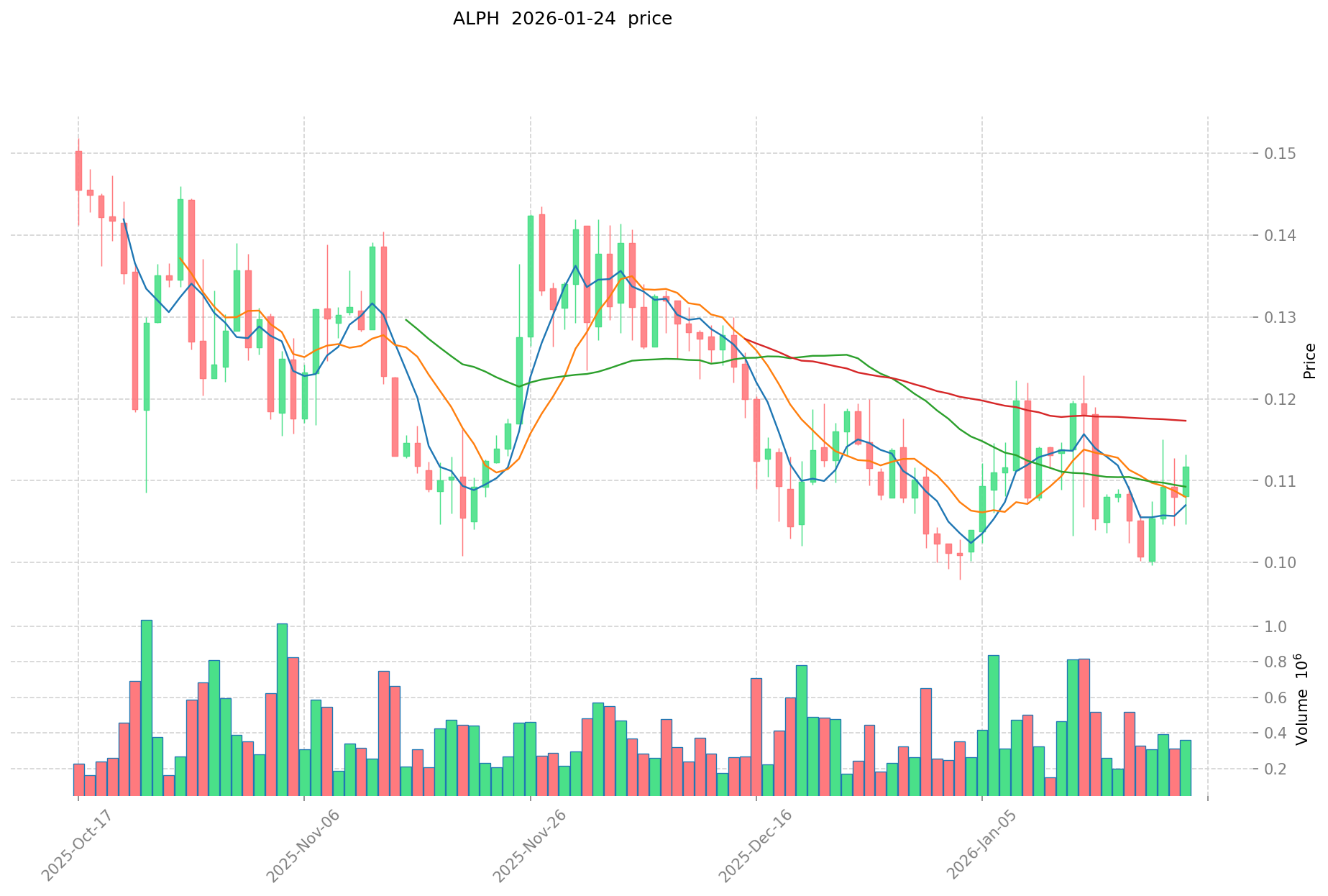
With a fully diluted market cap of $24.33 million and a maximum supply cap of 1 billion tokens, ALPH demonstrates a current circulation ratio of 12.55%. The asset has experienced notable price fluctuations since its inception, recording an all-time high of $3.86 in February 2024 and an all-time low of $0.00561836 in July 2023. Recent price movements show mixed performance, with short-term gains of 0.44% (1H), 1.55% (24H), and 2.4% (7D), while facing a 6.4% decline over 30 days and an 88.31% decrease over the past year.
Alephium distinguishes itself through its technical approach, bringing scalability and smart contract capabilities inspired by established blockchain technologies while emphasizing energy efficiency. With availability across 8 exchanges and a 24-hour trading volume of approximately $24,759, the token maintains active market participation. This article provides a comprehensive analysis of ALPH's investment characteristics, historical performance trends, future price considerations, and associated investment factors to serve as a reference for those evaluating cryptocurrency opportunities.
I. Historical Price Review and Current Investment Value of ALPH
- 2023: Price reached its lowest level → ALPH dropped to $0.00561836 on July 4, 2023
- 2024: Market expansion phase → ALPH climbed to $3.86 on February 27, 2024
- Recent period: Market adjustment → Price declined from the 2024 level to current trading range
Current ALPH Investment Market Status (January 2026)
- ALPH current price: $0.1113
- Market sentiment (Fear & Greed Index): Data not available in provided materials
- 24-hour trading volume: $24,759.27
- Institutional investor holdings: Data not available in provided materials
Click to view real-time ALPH market price
II. Core Factors Affecting Whether ALPH is a Good Investment (Is Alephium(ALPH) a Good Investment)
Supply Mechanism and Scarcity (ALPH investment scarcity)
- Maximum supply of 1,000,000,000 ALPH with current circulation of approximately 125.46 million tokens (12.55% of max supply) → influences price dynamics and investment value through controlled token release
- Circulating supply ratio: The relatively low circulation percentage suggests potential supply expansion over time, which may impact long-term scarcity considerations for investors
- Investment significance: The defined maximum supply cap provides a framework for evaluating scarcity, though the current low circulation rate means substantial additional tokens may enter the market
Institutional Investment and Mainstream Adoption (Institutional investment in ALPH)
- Market presence: ALPH is currently listed on 8 exchanges, indicating a developing but limited institutional infrastructure
- Trading activity: 24-hour trading volume of approximately $24,759 reflects moderate market participation levels
- Market capitalization standing: Ranked #1,042 with a market cap of approximately $13.96 million and market dominance of 0.00076%, suggesting ALPH remains in early-stage adoption with limited mainstream institutional involvement
Macroeconomic Environment's Impact on ALPH Investment
- General cryptocurrency market conditions influence ALPH's investment appeal, as broader market sentiment affects capital flows into alternative blockchain projects
- Market volatility considerations: ALPH has experienced significant price fluctuations, with historical ranges between $0.0056 and $3.86, reflecting sensitivity to overall crypto market cycles
- Risk assessment: As a relatively smaller market cap asset, ALPH may demonstrate heightened sensitivity to macroeconomic shifts affecting the broader digital asset sector
Technology and Ecosystem Development (Technology & Ecosystem for ALPH investment)
- Sharding technology: Alephium implements blockchain sharding as a core technological approach, designed to enhance scalability compared to traditional blockchain architectures
- Smart contract capability: The platform incorporates smart contract functionality inspired by Ethereum while building on Bitcoin's proven security model, aiming to support decentralized applications (dApps)
- Energy efficiency focus: The project emphasizes improved energy efficiency compared to traditional proof-of-work systems, potentially addressing environmental concerns in blockchain technology
- Development activity: Active GitHub repository indicates ongoing technical development, which may contribute to long-term ecosystem growth and investment value
III. ALPH Future Investment Forecast and Price Outlook (Is Alephium(ALPH) worth investing in 2026-2031)
Short-term Investment Forecast (2026, short-term ALPH investment outlook)
- Conservative forecast: $0.0988 - $0.111
- Neutral forecast: $0.111 - $0.1222
- Optimistic forecast: $0.1222 - $0.1443
Mid-term Investment Outlook (2027-2028, mid-term Alephium(ALPH) investment forecast)
- Market stage expectation: Gradual recovery phase with moderate growth momentum, supported by blockchain scalability features and sharding technology development
- Investment return forecast:
- 2027: $0.1162 - $0.1698
- 2028: $0.0996 - $0.2112
- Key catalysts: Technology upgrades in sharding blockchain infrastructure, potential expansion in smart contract adoption, and evolving energy-efficient consensus mechanisms
Long-term Investment Outlook (Is Alephium a good long-term investment?)
- Base scenario: $0.1490 - $0.2267 (assuming steady development of blockchain ecosystem and moderate market adoption)
- Optimistic scenario: $0.1693 - $0.3231 (assuming accelerated adoption of sharding technology and favorable market conditions)
- Risk scenario: Below $0.0996 (under adverse market conditions or significant technological challenges)
Check ALPH long-term investment and price forecast: Price Prediction
2026-01-25 to 2031 Long-term Outlook
- Base scenario: $0.1490 - $0.2159 (corresponding to steady progress and gradual mainstream application enhancement)
- Optimistic scenario: $0.1693 - $0.3231 (corresponding to large-scale adoption and favorable market environment)
- Transformative scenario: Above $0.3231 (if ecosystem achieves breakthrough progress and mainstream adoption)
- 2031-12-31 predicted high: $0.3231 (based on optimistic development assumptions)
Disclaimer: Price forecasts are based on historical data analysis and market trends. Cryptocurrency investments involve substantial risks, and actual prices may differ significantly from predictions. This content does not constitute investment advice.
| Year |
Predicted High Price |
Predicted Average Price |
Predicted Low Price |
Price Change |
| 2026 |
0.1443 |
0.111 |
0.09879 |
0 |
| 2027 |
0.1697745 |
0.12765 |
0.1161615 |
14 |
| 2028 |
0.211171395 |
0.14871225 |
0.0996372075 |
33 |
| 2029 |
0.2519185515 |
0.1799418225 |
0.16914531315 |
61 |
| 2030 |
0.22672669635 |
0.215930187 |
0.14899182903 |
94 |
| 2031 |
0.3231395248455 |
0.221328441675 |
0.19255574425725 |
99 |
IV. Alephium Investment Strategy and Risk Management (How to invest in Alephium)
Investment Methodology (Alephium investment strategy)
Long-term Holding (HODL Alephium): This approach suits conservative investors seeking to capitalize on the project's technological innovations in sharded blockchain architecture. Given Alephium's focus on scalability and energy efficiency improvements over Bitcoin's core technology, investors with a multi-year horizon may consider accumulating positions during market corrections.
Active Trading: Traders employing technical analysis can leverage ALPH's price movements. With a 24-hour trading volume of approximately $24,759 and recent volatility showing 1.55% daily gains alongside -88.31% annual decline from historical highs, swing trading opportunities exist for experienced market participants. Key technical levels include the 24-hour range between $0.1069-$0.1131 and the all-time high of $3.86 reached in February 2024.
Risk Management (Risk management for Alephium investment)
Asset Allocation Ratios:
- Conservative investors: Limit ALPH exposure to 1-3% of cryptocurrency portfolio
- Moderate investors: Allocate 3-7% depending on risk tolerance and blockchain technology conviction
- Aggressive investors: May consider 7-15% allocation with strict stop-loss parameters
Risk Hedging Strategies: Diversification across multiple blockchain platforms (Layer 1 competitors, established cryptocurrencies) can mitigate concentrated exposure. Position sizing should account for ALPH's relatively low market capitalization of approximately $13.96 million and ranking outside the top 1,000 cryptocurrencies.
Secure Storage Solutions:
- Hardware wallets: Recommended for holdings exceeding $1,000 equivalent
- Cold storage: Prioritize for long-term positions to minimize exchange hacking risks
- Hot wallets: Use only for active trading amounts with regular security audits
V. Alephium Investment Risks and Challenges (Risks of investing in Alephium)
Market Risks: ALPH demonstrates significant volatility characteristics. The token has declined approximately 88% from its all-time high of $3.86 to current levels around $0.11, indicating substantial downside risk potential. With a relatively modest 24-hour trading volume and limited exchange availability (8 exchanges), liquidity constraints may amplify price swings during market stress periods.
Regulatory Risks: As a blockchain platform offering smart contract functionality inspired by Ethereum while building on Bitcoin's architecture, Alephium faces evolving regulatory frameworks across jurisdictions. Potential classification uncertainties regarding securities laws and environmental regulations affecting proof-of-work mechanisms could impact adoption trajectories.
Technology Risks: While Alephium positions itself as the first operational sharded blockchain combining Bitcoin and Ethereum features, the technology remains relatively nascent. Network security considerations include:
- Sharding implementation complexity and potential attack vectors
- Smart contract vulnerabilities inherent in newer blockchain platforms
- Competition from established Layer 1 solutions with larger developer ecosystems
- Upgrade execution risks given the circulating supply represents only 12.55% of total supply
Liquidity and Adoption Risks: With a market dominance of merely 0.00076% and limited exchange presence, ALPH faces significant adoption challenges. The gap between circulating supply (125.46 million) and maximum supply (1 billion tokens) suggests potential dilution risks as more tokens enter circulation.
VI. Conclusion: Is Alephium a Good Investment?
Investment Value Summary: Alephium presents an innovative technical proposition combining sharding scalability with energy-efficient consensus mechanisms. However, the token has experienced substantial price depreciation, declining nearly 88% from peak valuations. The project's market positioning remains developmental, with modest trading volumes and limited mainstream adoption to date.
Investor Recommendations:
✅ Beginners: Consider small exploratory allocations (under 2% of portfolio) using dollar-cost averaging strategies. Prioritize secure storage through hardware wallets and avoid overexposure given the token's high volatility profile.
✅ Experienced Investors: May employ swing trading strategies around technical support/resistance levels while maintaining core positions sized appropriately for risk tolerance. Monitor development milestones and ecosystem growth metrics for portfolio rebalancing decisions.
✅ Institutional Investors: Evaluate Alephium as a speculative allocation within broader blockchain infrastructure themes. Conduct thorough due diligence on sharding technology implementation, team credentials, and competitive positioning before strategic commitments.
⚠️ Disclaimer: Cryptocurrency investments carry substantial risks including total capital loss. This analysis provides educational information only and does not constitute financial advice. Investors should conduct independent research and consult qualified financial advisors before making investment decisions.
VII. FAQ
Q1: What is Alephium's core technological advantage compared to other blockchains?
Alephium is the first operational sharded blockchain that combines Bitcoin's proven security model with Ethereum-inspired smart contract functionality while emphasizing energy efficiency. The project implements blockchain sharding technology to enhance scalability beyond traditional architectures, allowing parallel transaction processing across multiple shards. This approach aims to address the blockchain trilemma of scalability, security, and decentralization simultaneously, positioning ALPH as a technical innovation in the Layer 1 blockchain space.
Q2: What caused ALPH's significant price decline from its all-time high?
ALPH experienced an approximately 88.31% decline from its all-time high of $3.86 (February 2024) to current levels around $0.11 (January 2026). This substantial correction reflects broader cryptocurrency market volatility, limited mainstream adoption evidenced by its 0.00076% market dominance, and modest trading volumes averaging $24,759 daily. The token's relatively early development stage, with only 12.55% of maximum supply in circulation and presence on just 8 exchanges, contributes to heightened price sensitivity during market downturns.
Q3: How does ALPH's tokenomics structure affect long-term investment considerations?
ALPH has a maximum supply cap of 1 billion tokens with approximately 125.46 million currently circulating (12.55% circulation ratio). This means substantial additional tokens will enter the market over time, potentially creating dilution pressure on price appreciation. The controlled token release schedule provides a framework for evaluating scarcity, but investors should recognize that the low circulation percentage means supply expansion will continue, which may impact long-term valuation dynamics compared to assets with higher circulation ratios.
Q4: What are the primary risks associated with investing in Alephium?
Key investment risks include: (1) Market risk: 88% historical decline demonstrating extreme volatility potential; (2) Liquidity risk: Limited exchange availability (8 platforms) and modest trading volumes may amplify price swings; (3) Technology risk: Relatively nascent sharding implementation with potential security vulnerabilities inherent in newer blockchain platforms; (4) Adoption risk: Market capitalization ranking outside top 1,000 cryptocurrencies with minimal mainstream institutional involvement; (5) Regulatory uncertainty: Evolving frameworks affecting proof-of-work mechanisms and smart contract platforms.
Q5: What is a recommended asset allocation strategy for ALPH?
Asset allocation should align with investor risk profiles: Conservative investors should limit ALPH exposure to 1-3% of their cryptocurrency portfolio, treating it as a speculative position with high volatility characteristics. Moderate investors may allocate 3-7% depending on conviction in blockchain sharding technology and overall risk tolerance. Aggressive investors could consider 7-15% allocation with strict stop-loss parameters, recognizing the elevated risk profile. All allocations should incorporate diversification across multiple blockchain platforms and prioritize secure storage solutions, particularly hardware wallets for holdings exceeding $1,000 equivalent.
Q6: How realistic are the long-term price predictions for ALPH through 2031?
Price forecasts project ALPH reaching $0.1443-$0.3231 by 2031 under various scenarios, representing potential gains of 30-190% from current levels ($0.11). However, these predictions carry significant uncertainty given cryptocurrency market volatility and ALPH's early-stage development. The base scenario ($0.1490-$0.2159) assumes steady ecosystem progress, while the optimistic scenario ($0.1693-$0.3231) requires accelerated adoption of sharding technology and favorable market conditions. Investors should recognize these forecasts are based on historical data analysis and may differ substantially from actual outcomes, particularly given ALPH's limited track record and modest market presence.
Q7: What investment strategy works best for ALPH given its current market characteristics?
Two primary strategies suit different investor profiles: (1) Long-term holding (HODL) appeals to conservative investors with multi-year horizons focused on technological innovation in sharded blockchain architecture, accumulating positions during market corrections via dollar-cost averaging to mitigate volatility; (2) Active trading suits experienced traders leveraging technical analysis around support/resistance levels, capitalizing on ALPH's price movements within its 24-hour range ($0.1069-$0.1131) and longer-term volatility. Both approaches require strict risk management, with position sizing appropriately scaled to individual risk tolerance and secure storage implementation to minimize custody risks.
Q8: What key developments should investors monitor for ALPH's future prospects?
Critical factors include: (1) Technology milestones: Successful sharding implementation upgrades and smart contract ecosystem expansion; (2) Exchange listings: Expansion beyond current 8 platforms to enhance liquidity and accessibility; (3) Developer activity: Sustained GitHub contributions indicating ongoing ecosystem development; (4) Adoption metrics: Growth in active addresses, transaction volumes, and decentralized applications built on the platform; (5) Competitive positioning: Performance relative to established Layer 1 solutions and emerging sharding competitors; (6) Token circulation: Pace of additional token releases from the 87.45% non-circulating supply. Monitoring these indicators provides insight into whether ALPH can transition from early-stage development to mainstream adoption.
* The information is not intended to be and does not constitute financial advice or any other recommendation of any sort offered or endorsed by Gate.