This comprehensive guide evaluates whether ALICE is a worthwhile investment by analyzing the token's market fundamentals, historical performance, and growth potential through 2031. ALICE, the native token of the My Neighbor Alice gaming platform, currently trades at $0.17597 with a $16.2 million market cap and 92.08% circulating supply. The article examines key investment factors including fixed token supply mechanisms, ecosystem adoption, multi-chain blockchain integration, and NFT-based asset ownership that drive ALICE's utility and value proposition. Detailed price forecasts range from conservative ($0.14-$0.18 in 2026) to optimistic scenarios ($0.32-$0.44 by 2031), accompanied by evidence-based investment strategies for different investor profiles. Comprehensive risk analysis covers market volatility, regulatory uncertainties, and technical challenges, while practical guidance on asset allocation, portfolio hedging, and secure storage empowers informed decision-making for ALICE investors on Gate and other
Introduction: My Neighbor Alice (ALICE) Investment Position and Market Outlook
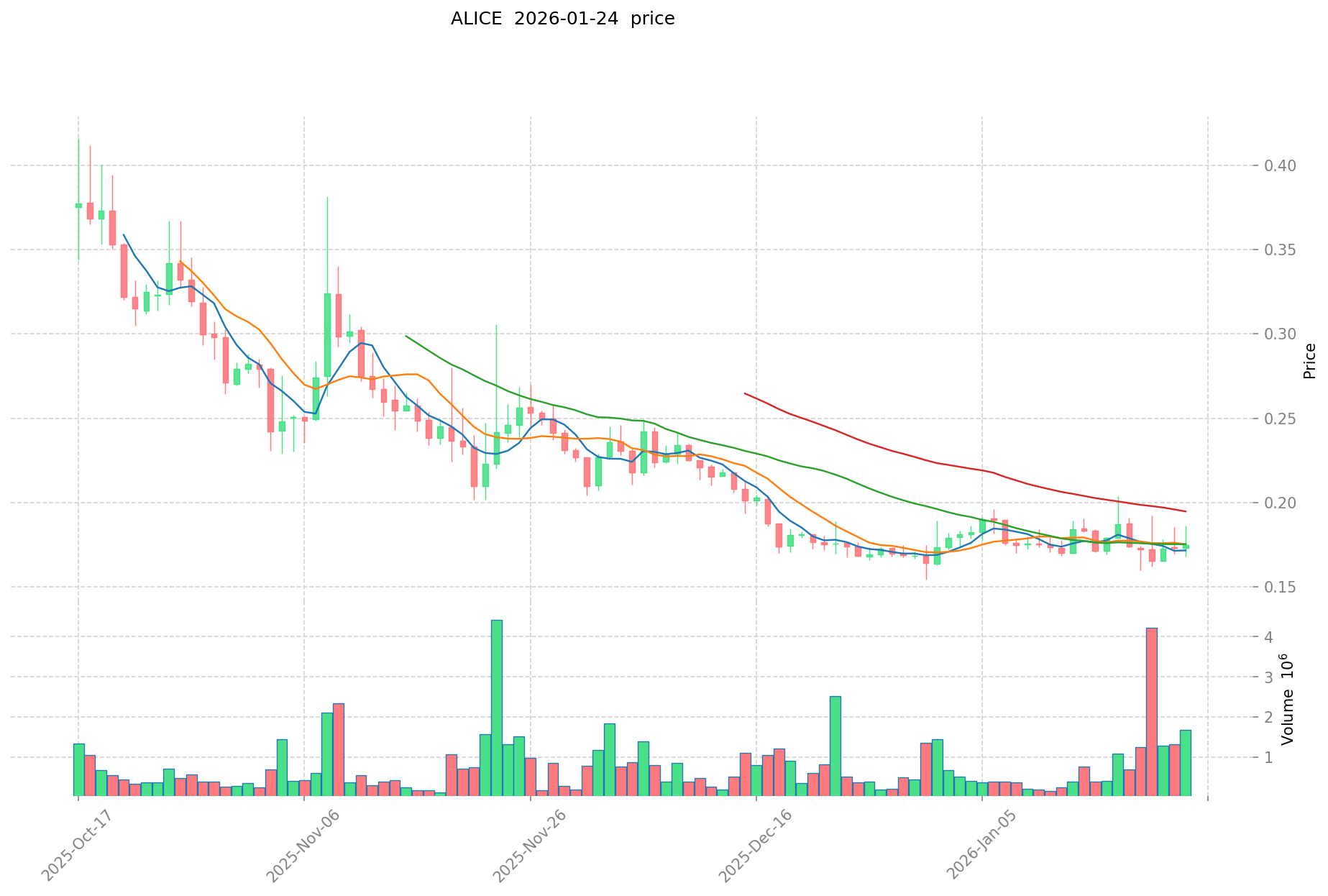
ALICE is a significant asset in the cryptocurrency field, having been launched in 2021 and achieving notable presence in blockchain gaming and NFT sectors. As of January 24, 2026, ALICE has a market capitalization of approximately $16.20 million, with a circulating supply of approximately 92.08 million tokens, and the current price is maintained around $0.176. With its positioning as the native functional token of the multiplayer farming game "My Neighbor Alice," ALICE has gradually become a focal point for investors discussing "Is ALICE a good investment?" This article will comprehensively analyze ALICE's investment value, historical trends, future price predictions, and investment risks to provide reference for investors.
I. ALICE (ALICE) Price History Review and Current Investment Value Status
- 2021: Token launch and market entry → Initial price was $0.1, with subsequent market fluctuations
- 2021 (March): Early market phase → Price showed volatility with significant changes from launch levels
- 2026 (January): Current market cycle → Price at $0.17597, showing recent decline of 4.21% over 7-day period
Current ALICE Investment Market Status (January 2026)
- ALICE current price: $0.17597
- 24-hour trading volume: $254,551.54
- Circulating supply: 92,083,333 ALICE (92.08% of total supply)
- Market capitalization: $16,203,904.11
- Fully diluted valuation: $17,597,000
- Market dominance: 0.00055%
- Price changes: 1H (+1.09%), 24H (-0.98%), 7D (-4.21%), 30D (+0.89%), 1Y (-82.96%)
- Total supply: 100,000,000 ALICE
- Maximum supply: 100,000,000 ALICE
- Number of exchanges listed: 31
- Token holders: 8,694
Click to view real-time ALICE market price
II. Core Factors Affecting Whether ALICE is a Good Investment
Supply Mechanism and Scarcity (ALICE Investment Scarcity)
- Fixed Supply Cap: ALICE has a maximum supply of 100,000,000 tokens, with 92,083,333 tokens currently in circulation (92.08% of total supply). This represents a relatively high circulation ratio, indicating that most tokens have already entered the market.
- Impact on Price: The fixed supply mechanism creates a potential scarcity dynamic. As of January 24, 2026, ALICE is trading at $0.17597, showing significant distance from its previous price level of $40.93 recorded in March 2021. The substantial price decline of 82.96% over the past year reflects market volatility and changing investor sentiment.
- Investment Consideration: The nearly complete token circulation (92.08%) means limited additional supply pressure from token unlocks. However, the scarcity effect alone does not guarantee price appreciation, as it must be balanced with demand factors driven by game adoption and ecosystem growth.
Institutional Investment and Mainstream Adoption (Institutional Investment in ALICE)
- Holder Base: The token currently has 8,694 holders, indicating a relatively modest community size for the project. This suggests limited institutional participation compared to major cryptocurrencies.
- Exchange Presence: ALICE is listed on 31 exchanges, providing reasonable liquidity and accessibility for investors. The 24-hour trading volume of $254,551.54 reflects moderate market activity.
- Adoption Indicators: As a gaming token, ALICE's investment value depends heavily on the adoption of My Neighbor Alice game and its NFT marketplace. The token's utility spans in-game purchases, governance participation, staking rewards, and player incentives, which tie its value directly to game engagement levels.
Technology and Ecosystem Development (Technology & Ecosystem for ALICE Investment)
- Blockchain Integration: ALICE operates through smart contracts on both Ethereum (ETH) and Binance Smart Chain (BSC), providing multi-chain accessibility and broader ecosystem reach.
- NFT-Based Asset Ownership: The game implements decentralized ownership of in-game assets including islands, houses, and pets through NFTs. This creates potential value for collectors and players who can trade assets in the marketplace.
- Social and Gaming Features: Built-in chat functionality, collaborative group tasks, and player-to-player asset transfers enhance the social gaming experience. The in-game marketplace provides liquidity for digital assets, creating economic incentives for active participation.
- Governance Mechanism: Token holders can participate in platform governance through a decentralized organization structure, including proposals and voting on operational decisions. This governance utility may appeal to investors seeking active participation in project direction.
- Staking Opportunities: ALICE staking allows token holders to earn a portion of platform revenue from land sales, asset transactions, and trading fees, providing a potential passive income stream for long-term holders.
III. ALICE Future Investment Forecast and Price Outlook (Is ALICE(ALICE) worth investing in 2026-2031)
Short-term Investment Forecast (2026, short-term ALICE investment outlook)
- Conservative forecast: $0.14 - $0.18
- Neutral forecast: $0.16 - $0.20
- Optimistic forecast: $0.20 - $0.26
Mid-term Investment Outlook (2027-2029, mid-term ALICE(ALICE) investment forecast)
-
Market stage expectation: Based on the provided data, ALICE may experience moderate volatility during the mid-term period. The token is projected to show gradual recovery trends as the gaming and NFT sectors continue to develop.
-
Investment return forecast:
- 2027: $0.17 - $0.23
- 2028: $0.22 - $0.29
- 2029: $0.16 - $0.35
-
Key catalysts: Expansion of My Neighbor Alice gaming ecosystem, increased NFT adoption, potential partnerships within the GameFi sector, and broader blockchain gaming market growth.
Long-term Investment Outlook (Is ALICE a good long-term investment?)
- Base scenario: $0.22 - $0.33 (assuming steady ecosystem development and maintained user engagement)
- Optimistic scenario: $0.32 - $0.44 (assuming significant gaming platform expansion and mainstream adoption of blockchain gaming)
- Risk scenario: Below $0.14 (considering potential market downturns or reduced gaming sector interest)
Click to view ALICE long-term investment and price forecast: Price Prediction
2026-01-24 - 2031 Long-term Outlook
- Base scenario: $0.22 - $0.33 (corresponding to steady progress and gradual mainstream application enhancement)
- Optimistic scenario: $0.32 - $0.44 (corresponding to large-scale adoption and favorable market environment)
- Transformative scenario: Above $0.44 (if the ecosystem achieves breakthrough development and mainstream popularization)
- 2031-12-31 forecast high: $0.44 (based on optimistic development assumptions)
Disclaimer: This forecast is based on historical data and current market trends. Cryptocurrency investments involve substantial risk, and past performance does not guarantee future results. Investors should conduct their own research and consider their risk tolerance before making investment decisions.
| Year |
Predicted High Price |
Predicted Average Price |
Predicted Low Price |
Price Change |
| 2026 |
0.2618079 |
0.17571 |
0.140568 |
0 |
| 2027 |
0.227509308 |
0.21875895 |
0.1728195705 |
24 |
| 2028 |
0.28561168512 |
0.223134129 |
0.21644010513 |
26 |
| 2029 |
0.3510346117428 |
0.25437290706 |
0.1577112023772 |
44 |
| 2030 |
0.329947097747526 |
0.3027037594014 |
0.284541533837316 |
72 |
| 2031 |
0.442855600004248 |
0.316325428574463 |
0.275203122859782 |
79 |
IV. ALICE Investment Strategy and Risk Management (How to invest in Gaming Tokens)
Investment Methodology (ALICE investment strategy)
Long-term Holding (HODL ALICE): Suitable for Steady Investors
For investors who believe in the long-term development of blockchain gaming and the My Neighbor Alice ecosystem, holding ALICE tokens may be a consideration. This strategy involves purchasing tokens during relatively low valuation periods and holding them through market cycles. Given that ALICE serves multiple functions within the game ecosystem—including in-game currency, governance participation, staking rewards, and player incentives—long-term holders may potentially benefit from the platform's growth and adoption. However, it's important to note that ALICE has experienced significant price fluctuations, with historical data showing a one-year decline of approximately 82.96% as of January 24, 2026.
Active Trading: Technical Analysis and Swing Operations
Active traders may approach ALICE through technical analysis and short-term trading strategies. Recent price data shows ALICE trading at approximately $0.17597 with 24-hour fluctuations between $0.1678 and $0.18636. The token has demonstrated hourly movements of around 1.09% and weekly changes of approximately -4.21%. Traders utilizing this approach typically rely on chart patterns, volume indicators, and momentum signals to identify entry and exit points. This strategy requires continuous market monitoring and carries higher risk due to the volatility inherent in gaming tokens.
Risk Management (Risk management for ALICE investment)
Asset Allocation Ratio: Conservative / Aggressive / Professional Investors
Given ALICE's volatility and relatively small market capitalization of approximately $16.2 million (as of January 24, 2026), investors should carefully consider their allocation:
- Conservative investors might limit exposure to gaming tokens like ALICE to a small percentage (1-3%) of their overall cryptocurrency portfolio
- Aggressive investors with higher risk tolerance might allocate 5-10% to such speculative assets
- Professional investors may employ more sophisticated strategies, adjusting positions based on market conditions and technical indicators
The token's current circulation represents approximately 92.08% of the maximum supply of 100 million tokens, which may impact future supply dynamics.
Investors concerned about ALICE's volatility might consider:
- Diversifying across different cryptocurrency sectors (not concentrating solely in gaming tokens)
- Maintaining positions in more established digital assets alongside speculative holdings
- Setting predetermined stop-loss levels to limit potential downside
- Monitoring the correlation between ALICE and broader market movements
Secure Storage: Hot/Cold Wallets + Hardware Wallet Recommendations
ALICE tokens are deployed on both Ethereum (ETH) and Binance Smart Chain (BSC) networks. Investors should consider:
- Hardware wallets (such as Ledger or Trezor) for long-term storage of significant holdings
- Cold storage solutions for tokens not actively traded
- Hot wallets only for amounts needed for immediate transactions
- Verifying contract addresses before any transfers (ETH: 0xac51066d7bec65dc4589368da368b212745d63e8; BSC: 0xAC51066d7bEC65Dc4589368da368b212745d63E8)
- Enabling all available security features, including two-factor authentication
V. ALICE Investment Risks and Challenges (Risks of investing in Gaming Tokens)
Market Risks: High Volatility and Price Manipulation
ALICE has demonstrated substantial price volatility. Historical data shows the token reached a peak of $40.93 on March 15, 2021, but declined to a low of approximately $0.156763 on January 1, 2026. As of January 24, 2026, the token trades at around $0.17597, representing a significant decline from its all-time high. The 24-hour trading volume of approximately $254,551 and relatively small market capitalization may make the token susceptible to larger price swings from concentrated trading activity. The market dominance of 0.00055% indicates ALICE represents a very small portion of the overall cryptocurrency market, which may contribute to liquidity challenges during periods of market stress.
Regulatory Risks: Policy Uncertainty Across Different Countries
Blockchain gaming projects and NFT-based ecosystems operate in an evolving regulatory landscape. Different jurisdictions maintain varying approaches to:
- Classification of gaming tokens (whether considered securities, commodities, or gaming assets)
- NFT trading and ownership regulations
- Cross-border digital asset transactions
- Tax treatment of in-game earnings and token rewards
Regulatory developments in major markets could impact the adoption and operation of platforms like My Neighbor Alice, potentially affecting ALICE token utility and value. The token's availability on 31 exchanges may be influenced by changing compliance requirements in different regions.
Technical Risks: Network Security Vulnerabilities and Upgrade Failures
As a blockchain-based gaming platform utilizing NFTs and smart contracts across multiple chains (Ethereum and BSC), My Neighbor Alice faces various technical considerations:
- Smart contract vulnerabilities that could affect token functionality or user assets
- Network congestion and transaction costs on underlying blockchain networks
- Interoperability challenges between different chain deployments
- Platform updates or upgrades that may temporarily affect token utility
- Security of the in-game marketplace and asset trading mechanisms
The platform's reliance on blockchain infrastructure means that issues affecting Ethereum or BSC networks could indirectly impact ALICE token operations and the broader gaming ecosystem.
VI. Conclusion: Is Gaming Tokens a Good Investment?
Investment Value Summary
ALICE tokens present characteristics common to gaming and NFT-related cryptocurrencies: potential for growth tied to platform adoption, but accompanied by substantial price volatility. The token's utility within the My Neighbor Alice ecosystem—spanning in-game currency, governance, staking, and player rewards—provides multiple use cases. However, significant price fluctuations, including an approximate 82.96% decline over one year and the substantial gap between current price and historical peak, illustrate the volatile nature of this asset class.
Investor Recommendations
✅ Beginners: Consider dollar-cost averaging with small amounts + secure wallet storage. Focus on understanding blockchain gaming fundamentals before investing.
✅ Experienced Investors: May explore swing trading strategies + diversified portfolio allocation. Monitor gaming sector trends and platform development updates.
✅ Institutional Investors: Conduct thorough due diligence on gaming token sector dynamics and evaluate strategic positioning within broader digital asset allocation frameworks.
⚠️ Important Notice: Cryptocurrency investment carries substantial risks, including potential loss of principal. This content is provided for informational purposes only and does not constitute investment advice. Market conditions, token prices, and project developments can change rapidly. Investors should conduct independent research and consider their risk tolerance before making investment decisions.
VII. FAQ
Q1: Is ALICE a good investment for beginners in 2026?
ALICE may not be ideal for most beginners due to its high volatility and specialized gaming sector exposure. The token has experienced significant price fluctuations, including an 82.96% decline over the past year and currently trades at $0.17597 compared to its all-time high of $40.93 in March 2021. For beginners interested in ALICE, a conservative approach would involve allocating only 1-3% of a cryptocurrency portfolio using dollar-cost averaging, ensuring proper wallet security, and thoroughly understanding blockchain gaming mechanics before investing. The relatively small market capitalization of $16.2 million and modest trading volume of $254,551 in 24 hours indicate this is a speculative asset requiring careful risk management.
Q2: What makes ALICE different from other gaming tokens?
ALICE distinguishes itself through multiple utility functions within the My Neighbor Alice ecosystem. Unlike many gaming tokens with single-purpose utility, ALICE serves as in-game currency for purchasing virtual assets (islands, houses, pets), enables governance participation through decentralized voting mechanisms, provides staking rewards from platform revenue (including land sales and trading fees), and functions as player incentive distribution. The platform operates on both Ethereum and Binance Smart Chain, offering multi-chain accessibility. Additionally, ALICE implements true NFT-based asset ownership, allowing players to buy, sell, and trade digital assets with verifiable ownership through blockchain technology, creating a player-driven economy with real monetary value.
Q3: What are the main risks of investing in ALICE?
ALICE investment carries three primary risk categories. Market risks include extreme volatility, demonstrated by the price ranging from $40.93 peak to recent lows around $0.156763, with limited liquidity given the 24-hour volume of approximately $254,551 and market dominance of only 0.00055%. Regulatory risks stem from evolving global policies on gaming tokens and NFTs, with different jurisdictions potentially classifying these assets as securities, commodities, or gaming items, which could affect platform operations and token utility. Technical risks involve smart contract vulnerabilities across Ethereum and BSC deployments, potential network congestion affecting transaction costs, interoperability challenges, and security concerns related to the in-game marketplace and asset trading mechanisms.
Q4: How should I allocate ALICE in my cryptocurrency portfolio?
Portfolio allocation for ALICE should align with your risk tolerance and investment experience. Conservative investors should limit ALICE exposure to 1-3% of their total cryptocurrency holdings, treating it as a speculative position within a diversified portfolio. Aggressive investors with higher risk tolerance might allocate 5-10% to gaming tokens like ALICE, while maintaining positions in more established cryptocurrencies to balance overall portfolio risk. Professional investors may employ dynamic allocation strategies, adjusting positions based on technical indicators, gaming sector trends, and platform development milestones. Given ALICE's volatility, all investors should implement stop-loss mechanisms, avoid concentrating solely in gaming tokens, and maintain adequate reserves in more stable assets to weather market downturns.
Q5: What price levels should I watch for ALICE investment decisions?
Key price levels for ALICE investment considerations include several technical and historical markers. The current trading range around $0.17597 represents a critical near-term support level, with recent 24-hour lows at $0.1678 establishing immediate downside risk. The recent 7-day decline of 4.21% suggests watching the $0.14-$0.16 range as potential accumulation zones for long-term investors. For short-term traders, resistance levels appear around $0.20-$0.26 based on recent volatility patterns. The token's circulation of 92.08% of maximum supply (92,083,333 of 100,000,000 tokens) means minimal additional supply pressure from unlocks, making demand-side factors and gaming platform adoption metrics more critical than supply dynamics for future price action.
Q6: What factors will drive ALICE's future price performance?
ALICE's price trajectory depends primarily on the My Neighbor Alice gaming platform's adoption and user engagement metrics. Key growth drivers include expanding the player base, increasing NFT marketplace transaction volumes, successful implementation of new game features, and broader blockchain gaming sector growth. The staking mechanism, which distributes platform revenue to token holders, creates direct correlation between ecosystem activity and token value proposition. External factors include overall cryptocurrency market sentiment, institutional adoption of gaming tokens, regulatory clarity in major markets, and competition from alternative blockchain gaming platforms. The token's multi-chain deployment on Ethereum and BSC provides technical flexibility, but actual price appreciation requires sustained growth in daily active users, in-game asset transactions, and community governance participation.
Q7: How does ALICE's fixed supply affect its investment potential?
ALICE's maximum supply cap of 100,000,000 tokens creates a deflationary foundation, with 92,083,333 tokens (92.08%) already in circulation as of January 24, 2026. This high circulation percentage means minimal future dilution risk from token unlocks, unlike many projects with extended vesting schedules. However, the scarcity mechanism alone does not guarantee price appreciation; demand must increase to drive value. The relatively complete token distribution reduces supply-side pressure but shifts investment focus entirely to adoption metrics and utility expansion. Compared to inflationary gaming tokens, ALICE's fixed supply may appeal to investors seeking assets with defined tokenomics, though the current holder base of 8,694 addresses suggests limited network effects compared to mainstream cryptocurrencies. Price performance ultimately depends on whether gaming platform growth can generate sufficient demand to absorb the circulating supply.
* The information is not intended to be and does not constitute financial advice or any other recommendation of any sort offered or endorsed by Gate.