This comprehensive analysis examines whether Allora (ALLO) represents a viable investment opportunity in the AI-blockchain sector. Trading at $0.08552 with a $17.15 million market cap, ALLO functions as an open intelligence platform enabling collaborative AI model optimization across Ethereum, BNB Chain, and Base networks. The article evaluates historical price performance, market fundamentals including supply mechanisms and ecosystem development, and detailed price projections ranging from $0.0446-$0.1183 (2026) to $0.1671-$0.2459 (2031). Key investment considerations include moderate liquidity, early-stage adoption with 647 holders, and significant price volatility reflecting -94.072% decline from historical peaks. The analysis provides tailored investment strategies for beginners, experienced traders, and institutional investors, coupled with comprehensive risk assessments covering market, regulatory, technical, and adoption challenges. Investors must carefully evaluate risk tolerance and conduct thorough
Introduction: Allora (ALLO) Investment Position and Market Prospects
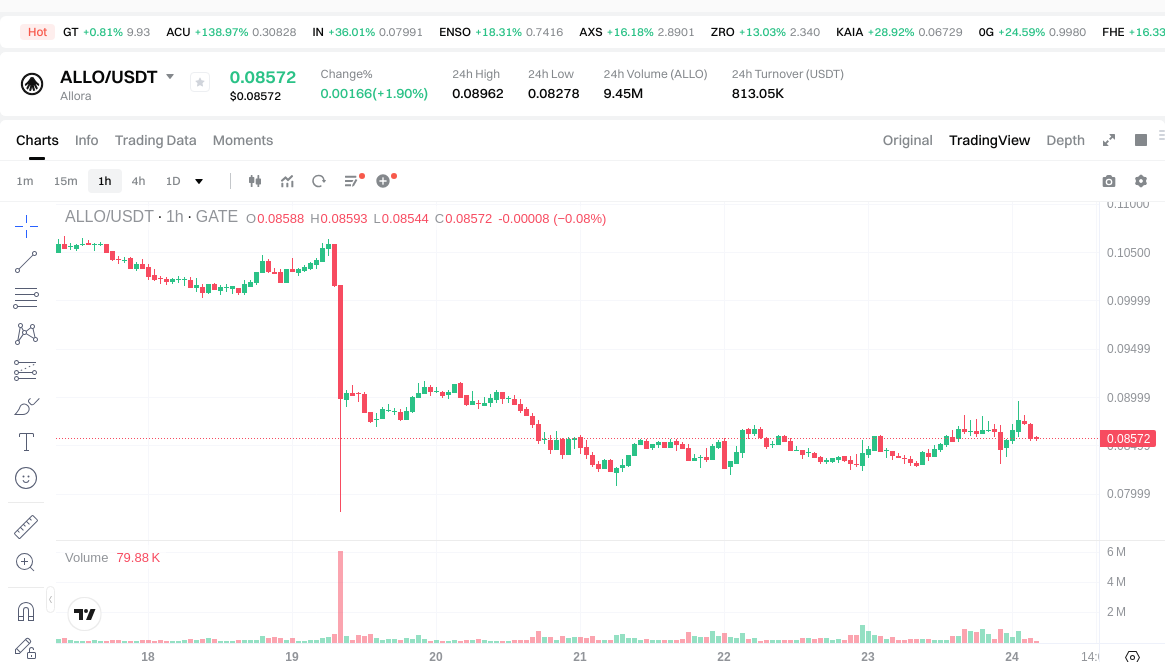
Allora (ALLO) is an emerging crypto asset in the digital currency space, functioning as an open intelligence platform designed to enhance the adaptability, collaboration, and efficiency of artificial intelligence systems. As of January 24, 2026, ALLO holds a market ranking of 944 with a market capitalization of approximately $17.15 million and a circulating supply of 200.5 million tokens. The current trading price stands at around $0.08552, reflecting a 24-hour change of 2.13%. With its positioning as a collaborative AI infrastructure layer, ALLO has gradually attracted attention from investors discussing "Is Allora (ALLO) a good investment?" The token is accessible across multiple blockchain networks including Ethereum, BNB Smart Chain, and Base, with a total supply cap of 1 billion tokens. This article provides a comprehensive analysis of ALLO's investment characteristics, historical price movements, future price projections, and associated investment risks to serve as a reference for potential investors.
I. ALLO Price Historical Review and Investment Value Status
- 2025: Network launched and listed on exchanges → ALLO reached $0.8937 in November before experiencing significant corrections
- 2026: Market adjustment phase → Price declined from $0.8937 to $0.0781, reflecting broader market volatility and project development stage
Current ALLO Investment Market Status (January 2026)
- ALLO current price: $0.08552
- 24-hour trading volume: $816,361.14
- Market capitalization: $17.15 million
- Circulating supply: 200.5 million ALLO (20.05% of total supply)
- Available on 27 exchanges with 647 holders
Click to view real-time ALLO market price
II. Core Factors Influencing Whether ALLO is a Good Investment (Is Allora(ALLO) a Good Investment)
Supply Mechanism and Scarcity (ALLO investment scarcity)
- Maximum supply capped at 1,000,000,000 ALLO with current circulating supply of 200,500,000 tokens (20.05% of max supply) → influences price dynamics and investment valuation
- Market cap to fully diluted valuation ratio stands at 20.05%, indicating significant token unlock potential
- Investment significance: The controlled token release schedule and fixed maximum supply create a supply-side dynamic that may support long-term valuation frameworks
Institutional Investment and Mainstream Adoption (Institutional investment in ALLO)
- Current holder base comprises 647 addresses, reflecting early-stage adoption patterns
- Cross-chain deployment across Ethereum (ERC-20), BNB Chain (BEP-20), and Base networks demonstrates technical infrastructure for broader accessibility
- Multi-platform listing on 27 exchanges provides liquidity channels for institutional and retail participation
Macroeconomic Environment's Impact on ALLO Investment
- Monetary policy shifts and interest rate fluctuations → alter risk appetite for emerging crypto assets
- Market volatility context: ALLO experienced price movements from $0.0781 to $0.8937 within its trading history, reflecting sensitivity to broader market conditions
- Geopolitical uncertainty and regulatory developments → shape investment sentiment toward AI-focused blockchain platforms
Technology and Ecosystem Development (Technology & Ecosystem for ALLO investment)
- Core value proposition: Open intelligence platform enabling collaborative AI model optimization and real-time refinement mechanisms
- Multi-chain infrastructure: Deployment across Ethereum, BNB Chain, and Base networks expands technical accessibility and interoperability potential
- Application scope: The platform's focus on adaptive AI systems positions ALLO within the intersection of artificial intelligence and decentralized infrastructure, though specific ecosystem partnerships or DeFi integrations remain to be further disclosed
III. ALLO Future Investment Prediction and Price Outlook (Is Allora(ALLO) worth investing in 2026-2031)
Short-term Investment Prediction (2026, short-term ALLO investment outlook)
- Conservative Forecast: $0.0446 - $0.0858
- Neutral Forecast: $0.0858 - $0.1020
- Optimistic Forecast: $0.1020 - $0.1183
Mid-term Investment Outlook (2027-2029, mid-term Allora(ALLO) investment forecast)
- Market Stage Expectation: The mid-term period may witness gradual ecosystem development and potential expansion in AI-related applications, subject to market conditions and platform adoption rates.
- Investment Return Prediction:
- 2027: $0.0633 - $0.1429
- 2028: $0.0735 - $0.1666
- 2029: $0.1214 - $0.1835
- Key Catalysts: Platform development progress, AI model integration advancement, strategic partnerships formation, and broader market sentiment toward AI-focused blockchain projects.
Long-term Investment Outlook (Is Allora a good long-term investment?)
- Base Scenario: $0.1254 - $0.1671 (assuming steady ecosystem growth and moderate market conditions)
- Optimistic Scenario: $0.1671 - $0.2459 (assuming accelerated adoption and favorable market environment)
- Risk Scenario: Below $0.1254 (under adverse market conditions or project development challenges)
Click to view ALLO long-term investment and price prediction: Price Prediction
2026-01-24 - 2031 Long-term Outlook
- Base Scenario: $0.1254 - $0.1671 (corresponding to steady progress and gradual mainstream application enhancement)
- Optimistic Scenario: $0.1671 - $0.2459 (corresponding to large-scale adoption and favorable market environment)
- Transformative Scenario: Above $0.2459 (if ecosystem achieves breakthrough progress and mainstream adoption)
- 2031-12-31 Predicted High: $0.2459 (based on optimistic development assumptions)
Disclaimer: The above predictions are based on historical data analysis and market trend assessments. Cryptocurrency markets are highly volatile and subject to various unpredictable factors. These forecasts do not constitute investment advice. Investors should conduct thorough research and consider their risk tolerance before making investment decisions.
| Year |
Predicted High Price |
Predicted Average Price |
Predicted Low Price |
Price Change |
| 2026 |
0.1183488 |
0.08576 |
0.0445952 |
0 |
| 2027 |
0.14287616 |
0.1020544 |
0.063273728 |
19 |
| 2028 |
0.1665527808 |
0.12246528 |
0.073479168 |
43 |
| 2029 |
0.183526468608 |
0.1445090304 |
0.121387585536 |
68 |
| 2030 |
0.17057845948416 |
0.164017749504 |
0.15417668453376 |
91 |
| 2031 |
0.245928213606297 |
0.16729810449408 |
0.12547357837056 |
95 |
IV. Allora Investment Strategy and Risk Management (How to invest in AI-focused blockchain projects)
Investment Methodology (Allora investment strategy)
-
Long-term Holding (HODL Allora): Suitable for conservative investors seeking exposure to the intersection of artificial intelligence and blockchain technology. This approach involves acquiring ALLO tokens and maintaining positions through market cycles, focusing on the platform's long-term development and adoption trajectory.
-
Active Trading: Relies on technical analysis and swing trading strategies. Given ALLO's price fluctuations, with 24-hour changes of 2.13% and 7-day movements of -16.99%, active traders may identify short-term opportunities. However, this approach requires careful monitoring of market conditions and technical indicators.
Risk Management (Risk management for Allora investment)
V. Allora Investment Risks and Challenges (Risks of investing in AI-focused blockchain projects)
-
Market Risks: ALLO has demonstrated notable price volatility, with the token experiencing a significant decline of -94.072% from its peak. The 24-hour trading volume of $816,361 indicates moderate liquidity, which may impact execution during large transactions. Price fluctuations remain substantial, as evidenced by the 7-day change of -16.99%.
-
Regulatory Risks: The intersection of AI and blockchain technology faces evolving regulatory frameworks across jurisdictions. Policy uncertainty in different countries may impact platform operations and token utility. Investors should monitor regulatory developments in their respective regions.
-
Technical Risks: As an open intelligence platform integrating multiple AI models, Allora faces potential technical challenges including network security vulnerabilities, smart contract risks across multiple chains (ETH, BSC, BASE), and the complexity of real-time AI model integration. The platform's ability to maintain system stability while scaling operations represents an ongoing technical consideration.
-
Adoption Risks: With 647 holders and availability on 27 exchanges, ALLO's current adoption metrics suggest early-stage market presence. The platform's success depends on attracting developers and users to contribute to its collective intelligence layer.
VI. Conclusion: Is AI-focused blockchain a Good Investment?
-
Investment Value Summary: Allora represents an innovative approach to decentralized artificial intelligence, offering potential long-term opportunities in the convergence of AI and blockchain technology. However, the token has experienced substantial price volatility, with current pricing at $0.08552 reflecting a significant decline from its previous levels. The platform's circulating supply of 200.5 million tokens (20.05% of total supply) and market capitalization of approximately $17.15 million indicate an early-stage project with corresponding risk-reward dynamics.
-
Investor Recommendations:
✅ Beginners: Consider dollar-cost averaging (DCA) strategies to mitigate volatility impact. Prioritize secure wallet storage and thoroughly research the platform's technology and use cases before investing. Start with minimal allocation to understand market dynamics.
✅ Experienced Investors: Implement swing trading strategies based on technical analysis, considering the token's price movements and volatility patterns. Maintain diversified portfolio allocation with position sizing appropriate to risk tolerance.
✅ Institutional Investors: Evaluate strategic long-term positioning in the AI-blockchain sector, conducting comprehensive due diligence on platform development, team credentials, and competitive landscape. Consider staged entry approaches to manage downside risk.
⚠️ Disclaimer: Cryptocurrency investments carry substantial risk, including the potential for total loss of capital. Market volatility in digital assets can be extreme and unpredictable. This analysis is provided for informational purposes only and does not constitute financial advice, investment recommendation, or endorsement. Investors should conduct independent research, assess their financial situation and risk tolerance, and consult qualified financial advisors before making investment decisions.
VII. FAQ
Q1: What is Allora (ALLO) and how does it differ from other AI-related crypto projects?
Allora (ALLO) is an open intelligence platform that functions as a collaborative AI infrastructure layer, designed to enhance the adaptability, collaboration, and efficiency of artificial intelligence systems through decentralized mechanisms. Unlike traditional AI crypto projects that may focus solely on computational power or data storage, Allora enables real-time AI model optimization and refinement through collective intelligence, allowing multiple AI models to collaborate and improve continuously. The platform operates across multiple blockchain networks (Ethereum, BNB Smart Chain, and Base), providing broader accessibility and interoperability. With a current market cap of approximately $17.15 million and 647 holders, ALLO represents an early-stage project positioning itself at the intersection of decentralized infrastructure and adaptive AI systems.
Q2: Is Allora (ALLO) suitable for long-term investment given its current volatility?
The suitability of ALLO for long-term investment depends heavily on individual risk tolerance and portfolio strategy. The token has experienced significant volatility, with a decline of approximately -94.072% from its peak, currently trading at $0.08552. However, for investors with high risk tolerance and belief in the convergence of AI and blockchain technology, ALLO may represent a speculative long-term opportunity. Conservative investors should limit allocation to 1-3% of their cryptocurrency portfolio, while more aggressive investors might consider 5-10% depending on their risk profile. The token's fixed maximum supply of 1 billion tokens and current circulating supply of only 20.05% creates a supply-side dynamic that may influence long-term valuation. Price predictions suggest potential growth ranges from $0.1254 to $0.2459 by 2031 under various scenarios, though these remain speculative and subject to numerous variables including platform adoption, technological development, and broader market conditions.
Q3: What are the main risks associated with investing in ALLO?
ALLO investment carries multiple risk categories that investors must carefully evaluate. Market risks include substantial price volatility, with recent 7-day changes of -16.99% and moderate liquidity reflected in 24-hour trading volume of $816,361, which may impact large transaction executions. Regulatory risks stem from the evolving legal frameworks surrounding both AI technology and cryptocurrency across different jurisdictions, creating potential policy uncertainty. Technical risks involve the complexity of integrating multiple AI models across different blockchain networks (ETH, BSC, BASE), potential smart contract vulnerabilities, and network security challenges inherent in decentralized AI platforms. Adoption risks reflect the project's early-stage status with 647 current holders and the dependency on attracting developers and users to build a viable collective intelligence ecosystem. Additionally, the substantial token unlock potential (with only 20.05% of total supply currently circulating) presents dilution risks that may impact future price dynamics.
Q4: How should beginners approach investing in Allora (ALLO)?
Beginners should adopt a cautious, educational approach when considering ALLO investment. Start by thoroughly researching the platform's technology, use cases, and position within the AI-blockchain sector to understand the fundamental value proposition. Implement a dollar-cost averaging (DCA) strategy to mitigate the impact of volatility, investing smaller amounts at regular intervals rather than committing a large sum at once. Begin with minimal allocation—no more than 1-2% of your cryptocurrency portfolio—to understand market dynamics without exposing yourself to excessive risk. Prioritize secure storage solutions, using reputable exchanges for small trading amounts and considering hardware or cold wallets for any long-term holdings. Ensure your wallet is compatible with ALLO's multiple chain deployments (ERC-20, BEP-20, BASE). Monitor the project's development progress, community engagement, and ecosystem growth metrics. Most importantly, never invest more than you can afford to lose completely, as cryptocurrency investments carry substantial risk including the potential for total capital loss.
Q5: What factors could drive ALLO's price appreciation in the medium to long term?
Several key factors could potentially drive ALLO price appreciation over the medium to long term (2027-2031). Platform development progress, particularly successful implementation of collaborative AI model optimization features and demonstrated real-world applications, would enhance fundamental value. Strategic partnerships with AI development teams, enterprise adopters, or integration with established DeFi protocols could expand the ecosystem and increase token utility. Broader market sentiment toward AI-focused blockchain projects, especially if the sector gains mainstream recognition, may create favorable tailwinds. Technological breakthroughs that showcase Allora's competitive advantages in adaptive AI systems could attract developer and user adoption. Increased liquidity through additional exchange listings and higher trading volumes would improve market accessibility. The controlled token release schedule and fixed maximum supply of 1 billion tokens creates supply-side dynamics that may support valuation as circulating supply gradually expands from the current 20.05%. However, these potential catalysts carry no guarantees, and adverse scenarios including development delays, competitive pressures, regulatory challenges, or broader market downturns could prevent price appreciation or result in further declines.
Q6: How does ALLO's multi-chain deployment affect its investment characteristics?
ALLO's deployment across multiple blockchain networks—Ethereum (ERC-20), BNB Smart Chain (BEP-20), and Base—creates distinct investment characteristics that affect both opportunities and complexities. The multi-chain strategy enhances accessibility, allowing investors to acquire and trade ALLO on their preferred network based on transaction costs, speed preferences, and existing wallet infrastructure. This cross-chain presence potentially expands the user base and liquidity pools across different blockchain ecosystems, reducing dependency on a single network's performance or issues. However, the multi-chain approach introduces technical considerations for investors, including ensuring wallet compatibility with specific chain implementations, understanding bridge mechanisms if transferring between networks, and recognizing that liquidity may fragment across different chains. From a security perspective, investors must manage private keys across potentially multiple wallet types and remain vigilant about chain-specific smart contract risks. The availability on 27 exchanges suggests reasonable accessibility, though investors should verify which specific chain implementation each exchange supports. For portfolio management, the multi-chain nature requires tracking positions across potentially different addresses and understanding that price may vary slightly between chains based on localized liquidity conditions.
Q7: What investment strategy is most appropriate for ALLO given current market conditions?
Given ALLO's current market conditions—trading at $0.08552 with significant volatility and early-stage adoption metrics—the most appropriate investment strategy depends on investor profile and objectives. For conservative, long-term focused investors, a passive holding (HODL) strategy with minimal portfolio allocation (1-3%) provides exposure to potential AI-blockchain convergence while limiting downside risk. This approach requires patience through market cycles and belief in the platform's long-term development trajectory, with price targets potentially reaching $0.1254-$0.2459 by 2031 under various scenarios. For active traders with technical analysis capabilities, swing trading strategies may capitalize on ALLO's volatility, though the 24-hour trading volume of $816,361 necessitates careful position sizing to ensure adequate liquidity for entry and exit. Dollar-cost averaging (DCA) represents a middle-ground approach, systematically accumulating positions over time to smooth out volatility impact, particularly suitable for investors building positions during the current market adjustment phase. Regardless of strategy, risk management principles must guide decision-making: maintain diversified portfolio allocation across multiple assets, implement stop-loss levels appropriate to risk tolerance, utilize secure storage solutions, and avoid investing capital needed for other financial obligations. The substantial decline from historical peaks (-94.072%) suggests exercising caution and conducting thorough due diligence before committing capital.
Q8: What metrics should investors monitor to evaluate ALLO's investment performance?
Investors should track multiple metrics across different categories to comprehensively evaluate ALLO's investment performance and make informed decisions. Price metrics include current spot price ($0.08552 as of January 24, 2026), 24-hour change (+2.13%), 7-day performance (-16.99%), and historical price ranges relative to all-time high and low. Volume indicators such as 24-hour trading volume ($816,361.14) and volume trends provide liquidity insights essential for understanding market depth and transaction feasibility. Market capitalization ($17.15 million) and its ratio to fully diluted valuation (20.05%) reveal current valuation relative to maximum potential token supply. Supply metrics including circulating supply (200.5 million tokens), total supply dynamics, and token unlock schedules impact long-term price pressure. Adoption metrics encompass holder count (647 addresses), exchange availability (27 exchanges), and growth rates in these figures indicating ecosystem expansion. Technical indicators relevant for active traders include moving averages, RSI, support/resistance levels, and volatility measures. Fundamental development metrics—though requiring deeper research—include platform development milestones, partnership announcements, transaction activity on the AI network, and comparative analysis versus competing projects. Additionally, broader market sentiment indicators such as Bitcoin and Ethereum performance, regulatory news, and AI sector trends provide contextual understanding. Regular monitoring of these metrics enables data-driven investment decisions rather than emotional reactions to short-term price movements.
* The information is not intended to be and does not constitute financial advice or any other recommendation of any sort offered or endorsed by Gate.