This comprehensive guide evaluates whether Altlayer (ALT) represents a viable investment opportunity in 2024-2026. ALT, a decentralized protocol introducing Restaked Rollups technology, operates across multiple blockchain stacks including OP Stack, Arbitrum Orbit, Polygon CDK, and ZK Stack, addressing critical Layer 2 scaling needs. The article analyzes ALT's volatile price history—from $0.018 launch in January 2024 to peak of $0.6948 in March 2024, currently trading at $0.0127 with market cap of approximately $66 million. Key investment considerations include tokenomics (52% circulating supply), institutional adoption across 73,632 holders on 30 exchanges, and technological innovation in rollup security. Price forecasts range from $0.0117-$0.0151 (2026) to $0.0199-$0.0317 (2031) under optimistic scenarios. The analysis provides structured investment strategies for different investor types, comprehensive risk assessment, and detailed FAQ addressing market opportunities and challenges in the Layer 2 infrastruc
Introduction: Altlayer (ALT)'s Investment Position and Market Outlook
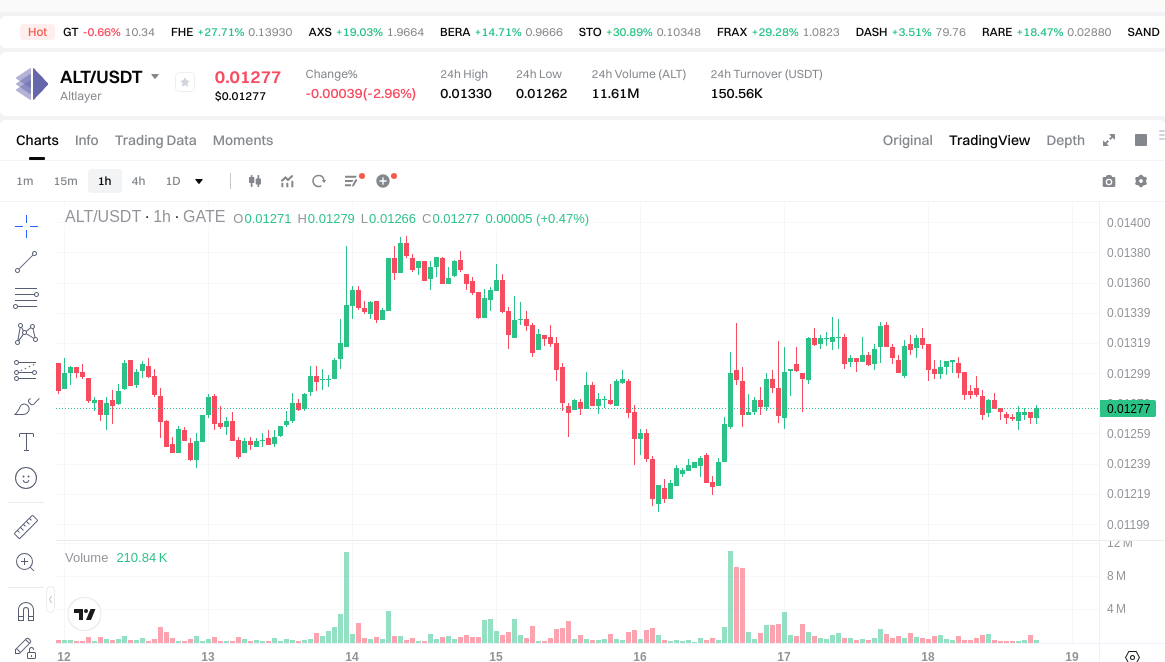
ALT is a significant asset in the cryptocurrency field. As of January 2026, Altlayer holds a market ranking of 452 with a market capitalization of approximately $66.04 million and a circulating supply of around 5.2 billion tokens. The current price stands at approximately $0.0127. As an open and decentralized protocol designed for rollups, AltLayer introduces the concept of Restaked Rollups, which enhances security, decentralization, interoperability, and crypto-economic fast finality through restaking mechanisms for rollups from various stacks including OP Stack, Arbitrum Orbit, Polygon CDK, and ZK Stack. With its innovative positioning in the Layer 2 scaling solutions space, ALT has gradually become a focal point for investors evaluating "Is Altlayer (ALT) a good investment?" This article will comprehensively analyze ALT's investment value, historical trends, future price predictions, and investment risks to provide reference for investors.
I. Altlayer (ALT) Price History Review and Current Investment Value
- 2024: Token launch at $0.018 on January 25, 2024 → Early investors witnessed significant volatility with peak gains reaching approximately 3,760% when price touched $0.6948 by March 27, 2024
- 2024: All-time high milestone at $0.6948 on March 27, 2024 → ALT price subsequently entered correction phase, declining substantially through the latter half of 2024
- 2025: Market consolidation phase → Price declined from elevated 2024 levels to $0.01270 range as of January 18, 2026, representing substantial retracement from peak valuation
Current ALT Investment Market Status (January 2026)
- ALT current price: $0.01270
- Market sentiment (Fear & Greed Index): Data not provided in reference materials
- 24-hour trading volume: $148,628.04
- Institutional investor holdings: Token holder concentration shows 73,632 addresses holding ALT tokens
Click to view real-time ALT market price
II. Core Factors Influencing Whether ALT is a Good Investment
Supply Mechanism and Scarcity (ALT Investment Scarcity)
-
Supply Structure: ALT has a maximum supply of 10,000,000,000 tokens, with current circulating supply at 5,199,999,997 tokens (approximately 52% circulation ratio). The fixed supply cap establishes a framework for potential scarcity dynamics as adoption increases.
-
Token Distribution Impact: With approximately 52% of total supply currently in circulation, the gradual release of remaining tokens may influence price dynamics over time. The relationship between circulating supply expansion and market demand represents a key consideration for investment evaluation.
-
Investment Implications: The defined maximum supply provides a structural foundation for long-term value consideration, though investment outcomes depend on multiple factors including adoption rates, technological development, and market conditions.
Institutional Investment and Mainstream Adoption (Institutional Investment in ALT)
-
Market Presence: ALT is listed on 30 exchanges and has attracted 73,632 holders as of January 18, 2026, indicating a growing user base and market accessibility.
-
Ecosystem Integration: AltLayer's protocol design for rollups (supporting OP Stack, Arbitrum Orbit, Polygon CDK, ZK Stack) positions it within broader blockchain infrastructure development. The restaking mechanism approach aims to provide enhanced security, decentralization, and interoperability features.
-
Adoption Indicators: Trading volume of approximately $148,628 over 24 hours reflects ongoing market activity, though investment evaluation should consider volume trends relative to market capitalization and broader ecosystem developments.
Macroeconomic Environment Impact on ALT Investment
-
Market Positioning: With a market capitalization of approximately $66,039,999 and market dominance of 0.0037%, ALT occupies a position within the broader digital asset ecosystem that may respond to macroeconomic factors affecting risk asset allocation.
-
Price Volatility Context: Recent price movements show -3.49% over 24 hours, -2.69% over 7 days, and +13.71% over 30 days, reflecting sensitivity to market conditions and sentiment shifts that characterize digital asset markets.
-
Long-term Performance: The 1-year dimension of -88.25% from January 2025 to January 2026 illustrates the volatility characteristics of the digital asset sector and the importance of considering market cycles in investment evaluation.
Technology and Ecosystem Development (Technology & Ecosystem for ALT Investment)
-
Protocol Innovation: AltLayer introduces restaked rollups concept, leveraging restaking mechanisms to provide rollup solutions with enhanced security, decentralization, interoperability, and crypto-economic fast finality.
-
Multi-Stack Compatibility: The protocol's design supports multiple rollup stacks (OP Stack, Arbitrum Orbit, Polygon CDK, ZK Stack), potentially expanding its addressable market within Layer 2 scaling solutions.
-
Technical Infrastructure: ALT operates with contracts on Ethereum (ETH) and Binance Smart Chain (BSC) networks, utilizing BEP20 and ERC20 standards for cross-chain accessibility and ecosystem integration potential.
III. ALT Future Investment Predictions and Price Outlook (Is Altlayer(ALT) worth investing in 2026-2031)
Short-term Investment Outlook (2026, short-term ALT investment outlook)
- Conservative forecast: $0.0117484 - $0.01277
- Neutral forecast: $0.01277 - $0.0138
- Optimistic forecast: $0.0138 - $0.0150686
Based on technical analysis indicators and market data, ALT displays a slight downward trend in the short term, with a 24-hour decrease of 3.49%. The current trading price of $0.0127 is positioned near the lower end of the predicted range, suggesting potential stabilization or modest recovery opportunities. Moving averages (SMA and EMA) show buy signals across multiple timeframes, while the RSI indicator remains neutral at 52.73, indicating balanced market sentiment without extreme overbought or oversold conditions.
Mid-term Investment Outlook (2027-2029, mid-term Altlayer(ALT) investment forecast)
- Market phase expectation: Recovery and gradual growth phase, with ALT potentially establishing higher price floors as the rollup ecosystem matures and adoption increases.
- Investment return predictions:
- 2027: $0.008490773 - $0.01948702 (potential increase of 9% from 2026 average)
- 2028: $0.0088526748 - $0.019208634 (potential increase of 31% from 2026 average)
- 2029: $0.0107735382 - $0.02424046095 (potential increase of 41% from 2026 average)
- Key catalysts: Expansion of restaking mechanisms, increased adoption of rollup solutions across blockchain networks, strategic partnerships within the Layer 2 ecosystem, and broader integration with OP Stack, Arbitrum Orbit, Polygon CDK, and ZK Stack frameworks.
Long-term Investment Outlook (Is ALT a good long-term investment?)
- Baseline scenario: $0.01160399843625 - $0.0232079968725 (2030-2031, assuming steady development of decentralized rollup infrastructure and moderate market expansion)
- Optimistic scenario: $0.019937779131375 - $0.031678915730962 (2030-2031, contingent on widespread adoption of restaked rollups, successful ecosystem partnerships, and favorable regulatory environment for Layer 2 solutions)
- Risk scenario: Below $0.01 (under conditions of severe market downturns, technological setbacks, or intensified competition from alternative rollup protocols)
Click to view ALT long-term investment and price prediction: Price Prediction
2026-01-18 to 2031 Long-term Outlook
- Base scenario: $0.01277 - $0.0232079968725 (corresponding to steady progress and gradual mainstream application enhancement)
- Optimistic scenario: $0.019937779131375 - $0.031678915730962 (corresponding to large-scale adoption and favorable market conditions)
- Transformative scenario: Above $0.035 (contingent on breakthrough ecosystem developments and mainstream proliferation)
- 2031-12-31 predicted high: $0.031678915730962 (based on optimistic development assumptions)
Disclaimer: The above predictions are based on historical data, technical analysis, and market trends. Cryptocurrency markets are highly volatile and unpredictable. These forecasts should not be considered as investment advice. Investors should conduct independent research and consider their risk tolerance before making any investment decisions. Past performance does not guarantee future results.
| Year |
Predicted High Price |
Predicted Average Price |
Predicted Low Price |
Price Change |
| 2026 |
0.0150686 |
0.01277 |
0.0117484 |
0 |
| 2027 |
0.01948702 |
0.0139193 |
0.008490773 |
9 |
| 2028 |
0.019208634 |
0.01670316 |
0.0088526748 |
31 |
| 2029 |
0.02424046095 |
0.017955897 |
0.0107735382 |
41 |
| 2030 |
0.0232079968725 |
0.021098178975 |
0.01160399843625 |
66 |
| 2031 |
0.031678915730962 |
0.02215308792375 |
0.019937779131375 |
74 |
IV. ALT Investment Strategy and Risk Management (How to invest in Altlayer)
Investment Methodology (ALT investment strategy)
Investors may consider different approaches when investing in ALT tokens:
-
Long-term Holding (HODL ALT): This strategy is typically suited for conservative investors who believe in the long-term development potential of AltLayer's restaked rollups technology. Given the project's focus on enhancing rollup security through restaking mechanisms, investors with a longer time horizon may choose to accumulate and hold ALT tokens through market cycles.
-
Active Trading: Some investors may prefer to engage in active trading based on technical analysis and swing trading strategies. With ALT's 24-hour price volatility of -3.49% and observable price ranges (24h high: $0.0133, 24h low: $0.01262), traders might identify short-term opportunities within established support and resistance levels.
Risk Management (Risk management for ALT investment)
-
Asset Allocation Ratio: Investment allocation should align with individual risk tolerance:
- Conservative investors: Consider allocating 1-3% of crypto portfolio to ALT
- Moderate investors: May allocate 3-7% based on conviction
- Experienced investors: Could allocate 5-10% with active monitoring
-
Risk Hedging Solutions: Diversification across multiple assets and risk management tools can help mitigate concentration risk. Investors might consider:
- Building a diversified portfolio including established cryptocurrencies
- Setting stop-loss orders to limit potential downside
- Regular portfolio rebalancing based on market conditions
-
Secure Storage: Proper token custody is essential for ALT holders. The token operates on both Ethereum (ERC-20) and Binance Smart Chain (BEP-20) networks, with contract address 0x8457CA5040ad67fdebbCC8EdCE889A335Bc0fbFB:
- Cold wallets: Hardware wallets (such as Ledger or Trezor) for long-term storage
- Hot wallets: Secure software wallets for active trading amounts
- Exchange custody: Only for short-term trading positions
V. ALT Investment Risks and Challenges (Risks of investing in Altlayer)
-
Market Risk: ALT exhibits significant price volatility. The token has experienced a -88.25% decline over the past year, with the current price at $0.0127 compared to its historical high of $0.6948 reached on March 27, 2024. The 24-hour trading volume of approximately $148,628 suggests moderate liquidity, which may contribute to price fluctuations.
-
Regulatory Risk: As with all cryptocurrency projects, regulatory uncertainty across different jurisdictions presents ongoing risks. Changes in regulatory frameworks regarding staking, restaking mechanisms, or rollup technologies could impact AltLayer's operations and token utility.
-
Technical Risk: While AltLayer's protocol aims to enhance rollup security through restaking mechanisms, the technology involves complex interactions with multiple rollup stacks (OP Stack, Arbitrum Orbit, Polygon CDK, ZK Stack). Potential technical vulnerabilities, smart contract risks, or challenges in protocol upgrades could affect the network and token value.
-
Competition Risk: The Layer 2 and rollup infrastructure space continues to evolve rapidly, with numerous projects developing similar or alternative scaling solutions. Market competition may impact AltLayer's adoption and growth trajectory.
-
Tokenomics Considerations: With a circulating supply of approximately 5.2 billion ALT tokens (52% of total supply) and a maximum supply of 10 billion tokens, future token releases could create selling pressure. The market cap to fully diluted valuation ratio stands at 52%, indicating additional tokens may enter circulation.
VI. Conclusion: Is Altlayer a Good Investment?
-
Investment Value Summary: ALT represents exposure to the evolving rollup infrastructure sector, specifically the restaked rollups concept that aims to enhance security and interoperability. While the project addresses technical needs in the Layer 2 ecosystem, the token has experienced significant price volatility, with substantial decline from its all-time high. Long-term potential depends on adoption of AltLayer's technology and successful execution of its protocol development.
-
Investor Recommendations:
✅ Beginners: Consider dollar-cost averaging with small allocations and prioritize secure storage using hardware wallets. Ensure thorough understanding of the project before investing.
✅ Experienced Investors: May explore tactical trading opportunities while maintaining disciplined risk management. Consider portfolio diversification and position sizing based on conviction.
✅ Institutional Investors: Could evaluate strategic allocation as part of broader Layer 2 infrastructure exposure, with emphasis on due diligence and risk assessment.
⚠️ Disclaimer: Cryptocurrency investments carry substantial risk due to high volatility and market uncertainty. This content is for informational purposes only and does not constitute investment advice. Investors should conduct their own research and consider their financial situation before making investment decisions.
VII. FAQ
Q1: What is AltLayer (ALT) and what makes it different from other Layer 2 solutions?
AltLayer is an open and decentralized protocol that introduces the concept of "Restaked Rollups" to enhance blockchain scalability. Unlike traditional Layer 2 solutions, AltLayer leverages restaking mechanisms to provide enhanced security, decentralization, interoperability, and crypto-economic fast finality for rollups. The protocol supports multiple rollup stacks including OP Stack, Arbitrum Orbit, Polygon CDK, and ZK Stack, enabling compatibility across diverse blockchain frameworks. This multi-stack approach positions AltLayer as an infrastructure layer that can work with various rollup technologies rather than competing directly with them.
Q2: Has ALT been a profitable investment historically?
Historical performance shows significant volatility. Early investors who purchased at the launch price of $0.018 on January 25, 2024, witnessed gains reaching approximately 3,760% when the price peaked at $0.6948 on March 27, 2024. However, the token subsequently experienced substantial correction, declining approximately 88.25% over the past year to its current price of $0.0127 as of January 18, 2026. This volatility pattern reflects both the speculative nature of cryptocurrency markets and the challenges of maintaining early momentum in infrastructure projects.
Q3: What is the tokenomics structure of ALT and how does it affect investment value?
ALT has a maximum supply of 10 billion tokens, with approximately 5.2 billion (52%) currently in circulation as of January 2026. The fixed supply cap provides a framework for potential scarcity dynamics, though the gradual release of the remaining 48% of tokens may create selling pressure over time. The market capitalization to fully diluted valuation ratio of 52% indicates substantial tokens remain to enter circulation. Investors should consider how future token releases might impact supply-demand dynamics and price action.
Q4: What are the main risks of investing in ALT?
Key investment risks include: (1) Market Risk: ALT exhibits high volatility with an 88.25% decline from its all-time high, and moderate liquidity with 24-hour trading volume around $148,628; (2) Competition Risk: The Layer 2 space is highly competitive with numerous projects developing similar solutions; (3) Technical Risk: Complex smart contract interactions across multiple rollup stacks present potential vulnerabilities; (4) Regulatory Risk: Uncertainty regarding regulations affecting staking, restaking mechanisms, and rollup technologies could impact operations; (5) Tokenomics: Future token releases from the remaining 48% of supply may create downward price pressure.
Q5: What is the realistic price outlook for ALT in 2026-2027?
Short-term forecasts for 2026 suggest a range between $0.0117 (conservative) to $0.0151 (optimistic), with neutral expectations around $0.0127-$0.0138. For 2027, predictions indicate potential recovery with prices ranging from $0.0085 to $0.0195, representing approximately 9% increase from 2026 average levels. These projections assume gradual ecosystem development, increased adoption of restaked rollups, and favorable market conditions. However, given the high volatility and the -88.25% performance over the past year, investors should approach these forecasts with caution and consider multiple scenarios.
Q6: How should different types of investors approach ALT investment?
Investment approach should align with experience level and risk tolerance: Beginners should consider dollar-cost averaging with allocations of 1-3% of their crypto portfolio, prioritizing secure storage and thorough project understanding before investing. Experienced investors may explore tactical trading opportunities with 3-7% allocations while maintaining disciplined risk management and position sizing. Institutional investors could evaluate strategic allocation of 5-10% as part of broader Layer 2 infrastructure exposure, with emphasis on comprehensive due diligence. All investors should implement proper risk management including stop-loss orders, portfolio diversification, and secure token custody using hardware wallets for long-term holdings.
Q7: What factors could drive ALT's future value appreciation?
Potential value drivers include: (1) Technology Adoption: Widespread implementation of restaked rollups across major blockchain networks could increase ALT utility and demand; (2) Ecosystem Partnerships: Strategic integrations with OP Stack, Arbitrum Orbit, Polygon CDK, and ZK Stack frameworks may expand the addressable market; (3) Network Growth: Expansion beyond the current 73,632 token holders and increased trading volume above $148,628 daily average; (4) Market Conditions: General cryptocurrency market recovery and increased interest in Layer 2 infrastructure solutions; (5) Technical Milestones: Successful protocol upgrades demonstrating enhanced security, interoperability, and fast finality capabilities. However, realization of these factors remains uncertain and depends on successful execution and favorable market dynamics.
Q8: Where can investors securely purchase and store ALT tokens?
ALT is available on 30 exchanges, providing multiple access points for investors. The token operates on both Ethereum (ERC-20) and Binance Smart Chain (BEP-20) networks with contract address 0x8457CA5040ad67fdebbCC8EdCE889A335Bc0fbFB. For secure storage, investors should consider: Hardware wallets (Ledger, Trezor) for long-term holdings and large amounts; Software wallets supporting ERC-20 and BEP-20 standards for active management; Exchange custody only for short-term trading positions. Given the dual-network compatibility, investors should verify they're using the correct network when transferring tokens and maintain proper backup procedures for wallet recovery phrases.
* The information is not intended to be and does not constitute financial advice or any other recommendation of any sort offered or endorsed by Gate.