Amp (AMP) serves as the native collateral token for the Flexa cryptocurrency payment network, offering a focused investment opportunity within the digital payments sector. As of January 2026, AMP trades at $0.002208 with a market capitalization of $186 million, representing a mid-cap digital asset available on 34 exchanges including Gate. This comprehensive analysis examines AMP's investment viability through multiple dimensions: historical price performance revealing an 68.25% annual decline contrasted with 14.05% recent 30-day gains, fundamental utility as collateral for instant merchant payments on the Ethereum blockchain, and price projections ranging from $0.00206-$0.00327 for 2026 to potential $0.00712 by 2031 under optimistic scenarios. Investment suitability varies by risk tolerance, with conservative allocations recommended at 1-3% portfolio exposure and active trading approaches requiring technical expertise. Critical considerations include AMP's dependency on Flexa network merchant adoption, market
Introduction: Amp (AMP) Investment Position and Market Outlook
Amp is a significant asset in the cryptocurrency field. As the native collateral token of the Flexa payment network, it has established a distinct role in facilitating cryptocurrency payments for merchants. As of 16 January 2026, Amp holds a market capitalization of approximately $186.09 million, with a circulating supply of around 84.28 billion tokens, and the current price stands at approximately $0.002208. With its positioning as a collateral mechanism within the Flexa ecosystem, Amp has gradually become a focal point for investors discussing "Is Amp (AMP) a good investment?" This article provides a comprehensive analysis of Amp's investment value, historical trends, future price predictions, and associated investment risks to offer reference for market participants.
Amp originated from the migration of Flexacoin (FXC) at a 1:1 ratio and serves multiple functions within the Flexa network. The token's primary use cases include serving as collateral for pending cryptocurrency payments, enabling staking to expand network capacity with rewards derived from transaction fees, and facilitating governance participation in decisions regarding funding recipients, partnerships, cross-chain integrations, and DeFi collaborations. The project's architecture encompasses the Flexa payment network, collateral managers with customizable rules for various applications, and token partitions that allow different collateral managers to execute rules without transferring tokens from user addresses.
As of the current date, Amp is ranked 249th by market capitalization, representing approximately 0.0065% market dominance. The token has experienced varied performance across different timeframes, with a 14.05% increase over the past 30 days, contrasting with declines of 0.76% in the past 24 hours and 1.11% over the past 7 days. The annual performance shows a decline of 68.25% from the previous year. Historical data indicates that the token reached a price level of $0.120813 on 17 June 2021, while the lower range was recorded at $0.00140933 on 13 October 2023. With a circulating supply representing 84.28% of the total supply and a maximum supply capped at 100 billion tokens, the token's supply dynamics present particular considerations for long-term analysis.
The token is available on 34 exchanges and has attracted a holder base of 101,691 addresses. Operating on the Ethereum blockchain with contract address 0xff20817765cb7f73d4bde2e66e067e58d11095c2, Amp benefits from the established infrastructure and security of the Ethereum network. The project maintains an active presence through various channels including its official website, Twitter, GitHub, and blockchain explorers, providing transparency for market participants conducting due diligence.
I. Amp (AMP) Price History Review and Current Investment Value
- 2021: On June 17, 2021, AMP reached a notable price level of $0.120813, reflecting early-stage market enthusiasm surrounding the Flexa payment network's collateral token model.
- 2023: On October 13, 2023, AMP touched $0.00140933, illustrating a period of market contraction and reduced speculative interest in payment infrastructure tokens.
- 2024-2026: Following the October 2023 low, AMP demonstrated recovery tendencies, with the token trading at $0.002208 as of January 16, 2026, representing movements influenced by broader cryptocurrency market cycles and evolving adoption patterns within the Flexa ecosystem.
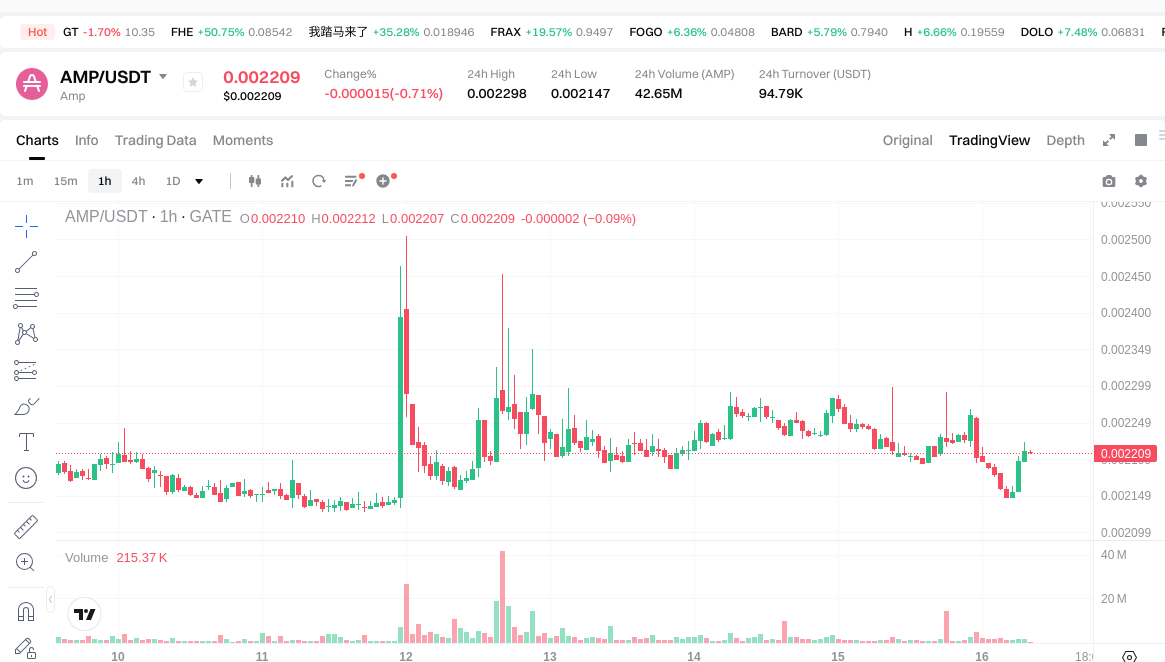
Current AMP Investment Market Status (January 2026)
- AMP current price: $0.002208
- 24-hour trading volume: $95,141.95
- Market capitalization: $186,094,980.70
- Circulating supply: 84,282,147,058.41 AMP (84.28% of total supply)
- Fully diluted valuation: $220,181,775.31
- Price changes: -0.05% (1H), -0.76% (24H), -1.11% (7D), +14.05% (30D), -68.25% (1Y)
- Contract address: 0xff20817765cb7f73d4bde2e66e067e58d11095c2 (Ethereum)
- Number of holders: 101,691
- Listed on 34 exchanges
Click to view real-time AMP market price
II. Core Factors Influencing Whether AMP is a Good Investment
Supply Mechanism and Scarcity (AMP Investment Scarcity)
- Supply structure → influences price and investment value
- AMP operates with a maximum supply of 100 billion tokens, with approximately 84.28% currently in circulation (84.28 billion tokens)
- The circulating supply of 84.28 billion AMP represents a relatively high percentage of the maximum supply, suggesting limited additional token releases may occur
- Investment consideration: the token's supply dynamics and distribution patterns contribute to understanding its potential scarcity characteristics in the market
Institutional Investment and Mainstream Adoption (Institutional Investment in AMP)
- Ecosystem integration: AMP functions as the native collateral token for the Flexa payment network, a cryptocurrency payment infrastructure designed to facilitate merchant acceptance of digital asset payments
- The token serves as collateral within Flexa's payment system, where staked AMP provides assurance for pending cryptocurrency transactions
- Merchants utilizing the Flexa network benefit from instant settlement guarantees backed by staked AMP tokens
- Real-world utility: the integration of AMP within payment infrastructure represents a practical use case that may influence investment considerations
Macroeconomic Environment's Impact on AMP Investment
- Broader market correlation: cryptocurrency assets, including AMP, may be influenced by monetary policy shifts and interest rate adjustments
- Market liquidity conditions and risk appetite in traditional financial markets can affect digital asset investment flows
- Regulatory developments surrounding cryptocurrency payments and collateral mechanisms may shape the investment landscape for payment-focused tokens
Technology and Ecosystem Development (Technology & Ecosystem for AMP Investment)
- Ethereum-based infrastructure: AMP operates as an ERC-20 token on the Ethereum blockchain, utilizing smart contract functionality for collateral management
- Collateral partitioning technology allows users to stake AMP tokens without transferring them to smart contracts, maintaining control while providing collateral
- Payment network capacity can be expanded through AMP staking, with stakers receiving rewards from network transaction fees
- Governance participation enables token holders to vote on proposals affecting future development, partnerships, cross-chain integrations, and DeFi collaborations
- The Flexa payment network's adoption and transaction volume directly relate to AMP's utility as collateral, potentially influencing long-term value considerations
III. AMP Future Investment Predictions and Price Outlook (Is Amp(AMP) worth investing in 2026-2031)
Short-term Investment Prediction (2026, short-term AMP investment outlook)
Based on available market analysis, Amp (AMP) presents the following short-term scenarios for 2026:
- Conservative Prediction: $0.00206 - $0.00274
- Neutral Prediction: $0.00221 - $0.00295
- Optimistic Prediction: $0.00274 - $0.00327
The token is expected to maintain relatively stable performance within this range, with projected average trading around $0.00221.
Mid-term Investment Outlook (2027-2029, mid-term Amp(AMP) investment forecast)
-
Market Stage Expectation: During this period, AMP may experience gradual development as the Flexa payment network potentially expands its merchant adoption and use cases in cryptocurrency payment infrastructure.
-
Investment Return Prediction:
- 2027: $0.00173 - $0.00321 (with an average around $0.00274)
- 2028: $0.00220 - $0.00336 (with an average around $0.00298)
- 2029: $0.00279 - $0.00456 (with an average around $0.00317)
-
Key Catalysts: Potential factors include expanded partnerships within the Flexa payment network, increased merchant adoption of cryptocurrency payments, development of collateral management applications, and broader DeFi integrations.
Long-term Investment Outlook (Is AMP a good long-term investment?)
- Base Scenario: $0.00317 - $0.00482 (assuming steady growth in payment network utilization and maintained staking rewards)
- Optimistic Scenario: $0.00482 - $0.00712 (assuming accelerated merchant adoption, successful cross-chain integrations, and favorable regulatory developments for crypto payments)
- Risk Scenario: $0.00141 - $0.00220 (under conditions of limited merchant adoption, competitive pressure from alternative payment solutions, or challenging regulatory environment)
For detailed AMP long-term investment and price predictions: Price Prediction
2026-01-16 to 2031 Long-term Outlook
- Base Scenario: $0.00317 - $0.00481 (corresponding to steady progress and stable mainstream application growth)
- Optimistic Scenario: $0.00481 - $0.00712 (corresponding to large-scale adoption and favorable market conditions)
- Transformative Scenario: Above $0.00712 (if the ecosystem achieves breakthrough developments and mainstream penetration)
- 2031-12-31 Predicted High: $0.00712 (based on optimistic development assumptions)
Disclaimer: These predictions are based on current market data, technical analysis, and available information as of January 16, 2026. Cryptocurrency markets are highly volatile and subject to numerous unpredictable factors. Past performance does not guarantee future results. These projections should not be considered as financial advice, and investors should conduct their own research and consider their risk tolerance before making investment decisions.
| Year |
Predicted High Price |
Predicted Average Price |
Predicted Low Price |
Price Change |
| 2026 |
0.00327376 |
0.002212 |
0.00205716 |
0 |
| 2027 |
0.0032091696 |
0.00274288 |
0.0017280144 |
24 |
| 2028 |
0.003362908024 |
0.0029760248 |
0.002202258352 |
34 |
| 2029 |
0.00456403163328 |
0.003169466412 |
0.00278913044256 |
43 |
| 2030 |
0.005761456043733 |
0.00386674902264 |
0.003170734198564 |
75 |
| 2031 |
0.007124871749116 |
0.004814102533186 |
0.003803141001217 |
118 |
IV. Amp Investment Strategy and Risk Management (How to invest in Amp)
Investment Strategy (Amp investment strategy)
Long-term Holding (HODL Amp)
For conservative investors seeking exposure to the digital payments sector, a long-term holding strategy may be considered. This approach involves acquiring Amp tokens and maintaining positions through market cycles, based on the fundamental value proposition of the Flexa payment network. Investors following this strategy typically focus on the protocol's adoption metrics, merchant integration progress, and overall network capacity growth rather than short-term price movements.
Active Trading
For those with experience in technical analysis, active trading strategies may involve:
- Monitoring key support and resistance levels based on historical price data
- Utilizing trading indicators to identify potential entry and exit points
- Implementing swing trading approaches during periods of heightened volatility
- Setting predefined profit targets and stop-loss orders to manage position sizing
Given Amp's 24-hour price change of -0.76% and 7-day change of -1.11% as of January 16, 2026, active traders may observe consolidation patterns before determining strategic positions.
Risk Management (Risk management for Amp investment)
Asset Allocation Ratios
- Conservative investors: Limit Amp exposure to 1-3% of total cryptocurrency portfolio, with majority holdings in established assets
- Moderate investors: Allocate 3-7% to Amp as part of a diversified altcoin strategy
- Aggressive investors: May consider 7-15% allocation, understanding the heightened volatility associated with mid-cap tokens
Risk Hedging Approaches
- Multi-asset portfolio construction: Combine Amp with tokens from different sectors (DeFi, Layer 1, stablecoins) to reduce correlation risk
- Position sizing: Avoid over-concentration in any single asset, including Amp
- Gradual accumulation: Consider dollar-cost averaging to mitigate timing risk, particularly given Amp's 30-day increase of 14.05%
Secure Storage Solutions
- Cold wallets: Hardware wallets such as Ledger or Trezor for long-term holdings
- Hot wallets: MetaMask or other Ethereum-compatible wallets for active trading positions, given Amp's deployment on the Ethereum network (contract address: 0xff20817765cb7f73d4bde2e66e067e58d11095c2)
- Exchange storage: Only for amounts intended for near-term trading, with awareness of custodial risks
- Security practices: Enable two-factor authentication, maintain offline backup of seed phrases, and regularly verify wallet addresses
V. Amp Investment Risks and Challenges (Risks of investing in Amp)
Market Risk
- High volatility: Amp has demonstrated significant price fluctuations, with a 1-year change of -68.25% as of January 16, 2026
- Liquidity considerations: With a 24-hour trading volume of approximately $95,142 and market cap of approximately $186 million, liquidity may be limited during periods of market stress
- Price discovery: Mid-cap tokens like Amp may experience wider bid-ask spreads compared to larger assets
Regulatory Risk
- Payment network oversight: As Amp functions within the Flexa payment infrastructure, regulatory developments affecting cryptocurrency payment processors could impact token utility
- Securities classification uncertainty: Ongoing regulatory discussions regarding token classifications may affect trading availability on certain platforms
- Geographic restrictions: Regulatory environments vary significantly across jurisdictions, potentially limiting adoption in certain markets
Technical Risk
- Smart contract vulnerabilities: As an ERC-20 token with specialized collateral management functionality, Amp relies on smart contract security
- Network dependency: Amp's operation on the Ethereum network exposes it to base layer risks, including network congestion and gas fee fluctuations
- Protocol upgrades: Changes to the Flexa payment network or Amp's collateral mechanisms may introduce unforeseen technical challenges
- Adoption risk: The token's value proposition depends on continued merchant adoption of the Flexa network and utilization of Amp as collateral
VI. Conclusion: Is Amp a Good Investment?
Investment Value Summary
Amp presents a focused use case within the cryptocurrency payments sector, operating as the collateral token for the Flexa payment network. The token's utility is directly tied to network transaction volume and merchant adoption. With a circulating supply of approximately 84.28 billion tokens (84.28% of max supply) and a fully diluted market cap of approximately $220 million, Amp occupies a mid-cap position in the digital asset market.
The token has experienced considerable volatility, as evidenced by its all-time high of $0.120813 in June 2021 and subsequent decline of -68.25% over the past year. Recent 30-day performance showing a 14.05% increase may indicate shifting market sentiment, though short-term fluctuations remain notable.
Investor Recommendations
✅ Beginners:
- Consider dollar-cost averaging with small allocations
- Utilize secure hardware wallets for storage
- Focus on understanding the Flexa network's fundamental value proposition before investing
- Start with educational resources about payment-focused cryptocurrencies
✅ Experienced Investors:
- Evaluate Amp within a diversified portfolio context
- Monitor Flexa network metrics and merchant adoption trends
- Consider swing trading opportunities during volatility periods
- Maintain strict position sizing discipline given historical price movements
✅ Institutional Investors:
- Assess Amp's role within broader payment infrastructure trends
- Evaluate correlation with other payment-focused digital assets
- Consider strategic allocation as part of sector-specific exposure
- Conduct thorough due diligence on Flexa network partnerships and growth metrics
⚠️ Notice: Cryptocurrency investments carry substantial risk. Amp's price volatility, relatively concentrated use case, and dependency on Flexa network adoption present specific risk factors. This analysis is for informational purposes only and does not constitute investment advice. Investors should conduct independent research, consider their risk tolerance, and consult with financial professionals before making investment decisions.
VII. FAQ
Q1: What is Amp (AMP) and how does it function in the cryptocurrency ecosystem?
Amp is the native collateral token of the Flexa payment network, designed to facilitate instant, fraud-proof cryptocurrency payments for merchants. The token operates as a programmable collateral mechanism on the Ethereum blockchain, where it can be staked to guarantee pending cryptocurrency transactions without requiring users to transfer tokens from their wallets. When merchants accept cryptocurrency payments through Flexa, staked AMP serves as collateral to ensure instant settlement, protecting against transaction failures or payment delays. Token holders can stake AMP to earn rewards from network transaction fees and participate in governance decisions regarding partnerships, cross-chain integrations, and DeFi collaborations.
Q2: Is Amp (AMP) a good investment in 2026?
Amp's investment viability depends on individual risk tolerance and investment objectives. As of January 16, 2026, AMP demonstrates mixed signals: a 14.05% gain over 30 days suggests short-term momentum, while the 68.25% annual decline reflects significant volatility. The token holds a market capitalization of approximately $186 million with 84.28% of its maximum supply already circulating. Conservative predictions suggest a 2026 price range of $0.00206-$0.00327, indicating moderate growth potential. Investment suitability varies: conservative investors may limit exposure to 1-3% of portfolio, while experienced traders might consider 3-7% allocation. The token's value proposition rests on Flexa network adoption and merchant integration, making it more appropriate for those comfortable with mid-cap token volatility and the payment infrastructure sector.
Q3: What are the primary risks associated with investing in Amp?
Amp investment carries several distinct risk categories. Market risk is substantial, evidenced by high volatility with a 68.25% annual price decline and relatively limited liquidity with approximately $95,142 in 24-hour trading volume. Regulatory risk encompasses potential oversight of cryptocurrency payment networks, ongoing securities classification discussions, and varying geographic restrictions that could impact adoption. Technical risks include smart contract vulnerabilities inherent to specialized collateral management functions, dependency on Ethereum network stability and gas fees, and potential complications from protocol upgrades. Most critically, adoption risk affects Amp's fundamental value proposition—the token's utility directly correlates with merchant adoption rates of the Flexa network and actual utilization of AMP as collateral for transactions.
Q4: What is the long-term price outlook for Amp through 2031?
Long-term projections for Amp extend across multiple scenarios through 2031. Under base assumptions of steady merchant adoption and maintained staking rewards, prices may range from $0.00317 to $0.00482. An optimistic scenario accounting for accelerated merchant integration, successful cross-chain expansions, and favorable regulatory developments suggests potential appreciation to $0.00481-$0.00712 by 2031. Conversely, a risk scenario involving limited merchant adoption, competitive pressure from alternative payment solutions, or challenging regulatory environments could see prices constrained to $0.00141-$0.00220. The 2031 predicted high of $0.00712 represents a transformative scenario requiring breakthrough developments in mainstream payment infrastructure adoption. These projections incorporate current market dynamics, the Flexa network's development trajectory, and broader cryptocurrency payment sector trends.
Q5: How should investors approach Amp position sizing and portfolio allocation?
Position sizing for Amp should align with investor experience and risk tolerance levels. Conservative investors are advised to limit Amp exposure to 1-3% of total cryptocurrency portfolio, maintaining majority holdings in established digital assets. Moderate investors may allocate 3-7% to Amp as part of a diversified altcoin strategy, balancing exposure across multiple sectors including DeFi, Layer 1 protocols, and stablecoins. Aggressive investors comfortable with heightened volatility might consider 7-15% allocation, understanding the amplified risk associated with mid-cap tokens. Dollar-cost averaging is recommended to mitigate timing risk, particularly relevant given Amp's 30-day increase of 14.05%. Multi-asset portfolio construction reduces correlation risk, while strict position sizing discipline prevents over-concentration in any single asset.
Q6: What role does the Flexa network play in Amp's investment value?
The Flexa payment network fundamentally underpins Amp's investment thesis and utility. Flexa operates as a cryptocurrency payment infrastructure enabling merchants to accept digital asset payments with instant settlement guarantees. Amp serves as the collateral mechanism within this system—when users stake AMP tokens, they provide economic security for pending transactions, receiving rewards from network transaction fees in return. The network's architecture allows merchants to benefit from fraud-proof payments without exposure to cryptocurrency volatility, as Flexa handles conversion and settlement. Amp's value proposition directly correlates with Flexa's transaction volume, number of integrated merchants, and overall network capacity. Therefore, evaluating Amp as an investment requires assessing Flexa's competitive position within the cryptocurrency payments sector, partnership development, and adoption metrics among both merchants and consumers.
Q7: What security considerations should Amp investors prioritize?
Security practices for Amp holdings vary based on investment strategy and holding period. Long-term investors should utilize cold storage solutions such as Ledger or Trezor hardware wallets, which provide offline security for extended holding periods. Active traders may employ hot wallets like MetaMask or other Ethereum-compatible solutions for operational convenience, given Amp's deployment on Ethereum (contract address: 0xff20817765cb7f73d4bde2e66e067e58d11095c2). Exchange storage should be limited to amounts intended for near-term trading, with awareness of custodial risks and potential platform vulnerabilities. Essential security protocols include enabling two-factor authentication on all accounts, maintaining offline backups of seed phrases in secure locations, regularly verifying wallet addresses before transactions, and avoiding public WiFi for wallet access. Given Amp's ERC-20 token standard, investors should also monitor Ethereum network conditions and gas fees to optimize transaction timing.
Q8: How does Amp compare to other cryptocurrency payment infrastructure tokens?
Amp occupies a specific niche within the cryptocurrency payments sector as a dedicated collateral token rather than a payment currency itself. This distinguishes it from payment-focused cryptocurrencies that serve as direct transaction media. With a market capitalization of approximately $186 million and ranking 249th by market dominance (0.0065%), Amp represents a mid-cap asset within this category. The token's 84.28% circulating supply ratio indicates relatively complete distribution compared to projects with significant token vesting schedules. Amp's integration with the Flexa network provides established infrastructure partnerships, though adoption metrics and transaction volume growth remain critical differentiators. When evaluating Amp against alternative payment infrastructure tokens, investors should consider merchant adoption rates, transaction processing capabilities, geographic reach, regulatory compliance frameworks, and the specific technical approach to solving payment settlement challenges. Amp's collateral-based model presents both distinct advantages in fraud prevention and unique dependencies on staking participation rates.
* The information is not intended to be and does not constitute financial advice or any other recommendation of any sort offered or endorsed by Gate.