This comprehensive analysis examines whether Ampleforth (FORTH) represents a viable investment opportunity in the cryptocurrency market. The article evaluates FORTH's governance token position within the Ampleforth protocol ecosystem, analyzing its dramatic price decline from $54.44 to approximately $1.73 as of January 2026, alongside its current market capitalization of $19.89 million. Key investment considerations include supply mechanics with unlimited maximum supply, ecosystem functionality enabling decentralized governance, and availability across 14 exchanges including Gate. The analysis projects price ranges from $1.29-$2.30 through 2026 and potential long-term growth to $4.03 by 2031 under optimistic scenarios. However, significant risks persist including market volatility, regulatory uncertainty for DeFi protocols, and technical vulnerabilities. For different investor profiles, appropriate allocation strategies range from 1-3% for conservatives to 5-10% for aggressive investors, with emphasis on secu
Introduction: Ampleforth (FORTH) Investment Position and Market Outlook
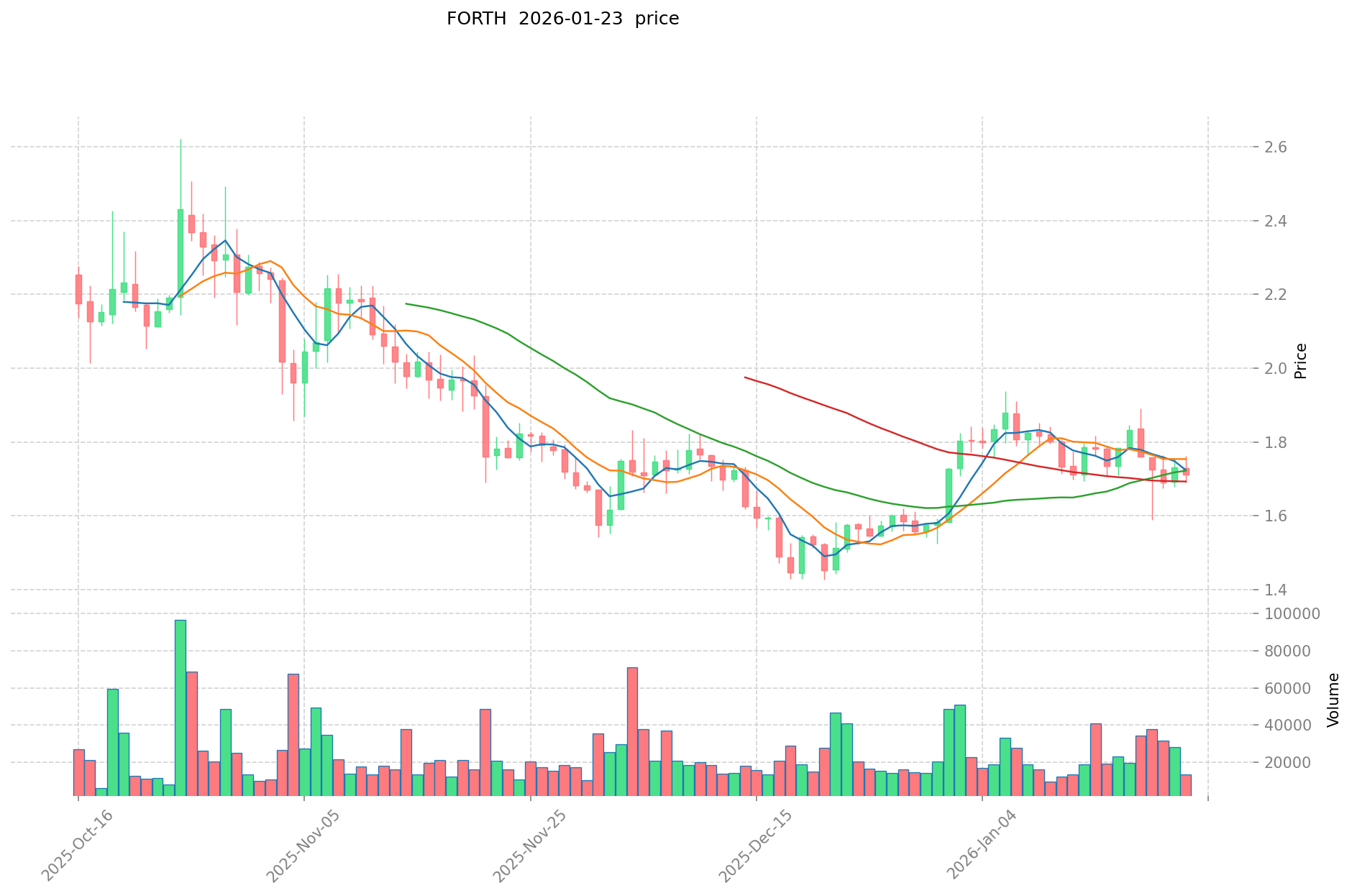
FORTH is a governance token in the cryptocurrency sector, launched in April 2021 as part of the Ampleforth protocol ecosystem. The token plays a central role in decentralized governance and DAO operations within the DeFi space. As of January 23, 2026, FORTH holds a market capitalization of approximately $19.89 million, with a circulating supply of around 11.50 million tokens, and a current trading price near $1.729. Ranked at position 885 in the cryptocurrency market with a market share of 0.00083%, FORTH serves as the governance mechanism for the Ampleforth platform and FORTH DAO. The token has experienced significant price fluctuations since its initial launch price of $54.44, declining approximately 96.82% from its initial offering. With its positioning as a governance-focused token within the elastic finance ecosystem, FORTH has become a subject of analysis when investors discuss "Is Ampleforth (FORTH) a good investment?" This article will comprehensively examine FORTH's investment value, historical performance trends, future price projections, and associated investment risks to provide reference information for market participants.
I. FORTH Price History Review and Current Investment Value Status
- 2021: FORTH token launch and initial trading → Price reached $180.47 in April 2021, representing significant early volatility for initial investors
- 2025: Market adjustment period → FORTH price experienced substantial decline, touching $1.17 in October 2025
- 2026 (Recent): Recovery phase → Price rebounded to approximately $1.73, showing an increase of 11.84% over the past 30 days
Current FORTH Investment Market Status (January 2026)
- FORTH current price: $1.729
- Market sentiment: Neutral with slight positive momentum (1-hour change: +0.16%, 30-day change: +11.84%)
- 24-hour trading volume: $22,541.97
- Circulating supply: 11,503,546 FORTH tokens (representing 75.2% of total supply)
- Market capitalization: $19,889,631
- Number of token holders: 26,100
Click to view real-time FORTH market price
II. Key Factors Affecting Whether FORTH is a Good Investment
Supply Mechanism and Scarcity (FORTH Investment Scarcity)
- Total supply of 15,297,897 FORTH with unlimited maximum supply → influences price dynamics and investment considerations
- Circulating supply represents 75.20% of total supply, with 11,503,546 FORTH currently in circulation
- Historical data shows price volatility from launch price of $54.44 to current levels around $1.73, reflecting market-driven supply-demand dynamics
- Investment perspective: The unlimited maximum supply characteristic requires consideration when evaluating long-term scarcity factors
Institutional Investment and Mainstream Adoption (Institutional Investment in FORTH)
- Trading availability: FORTH is listed on 14 exchanges, including major platforms such as Binance, Coinbase Pro, and OKX
- Current holder base: Approximately 26,100 addresses hold FORTH tokens
- Market positioning: With a market dominance of 0.00083% and market cap of approximately $19.89 million, FORTH operates within the broader DeFi governance token segment
Technology and Ecosystem Development (Technology & Ecosystem for FORTH Investment)
- Governance functionality: FORTH enables holders to participate in Ampleforth protocol governance through a six-phase process including discussion, proposals, targeted discussion, off-chain signaling, technical development, and binding votes
- Platform integration: FORTH operates on Ethereum (contract address: 0x77fba179c79de5b7653f68b5039af940ada60ce0), supporting participation in the Ampleforth Elastic Finance Ecosystem
- DAO involvement: FORTH holders can engage with Forth DAO activities, which focuses on developing AMPL use cases and managing the Ampleforth treasury
- Ecosystem role: The token functions within a dual-token system alongside AMPL, which serves lending, borrowing, derivatives creation, and collateral applications in decentralized finance
III. FORTH Future Investment Forecast and Price Outlook (Is Ampleforth(FORTH) worth investing in 2026-2031)
Short-term Investment Forecast (2026, short-term FORTH investment outlook)
- Conservative forecast: $1.29 - $1.73
- Neutral forecast: $1.73 - $2.01
- Optimistic forecast: $2.01 - $2.30
Mid-term Investment Outlook (2027-2029, mid-term Ampleforth(FORTH) investment forecast)
-
Market stage expectation: During the mid-term period, FORTH may experience gradual growth as the DeFi ecosystem continues to evolve and the Ampleforth protocol's elastic supply mechanism attracts more attention from decentralized finance participants.
-
Investment return forecast:
- 2027: $1.37 - $2.69
- 2028: $1.79 - $2.61
- 2029: $2.33 - $2.80
-
Key catalysts: Expansion of AMPL use cases in lending protocols, increased adoption of elastic finance models, development of governance initiatives through FORTH DAO, and broader integration with DeFi platforms.
Long-term Investment Outlook (Is FORTH a good long-term investment?)
- Base scenario: $2.43 - $2.64 (assuming steady development of the Ampleforth ecosystem and moderate growth in DeFi adoption)
- Optimistic scenario: $2.88 - $3.12 (assuming accelerated adoption of elastic supply tokens and favorable regulatory developments for DeFi)
- Risk scenario: $2.31 - $4.03 (under conditions of either market volatility or breakthrough adoption of the Ampleforth protocol)
Click to view FORTH long-term investment and price forecast: Price Prediction
2026-01-23 - 2031 Long-term Outlook
- Base scenario: $2.43 - $2.64 (corresponding to steady progress and gradual mainstream application improvement)
- Optimistic scenario: $2.88 - $3.12 (corresponding to large-scale adoption and favorable market conditions)
- Transformative scenario: Above $4.03 (if ecosystem achieves breakthrough progress and mainstream popularization)
- 2031-12-31 forecast high: $4.03 (based on optimistic development assumptions)
Disclaimer: The above forecasts are based on historical data and current market trends and do not constitute investment advice. Cryptocurrency markets are highly volatile, and actual prices may differ significantly from predictions. Investors should conduct their own research and consider their risk tolerance before making investment decisions.
| Year |
Predicted High Price |
Predicted Average Price |
Predicted Low Price |
Price Change |
| 2026 |
2.29558 |
1.726 |
1.2945 |
0 |
| 2027 |
2.6944586 |
2.01079 |
1.3673372 |
16 |
| 2028 |
2.611412973 |
2.3526243 |
1.787994468 |
36 |
| 2029 |
2.804681059245 |
2.4820186365 |
2.33309751831 |
43 |
| 2030 |
3.11915282048955 |
2.6433498478725 |
2.4318818600427 |
53 |
| 2031 |
4.033751867853435 |
2.881251334181025 |
2.30500106734482 |
66 |
IV. FORTH Investment Strategy and Risk Management (How to invest in FORTH)
Investment Methodology (FORTH investment strategy)
Long-term Holding (HODL FORTH): Suitable for conservative investors
For investors with a long-term perspective, FORTH may represent an opportunity to participate in the governance and development of the Ampleforth protocol ecosystem. A HODL strategy involves acquiring FORTH tokens and holding them through market cycles, potentially benefiting from the protocol's evolution and increased adoption of elastic finance mechanisms. This approach may appeal to those who believe in the fundamental value proposition of Ampleforth's unique supply adjustment mechanism and its role in the DeFi landscape.
Active Trading: Relying on technical analysis and swing operations
Active traders may approach FORTH through technical analysis and swing trading strategies. With 24-hour trading volume of approximately $22,541.97 and availability on multiple exchanges including Binance, CoinBase Pro, and OKX, FORTH presents opportunities for short-term position trading. Traders can monitor price movements between support and resistance levels, with recent data showing 24-hour highs of $1.754 and lows of $1.691. However, active trading requires constant market monitoring and understanding of broader cryptocurrency market dynamics.
Risk Management (Risk management for FORTH investment)
Asset Allocation Ratio: Conservative / Aggressive / Professional investors
- Conservative investors: May consider allocating 1-3% of their cryptocurrency portfolio to FORTH, maintaining larger positions in established assets
- Aggressive investors: Could allocate 5-10% to FORTH as part of a diversified DeFi-focused portfolio
- Professional investors: May implement strategic allocations based on comprehensive research, potentially including governance participation through FORTH DAO
Risk Hedging Solutions: Multi-asset portfolio + hedging instruments
Diversification remains essential when investing in FORTH. Investors should consider:
- Maintaining exposure across multiple cryptocurrency categories beyond governance tokens
- Balancing FORTH positions with stablecoin holdings
- Monitoring correlation with broader DeFi market movements
- Considering the relationship between FORTH and AMPL within the Ampleforth ecosystem
Secure Storage: Hot and cold wallets + hardware wallet recommendations
Given that FORTH operates on the Ethereum blockchain (contract address: 0x77fba179c79de5b7653f68b5039af940ada60ce0), proper storage is important:
- Hardware wallets: Ledger and Trezor devices support ERC-20 tokens including FORTH
- Cold storage: For long-term holdings, consider hardware wallets or offline storage solutions
- Hot wallets: MetaMask and other Ethereum-compatible wallets for active trading, though these carry higher security risks
- Exchange custody: While convenient for trading, storing large amounts on exchanges introduces counterparty risk
V. FORTH Investment Risks and Challenges (Risks of investing in FORTH)
Market Risk: High volatility and potential price manipulation
FORTH exhibits substantial price volatility characteristic of governance tokens. Historical data shows the token reached $180.47 in April 2021 but declined to $1.17 in October 2025, representing significant downward movement. Current price data indicates a 1-year decline of 62.69% and a 96.82% decrease from its initial offering price of $54.4443. With a relatively modest 24-hour trading volume and a market cap of approximately $19.89 million, FORTH may be susceptible to price swings driven by relatively small trading volumes. The token's market share of 0.00083% suggests limited liquidity compared to major cryptocurrencies.
Regulatory Risk: Policy uncertainty across different jurisdictions
As a governance token associated with DeFi protocols, FORTH faces evolving regulatory landscapes:
- Different jurisdictions maintain varying approaches to classifying and regulating governance tokens
- Lending and borrowing protocols, which Ampleforth supports, face increasing regulatory scrutiny
- Changes in securities regulations could impact how FORTH is classified and traded
- Cross-border regulatory differences may affect availability and trading options for international investors
Technical Risk: Network security vulnerabilities and upgrade failures
Technical risks associated with FORTH investment include:
- Smart contract vulnerabilities: As an Ethereum-based token, FORTH relies on smart contract security; potential bugs or exploits in the Ampleforth protocol could impact value
- Ethereum network dependencies: FORTH's functionality depends on Ethereum network performance and security
- Governance implementation risks: The six-phase governance process, from discussion through binding vote and deployment, introduces complexity where technical implementation may not proceed as planned
- Protocol upgrade challenges: Changes to the Ampleforth protocol or AMPL supply adjustment mechanisms could encounter technical difficulties
- Integration risks: FORTH's utility depends on successful integration with the broader DeFi ecosystem and continued development of the Ampleforth platform
VI. Conclusion: Is FORTH a Good Investment?
Investment Value Summary: FORTH presents opportunities for participation in the Ampleforth governance ecosystem and exposure to elastic finance mechanisms. However, the token has experienced substantial price volatility with significant declines from historical peaks.
Investor Recommendations:
✅ Beginners: Consider dollar-cost averaging combined with secure wallet storage; understand governance mechanisms before participating; allocate only amounts comfortable with potential loss
✅ Experienced Investors: May implement swing trading strategies while maintaining risk-appropriate position sizes; consider governance participation opportunities; monitor broader DeFi market trends
✅ Institutional Investors: Can evaluate strategic allocation as part of diversified DeFi governance exposure; assess governance participation benefits; conduct thorough due diligence on protocol mechanics
⚠️ Notice: Cryptocurrency investment carries significant risk. This content is for reference purposes only and does not constitute investment advice.
VII. FAQ
Q1: What is FORTH and how does it differ from AMPL?
FORTH is the governance token of the Ampleforth protocol, while AMPL is the elastic supply token used for DeFi applications. FORTH was launched in April 2021 specifically to enable decentralized governance and DAO operations within the Ampleforth ecosystem. Unlike AMPL, which automatically adjusts its supply based on market conditions for use in lending, borrowing, and collateral applications, FORTH serves purely as a governance mechanism. Holders of FORTH can participate in protocol decisions through a six-phase governance process, including discussion, proposals, targeted discussion, off-chain signaling, technical development, and binding votes. The two tokens operate in a complementary dual-token system where FORTH governs the protocol while AMPL functions as the elastic finance instrument.
Q2: How has FORTH performed since its launch and what is its current market position?
FORTH has experienced substantial price decline since launch, decreasing approximately 96.82% from its initial offering price of $54.44 to the current price near $1.73 as of January 2026. The token reached a peak of $180.47 in April 2021 shortly after launch, then declined to a low of $1.17 in October 2025. Currently, FORTH holds a market capitalization of approximately $19.89 million with a circulating supply of 11.50 million tokens, ranking at position 885 in the cryptocurrency market with a market share of 0.00083%. Recent momentum shows an 11.84% increase over the past 30 days, though the 1-year performance remains negative at -62.69%. The token is traded on 14 exchanges including Binance, Coinbase Pro, and OKX, with approximately 26,100 token holders.
Q3: What are the primary risks associated with investing in FORTH?
FORTH investment carries three major risk categories: market risk, regulatory risk, and technical risk. Market risk includes high volatility evidenced by the 96.82% decline from launch price, relatively low liquidity with 24-hour trading volume of only $22,541.97, and potential price manipulation given its modest market cap of $19.89 million. Regulatory risk stems from evolving DeFi governance token classifications across different jurisdictions and increasing scrutiny of lending and borrowing protocols that Ampleforth supports. Technical risk encompasses smart contract vulnerabilities as an Ethereum-based token, dependencies on Ethereum network performance, potential complications in the six-phase governance implementation process, and risks associated with protocol upgrades or integration with the broader DeFi ecosystem. These risks require careful consideration and appropriate risk management strategies.
Q4: What is the governance process for FORTH token holders?
FORTH token holders participate in Ampleforth protocol governance through a structured six-phase process designed to ensure comprehensive community input. The process begins with discussion where community members explore ideas and gather feedback. This advances to proposals where formal suggestions are submitted for consideration. Targeted discussion follows, focusing on specific proposal elements and refinements. Off-chain signaling allows the community to express preliminary sentiment through non-binding votes. Technical development translates approved proposals into implementable code and specifications. Finally, binding votes provide the formal decision-making mechanism where FORTH holders exercise their governance rights. This comprehensive framework operates through FORTH DAO, which focuses on developing AMPL use cases and managing the Ampleforth treasury, enabling token holders to meaningfully influence protocol direction and development.
Q5: What price forecasts exist for FORTH through 2031?
Price forecasts for FORTH suggest gradual recovery through 2031, though projections carry significant uncertainty given cryptocurrency market volatility. For 2026, short-term forecasts range from a conservative $1.29-$1.73 to an optimistic $2.01-$2.30. Mid-term projections show increasing ranges: 2027 ($1.37-$2.69), 2028 ($1.79-$2.61), and 2029 ($2.33-$2.80). Long-term 2031 forecasts present a base scenario of $2.43-$2.64, an optimistic scenario of $2.88-$3.12, and a transformative scenario exceeding $4.03, with the predicted high reaching $4.03 by year-end 2031. These forecasts assume various conditions including steady development of the Ampleforth ecosystem, increased adoption of elastic finance models, expansion of AMPL use cases, and broader DeFi integration. However, these predictions are based on historical data and current trends, not guarantees, and actual prices may differ significantly from projections.
Q6: How should different investor types approach FORTH allocation?
Investment approach to FORTH should align with investor experience level and risk tolerance. Conservative investors may consider allocating 1-3% of their cryptocurrency portfolio to FORTH, maintaining larger positions in established assets while implementing a HODL strategy focused on long-term participation in Ampleforth protocol governance. Aggressive investors could allocate 5-10% to FORTH as part of a diversified DeFi-focused portfolio, potentially employing active trading strategies using technical analysis and monitoring price movements between support and resistance levels across the 14 exchanges where FORTH trades. Professional investors may implement strategic allocations based on comprehensive research, potentially including direct governance participation through FORTH DAO. All investor types should prioritize secure storage using hardware wallets like Ledger or Trezor for long-term holdings, or Ethereum-compatible wallets like MetaMask for active trading, while maintaining diversification across multiple cryptocurrency categories beyond governance tokens.
Q7: What factors could drive FORTH price appreciation in the future?
Several catalysts could potentially drive FORTH value appreciation, primarily related to ecosystem development and DeFi adoption. Expansion of AMPL use cases in lending protocols could increase interest in the broader Ampleforth ecosystem, indirectly benefiting FORTH. Increased adoption of elastic finance models and growing recognition of Ampleforth's unique supply adjustment mechanism might attract more participants to the platform. Development of governance initiatives through FORTH DAO and active participation in protocol decision-making could enhance token utility. Broader integration with DeFi platforms and partnerships expanding the Ampleforth ecosystem's reach represent additional positive catalysts. Favorable regulatory developments for DeFi and clearer classification of governance tokens could reduce uncertainty. However, realization of these catalysts depends on continued technical development, market conditions, and competitive dynamics within the DeFi governance token segment, with no guarantee of occurrence or resulting price impact.
Q8: Where can investors purchase FORTH and what storage options exist?
FORTH is available for purchase on 14 cryptocurrency exchanges, including major platforms such as Binance, Coinbase Pro, and OKX, providing multiple access points for investors. As an Ethereum-based token with contract address 0x77fba179c79de5b7653f68b5039af940ada60ce0, FORTH supports standard ERC-20 storage solutions. For secure storage, investors have several options depending on their needs and holdings size. Hardware wallets including Ledger and Trezor devices offer cold storage solutions suitable for long-term holdings, providing enhanced security by keeping private keys offline. Hot wallets such as MetaMask and other Ethereum-compatible wallets enable convenient access for active trading, though they carry higher security risks due to internet connectivity. Some investors may choose exchange custody for immediate trading convenience, though this introduces counterparty risk and is generally not recommended for large holdings or long-term storage. The choice between hot and cold storage should balance security requirements against accessibility needs.
* The information is not intended to be and does not constitute financial advice or any other recommendation of any sort offered or endorsed by Gate.