Analog (ANLOG) is a Universal Liquidity Hub addressing cross-chain fragmentation through Timechain technology. This comprehensive analysis evaluates ANLOG's investment merit by examining historical price performance, current market conditions, and future outlooks. The token declined 92.39% from its $0.0171 peak, trading near $0.0002326 with a $347,683 market cap across 2 exchanges on Gate. While the project demonstrates technological innovation in omnichain tokenization and AI-driven liquidity execution, investors face substantial risks including extreme volatility, low liquidity, regulatory uncertainty, and a 16.5% circulation ratio suggesting future dilution. The article provides layered investment recommendations for beginners (1-3% allocation maximum), experienced traders (speculative positioning), and institutional investors (comprehensive due diligence required), emphasizing risk management, security protocols, and realistic price forecasts through 2031.
Introduction: Analog (ANLOG)'s Investment Position and Market Prospects
ANLOG represents a distinctive asset within the cryptocurrency sector, positioning itself as a Universal Liquidity Hub for Autonomous Chains. As of February 7, 2026, Analog maintains a market capitalization of approximately $347,683.63, with a circulating supply of around 1,494,770,562 tokens and a current price hovering near $0.0002326. The project addresses liquidity fragmentation challenges by seamlessly integrating multiple blockchain ecosystems including EVM-compatible chains, Solana, Polkadot, TON, and RWAs without requiring bridges. Powered by Timechain technology, the platform facilitates AI-driven liquidity execution, omnichain tokenization, and trustless GMP transfers across diverse L1 and L2 ecosystems. This analysis examines Analog's investment characteristics, historical price movements, future price projections, and associated risks to provide reference information for those evaluating whether Analog (ANLOG) aligns with their research interests.
I. Historical Price Review and Current Investment Value of Analog (ANLOG)
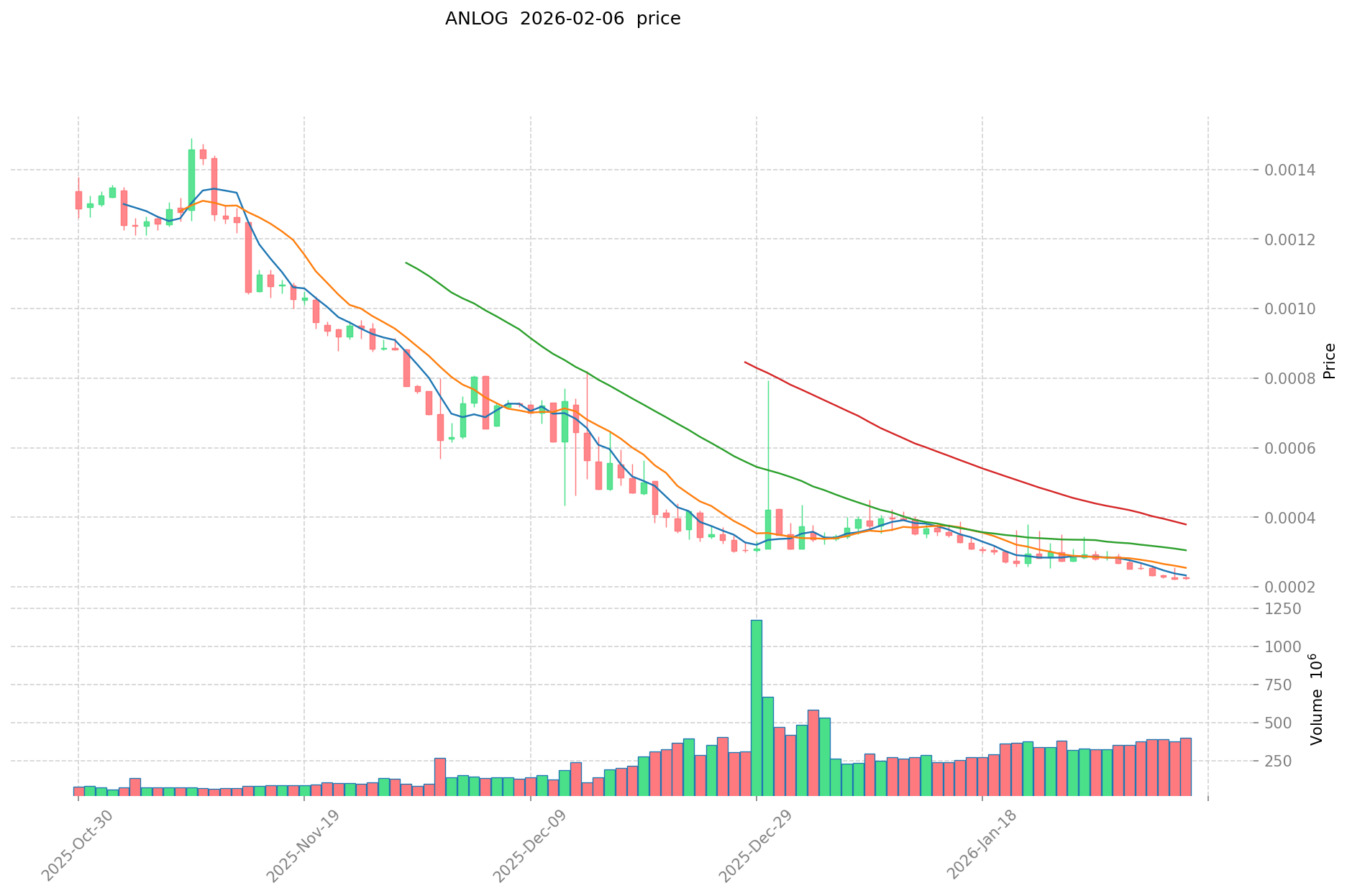
Analog (ANLOG) has experienced significant volatility since its market debut. According to available data, the token launched in January 2025 at an offering price of $0.055. Within the first month of trading, the price reached a notable level of $0.0171 on February 10, 2025, reflecting initial market enthusiasm for the project's universal liquidity hub positioning.
However, the subsequent price trajectory has been challenging. By February 5, 2026, ANLOG declined to $0.0002208, representing a substantial contraction from earlier levels. Over the past year, the token has declined approximately 92.39%, while the 30-day period shows a decline of around 37.05%. The 7-day trend indicates a decrease of approximately 16.39%.
Several factors may have contributed to these price movements, including broader market conditions affecting emerging blockchain infrastructure projects, evolving competitive dynamics in the cross-chain liquidity sector, and the typical maturation process of newly launched tokens.
Current ANLOG Investment Market Status (February 2026)
As of February 7, 2026, ANLOG presents the following market characteristics:
- Current ANLOG Price: $0.0002326
- 24-Hour Price Change: +2.7%
- 24-Hour Trading Volume: $87,946.53
- Market Capitalization: $347,683.63
- Circulating Supply: 1,494,770,562 ANLOG
- Total Supply: 9,057,971,000 ANLOG
- Maximum Supply: 9,057,971,000 ANLOG
- Circulation Ratio: 16.50%
- Fully Diluted Valuation: $2,106,884.05
- Market Cap to FDV Ratio: 16.5%
- Number of Exchanges Listing: 2
The recent 24-hour price movement shows a modest recovery of 2.7%, suggesting some stabilization after the extended downward trend. Trading volume remains relatively limited at under $90,000 daily, which may indicate constrained liquidity conditions. The circulating supply represents approximately 16.5% of the total token allocation, suggesting substantial future token unlocks may occur.
Click to view real-time ANLOG market price
II. Core Factors Influencing Whether ANLOG is a Good Investment
Supply Mechanism and Scarcity (ANLOG Investment Scarcity)
- Supply Structure: Analog (ANLOG) has a maximum supply of 9,057,971,000 tokens, with a current circulating supply of approximately 1,494,770,562 tokens, representing a circulation ratio of about 16.5%. This relatively low circulation ratio may indicate potential supply-side pressure as more tokens enter the market over time.
- Scarcity Dynamics: The token's fully diluted market capitalization stands at approximately $2,106,884, while the circulating market cap is around $347,684 as of February 7, 2026. The significant gap between circulating and total supply suggests that scarcity effects may be limited in the near term.
- Investment Implications: The large total supply relative to current circulation may impact long-term scarcity-driven value appreciation. Investors should monitor token release schedules and circulation trends when evaluating investment potential.
- Price Trends: As of February 7, 2026, ANLOG is trading at approximately $0.0002326, showing mixed short-term performance with a 1-hour gain of 1.84% and a 24-hour gain of 2.7%. However, longer-term trends show declines of -16.39% over 7 days, -37.05% over 30 days, and -92.39% over one year.
- Historical Price Range: The token has experienced significant volatility, with a historical high of $0.0171 recorded on February 10, 2025, and a historical low of $0.0002208 on February 5, 2026. The current price is near its historical low level.
- Market Liquidity: With a 24-hour trading volume of approximately $87,946.53 and trading availability on 2 exchanges, liquidity appears relatively limited, which may contribute to price volatility and impact investment risk considerations.
Technology and Ecosystem Development (Technology & Ecosystem for ANLOG Investment)
- Core Technology: Analog positions itself as a Universal Liquidity Hub for Autonomous Chains, powered by Timechain technology. The platform aims to enable seamless integration across EVM-compatible chains, Solana, Polkadot, TON, and RWAs without requiring traditional bridges.
- Ecosystem Features: The project focuses on eliminating liquidity fragmentation through AI-driven liquidity execution, omnichain tokenization, and trustless General Message Passing (GMP) transfers across diverse Layer 1 and Layer 2 ecosystems.
- Investment Consideration: While the technological vision addresses cross-chain liquidity challenges, investors should evaluate the actual implementation progress, network adoption metrics, and competitive positioning within the cross-chain infrastructure sector when assessing long-term investment value.
Market Sentiment and Risk Factors (ANLOG Investment Risk Assessment)
- Market Positioning: With a market cap ranking of 3,366 and a market dominance of 0.000084%, Analog represents a relatively small-cap cryptocurrency with limited market presence as of February 2026.
- Price Forecasts: Various market analyses show mixed predictions for ANLOG's investment potential in 2026, with some quantitative indicators suggesting bullish forecasts while others indicate bearish trends. Projected trading ranges for 2026 vary across different sources.
- Investment Risk: The token's significant price decline from its launch price of $0.055 to current levels, combined with its low market cap and limited exchange availability, suggests elevated investment risk. Potential investors should carefully consider risk tolerance and conduct thorough due diligence before investment decisions.
III. ANLOG Future Investment Forecast and Price Outlook (Is Analog(ANLOG) worth investing in 2026-2031)
Short-term Investment Forecast (2026, short-term ANLOG investment outlook)
- Conservative estimate: $0.000225 - $0.000232
- Neutral estimate: $0.000232 - $0.000238
- Optimistic estimate: $0.000238 - $0.000246
Mid-term Investment Outlook (2027-2029, mid-term Analog(ANLOG) investment forecast)
- Market stage expectations: The token may experience gradual recovery phase with moderate volatility, characterized by building ecosystem adoption and expanding cross-chain integration capabilities.
- Investment return forecast:
- 2027: $0.000146 - $0.000315
- 2028: $0.000233 - $0.000346
- 2029: $0.000200 - $0.000437
- Key catalysts: Advancement in AI-driven liquidity execution technology, expansion of omnichain integration partnerships, and broader adoption of trustless GMP transfers across diverse blockchain ecosystems.
Long-term Investment Outlook (Is Analog a good long-term investment?)
- Base scenario: $0.000200 - $0.000437 (assuming steady development of Universal Liquidity Hub infrastructure and moderate market adoption)
- Optimistic scenario: $0.000352 - $0.000553 (assuming accelerated adoption of Timechain technology and successful elimination of liquidity fragmentation across major L1 and L2 ecosystems)
- Risk scenario: Below $0.000200 (under conditions of intensified competition in cross-chain solutions or delayed technical implementation)
For detailed ANLOG long-term investment and price forecasts: Price Prediction
2026-02-07 - 2031 Long-term Outlook
- Base scenario: $0.000232 - $0.000437 (corresponding to steady progress and gradual mainstream application enhancement)
- Optimistic scenario: $0.000437 - $0.000553 (corresponding to large-scale adoption and favorable market conditions)
- Transformative scenario: Above $0.000553 (contingent upon breakthrough ecosystem developments and mainstream proliferation)
- 2031-12-31 Projected high: $0.000553 (based on optimistic development assumptions)
Disclaimer: The forecasts presented are based on historical data patterns and market analysis models. Cryptocurrency investments carry substantial risk, and actual price movements may differ significantly from projections. This content does not constitute investment advice, and investors should conduct independent research and risk assessment before making investment decisions.
| Year |
Predicted High Price |
Predicted Average Price |
Predicted Low Price |
Price Change |
| 2026 |
0.00024592 |
0.000232 |
0.00022504 |
0 |
| 2027 |
0.0003154272 |
0.00023896 |
0.0001457656 |
2 |
| 2028 |
0.000346492 |
0.0002771936 |
0.000232842624 |
19 |
| 2029 |
0.00043657992 |
0.0003118428 |
0.000199579392 |
34 |
| 2030 |
0.0004153746096 |
0.00037421136 |
0.0003517586784 |
60 |
| 2031 |
0.00055271017872 |
0.0003947929848 |
0.00033557403708 |
69 |
IV. Analog Investment Strategy and Risk Management (How to invest in Analog)
Investment Methodology (Analog investment strategy)
Long-term Holding (HODL Analog): Suitable for conservative investors
Long-term holding involves purchasing ANLOG tokens and maintaining the position over an extended period, regardless of short-term price fluctuations. This strategy may be appropriate for investors who believe in Analog's fundamental value proposition as a Universal Liquidity Hub for cross-chain integration. Given the token's significant price volatility, with a 1-year decline of 92.39%, long-term holders should be prepared for sustained drawdowns and focus on the project's technological development rather than short-term price movements.
Active Trading: Relies on technical analysis and swing trading
Active trading strategies involve capitalizing on Analog's price movements through technical analysis and timing market entries and exits. With 24-hour price changes of 2.7% and 1-hour changes of 1.84%, ANLOG demonstrates short-term volatility that may present trading opportunities. However, the token's relatively low liquidity, with a 24-hour trading volume of approximately $87,946.53, may result in slippage and difficulty executing larger orders. Traders should employ stop-loss orders and position sizing appropriate to the token's volatility profile.
Risk Management (Risk management for Analog investment)
Asset Allocation Ratio: Conservative / Aggressive / Professional investors
- Conservative investors: Consider allocating no more than 1-3% of total portfolio to ANLOG, given its low market capitalization of approximately $347,683.63 and ranking of 3366 among cryptocurrencies
- Aggressive investors: May allocate 5-10% while maintaining awareness of the elevated risk profile associated with lower-cap assets
- Professional investors: Could consider larger allocations as part of a diversified blockchain infrastructure thesis, while implementing strict risk controls
The circulating supply represents only 16.5% of the maximum supply of 9,057,971,000 tokens, indicating potential future dilution that should factor into allocation decisions.
Risk Hedging Strategies: Multi-asset portfolio + hedging instruments
Investors may consider:
- Diversifying across multiple blockchain infrastructure projects rather than concentrated exposure to Analog
- Maintaining positions in established cryptocurrencies with deeper liquidity to balance portfolio volatility
- Utilizing stablecoin allocations to preserve capital during market downturns
- Monitoring correlation with broader crypto market movements and adjusting positions accordingly
Secure Storage: Hot and cold wallets + hardware wallet recommendations
Given that ANLOG operates on its own Mainnet according to available information, investors should:
- Research compatible wallet solutions that support Analog's native blockchain
- Use hardware wallets for long-term holdings to minimize exposure to online security risks
- Maintain only necessary amounts in exchange hot wallets for active trading
- Implement multi-signature or multi-factor authentication where available
- Keep backup copies of private keys and recovery phrases in secure, offline locations
V. Analog Investment Risks and Challenges (Risks of investing in Analog)
Market Risk: High volatility and potential price manipulation
Analog exhibits substantial price volatility, with the token declining 92.39% over the past year from its all-time high of $0.0171 on February 10, 2025, to recent prices near $0.0002326. The 30-day decline of 37.05% further illustrates significant downward price pressure. With a relatively small market capitalization of approximately $347,683.63 and low trading volume of $87,946.53 over 24 hours, the token may be susceptible to price manipulation and large price swings from individual trades. The limited exchange listings (available on 2 exchanges) further constrains liquidity and may amplify volatility during periods of selling pressure.
Regulatory Risk: Policy uncertainty across different jurisdictions
As a cross-chain liquidity protocol integrating multiple blockchain ecosystems including EVM-compatible chains, Solana, Polkadot, and TON, Analog may face regulatory scrutiny in multiple jurisdictions. The evolving regulatory landscape for cross-chain protocols and liquidity aggregation services presents uncertainty. Different countries maintain varying approaches to cryptocurrency regulation, which could impact Analog's operations, token classification, or accessibility in certain markets. Changes in securities laws, anti-money laundering requirements, or restrictions on cross-border crypto transfers could affect the protocol's functionality and token value.
Technical Risk: Network security vulnerabilities and upgrade failures
Analog's positioning as a cross-chain liquidity hub without bridges introduces unique technical challenges. The protocol's reliance on Timechain technology and integration with multiple diverse blockchain ecosystems creates potential attack surfaces. Cross-chain protocols have historically been targets for exploits, and any security vulnerabilities in Analog's infrastructure could result in loss of user funds or network disruption. Additionally, the complexity of maintaining compatibility across multiple L1 and L2 ecosystems presents ongoing technical maintenance challenges. Protocol upgrades or changes to integrated chains could introduce unforeseen issues or compatibility problems.
VI. Conclusion: Is Analog a Good Investment?
Investment Value Summary: Analog presents a high-risk, high-uncertainty investment opportunity with significant technological ambition but unproven market traction.
Analog's value proposition as a Universal Liquidity Hub for cross-chain integration addresses a meaningful problem in blockchain infrastructure—liquidity fragmentation across ecosystems. However, the token's market performance indicates substantial challenges, with a 92.39% decline over the past year and recent price near its all-time low of $0.0002208. The limited market capitalization of approximately $347,683.63, ranking of 3366, and circulation of only 16.5% of maximum supply suggest the project remains in early stages with uncertain long-term viability.
Investor Recommendations:
✅ Beginners: Exercise extreme caution. If considering exposure, implement strict position sizing (no more than 1-2% of portfolio), utilize dollar-cost averaging over extended periods, and ensure secure wallet storage. Thoroughly research the project's technical documentation and development progress before investing.
✅ Experienced Investors: May consider small speculative allocations as part of a diversified blockchain infrastructure thesis. Employ active monitoring of project milestones, partnership announcements, and technical developments. Utilize swing trading strategies only with appropriate risk controls given the token's volatility and limited liquidity.
✅ Institutional Investors: Conduct comprehensive due diligence on the protocol's technical architecture, team credentials, competitive positioning, and tokenomics before consideration. Any allocation should be part of a broader venture-stage digital asset strategy with appropriate risk assessment frameworks.
⚠️ Disclaimer: Cryptocurrency investments carry substantial risk, including potential complete loss of capital. This analysis is provided for informational purposes only and does not constitute investment advice. Readers should conduct independent research and consult qualified financial advisors before making investment decisions.
VII. FAQ
Q1: Is Analog (ANLOG) a good investment for beginners?
No, Analog (ANLOG) represents a high-risk investment that is generally not suitable for beginners. The token has experienced a dramatic 92.39% decline over the past year, falling from $0.0171 on February 10, 2025, to approximately $0.0002326 as of February 7, 2026. The project maintains a small market capitalization of only $347,683.63, ranks 3,366 among cryptocurrencies, and demonstrates limited liquidity with 24-hour trading volume under $90,000. Beginners considering exposure should limit allocation to no more than 1-2% of their portfolio, implement dollar-cost averaging strategies, and thoroughly research the project's technical documentation before investing. The low circulation ratio of 16.5% indicates substantial future token unlocks that could create additional downward price pressure.
Q2: What is Analog's core technology and how does it differentiate from competitors?
Analog positions itself as a Universal Liquidity Hub powered by Timechain technology that enables seamless cross-chain integration without traditional bridges. The platform addresses liquidity fragmentation by connecting multiple blockchain ecosystems including EVM-compatible chains, Solana, Polkadot, TON, and RWAs. Key differentiators include AI-driven liquidity execution, omnichain tokenization capabilities, and trustless General Message Passing (GMP) transfers across diverse Layer 1 and Layer 2 ecosystems. However, investors should carefully evaluate actual implementation progress, network adoption metrics, and competitive positioning within the increasingly crowded cross-chain infrastructure sector, as the technological vision alone does not guarantee investment success.
Q3: What are Analog's price forecasts for 2026-2031?
Price projections for Analog show modest potential growth under optimistic scenarios but significant uncertainty. For 2026, conservative estimates range from $0.000225 to $0.000246. Mid-term forecasts suggest potential ranges of $0.000146 to $0.000315 for 2027, $0.000233 to $0.000346 for 2028, and $0.000200 to $0.000437 for 2029. By 2031, optimistic scenarios project a high of approximately $0.000553. However, these forecasts are based on historical data patterns and favorable development assumptions. Given the token's significant recent decline and low market position, actual price movements may differ substantially from projections. Investors should treat these forecasts as reference points rather than guaranteed outcomes.
Q4: What are the main risks associated with investing in Analog?
Analog presents multiple significant risk factors. Market risk includes extreme volatility, with 30-day declines of 37.05%, potential price manipulation due to low liquidity, and limited exchange availability (only 2 exchanges). Regulatory risk stems from uncertain policy frameworks across jurisdictions for cross-chain protocols and evolving securities laws that could affect operations. Technical risk involves potential security vulnerabilities in cross-chain infrastructure, as such protocols have historically been targets for exploits. Additionally, the low circulation ratio of 16.5% suggests substantial future token unlocks that could create dilution pressure. The project's small market cap of $347,683.63 and limited trading volume amplify all these risks.
Q5: How should investors approach position sizing and risk management for Analog?
Position sizing should reflect Analog's high-risk profile and vary by investor sophistication. Conservative investors should allocate no more than 1-3% of total portfolio value to ANLOG, given its low market capitalization and elevated volatility. Aggressive investors may consider 5-10% allocations while maintaining strict risk controls. Professional investors could allocate larger portions as part of diversified blockchain infrastructure strategies. Risk management strategies should include diversifying across multiple blockchain projects rather than concentrated exposure, maintaining stablecoin allocations for capital preservation, utilizing stop-loss orders for active trading, and storing assets in hardware wallets for long-term holdings. Investors should monitor the token's correlation with broader crypto market movements and adjust positions accordingly.
Q6: What factors could drive Analog's price appreciation in the future?
Potential positive catalysts for Analog include advancement in AI-driven liquidity execution technology, expansion of omnichain integration partnerships, broader adoption of trustless GMP transfers across blockchain ecosystems, and successful implementation of the Universal Liquidity Hub infrastructure. The elimination of liquidity fragmentation across major Layer 1 and Layer 2 networks could drive increased demand for ANLOG tokens. Additionally, mainstream adoption of Timechain technology and strategic partnerships with established blockchain platforms could improve market positioning. However, investors should note that these catalysts remain speculative, and the project must overcome significant challenges including limited current market presence, intense competition in cross-chain solutions, and the need to demonstrate practical utility beyond technological vision.
Q7: Where can investors purchase and store Analog (ANLOG) tokens?
As of February 2026, Analog (ANLOG) is available for trading on 2 exchanges, though specific exchange names should be verified through official channels. The limited exchange availability constrains liquidity and may result in price slippage for larger orders. For storage, investors should research compatible wallet solutions that support Analog's native Mainnet blockchain. Long-term holders should prioritize hardware wallets to minimize exposure to online security risks, while maintaining only necessary amounts in exchange hot wallets for active trading. Security best practices include implementing multi-signature or multi-factor authentication where available, keeping backup copies of private keys and recovery phrases in secure offline locations, and never sharing sensitive wallet information. Given the project's early stage, investors should monitor official Analog channels for updated wallet compatibility information.
Q8: How does Analog's token supply structure impact long-term investment potential?
Analog's token supply structure presents notable considerations for long-term investors. The project has a maximum supply of 9,057,971,000 tokens, with only approximately 1,494,770,562 tokens (16.5%) currently in circulation as of February 2026. This low circulation ratio indicates substantial future token unlocks that could create significant supply-side pressure on price. The fully diluted market capitalization of approximately $2,106,884 compared to the circulating market cap of $347,684 reveals a gap of over 6x, suggesting limited scarcity effects in the near term. Investors should carefully monitor token release schedules, vesting timelines, and circulation trends when evaluating investment potential. The large total supply relative to current circulation may constrain scarcity-driven value appreciation unless accompanied by proportional growth in adoption and utility demand.
* The information is not intended to be and does not constitute financial advice or any other recommendation of any sort offered or endorsed by Gate.